
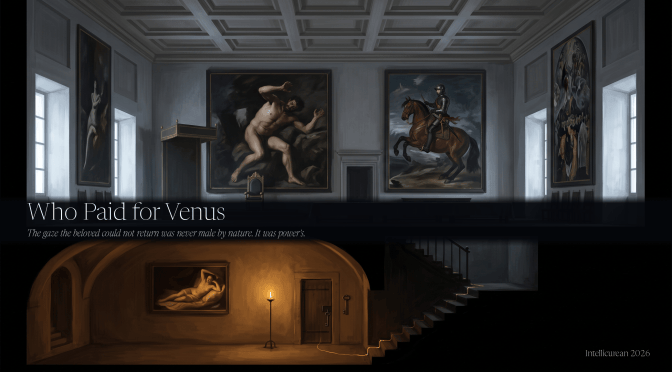

Two rooms, one painter, two very different buyers. In 1549 a queen hung Titian’s tormented giants to greet the future king of Spain. A few years later that king hung Titian’s nudes for himself. The essay asks who was doing the looking, and finds it was never simply the men.
Why we’re pointing you there
Everyone who took an art-history survey met John Berger’s line about men looking and women being looked at. Michael Cummins takes that line to the Prado, where the museum’s new volumes on women and the Spanish collections show something the slogan can’t hold: Mary of Hungary commissioning, Christina of Sweden collecting, Isabella Farnese marking her paintings with a lily like a brand on cattle. Power looked, and power was often a woman. The essay does not overturn Berger. It finds the room he left out.
What we liked most is the discipline. Every claim about who owned what rests on an inventory, and where the record gives only a later opinion rather than a fact, the essay says so and moves on. It is also the first piece in the series with no artificial intelligence in it at all, which is the point: Intellicurean was always a project about judgment, and here the judgment is a queen’s. Read it for Binche in 1549, and for a Sisyphus who turns out to have been a political statement.
Read the full essay at Intellicurean →
Essays & Reviews for the Intellectually Curious
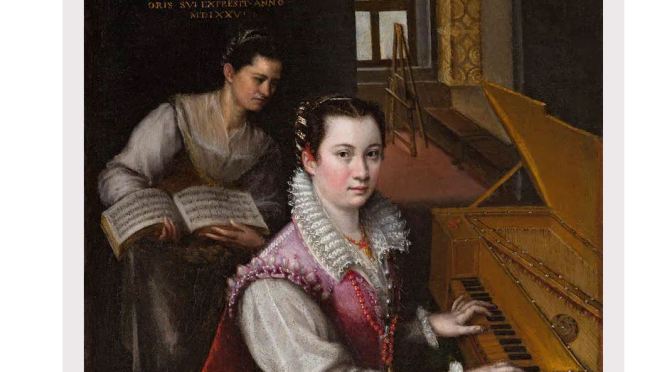
 Born in Bologna in 1552, Lavinia Fontana is often considered to be the first professional woman painter; she was the first to be accepted into the Accademia di San Luca in Rome, and supported her family throughout her life by gaining prestigious commissions for portraits in the city. This self-portrait has been interpreted as a wedding painting; it was completed in the year of Fontana’s marriage to Giovan Paolo Zappi, a fellow artist who became her agent and manager.
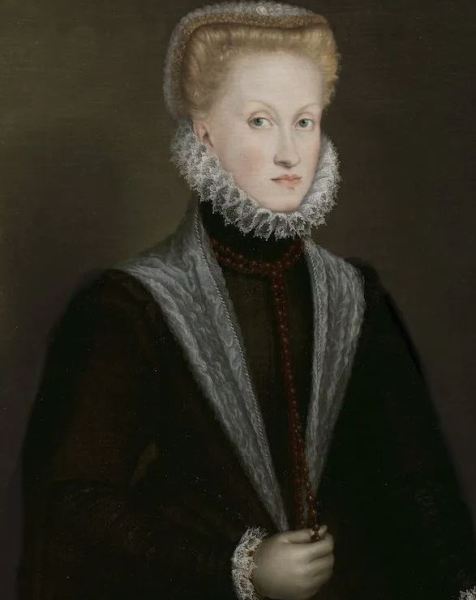
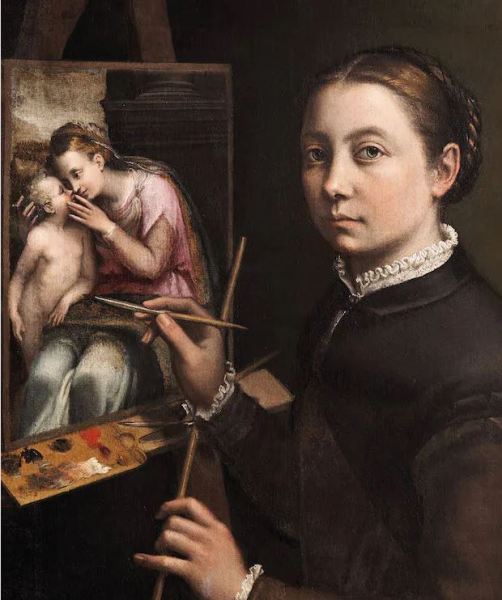 Sofonisba Anguissola was born into an aristocratic family from Cremona in around 1532; she travelled to Rome as a young woman, where her talent was recognised by Michelangelo, and in 1559 became lady-in-waiting to Elisabeth de Valois, Queen of Spain (and a keen amateur painter). She became a court painter to Philip II, and remained at court for some 15 years – at least until her marriage to a Sicilian nobleman after Elisabeth’s death in 1568, for which Philip II provided the dowry. Here she portrays Anna of Austria, who became Queen of Spain after Philip remarried in 1570.
 Part of the Prado’s bicentenary celebrations, this exhibition looks at two of the most significant women artists of the Renaissance. Though born into very different social classes, both Lavinia Fontana and Sofonisba Anguissola rose to heights of prestige that had not previously been scaled by women painters – Fontana at the Vatican, and Anguissola at the Spanish court.

