
Tag Archives: Space Programs

THE CIRCLE AND THE FLAG

Intellicurean Essays on Intellicurious

NASA wants a nuclear reactor running at the moon’s south pole by 2030. Russia promises one for China by 2036. When they stop, both say they will leave the radioactive material where it is. The treaty that governs the moon forbids planting a flag. It has nothing to say about drawing a circle.
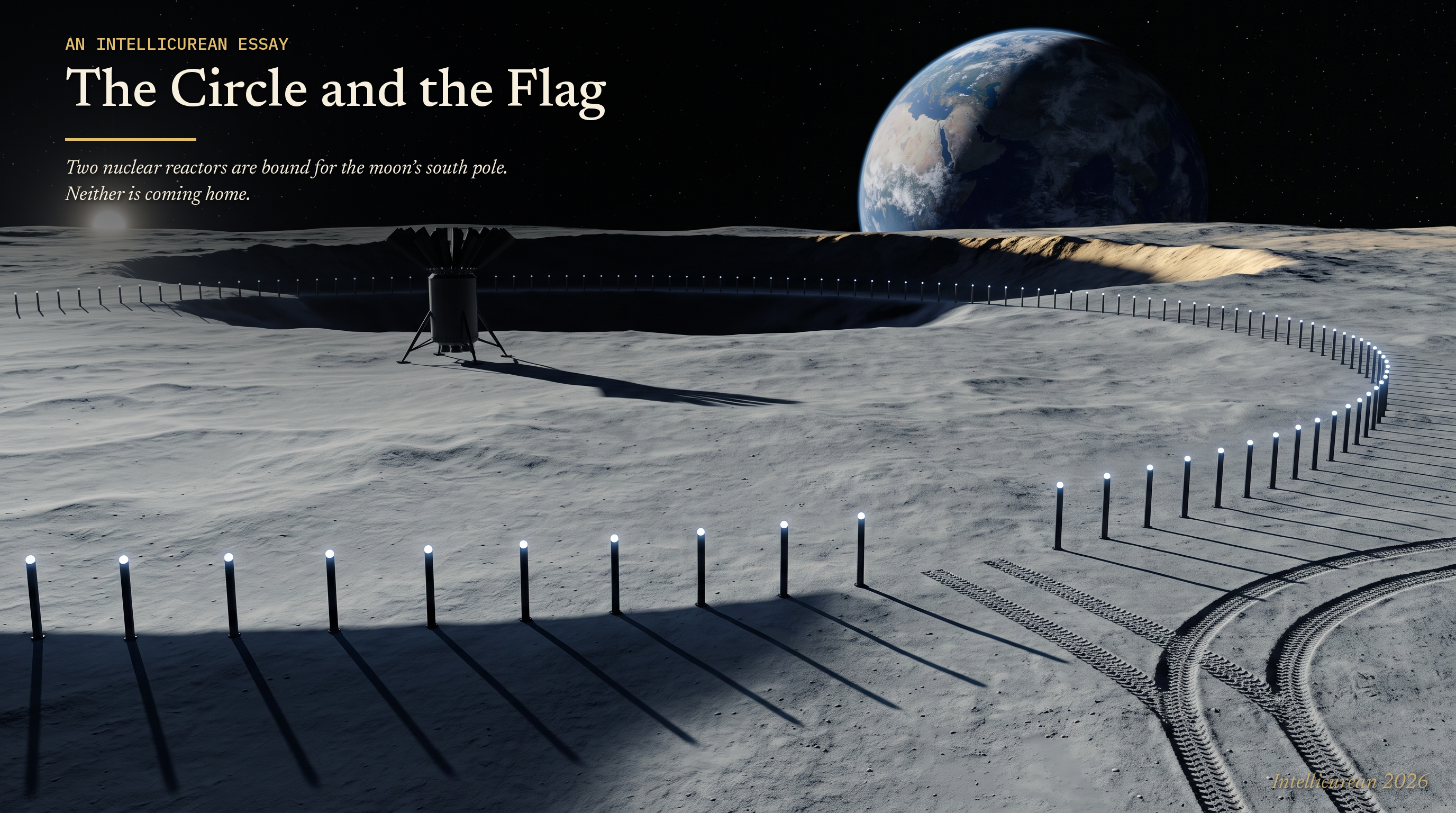
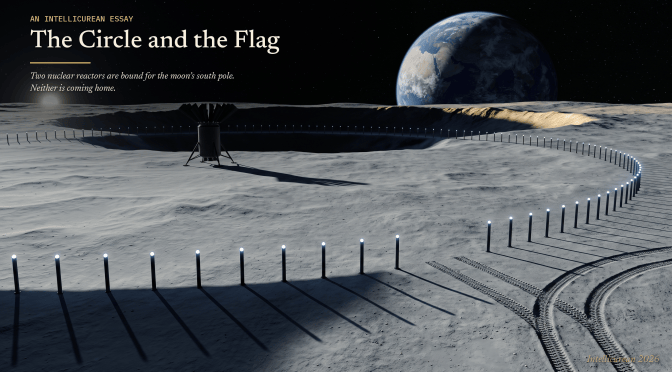
The Circle and the Flag — a ring of lit beacon pylons on the moon’s south pole encloses a small finned reactor on a crater rim; rover tracks reach the beacons and turn away; Earth hangs low over the horizon
The tracks come up to the line and turn away, made for the essay.

Why we’re pointing you there

The essay starts from a report in the New York Times on the race to put reactors on the moon and asks a question the report doesn’t: what happens to the ground around a reactor that nobody intends to remove? A reactor at power can’t be approached without shielding, so it sits inside a no-go zone, and the few ridges near the pole with sunlight above and ice below are the only places anyone wants to go. The Outer Space Treaty forbids appropriating the moon by sovereignty, use or occupation. A zone takes nothing; it makes ground nobody’s. So the treaty doesn’t reach it.

What we liked most is that the essay gives the other side its full strength before answering it: the polar dark is real, a cold launch is safer, the Artemis Accords do promise zones will end, and radioactivity does decay. Then it goes to the one place on Earth that has lived with a reactor nobody could remove, and to a 1972 Soviet novel that imagined the shape of such a place fourteen years before it existed. It ends on a question rather than a verdict: whether a place no one can enter is owned, or only lost, and who gets to decide.
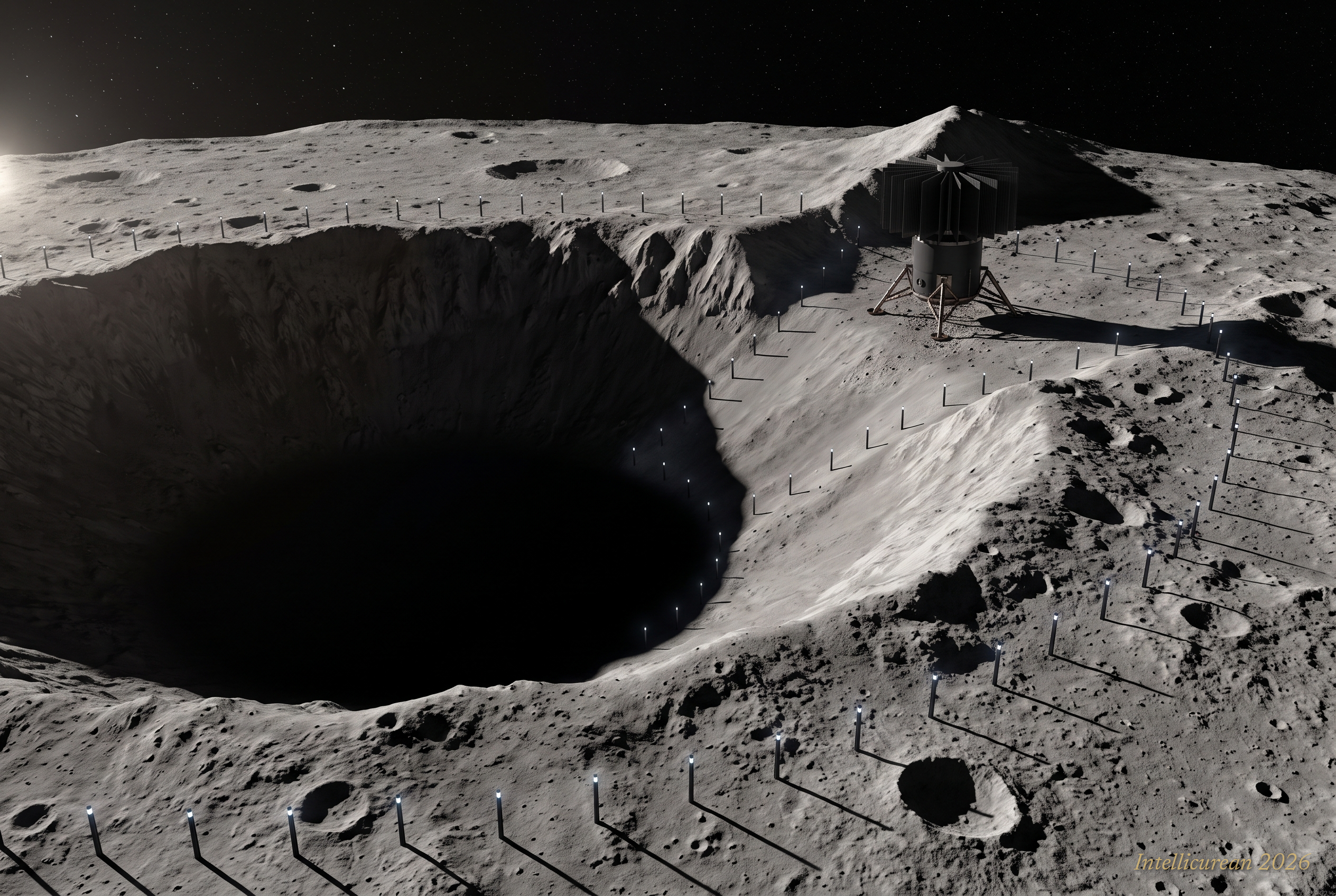
Oblique view of a lunar crater at the south pole: a small reactor with a crown of radiator fins stands on the rim, and a line of lit beacon pylons marks its zone, running along the rim, down the one slope into the crater and on into the shadow of its floor.
A zone on ground follows the ground, made for the essay.

Read the full essay at Intellicurean →

Essays & Reviews for the Intellectually Curious

Morning News: China Cyber Hack Rebuke, Africa Space Race, Mice Plague

The European Union, NATO and the “Five Eyes” intelligence partners have all joined America in accusing China’s government of involvement in hacking campaigns. Now what? 

Away from the spectacle of billionaires’ race to the heavens, many African countries are establishing space programmes—with serious innovation and investment opportunities on the ground. And why Australia is suffering from a plague of mice.

Mars Missions: The China And U.S. ‘Battle Of Rovers’

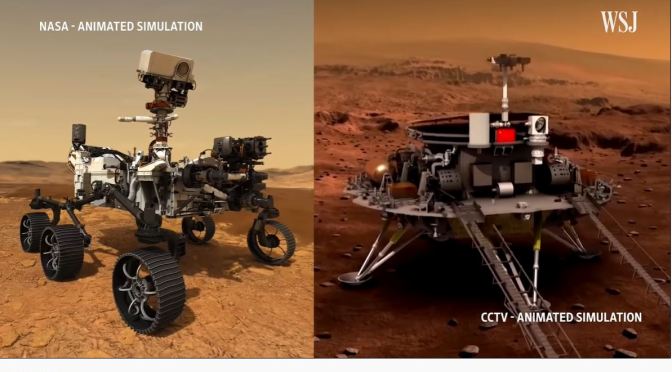
The U.S. and China are locked in a fierce battle in the race for Mars. China’s Zhurong rover is circling Mars as the country attempts to land a spacecraft on the red planet for the first time, just months after NASA landed its Perseverance rover. Photos: NASA; CCTV

Analysis: ‘A New Space Race – USA Vs China Vs Russia’

In the skies above our heads, humanity’s titanic geopolitical superpowers are yet again duking it out for supremacy among the stars. Only this time, unlike the 1960s, there’s three of them. Or is there? It’s complicated. Join us today as we helmet up and examine the new space race unfolding right now between the US, China and Russia.

What you might call the oldschool or ‘classic’ space race started in the 1950s, peaked during the 60s, and petered out by the mid 70s. It was, to be sure, an unofficial race. Nobody waved a novelty green flag to set things off. But the two largest economic and technological powers of the day – the United States of America and the Soviet Union – fought bitterly to be the first to make meaningful headway into the cosmos.

Space Programs: ‘The Search For Life On Mars’

China, the UAE and the U.S. all have spacecraft visiting Mars in February to study the Red Planet. WSJ explains how out-of-this-world technology is being used by NASA’s Perseverance and China’s Tianwen-1 in the search for evidence of life beyond our planet. Photo: NASA