All posts by Intellicurious

News, Views and Reviews for the Intellectually Curious

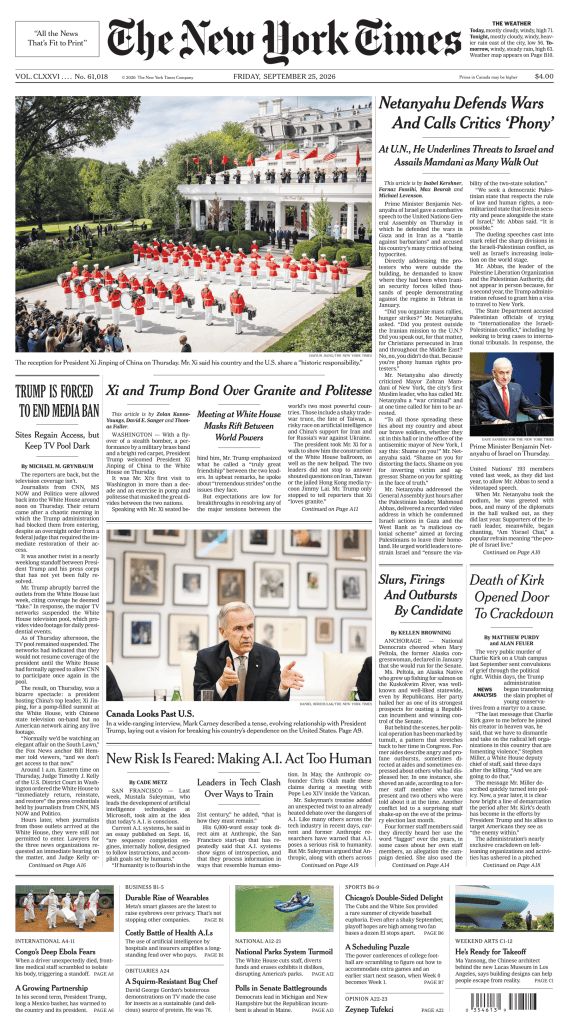
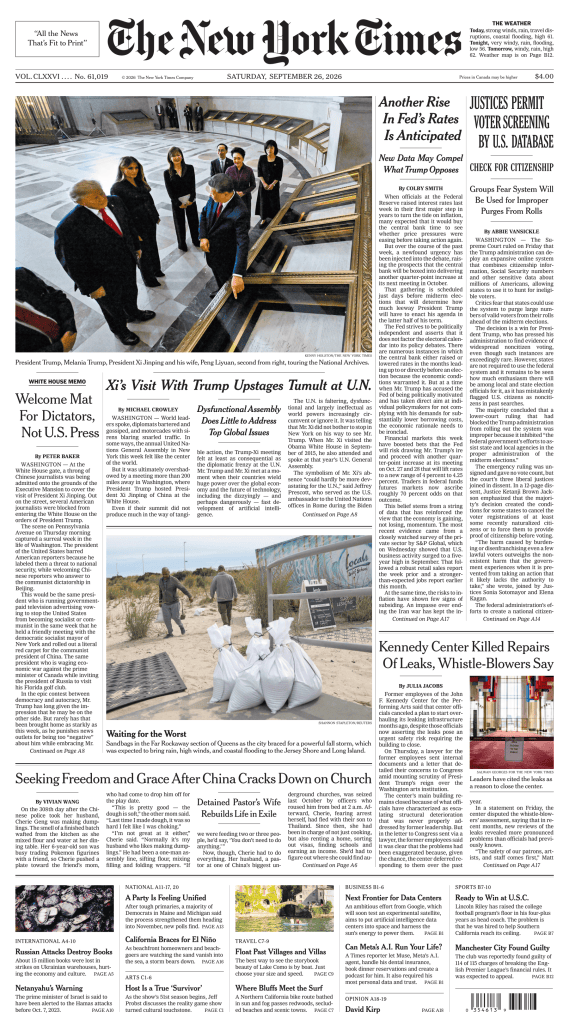
THE NEW YORK TIMES – SATURDAY, SEPT. 26, 2026

At Summit, Xi Sought to Tilt Trump’s Stance on America’s Place in Asia

In his talks with President Trump, the Chinese leader used praise, warnings and wartime history to challenge American support for Taiwan and Japan.

China’s Xi Snubs a Troubled U.N. for Trump, Overshadowing Its Big Week

The U.S.-China summit offered a sharp contrast with the action at the faltering United Nations in a gridlocked New York.

You Get an Eagle, and You Get an Eagle: Xi Takes Home Trump’s Go-To Gift

The president has often reached for statues of the national bird on diplomatic occasions in his second term. (Ronald Reagan favored them, too.)

Heroine or Public Enemy? The Israeli Blocking Much of Netanyahu’s Agenda.

Gali Baharav-Miara, Israel’s first female attorney general, has stopped many of the government’s efforts to remove constraints on its power.

A 7-Day Standoff That Said So Much About Trump and the Media

An abrupt decree, a network boycott, a legal intervention and an uneasy détente: This was no typical battle between a president and his press corps.

White House Blocks CNN From Air Force One

In the latest twist, the news outlet won’t be able to accompany President Trump on a trip to Tennessee today.
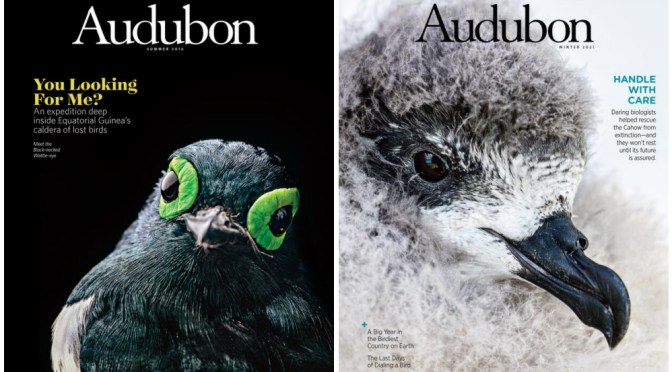

AUDUBON MAGAZINE – AUTUMN 2026 PREVIEW

AUDUBON MAGAZINE: The latest issue features ‘2026 AUDUBON PHOTOGRAPHY AWARDS’….

The 2026 Audubon Photography Awards: The Top 100

These jaw-dropping images and behind-the-scenes stories showcase the photographers’ artistry and the beauty of birdlife from Canada to Chile.

Smoke from Wildfires Is a Growing Health Threat to Both People and Birds

Catastrophic wildfires are stalling decades of clean air progress. Now scientists are asking: How can we help birds navigate a hazier future?

The London Magazine – October/November 2026

THE LONDON MAGAZINE: Despair – its causes, symptoms and consequences – becomes something of a theme across the issue. At least according to its etymological root, to despair is to be without hope (de-sperare), and in Mavis Gallant’s 1965 story ‘Paola and Renata’, published in the issue, mothers have no hope of controlling their inscrutable, insolent daughters.

Review | Comfort and Its Discontents by Devki Panchmatia

‘While it must be stressed that Rankine’s lyric practice is capacious and stylistically thrilling, that her insights are always valuable in isolation, I am left slightly unsure of what Triage’s greater intentions are.’

Essay | The Scale Against Poetry: Tony Harrison’s Prose by Dane Holt

‘Partly due to critical neglect, partly due to the single-minded determination to be a poet who survived on nothing but his poetry, Harrison’s prose is doomed to be a footnote in his career.’

Essay | It’s a Devil of a Gap by Alex Niven

‘Might there be something, beyond backwater nihilism, in the vanishing of the Tree at Sycamore Gap that speaks to us about a country increasingly unable to protect its social and civic structures in the most basic ways?’

DOES A SHIELD MAKE PEACE?

The Intellitake
One argument · Two sides · One verdict · Daily
Friday, September 25, 2026 · The Missile Defense Debate
“

Geography no longer protects America. A shield over the homeland is not a provocation — it is a commitment to peace through strength.

The Thesis — Gen. Mike Guetlein, The Washington Post

THE ARGUMENT

In the Washington Post, Gen. Mike Guetlein — the U.S. Space Force general who directs Golden Dome for America — makes the program’s public case. For generations, he writes, Americans could believe that two vast oceans and friendly neighbors kept major conflict far from our shores; that era of quiet skies is over. His framing, consistent with his testimony to Congress: near-peer competitors, specifically China and Russia, are rapidly expanding and modernizing their strategic arsenals, while the old U.S. missile defense architecture was designed only for rogue-state threats. The shield — a network of sensors and interceptors against ballistic, hypersonic, and cruise missiles — is, in his words, a commitment to peace through strength and deterrence: raising the cost of attacking America until no adversary tries.

vs

THE ANSWER

Veteran nuclear-policy analyst Joe Cirincione, in the Bulletin of the Atomic Scientists, states the stability school’s counter-case: any missile defense stimulates an offensive arms race, because the cheapest answer to a shield is more spears — an adversary cannot assume the system will fail, so it must build enough missiles to overwhelm it. That, he notes, is precisely why Nixon and Kissinger paired the first offensive arms treaty with the ABM Treaty in 1972: you cannot limit offense without limiting defense. China’s missile buildup, on this view, is already partly a response to U.S. defenses — and analysts like Laura Grego add the arithmetic: intercepting even a handful of ICBMs could require tens of thousands of space-based interceptors. The shield, the critics conclude, doesn’t end the missile age; it accelerates it.

iC

THE INTELLITAKE

Both sides claim the same goal — deterrence — and prescribe opposites, because they disagree about what an adversary sees when it looks at a shield. Guetlein sees a wall that makes attack futile; Cirincione sees a promise that America means to strike first and block the reply, which makes an adversary build until the wall is irrelevant. This is not a new argument: it is the SDI debate of 1983 and the ABM debate of 1972, rerun with hypersonics and orbital interceptors. What is new is the author — not a columnist but the program’s own director, making his case to the public in a newspaper, which is itself a datum: shields need believers to deter. The unresolved question is the one the 1972 negotiators answered one way and this administration answers the other: is defense the end of the arms race, or its engine?

TODAY’S PROVOCATION

If a perfect shield existed, would you trust your own government more — knowing it could strike without fear of reply?

— THE EDITORS, INTELLICURIOUS —

ANOTHER MAN’S ELOQUENCE

Intellicurean Essays

New on Intellicurean

Another Man’s Eloquence

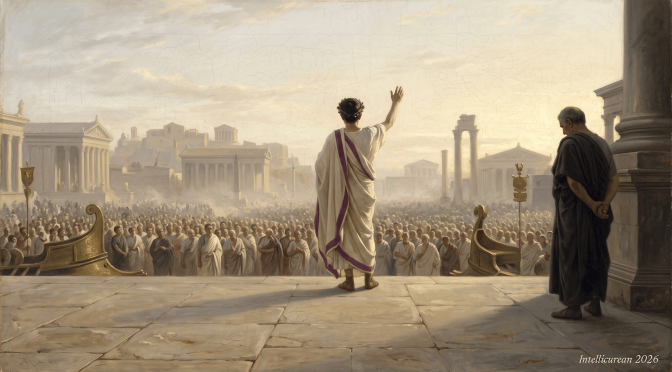
In the autumn of 54 a boy emperor praised a dead man, and the crowd smiled at the wrong moment. The sentences were Seneca’s. What happens to a philosopher who spends eight years as someone else’s voice?

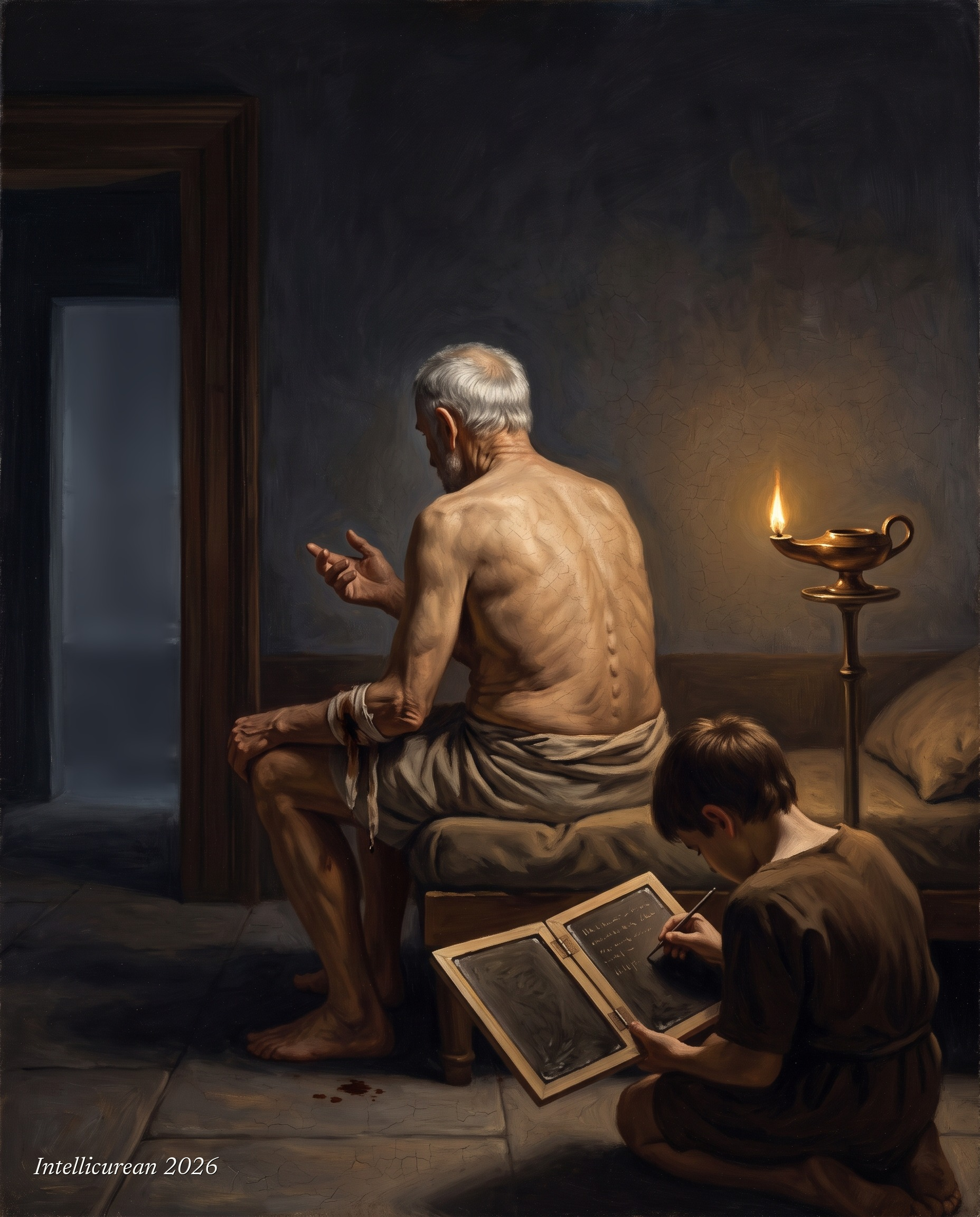
Seneca, seen from behind by lamplight, dictating to a single scribe

The dictation, AD 65, as the essay imagines it. A generated image, not a record.

Tacitus says the old men in the Forum noticed something new that day: Nero was the first ruler of Rome to need another man’s eloquence. Five years later the same man wrote the letter that explained a mother’s murder to the Senate, and the city blamed the ghost, not the emperor. Three years after that, the charge that ended his career was that he had claimed the credit. And in the first year he owned his own mouth, he wrote the most famous opening in Roman philosophy: set yourself free for your own sake.

Why we’re pointing you there

Michael Cummins follows the voice through four dates, 54, 59, 62 and 65, and finds one word doing the work: aliena, “another’s,” the word Tacitus used for Nero’s borrowed speech and the word Seneca used, in his own letters, for everything a man does not own. The essay makes one guess about what the throne cost him, grades it, and prints the two hostile witnesses who say it cost him nothing. It ends with the one text Seneca dictated as unmistakably his own, on the night he died, and why we don’t have it.

Every speechwriter since is Seneca, and the letter after the crime still gets written.

Read the essay at Intellicurean →

Intellicurious points to the best of what we read and make. The full essay, with its sources and colophon, lives at intellicurean.com.

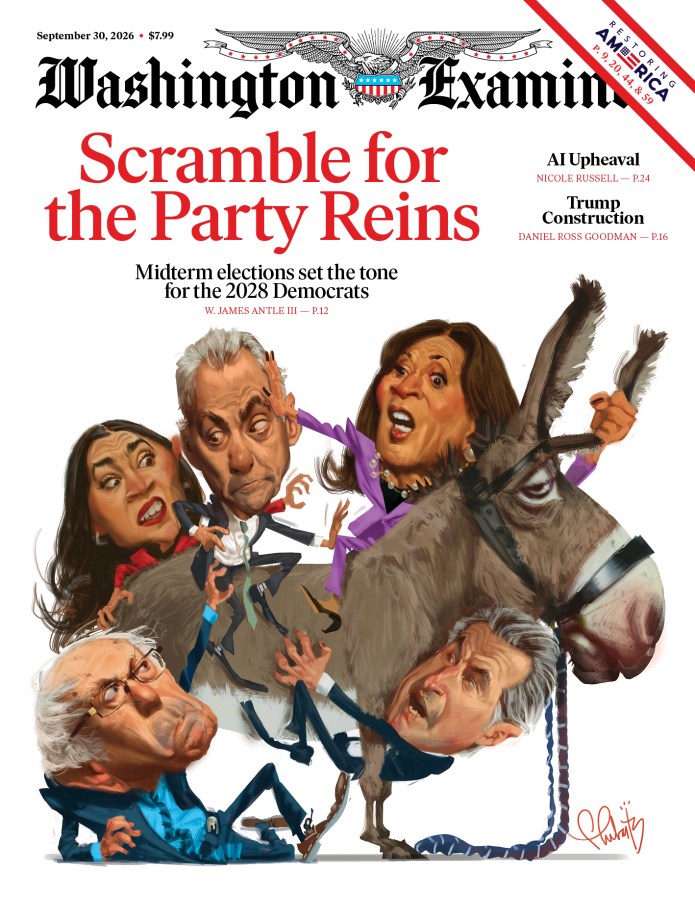
WASHINGTON EXAMINER MAGAZINE – SEPT. 30, 2026

September 30, 2026

WASHINGTON EXAMINER MAGAZINE: ‘SCRAMBLE FOR THE PARTY REINS’ – Midterm elections set the tone for the 2028 Democrats.

How the midterm elections will set Democrats up for 2028 success or failure

Campaign staff hiring and early decision-making for prospective presidential candidates has already started.

Failing public schools need higher standards, not more money

Nikole Hannah-Jones, creator of the “1619 Project,” recently scored rare bipartisan plaudits.

As Trump’s popularity plummets, House Democratic target emerges in red Indiana

Rep. Victoria Spartz (R-IN) should be coasting to reelection in the House district to which she was first elected in 2020, covering northern Indianapolis suburbs and part of central Indiana.

Instead, Spartz is facing what appears to be a surprisingly tough race against Democrat J.D. Ford, Indiana’s first openly gay state senator. It’s the kind of seat that can emerge on an out-party’s political target list in a wave election year with an unpopular president.

THE NEW YORK TIMES – FRIDAY, SEPTEMBER 25, 2026

In Trump’s White House, China’s Strongman Is Welcome. The U.S. Media, Less So.

President Trump’s partial media ban played out as he welcomed President Xi Jinping, whose government is ranked among the world’s most repressive.

Flyovers, Pandas and Pomp Masked Divides in U.S.-China Summit

President Trump pressed his personal brand of diplomacy as China’s leader made his first trip to the White House in more than a decade.

Stalled on the Battlefield, Russia Intensifies Its Focus on Ukraine’s Economy

Ukrainian officials are calling Russia’s campaign “total war” for its emphasis on economic impact, rather than on battlefield gains or infrastructure damage.

Powerful Fall Storm Strengthens as It Crawls Up the East Coast

Rain, flooding and gusty winds are in the forecast this weekend for the Northeast, including New York and Boston.

Leo XIV, Trying to Be Everyone’s Pope, Tours Secular France

After visiting Africa, Pope Leo’s four-day trip to France shows how he is seeking to appeal to Roman Catholicism’s original heartlands as well as to the church’s newest strongholds.

HATS AND CLOAKS

Intellicurean Essays on Intellicurious

Prague, February 1948. A photograph of the new Communist leader on a balcony, a fur hat on his head, a comrade at his shoulder. Four years later the comrade is hanged and painted out of the picture. Milan Kundera built the most famous opening in Czech literature on what was left: the hat. A scholar has since checked the print, and the story is not quite what the photograph shows.

A painting of a dark study looking down through a leaded window at a snowy street, where walkers are seen from above as hats and cloaks only
Descartes’s window, painted for the essay: hats and cloaks in the street, and the men supplied by judgment.

Why we’re pointing you there

Everyone quotes Kundera’s line about memory and forgetting. Michael Cummins reads the page it’s on, and finds that Kundera gave the line to a character who is busy trying to erase his own past, and knew exactly what he was doing. From there the essay follows one fur hat through four sets of hands: the state’s, the novelist’s, Kundera’s own on his early work, and Nietzsche’s sister’s on her brother’s notebooks. Descartes supplies the frame, from a window in 1641: we see hats and cloaks in the street, and the men beneath them are something we judge, not something we see.

The hardest section concerns a half-page police report from 1950 that surfaced in 2008 with Kundera’s name on it. The essay lays out what the document says, what is contested, who the witnesses are related to, and decides nothing, which is the only honest thing to do with it. It makes exactly one guess about Kundera, labels it as a guess, and gives its grade. Read it for the ending, where the record does something the novel never mentions.

Read the full essay at Intellicurean →

Essays & Reviews for the Intellectually Curious

THE ECONOMIST MAGAZINE – SEPTEMBER 26, 2026

THE ECONOMIST MAGAZINE: The latest issue features ‘When America walks away’…

When America walks away

For decades America has enjoyed hegemony over the Middle East. That is about to end

Why house prices may be in trouble

In a big serving of bad news, there are crumbs of comfort

Brazil turns its back on the future

The looming election will not bring the change the country needs

Back and shoulder surgery is often worse than useless

Millions of operations should be scrapped

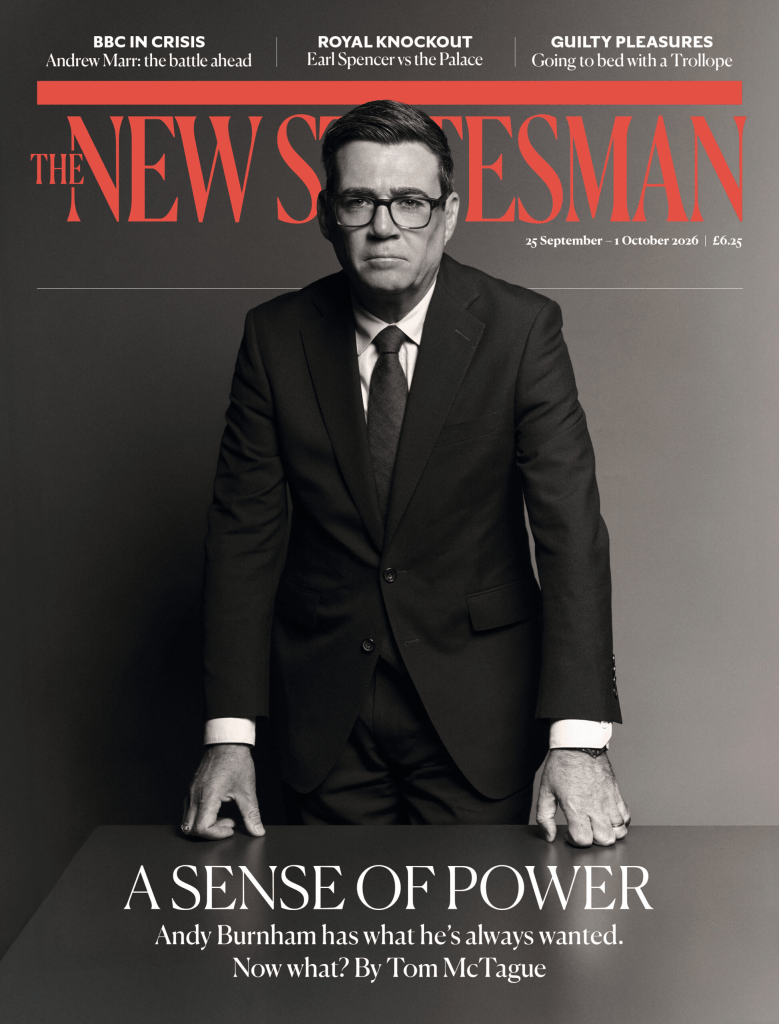
THE NEW STATESMAN MAGAZINE – SEPT. 25, 2026

THE NEW STATESMAN: The latest issue features ‘A SENSE OF POWER’ – Andy Burnham has what he’s always wanted. Now what?

Andy Burnham seizes control

The Prime Minister on life, fate and his plan to make Britain believe again By Tom McTague

Darren Jones: “I was asked whether I would call for Keir Starmer to resign”

The former cabinet minister on the dirty deals behind the No 10 takeover, and what Labour should do next By Ailbhe Rea

Labourism vs neoliberalism

To undo Thatcher’s legacy, Burnham must reckon with our country’s social conservatism By David Kynaston

The BBC is fighting for its life

As the Today programme loses presenters, the corporation is suffering a crisis of confidenceBy Andrew Marr