A decade ago, Xi Jinping asked if China could master A.I. His push is remaking the economy, challenging the United States and keeping society under control.
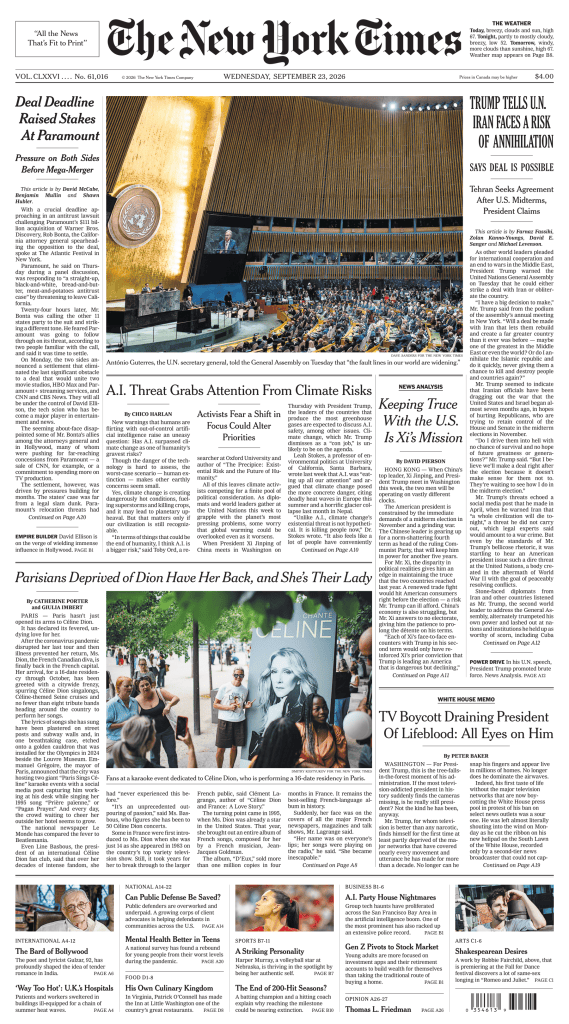
Masoud Pezeshkian is the first leader whose country is at war with the United States to travel to New York to address the General Assembly. President Trump said he faced a choice over whether to “annihilate” the Islamic republic.1h ago
As the far right surges, Chancellor Friedrich Merz’s unpopular economic policies and gruff manner have failed to sway voters turned by rivals’ promises of easy fixes.
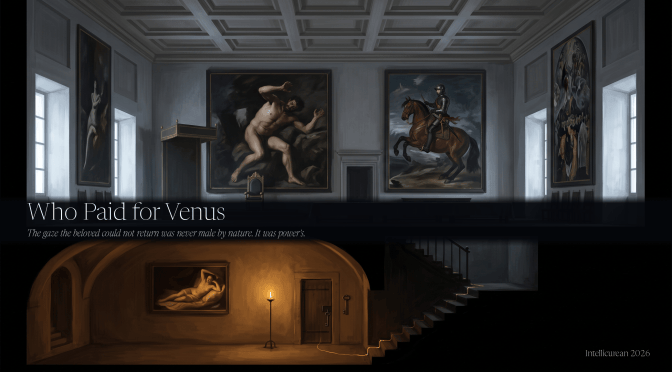
Two rooms, one painter, two very different buyers. In 1549 a queen hung Titian’s tormented giants to greet the future king of Spain. A few years later that king hung Titian’s nudes for himself. The essay asks who was doing the looking, and finds it was never simply the men.
Why we’re pointing you there
Everyone who took an art-history survey met John Berger’s line about men looking and women being looked at. Michael Cummins takes that line to the Prado, where the museum’s new volumes on women and the Spanish collections show something the slogan can’t hold: Mary of Hungary commissioning, Christina of Sweden collecting, Isabella Farnese marking her paintings with a lily like a brand on cattle. Power looked, and power was often a woman. The essay does not overturn Berger. It finds the room he left out.
What we liked most is the discipline. Every claim about who owned what rests on an inventory, and where the record gives only a later opinion rather than a fact, the essay says so and moves on. It is also the first piece in the series with no artificial intelligence in it at all, which is the point: Intellicurean was always a project about judgment, and here the judgment is a queen’s. Read it for Binche in 1549, and for a Sisyphus who turns out to have been a political statement.
Facing an American president constrained by war and politics, China’s leader may seek to lock in a tactical truce while he shores up a fragile economy at home.
Manufacturers are struggling with supplies of the metals as U.S. and Chinese officials negotiate over export restrictions with consequences for global industry.
Monday, September 21, 2026 · The Nature of War Debate
“
A world war is raging at this moment, with millions dying every week on fronts that never make the news. The soldiers are ants — and their war may explain our own.
The Thesis — Mark W. Moffett, The Washington Post
THE ARGUMENT
In the Washington Post, Smithsonian entomologist Mark W. Moffett — who earned his doctorate under E.O. Wilson — opens with a jolt: a world war is raging at this very moment, millions dying each week along battlefronts that never make front-page news. He means the Argentine ants, whose wars, he argues, cast surprising light on human conflict. As Moffett documented in The Human Swarm, one of their supercolonies stretches from the Mexican border past San Francisco, with others along some 2,000 miles of European coast — and where rival supercolonies meet, the borders are battlefronts. His larger claim: ants and humans are the rare species that form anonymous societies, strangers cooperating under shared markers — chemical for them, cultural for us — and with sharply marked societies come sharply defended borders. The us-versus-them that fuels war, on this view, runs deeper than politics.
vs
THE ANSWER
Rutgers anthropologist R. Brian Ferguson, after four decades studying war’s origins, argues in “War Is Not Part of Human Nature” (Scientific American) that the biological story fails on the evidence. Humans have an obvious capacity for war, he writes, but no hardwired propensity: homicide is not war — war is social, groups organized to kill other groups — and if it expressed an inborn tendency, the archaeological record should show it everywhere, always. It doesn’t: whole regions, including the American Southwest and Great Plains, show no evidence of war until roughly 2,000 years ago. On this view, war emerged with changing social conditions in recent millennia — an institution, not an instinct. Ants may be prisoners of their chemistry; we are not.
iC
THE INTELLITAKE
Nobody disputes that the ants are at war; the fight is over whether the analogy travels. Moffett’s case is structural: ants and humans solved the same problem — cooperation among strangers — and inherited the same shadow, the defended border. Ferguson’s case is historical: a true instinct doesn’t skip whole continents for millennia. And the stakes are the largest imaginable. If Moffett is right, hostility to outsiders is the standing price of anonymous society, and peace is a discipline we must maintain against our grain. If Ferguson is right, war is an invention — and what was invented can, in principle, be unmade. Read Moffett for the vertigo; read Ferguson for the reprieve; then decide which one you find harder to believe.
TODAY’S PROVOCATION
When you feel that flash of us-versus-them — at a border, a stadium, a comment section — is that the ant in you, or a habit you were taught?
Why can’t the people who produced the technology, which has already shown that a different world is possible, just do the things that would prevent extinction? By Gideon Lewis-Kraus
Students and faculty across the country were punished for their reactions to the conservative activist’s murder. A recent graduate of Texas Tech’s law school is still trying to clear her name. By Benjamin Wofford
President Trump decided not to join Saudi Arabia, for now, in strikes against the Houthis in Yemen, but he needs the kingdom’s cooperation in the Iran war.
As Beijing presses President Trump to freeze a proposed $14 billion weapons sale to the island, Taiwan is trying to show that its security is in U.S. interests.
The populist emphasis on national identity and pride, rather than the sins of the past, finds a deep response in voters adrift in a world they no longer understand.