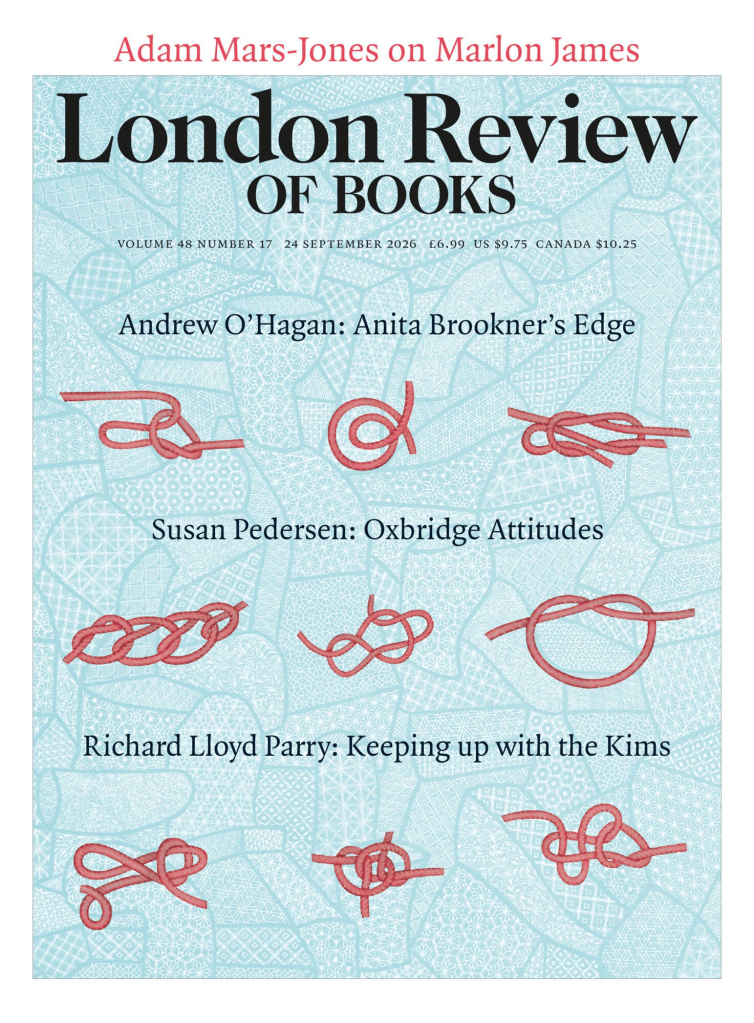
LONDON REVIEW OF BOOKS – SEPTEMBER 24, 2026 PREVIEW


GUERNICA MAGAZINE: The latest issue features essays evaluating artificial intelligence through Emily Dickinson’s poetry, examining humanity’s relationship with divinity via Mark Twain, and an interview on how poetry transforms experiences of violence and displacement.
I’ve been thinking about Newton’s third law of motion after recently revisiting it for my son’s science project: for every action, there is an equal and opposite reaction. It is a consoling law, built upon certainty. But human lives seldom hold such hard consolations. The leaders we elect, the borders we erect, the violence we permit produce consequences that outlive the choices that set them in motion. Mothers understand something of this. To bring a life into the world is to initiate a sequence whose consequences can never be calculated or contained. Across Guernica’s August–September double issue, motherhood appears as place, inheritance, origin, and impossible return. The works gathered here cast a look upon the afterlives of history; they ask what follows from our most intimate and collective decisions.
In fiction, Naeem Murr’s Bye-Bye Palestine traces the complex entanglements of lives back to a historical rupture whose convulsions remain present in the ongoing genocide in Palestine. “Haifa became known as Um Al Gharib, Mother of the Stranger,” Murr writes. The name holds the story’s central contradiction: a city figured as mother to those made strangers within it. In Emmy Rossum’s Tether, motherhood becomes its own law of action and reaction. In a futuristic world, a daughter uses her heightened olfactory abilities to mark the boundary between herself and her mother. Following a matrilineal inheritance through scent, she attempts to trace her way back to her own beginnings. In Yukiko Tominaga’s The Little Corner of the Factory, a child discovers the many forms love can take, and the hurt and betrayals it can contain. In a small room inside a rental hot-towel factory, the youngster is initiated into a tenderness that will outlast the people who teach it to her.
In nonfiction J. Malcolm Garcia’s narrative reportage Last Fight tells the story of a man living in the wake of his brother’s death. Nazeer, an Afghan interpreter who served alongside US forces in Afghanistan, is detained by ICE and dies within twenty-four hours of entering custody. Garcia follows a chain of consequence stretching from the war in Afghanistan to the American immigration system, tracing the afterlife of a vote, and the distance between a choice made in a voting booth and the body upon which its force eventually lands.
In A Nation Wrestles with God, excerpted from A Nation Wrestles with God: American Prophets, Philosophers, and Firebrands, Ilan Stavans traces America’s long and unsettled relationship with the idea of God. From the use of divine authority in the service of empire to God’s persistent presence in the nation’s literature, politics, vernacular, and imagination, Stavans traces how belief becomes another force with an afterlife. The gods a nation creates continue to shape the lives over which it assumes the right to “play God.”
In Guernica’s first foray into the encounter between artificial intelligence and human epistemology, Liane Strauss and an AI read Emily Dickinson’s “I felt a Funeral, in my Brain” together. Moving between Dickinson, Monet’s Water Lilies, and the irresolvable problems literature allows us to inhabit, Strauss discovers that an AI can identify ambiguity but cannot experience the doubt that lends it its resonant weight. The first instalment in a three-part series, the essay is a reminder that human knowledge begins in uncertain spaces.
In interviews, The Insistence of Beauty brings poets Tina Chang and Nathalie Handal into a reciprocal conversation about their new collections, LION and Roma Roam, respectively. A question becomes an invitation to step beyond the stories assigned to us, and in this exchange, each poet turns that invitation toward the other. Here, imagination creates another kind of afterlife: the freedom to move beyond violence’s last account.
In the latest installment of Guernica’s Posthumanitarian interviews series, After Development, Russell Reed speaks with Bhutanese scholar Dasho Karma Ura about the intrinsic relationship between our individual choices and communal happiness. Critiquing the humanitarian regime’s presentism, Ura suggests that our individual well-being cannot be separated from the ecological futures our present choices are already creating.
In Global Spotlights this month, Nwanne Agwu’s Faint Lines maps identity through maternal and paternal lines, and asks what it means to belong to people who came before us. Published first in Isele Magazine, the narrative reimagines home not as where one comes from, but as a place where one is recognized and held with love.
Poetry in this issue enters the charged space where beauty and violence meet. In Tina Chang’s I’ve Gone to Look for America, Term One, Pistil/Pistol, and I’ve Gone to Look for America, Term Two, roses tangle in the brain; a peony becomes first a woman’s cheek and then a bullet; the pistil carries within it the sound of a pistol. Within these poems, the inherited past exerts its force upon the present, but the speaker answers by naming herself—lion, flower, weapon, and “little spark”—and turning that inheritance toward another future.
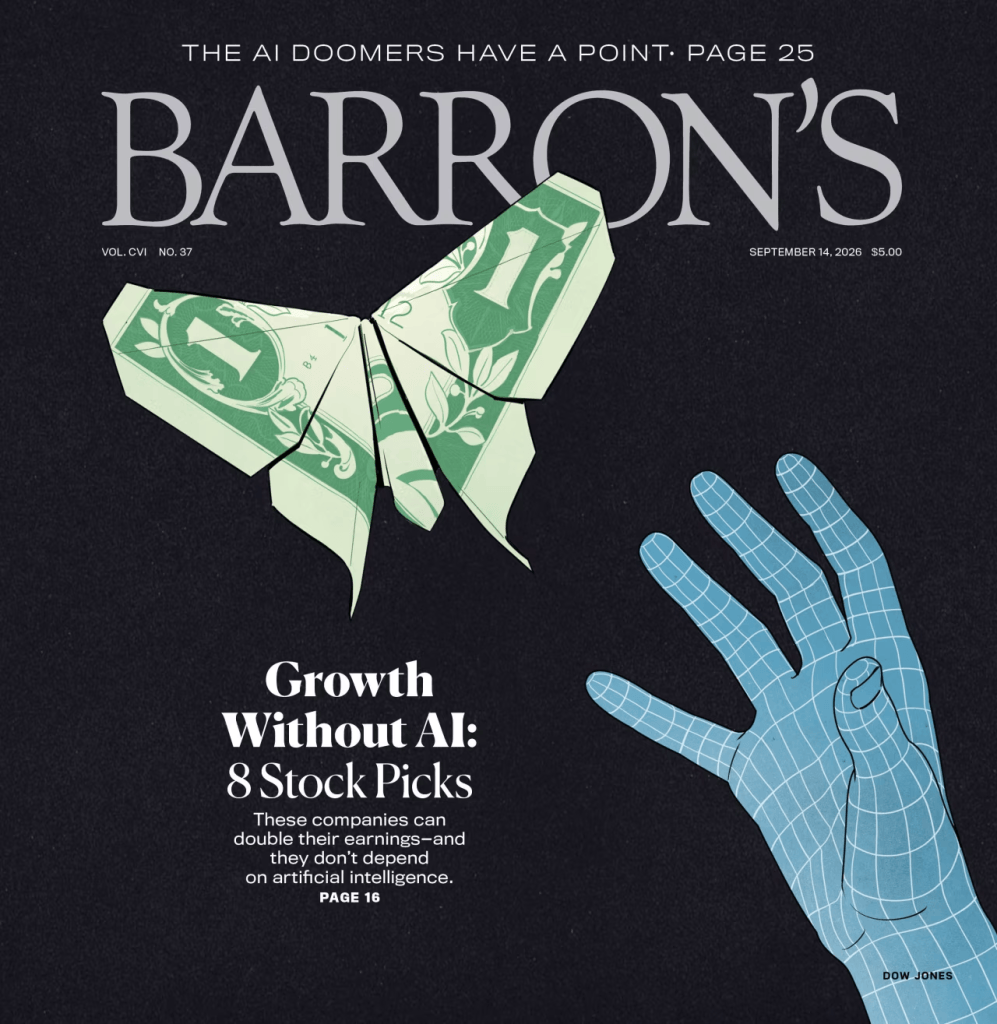
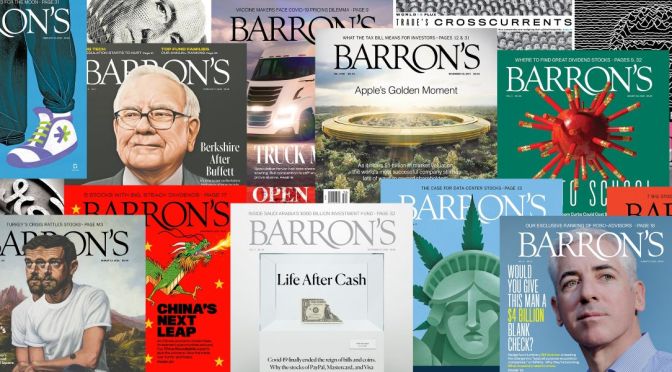
BARRON’S MAGAZINE: The latest issue features ‘GROWTH WITHOUT AI’: These companies can double their earnings – and they don’t depend on artificial intelligence….
With products ranging from cardboard boxes to new drugs, these companies are all on track to double their earnings.
The public company’s market cap is $3.3 billion, but it could be worth far more to a private buyer.
Bad news grabs the headlines, but European companies are turning in strong profit gains.
As the NFL season opens Wednesday, there’s a new game in town. Prediction markets could drive $35 billion in wagers, on par with the traditional sports betting industry.
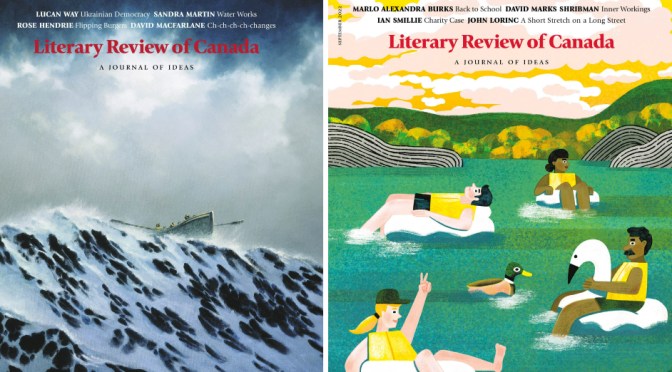
LITERARY REVIEW OF CANADA: The latest issue features…
On the connection between books and home Kyle Wyatt
Does healing the world mean abandoning capitalism? Darrell Varga
Where non-sovereign nations dwell George Anderson
Jackie Robinson’s season in Montreal David Marks Shribman

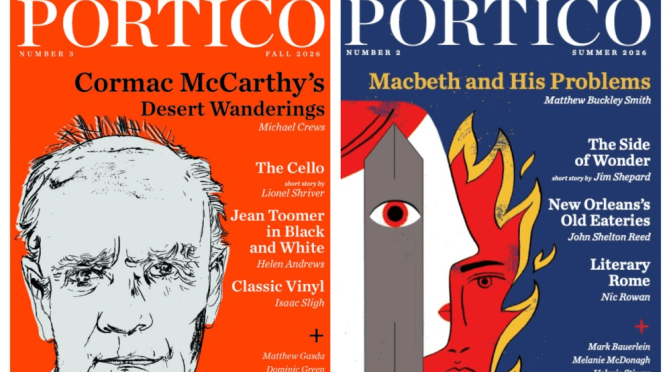
PORTICO LITERARY QUARTERLY: The latest issue features….
By Michael Crews
Tracy Daugherty’s biography of Cormac McCarthy is a landmark publication. Putting together the life of a writer who not only shunned publicity but actively worked to keep fans, journalists, the media, and academics off his trail requires the powers of both a skilled biographer and a nosy private detective. In that latter role, some of what Daugherty has uncovered is unsavory, though with the recent revelation of McCarthy’s relationship with Augusta Britt, who was sixteen when they began an affair, readers may be prepared for some of the shocks. One of Daugherty’s leitmotifs is McCarthy the “bad boy” and “outlaw,” and though such appellations risk cliché, the story he tells is of a man who, at least in the first half of his life, preferred the company of moonshiners, gamblers, hard drinkers, and petty criminals like his old Knoxville pal John Sheddan, who seems to have been the Falstaff to McCarthy’s Prince Hal.
Helen Andrews
There are two books before me, which, if I mistake not, will mark an epoch,” wrote W. E. B. Du Bois in The Crisis magazine in 1924. One was a novel of middle-class African-American life by Jessie Fauset called There Is Confusion. The other was a collection of stories, songs, poems, and character sketches called…
Christopher J. Scalia
During the last quarter of the twentieth century, few writers were more admired by peers and critics than Andre Dubus. But because Dubus’s territory was the relatively confined space of the short story and novella, he never enjoyed great commercial success or recognition. Dubus was destined to be a writer’s writer—what Joshua Bodwell calls a…
By Lionel Shriver
In that we’ve been married for sixteen years, you really don’t have to try so hard to make your feelings known,” Janet said at the wheel. “I’m well aware you don’t want to do this.”
“I THINK I’ve been pretty stoic about it,” Rick said, eyes to the thick woods he’d be reflexively scanning for deer. Ever since they’d planted an ambitious garden behind their upstate New York summerhouse, the creatures that had once seemed so exquisite had become evil incarnate.
“Stoic? More like long-suffering,” Janet said. “You’ve hardly said a word the whole way here. But there’s no point in having joined Saint Peter’s if we don’t put our beliefs into practice. Charity doesn’t only mean parting with twenty bucks to get someone at the door to go away. It means sometimes doing what’s right when you don’t feel like it.”
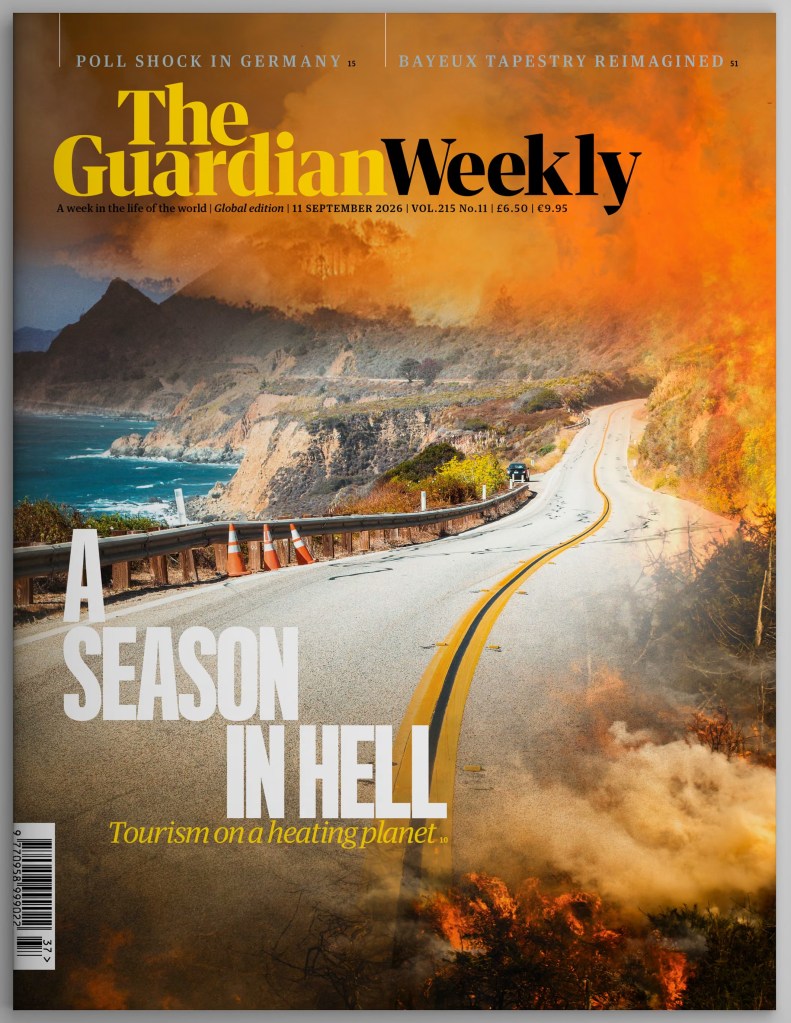
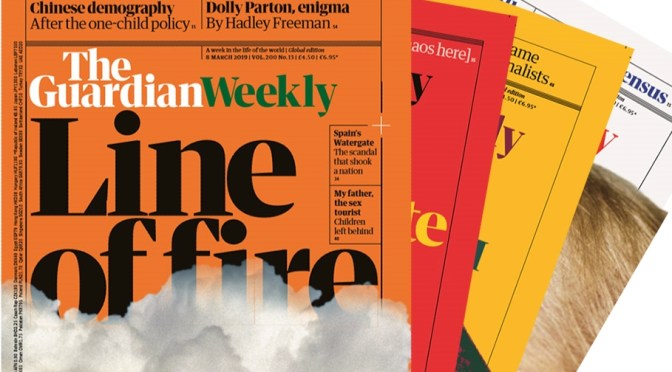
THE GUARDIAN WEEKLY: The latest issue features ‘A Season In Hell’ – Tourism on a heating planet.
California’s Big Sur coastline is often called a slice of heaven. But this year – beset by wildfires, road closures and disruptions to tourist amenities – it has endured a long summer of hell. Now questions are being asked about how many visitors it can sustain in the face of the climate crisis.
For our big story this week, Andrew Gumbel visits Big Sur, where the tourist industry accounts for about 90% of the local economy, to hear why the community fears its ethos is under threat.
The UN has warned that the El Niño climate phenomenon is “supersizing before our eyes”. Environment editor Damien Carrington reports on the latest forecasts, which predict the event is near certain to shatter temperature records.
Then, the mayors of Paris, Milan and Phoenix write about how their cities are learning from each other on responding to the heat crisis. “How do you protect millions of people,” they ask, “when extreme heat is no longer an exceptional event, but an increasingly familiar part of summer?”
Spotlight | ‘It breaks my heart’
Kate Connolly reports from Magdeburg, the capital of Saxony-Anhalt, where voters are digesting the far-right Alternative für Deutschland’s state election triumph
Science | Forbidden planet
Since it was stripped of planetary status, Pluto’s defenders have been fighting the decision – and they’re only getting more passionate, writes Tim Dowling
Feature | Your lying AIs
LLMs have an alarming tendency to deceive and manipulate their users. As they become ever more embedded in society, the race is on to find out why – and stop them doing it. Snigdha Poonam explains
Opinion | The route to a brighter future
The world is being driven to the brink by thugs and dictators, says Simon Tisdall, but ordinary people have more power than we think
Culture | A stitch up
As the Bayeux tapestry goes on show in London, cartoonist Edith Pritchett offers an alternative 21st century take, capturing today’s battles, while art critic Jonathan Jones reviews the British Museum’s blockbuster exhibition of the original masterpiece
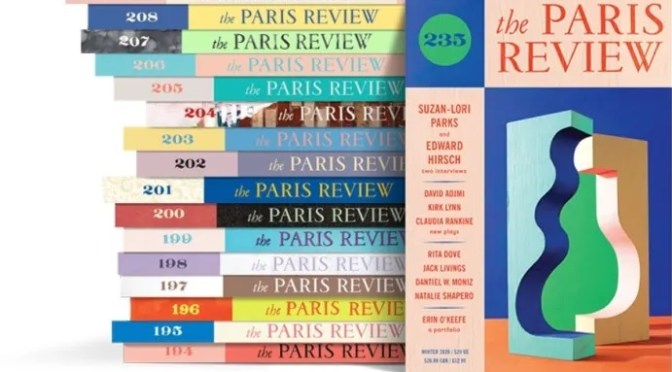
THE PARIS REVIEW : The latest features Interviews, Prose, Poetry and Art….
Svetlana Alexievich on the Art of Oral History: “If you cut straight to the part you need, which is what journalists do, it won’t be interesting, and it won’t be the truth, either. Not the whole truth.”
Donald Antrim on the Art of Fiction: “I deplored the idea that writing involves suffering, that it had to be a bloodletting. Later I found out that it would be, and maybe should be.”
Prose by Eka Kurniawan, Angie Sijun Lou, Brian Ma, Scott McClanahan, Sam McKinniss, Tomoka Shibasaki, and Woo Dayoung.
Poetry by Asha Futterman, Zakaria Mohammed, Geoffrey G. O’Brien, Vasko Popa, Diane Seuss, and Natalie Shapero.
Art by Gertrude Abercrombie, Silke Otto-Knapp, and Laura Owens; cover by Elizabeth Glaessner.
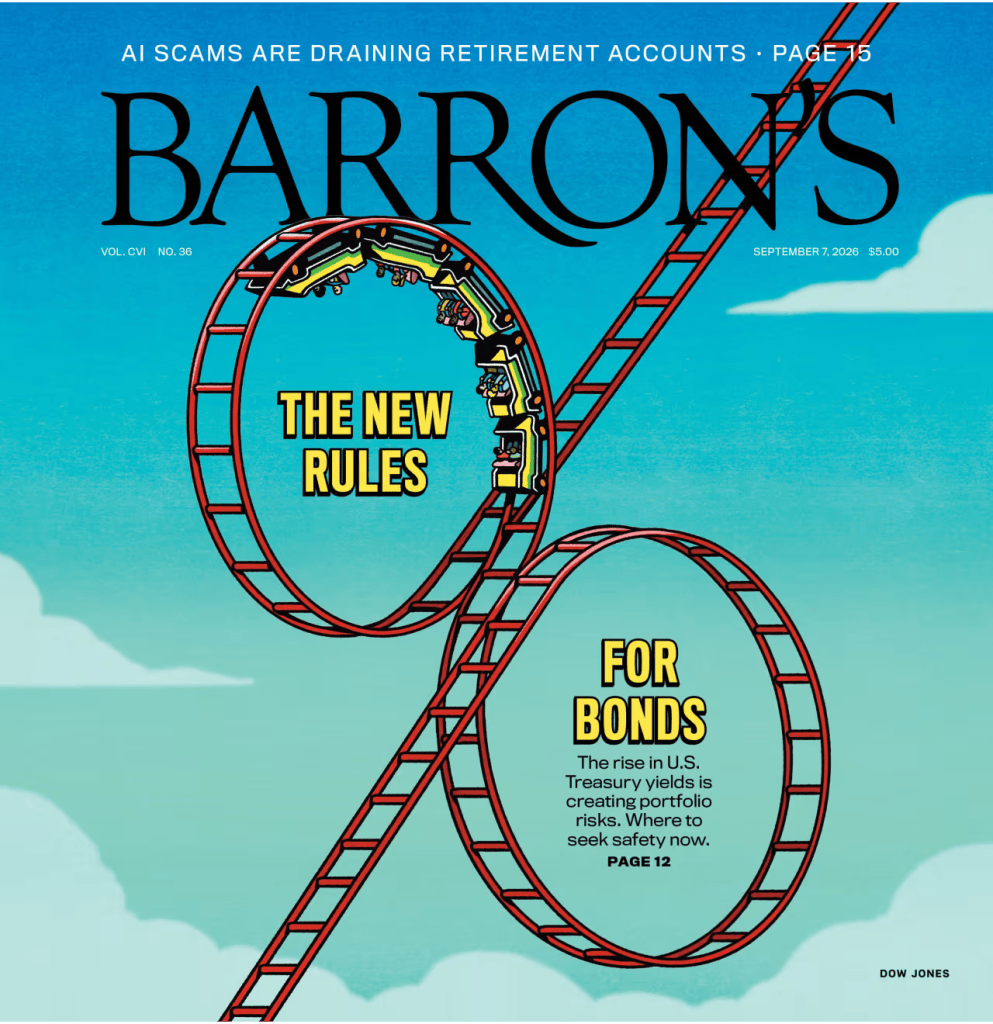
BARRON’S MAGAZINE: The latest issue features ‘THE NEW RULES FOR BONDS’ – The rise in U.S. Treasury yields is creating portfolio risks. Where to seek safety now.
The rise in U.S. Treasury yields is creating opportunities—along with serious portfolio risks.
Retirees can benefit as AI expands into healthcare and other areas. What to know, from managing your health to your portfolio.
Venture capital funding for consumer tech has stalled as funds shift to artificial intelligence. That makes the story of Nothing, a start-up maker of phones and audio gear, all the more surprising.
Artificial intelligence is making it easier to be an online swindler. Everyone is at risk, particularly the elderly.
Many economists and investors expect the Federal Reserve to raise interest rates by a quarter of a percentage point at its Sept. 16-17 policy meeting. But this coming week’s inflation data may prove cool enough to keep officials on the sidelines—and the federal-funds rate in a target range of 3.50% to 3.75%.
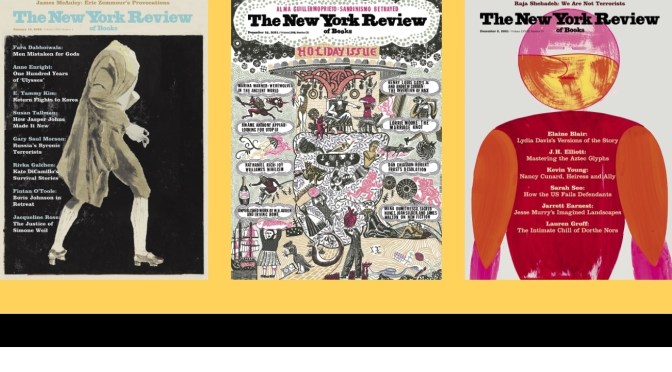
THE NEW YORK REVIEW OF BOOKS: The latest issue features ‘Fall Books’…
As AI erodes our attention spans and expressiveness, philosophers like Simone Weil and Arthur Schopenhauer offer profound insights on what it means to be an individual.
Timely questions lurk at the heart of connoisseurship: What counts as originality, what value do we place on it, how do we protect it?
The Connoisseur: A Cultural History by Peter Burke
The Goldsmith’s Debt: Conceptions of Property in Early Modern Art by Shira Brisman
Among its peers in the Ivy League, Dartmouth was perfectly positioned to resist Trump’s attack on higher education. It chose not to.
In The Diversity of Morals, Steven Lukes attempts to reconcile philosophical arguments that there is one morality despite cultural differences with empirical studies that suggest it’s all relative.
The Diversity of Morals by Steven Lukes
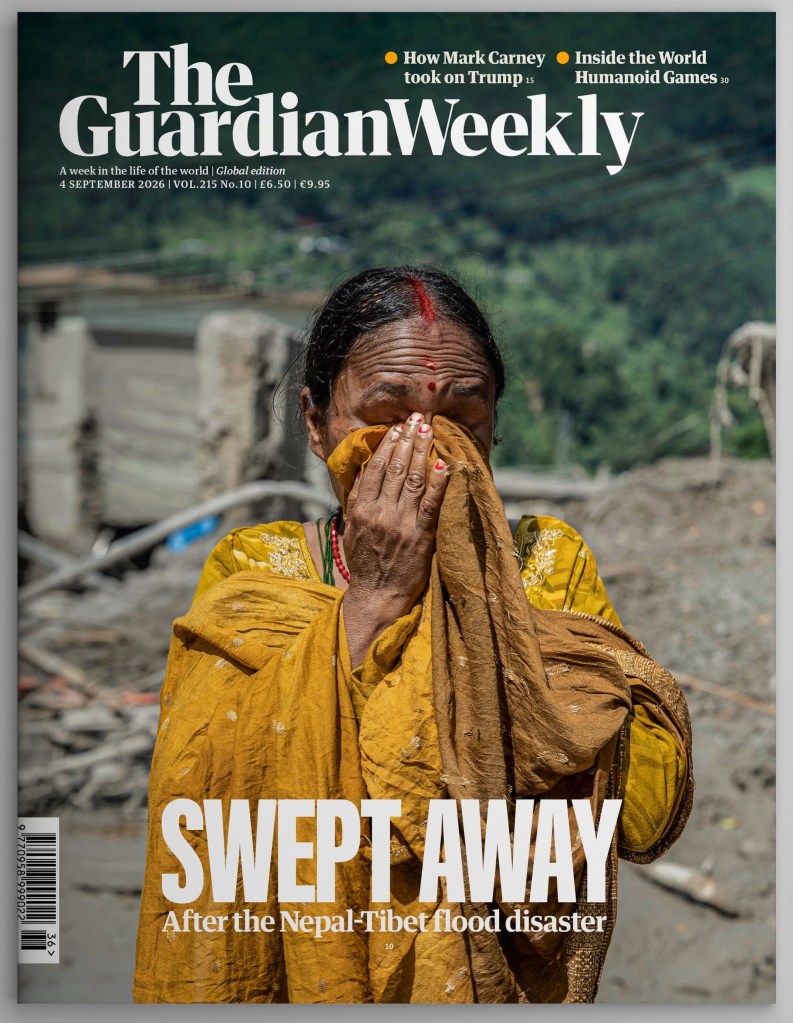
THE GUARDIAN WEEKLY: The latest issue features ‘Swept Away’ – After the Nepal-Tibet flood disaster…
Over the last week, the world has watched with horror the scenes from the Tibet-Nepal border where a devastating torrent of mud, water and ice tore along the Bhotekoshi River, destroying entire communities and leaving more than 1,000 people dead and several thousand more missing.
From the Nepali town of Devighat, our south Asia correspondent Hannah Ellis-Petersen describes a nightmarish scene of overflowing mortuaries and unidentifiable bodies, as shellshocked survivors of the flood slowly return to the ruins of their homes.
The disaster happened after the collapse of a glacier – and while global heating has not been definitively attributed as the cause, it is undeniable that steep mountain slopes and valleys are especially vulnerable to flooding and landslides, while extreme weather events such as monsoons and melting glaciers have become more common because of warming due to human-caused climate breakdown, as our global environment writer Jonathan Watts explains.
Then columnist Nesrine Malik paints a wider picture and argues that while for many people these floods may feel as though they have happened a world away, the climate crisis is coming for us all, one way or another.
Spotlight | Mark Carney shows combative nature in face-off with Trump
The Canadian PM is one of the few world leaders to stand up to the US president. Former colleagues say they are not surprised. Leyland Cecco, Heather Stewart and Kalyeena Makortoff report
Science | The robots are coming!
… Or are they? As entrants at the World Humanoid Games lurched from triumph to farce, Robert Booth finds that a robotics revolution may not be as close as it first appears
Interview | Gordon Brown on Burnham, billionaires – and a better Britain
The former UK prime minister is still shaping politics (even if he doesn’t want to interfere). He tells Charlotte Edwardes about keeping his temper, staying fit – and why he won’t splash out for a Scotland football shirt
Opinion | The tech titans must be stripped of their power, and soon
Those who said Meta harms children struck a blow, but the ability of big tech to gouge profits and cause harm is barely diminished. That’s the battle to come, argues Jonathan Freedland
Culture | Dolly Parton’s peerless career turned country music cliches inside out
Beneath the wig and rhinestones, the late US country singer was the genius behind strings of classic songs that continue to inspire new artists, says Alexis Petridis