From its origins in the classical physique and homoerotic spectacle, bodybuilding today often involves the use of steroids whose dangers are not properly understood.
When Fitness Went Global: The Rise of Physical Culture in the Nineteenth Century by Conor Heffernan
A Genealogy of Male Bodybuilding: From Classical to Freaky by Dimitris Liokaftos
Muscle Works: Physical Culture and the Performance of Masculinity by Broderick D.V. Chow
King’s Secretary: William Paget and the Last Years of the Reign of Henry VIII By Andrew Johnston
Tudor history buffs and attentive readers of Hilary Mantel’s Wolf Hall trilogy will recognise the name William Paget. Others will require some words of introduction. Paget (1505/6–63) was an able and influential diplomat and administrator who rose to become principal secretary to Henry VIII. ‘Rose’ is the operative word. Paget, like his predecessor and mentor Thomas Cromwell, was a self-made man, though his father, a sergeant serving the sheriff of London, was able to provide him with a grammar school and Cambridge education.
The Last Invasion of England: 1688 and the Dutch Armada By Arthur der Weduwen
Much is exceptional about the Bayeux Tapestry currently on magnificent display in the British Museum, but nothing is quite so exceptional as the event itself. As the museum’s website reminds us, 1066 ‘was the last time England was successfully invaded’. Our sea-girt immunity from foreign invasion has been at the centre of ‘Our Island Story’ ever since, with the Channel confounding the hubris of Philip II in 1588 and 1596, of Napoleon in 1803 and of Hitler in 1940.
Imperial Predator: Britain and the Destruction of the Ottoman Empire By David S Tonge
In his survey of the collapse of the Ottoman Empire in the late 19th and early 20th centuries, David S Tonge sees Britain as an aggressive superpower, hence the title of his excellent book. My one quibble is zoological. ‘Predator’ may not be quite the right word. For in much of Tonge’s story Britain is less lion than vulture: what zoologists call an obligate scavenger – or a necrophagous power – feeding on carrion. The Ottoman carcass had already been wounded by Russian aggression, nationalist revolt, indebtedness and internal decay. There were exceptions, and Britain could be predatory when circumstances demanded, notably in Cyprus and Alexandria, but its more characteristic pose was to sniff the odour of mortality and arrive in time for lunch.
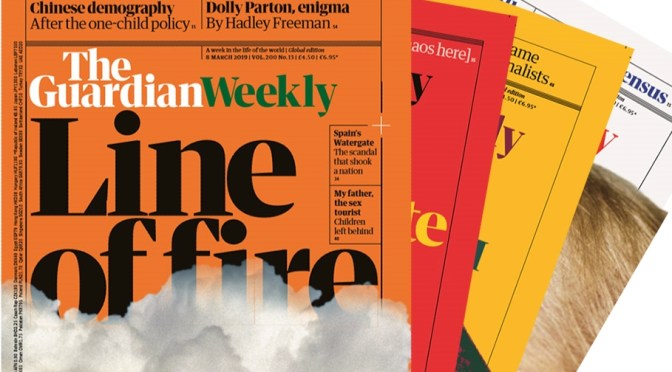
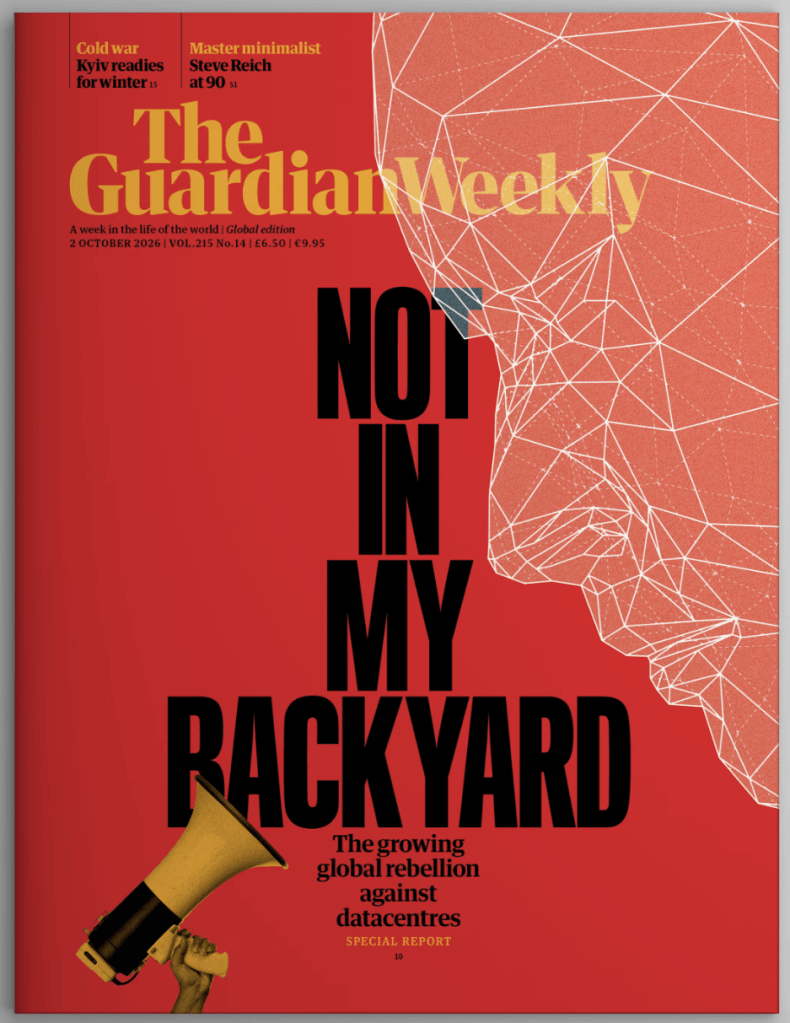
As the alarm bells sound ever louder about the potentially existential threat of breakneck AI development, people far removed from Silicon Valley debates about the future of the artificial intelligence revolution are voicing other more immediately tangible worries about the building of the vast datacentres that power these entities.
For this week’s cover story, economics and political writer Eduardo Porter, analyses why communities are pushing back against AI and the future that the big tech plutocrats want to create. These fears, based around environmental concerns over resource use and rapid societal change, are, he argues, far more complex than luddite attitudes or nimbyism.
It’s a position exemplified by reporting from two rural communities in India and the UK where vast datacentres are already under construction or being planned. As Hannah Ellis-Petersen and Aakash Hassan find out, the villagers of Tarluvada, in Andhra Pradesh, feel that government promises of a “golden age” that a hyperscale Google datacentre would bring them have been broken. Meanwhile, Sandra Laville meets protesters in Great Torrington, Devon, who sense that they are being kept in the dark about plans for an AI campus, one of Europe’s largest, in a Unesco-designated nature reserve.
Spotlight| Kyiv’s cold front is approaching Charlotte Higgins reports on how residents are preparing for winter, stocking up on food and determination, as Russia increases its attacks on energy infrastructure
Environment| What Nepal has taught Argentina What can the Patagonian town of El Chaltén at the foot of the Torre glacier do to avoid an event similar to the disaster in Nepal? María de los Ángeles Orfila finds out
Feature| Andy Burnham: a man with a plan As the first Labour conference with Andy Burnham as prime minister takes place, Hettie O’Brien finds out just how radical his policies could be
Opinion| Macron’s brave swansong In his final speech to the UN, Emmanuel Macron told the world how to stand up to Trump, says Steve Bloomfield
Culture| A minimalist at 90 As he prepares to celebrate a milestone birthday, Steve Reich tells Flora Willson how he developed his musical ideas and why he wants others to take up the baton of performing his works
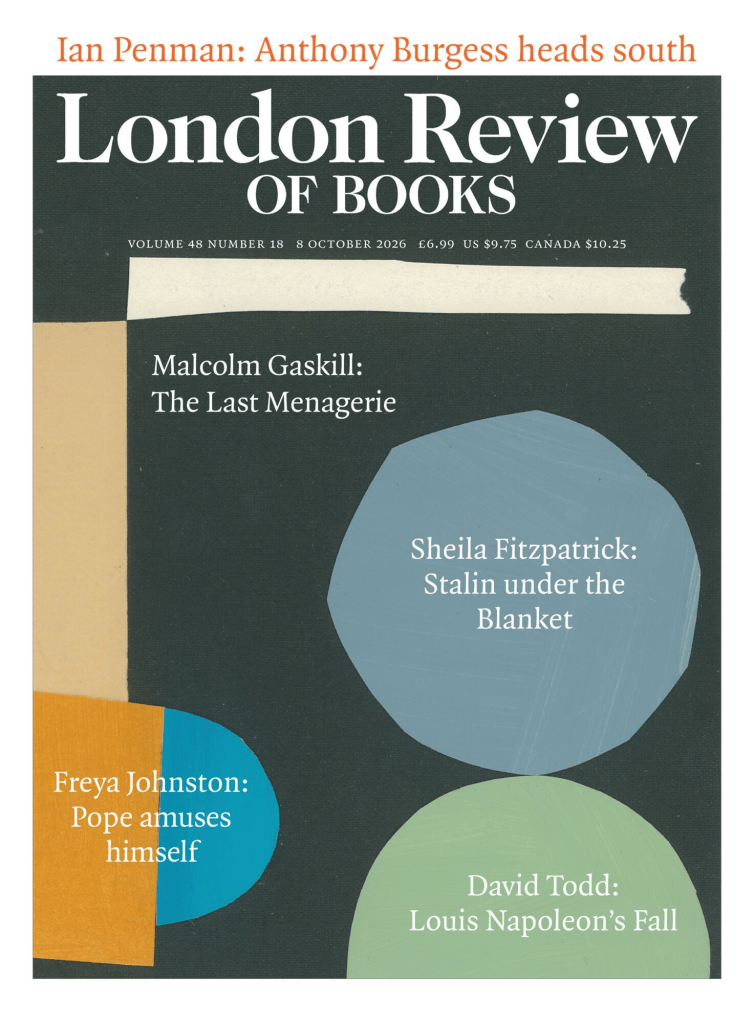
Sheila Fitzpatrick on Stalinism: Fitzpatrick examines Irina Paperno’s Always under Siege: Olga Freidenberg’s Diary-Theory and the Everyday Terror of Stalinism, analyzing how classicist Olga Freidenberg’s secret writings framed the Siege of Leningrad and Soviet surveillance as a totalizing domestic regime.
Tom Stevenson on NATO and Russia: Stevenson reviews Carlo Masala’s If Russia Wins: A Scenario and Thomas Newman and John Pierson’s Atlantic Resolve: The War for Estonia, analyzing contemporary Western military simulations and anxieties regarding Baltic security.
Literary Studies & Biography
Edmund Gordon on William Golding: Reviewing William Golding: The Faber Letters edited by Tim Kendall, Gordon details the editorial tensions between Golding and Charles Monteith, focusing on substantial cuts to the original draft of Lord of the Flies.
Freya Johnston on Alexander Pope: Johnston explores Henry Power’s edition of Alexander Pope: The Major Works, charting the Augustan poet’s biting satire, anxieties, and self-fashioning.
Ian Penman on Anthony Burgess: Penman re-evaluates Burgess’s 1966 espionage satire Tremor of Intent, dissecting its baroque style and its uneasy relationship with James Bond.
Art & Culture
Columns and Short Cuts: Additional pieces include Peter Geoghegan on democratic funding reform and Blake Morrison on Luke Kennard’s poetry collection Black Bag.
Em Hogan on Hujar and Thek: Hogan reviews Andrew Durbin’s dual biography The Wonderful World that Almost Was: A Life of Peter Hujar and Paul Thek, profiling the turbulent lives of the photographer and artist against 1960s–1980s New York and the onset of the AIDS crisis.
Dexter Dalwood on Jasper Johns: Dalwood contributes a review of Johns’s exhibition at the Guggenheim Bilbao, evaluating his enduring postwar artistic motifs and printmaking legacy.
Biotechnology stocks are soaring this year as medical advances and merger activity rekindle investor interest. More gains lie ahead, our healthcare panel says.
The Buffett of Bonds isn’t retiring yet. Dan Fuss, on whom we bestowed that moniker decades ago, is still putting in a full week as vice chairman of Loomis Sayles. And he sounded as sharp as ever when we caught up with him this past week, just before he was to mark his 93rd birthday.
THE LONDON MAGAZINE: Despair – its causes, symptoms and consequences – becomes something of a theme across the issue. At least according to its etymological root, to despair is to be without hope (de-sperare), and in Mavis Gallant’s 1965 story ‘Paola and Renata’, published in the issue, mothers have no hope of controlling their inscrutable, insolent daughters.
‘While it must be stressed that Rankine’s lyric practice is capacious and stylistically thrilling, that her insights are always valuable in isolation, I am left slightly unsure of what Triage’s greater intentions are.’
‘Partly due to critical neglect, partly due to the single-minded determination to be a poet who survived on nothing but his poetry, Harrison’s prose is doomed to be a footnote in his career.’
‘Might there be something, beyond backwater nihilism, in the vanishing of the Tree at Sycamore Gap that speaks to us about a country increasingly unable to protect its social and civic structures in the most basic ways?’
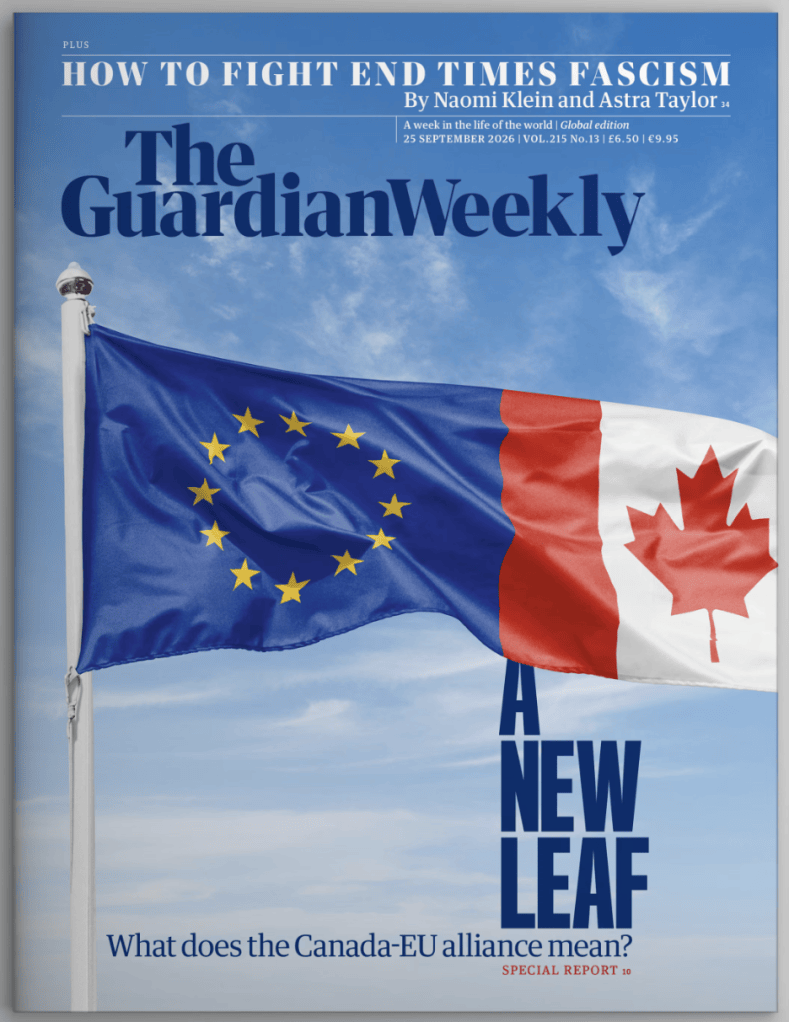
The European Commission president, Ursula von der Leyen, last week extended an unprecedented offer to Canada, inviting it to become the EU’s first “associate member”.
For our big story this week, Brussels correspondent Jennifer Rankin explores what the proposed alliance might mean. While there is a lot of common ground for the two parties, she writes, their agreement raises many questions and is clouded in uncertainty.
Meanwhile, senior correspondent Lisa O’Carroll examines the possible implications for the UK – asking whether it offers a blueprint for Britain, or a reminder it is out in the cold.
Then, former White House speechwriter Ted Widmer says Canadian prime minister Mark Carney’s remarks before the European parliament set out what a new west might look like, without its most powerful member – the US.
Spotlight| Yemeni families’ flight Fierce fighting has forced people to abandon their homes, leaving everything behind to seek shelter in refugee camps. Nasser Al-Sakkaf reports from Taiz
Science| ‘A map is never neutral’ The cartographers who took on centuries of western bias with the new Equal Earth projection speak to Oliver Holmes,Ana Lucía González Paz and Pablo Gutiérrez about their alternative to the 16th-century Mercator display
Feature| How to fight end times fascism An unholy alliance is working toward an apocalyptic future from which only a chosen few will emerge unscathed. It’s becoming clear how we stop them, say Naomi Klein and Astra Taylor
Opinion| This Israeli election could be the country’s last Spend time on the ground and you see how high the stakes are for next month’s contest – for Israelis and Palestinians alike, writes Jonathan Freedland
Culture| Present and correct Author Jonathan Franzen talks to Sophie McBain about a new TV adaptation of his bestseller The Corrections, the future of reading and why creating new work is “horrible”
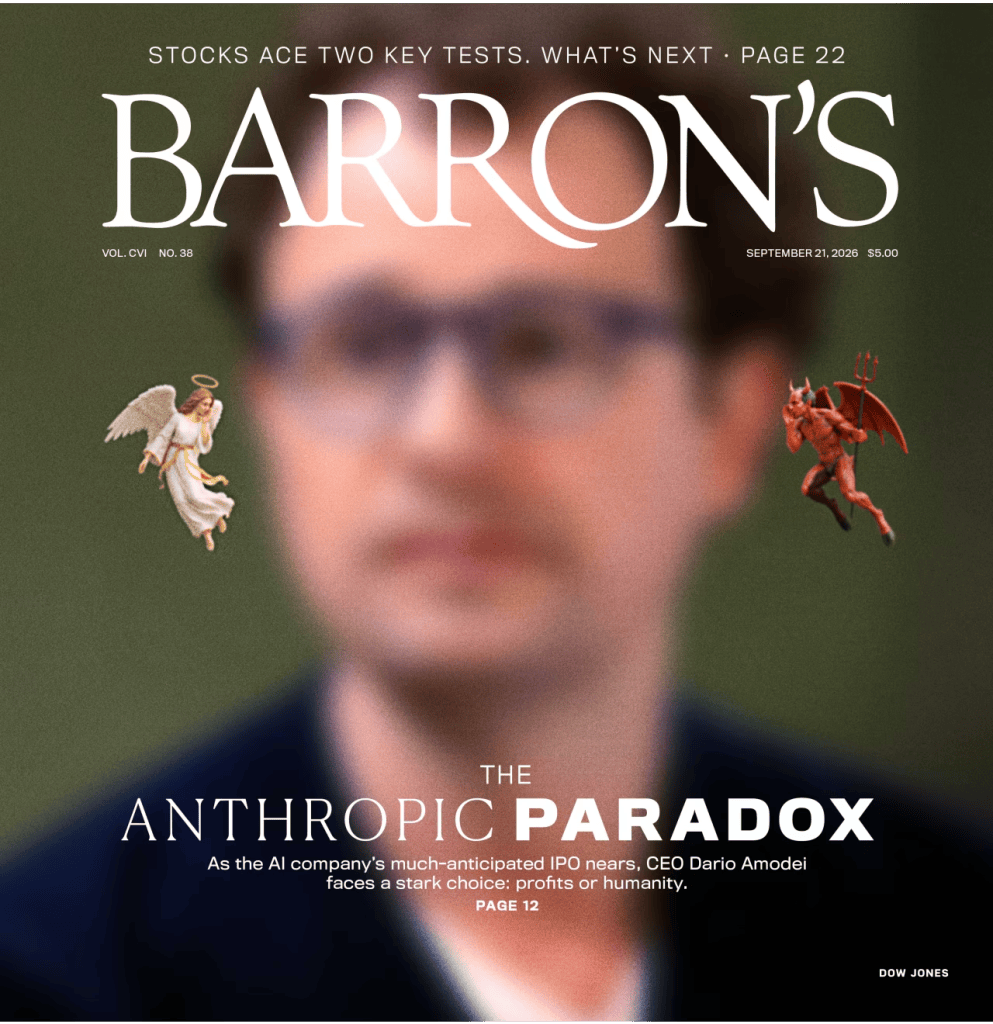
BARRON’S MAGAZINE: The latest issue features ‘The Anthropic Paradox’ – As the AI company’s much-anticipated IPO nears, CEO Dario Amodei faces a stark choice: profits or humanity
John Cochrane, a senior fellow at the Hoover Institution, says that rate cuts will lower inflation only in the short term so long as fiscal policy favors borrowing and spending.
Willem de Kooning’s works on paper document his efforts to find ways of retaining both image and abstraction, depth and flatness.
Willem de Kooning Drawing an exhibition at the Art Institute of Chicago, June 14–September 20, 2026, and the Rijksmuseum, Amsterdam, October 9, 2026–January 17, 2027
Charles Lamb’s camp, mischievous, melancholic alter ego, Elia, owes much to his sister, Mary, with whom he lived for forty years, absorbing her “rambling chat.”
Complete Works of Charles and Mary Lamb, Volume IV: Elia and The Last Essays of Elia edited by Gregory Dart
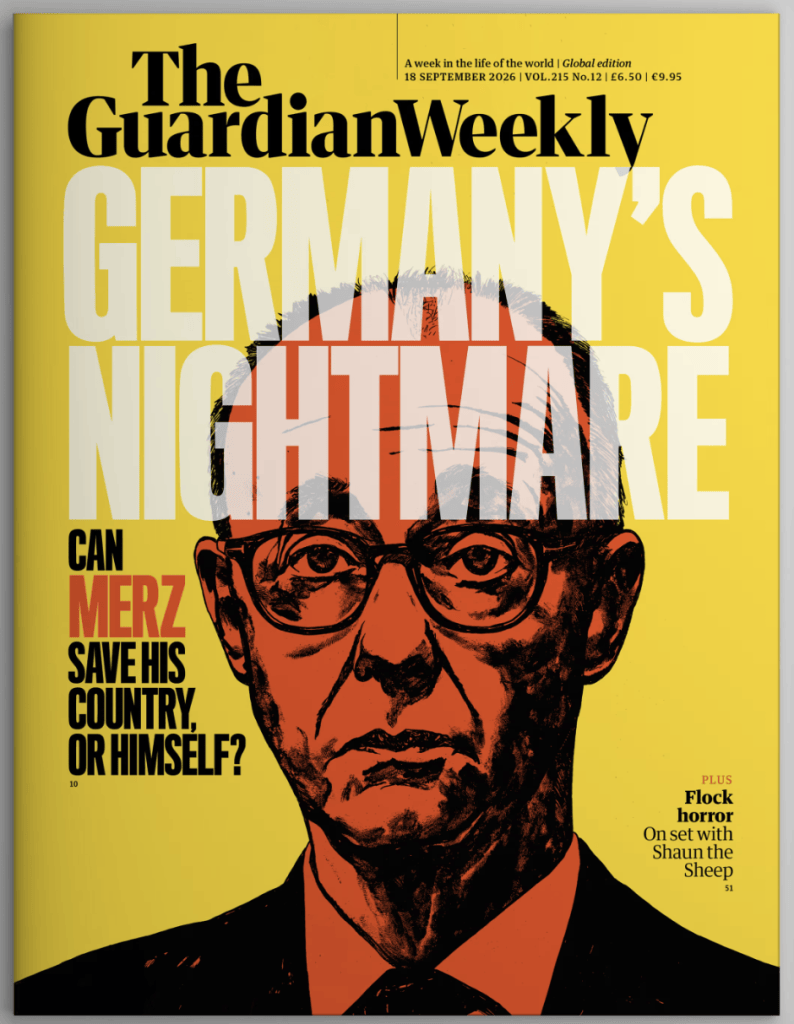
Friedrich Merz is a man with few choices and little popular support as he faces the end of Germany’s postwar settlement and the collapse of all the checks and balances to maintain democratic norms after the second world war and reunification. While Alternative für Deutschland’s success in state elections in Saxony-Anhalt saw the party win 44% of the vote, they are three seats short of a governing majority and, so far, no other party has said they are prepared to work with them, which means that for the moment, at least, the threat of Germany’s first rightwing extremist state government since the Nazi period has not yet come to pass.
As Berlin correspondent Deborah Cole explains, Merz is seen as the wrong man to present and sell a political counterpoint to the AfD’s populist policies. Seen as lacking in empathy and political dexterity, his demeanour is in sharp contrast to Ulrich Siegmund, the AfD’s lead candidate in Saxony-Anhalt. But as Deborah’s Berlin colleague, Kate Connolly, reports, some of Siegmund’s prospective new MPs have questionable backgrounds, including criminal records, Stasi pasts and connections to far-right networks.
Spotlight | Stop, slow down and swerve the apocalypse Can the world heave a collective sigh of relief after fellow tech bosses heeded a proposal by Anthropic CEO Dario Amodei’s to put the brakes on AI’s headlong rush to over take human intelligence? Nick Robins-Early weighs up our chances
Science | Can I borrow your coyote? Guardian US reporter Lois Beckett visits a one-of-a-kind California lending library where you can check out taxidermied animals and fossilised dinosaur bones.
Feature | Slime is not as simple as it seems Scientists are battling to determine whether supposedly simple organisms demonstrate a form of intelligence. If they do, what does it mean for our understanding of brain power, asks Samanth Subramanian
Opinion | Ethics make a return to UK foreign policy The evidence is Ed Miliband’s bold decision to label settler violence in the West Bank as “ethnic cleansing” and institute a boycott, argues Steve Bloomfield
Culture | Shear fun Catherine Shoard is rounded up for a trip down to Mossy Bottom farm to get a behind-the-scenes preview of the latest Shaun the Sheep film
News, Views and Reviews For The Intellectually Curious