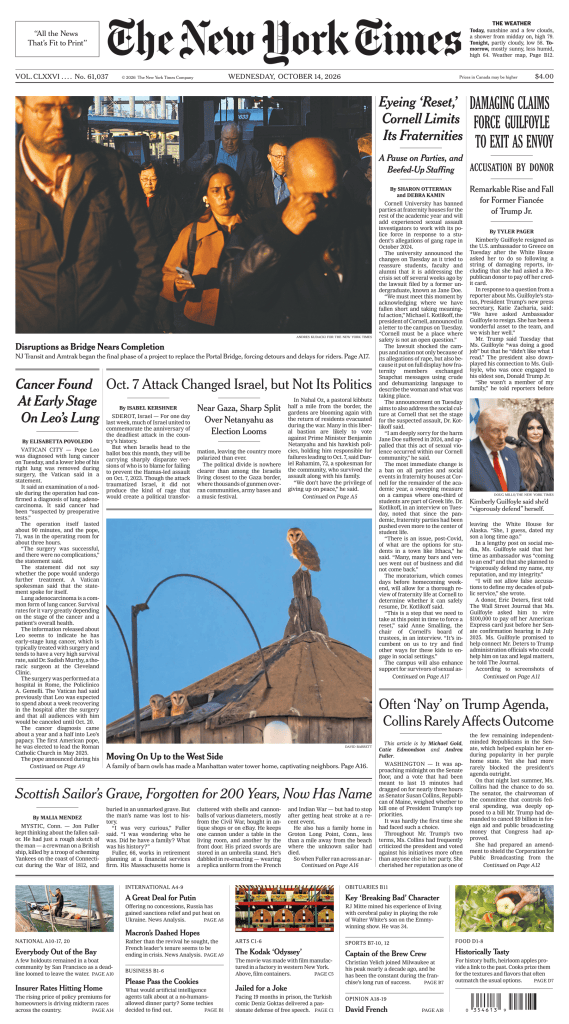
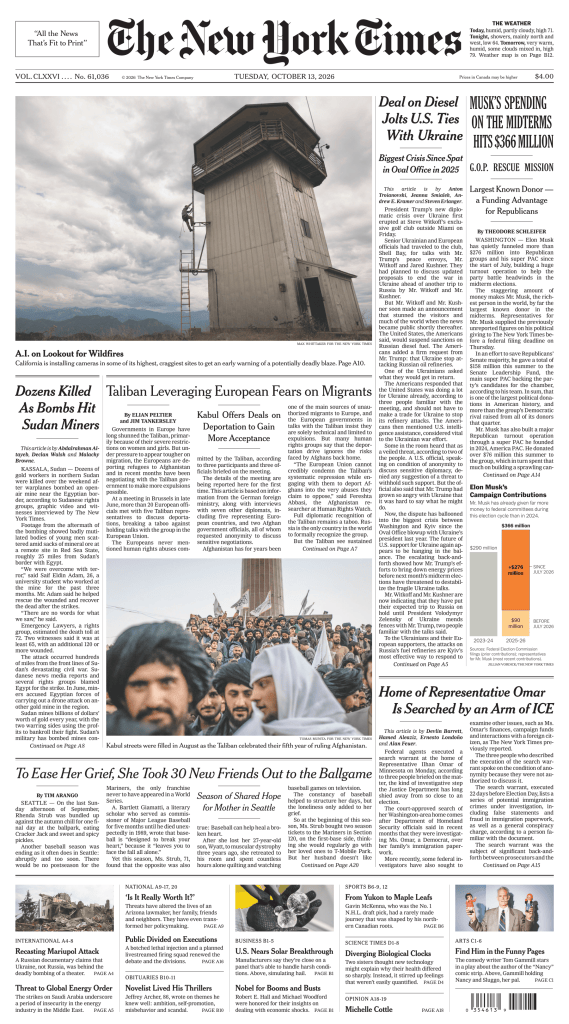
The attack came after the Yemeni militia warned it would attack the headquarters of Aramco. The Saudi-led coalition said it was targeting Houthi capabilities.
Russia has reaped a diesel deal and an increase in U.S. pressure on Ukraine as President Trump’s political needs align with his longstanding inclinations toward Russia.
The race in Maine, which could decide Senate control, is testing whether there is still room for Ms. Collins’s brand of moderation during a polarizing presidency.
Kyiv is increasingly vulnerable. A huge attack cut power to 600,000 people, and a Pentagon-funded satellite program appeared to be curbed without warning.
In the early 2000s, geneticists Helen Hobbs and Jonathan Cohen at the University of Texas Southwestern Medical Center launched an ambitious effort to investigate cardiovascular health in Dallas County. Their study was unusual for the time. Rather than largely focusing on people of European ancestry, the Dallas Heart Study deliberately recruited a diverse population that reflected the region’s demographics.
QUICK TAKE
Rare genetic changes in a gene called PCSK9 help control low-density lipoprotein (LDL) cholesterol, the “bad” cholesterol linked to heart disease.
People who naturally make less of the PCSK9 protein have much lower LDL levels, pointing researchers toward new possibilities for lowering cholesterol.
That insight led to a new class of cholesterol-lowering drugs and showed how studying diverse populations can uncover important clues about disease.
I spent much of my childhood in Colorado, which means that I, like millions of others living in the American West, grew up hearing warnings about the dangers of plague. People often find it shocking to learn that Yersinia pestis, the bacterium discovered in 1894 that is believed to have caused the mid-14th-century Black Death and other plague pandemics, is still around and dangerous, but that is one of many misperceptions about plague that need correcting. Plague’s multiple pandemics were not limited to the Black Death nor to Europe. And it is not a disease that disappears simply because no human cases are being reported at epidemic levels. Plague is not a thing of the past, and infections most definitely occur to this day.
QUICK TAKE
For centuries, our understanding of plague was riddled with assumptions based on a few historical accounts and data from modern plague victims.
Advances in genomics and bioarcheology now allow us to tie historical plague pandemics to human remains and even reconstruct the full plague family tree.
These data tell a new, broader story in which plague arrives earlier, stays later, and lurks in rural animal reservoirs before spilling over into human populations.
Seeking and evaluating explanations can shape the very process of learning. Just like tasting the soup as you’re cooking can shift the final product toward a closer approximation of soupy perfection, explaining as you learn can change the course of learning itself, pushing you to find a closer approximation of a truly great explanation: one that covers all the relevant observations in the simplest way possible. But how does that work?
QUICK TAKE
The process of explaining is a powerful learning tool.From a young age, humans ask “why”; answering that question can reveal deeper meanings and reveal hidden patterns.
Explaining can unlock abstraction, a complex thought process that allows people to generalize from specific examples to identify common themes.
The need to know why can unlock learning, but it can also drive some people to latch on to patterns that do not exist, such as conspiracy theories.
The Adriatic has been crossed by Odysseus and Caesar, by Venetian fleets and Napoleon’s navy, by countless men bent on dominating the world. It has seen its share of courage and folly. But one day in June 2025, off the island of Cres, it witnessed something genuinely new: a man worth $240 billion standing waist-deep in bubbles on the deck of a $500 million yacht, wearing a white bucket hat.
Clinton, Iowa, is topographically flat and economically declining. The sawmills that made the city rich in the late 19th century have been repurposed as a museum. One of the Victorian mansions long since abandoned by the old lumber barons is open for tours, but tourists are scarce. Clinton has shrunk to about 24,000 people, and the town center, along the Mississippi River, feels nearly empty. On the west side, miles of deep-green corn and soy fields are crisscrossed with transmission wires and zoned for heavy industrial use. The city’s economic activity includes corn processing, pet-food production, and methamphetamines. With available land and a dire need for investment, Clinton seems like the perfect place for a gigantic data center.
ne evening this summer, in the village of Bezdonys, in eastern Lithuania, I watched as a platoon of riflemen arrived at a train station occupied by enemy forces. Some of the Lithuanians let out a burst of gunfire from across the tracks, pinning the adversary in place as the rest of the unit advanced on the station. As the firefight intensified, wounded riflemen were evacuated to makeshift medical tents. An enemy soldier lay slumped against the station’s yellow clapboard siding.
This term the Supreme Court has plans to trample even more of our rights. But we, the people, are not powerless in the face of their power grab. Elie Mystal
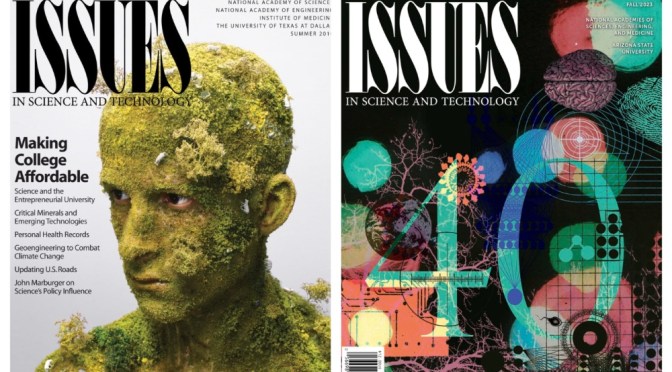
The Fall 2026 issue explores how artificial intelligence might affect public policy in a variety of domains. Take biosecurity: Despite the fear that AI could be used to engineer dangerous pathogens, a former FBI special agent argues that the technology can also be used to uncover suspicious activity and possible bad actors before they become a threat. On economic policy: Spectacular wealth from AI will accrue to relatively few companies and individuals. What if a country were to create an AI sovereign wealth fund to distribute these profits more equitably? A group of Canadian scholars and legislators proposes to set up just such a fund. And when it comes to trust, a cultural anthropologist argues that CERN, the world’s most successful large-scale science collaboration, has many lessons to offer European regulators about how to build trust and transparency when using AI for science.
What Are the Goals for AI?
In “Escaping AI’s Measurement Trap” (Issues, Summer 2026), Urs Gasser, Viktor Mayer-Schönberger, and Fabienne Marco make a compelling case that governance of artificial intelligence faces a problem. Once benchmarks become targets, systems and their developers adapt to them, and measured performance may increasingly diverge from behavior in the real world. Their argument leads to a broader question: How can democratic societies not only improve the oversight of increasingly optimized AI systems, but shape what gets optimized in the first place?
There is much discussion on how artificial intelligence poses threats to biosecurity; there should be at least as much focus on how AI can expand the solutions.
Today’s biosecurity approach is still grounded in a foundation laid nearly two decades ago. In 2008, when I reported to Federal Bureau of Investigation Headquarters as a newly minted supervisory special agent to support biosecurity policy, one important, emerging question was how providers of synthetic DNA should screen orders from customers. As commercial gene synthesis became increasingly accessible, many people worried that individuals could order genetic sequences coding for toxins and pathogens and then use them to cause harm.
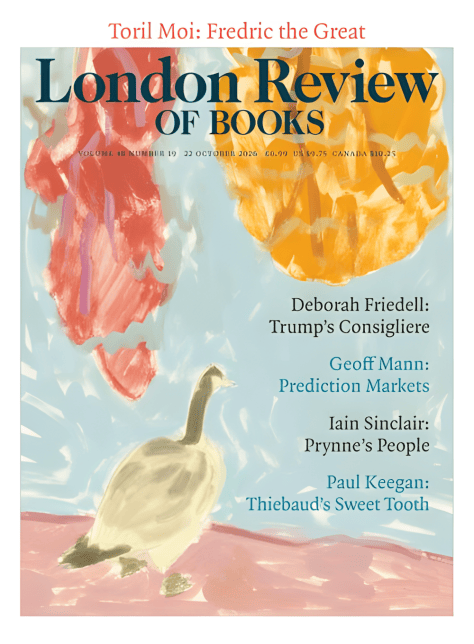
LONDON REVIEW OF BOOKS: The latest issue featuresFredric the Great by Toril Moi; Trump’s Consigliere by Deborah Friedell; Prediction Markets by Geoff Mann; Prynne’s People by Iain Sinclair; and Theibaud’s Sweet Tooth by Paul Keegan….
Fredric Jameson seemed to me to have read absolutely everything. He was the very antithesis of the intellectual type I think of as an empty theoriser, by which I mean someone who endlessly conjectures without having a genuine command of any relevant archive. To look at Fred as a reader of literature is not to reduce the scope of his work, but rather to try to understand its origins.
As Israelis prepare to vote for the first time since the Hamas-led assault, they remain divided over whether to hold Prime Minister Benjamin Netanyahu responsible for negligence or fault the “treason” of his generals.
Shocked by the U.S. agreement with Russia, which Ukraine has called “a gift” to President Putin, officials in Europe have coalesced around a cautious diplomatic message.
Two Republican super PACs are said to be withdrawing cash from two House races as the party scrambles to prevent more widespread losses in the midterms.
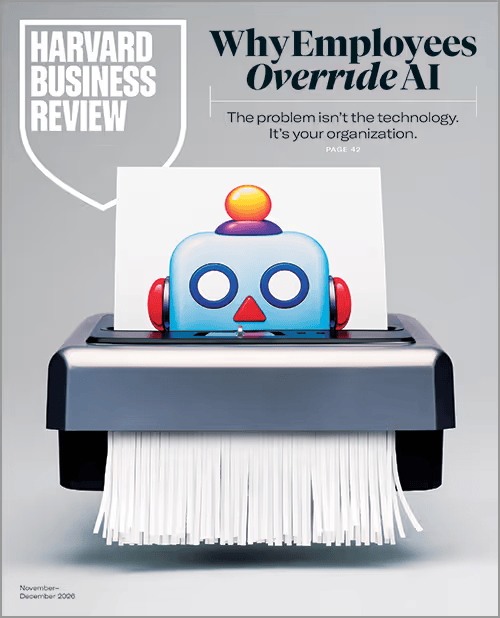
It’s not that they don’t trust the technology. It’s that they don’t trust your organization.
Summary
Companies are deploying AI systems faster than they are redesigning the governance surrounding them. As a result, many AI systems remain permanent advisers rather than actual decision-makers—not because the technology falls short but because the…more
In late 2022 a global bank approved an AI system designed to automate routine credit decisions. On paper it looked exactly like the kind of forward-thinking move experts had been urging companies to make. In pilots the system processed applications faster than humans did, reduced errors, and promised meaningful cost savings. The risk management team signed off on it, compliance approved it, and the CEO touted it publicly as proof that the bank was leaning into the future.
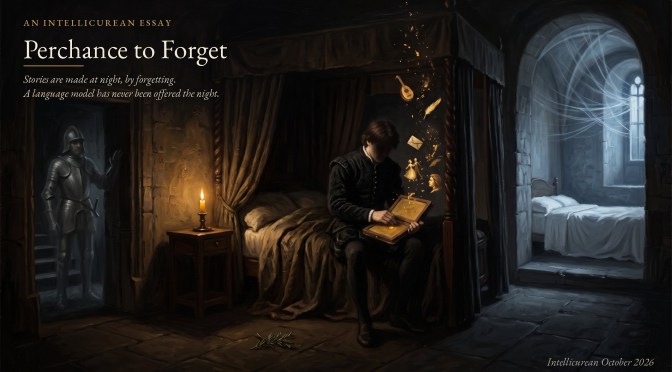
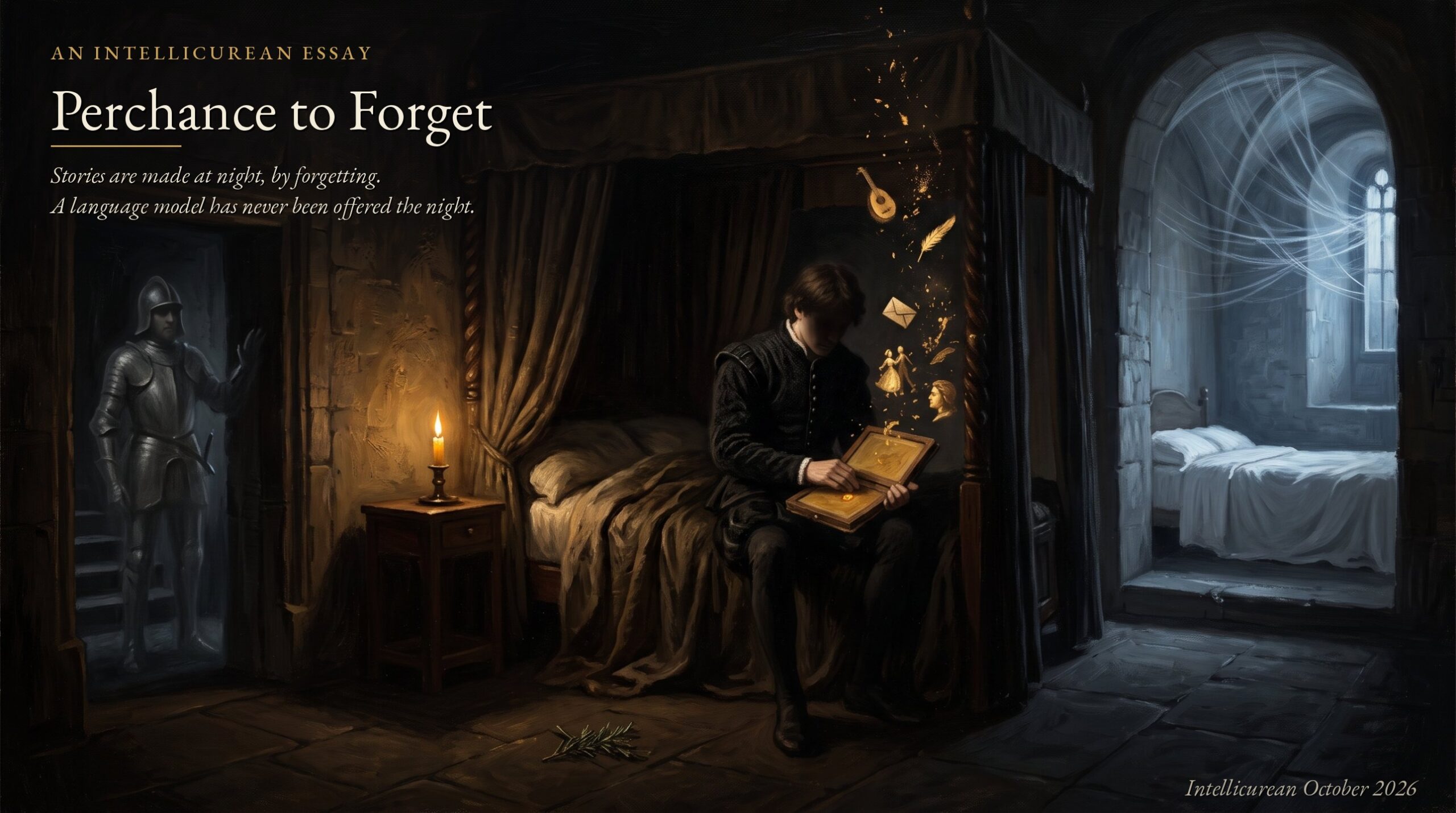
You wake the morning after a long dinner with an old friend, and the exact words are gone. What remains is the turn of it, the first draft of a story you may tell for years. Something chose what to keep while you slept. A new essay asks what happens to the minds that never get that night.
A prince wipes the table of his memory; across the hall, a bed no one sleeps in. Made for the essay.
Why we’re pointing you there
Sleep, on one leading account, is when the brain lets most of the day go, and the selection is where stories begin. Michael Cummins follows the people who could not make that trade. Borges’s Funes remembers every leaf of every tree and cannot think, because “to think is to forget a difference.” Solomon Shereshevsky, the real-life mnemonist Alexander Luria studied for almost thirty years, wrote down what he wanted to forget, burned the slips, and still saw the words. Nietzsche held that without forgetting it is impossible to live at all, and slept badly. Oliver Sacks’s amnesiac patients kept nothing, and one of them invented a new world every few minutes, while Sacks’s own journals, it turns out, confess inventions of his own.
Then the machine. A language model, the essay argues, has two memories, and they are opposites: a vast library that forgot almost every particular, and a conversation it holds entire and keeps none of. What it lacks is the night between them. When engineers try to make a model unlearn, the forgotten knowledge comes back, just as the words came back to Shereshevsky through the fire. The essay says plainly that it was drafted with Claude, and it asks one question: what would it mean for a machine to sleep?
Burning the paper, and what survives the fire. Made for the essay.