Category Archives: Reviews

THE GUARDIAN WEEKLY – OCTOBER 30, 2026

THE GUARDIAN WEEKLY: The latest issue features ‘KEEP LEFT’ – How Lula won a historic fourth term; Serbia celebrates defeat of Vučić; Competitive yoga – A stretch too far?

How many grinning faces, jubilant crowds and celebrating politicians can you fit into a single issue of the Guardian Weekly? That’s not a question that often troubles us, but the spectacular triumph of President Luiz Inácio Lula da Silva, winning a historic second-round vote after losing the first to rightwing opponent Flávio Bolsonaro, and the victory of the student-led campaign against autocrat Aleksandar Vučić in Serbia gave me a happy problem to solve this week. In an era when the right seems to be riding high in the world, popular pushbacks against strongmen politicians is something to celebrate.

For our Brazil cover story, Tom Phillips and Tiago Rogero report on the reaction to Lula’s victory and how he pulled eventual success from the jaws of what, until the first results came on Sunday evening, seemed a probable defeat. As government health minister Alexandre Padilha said that evening: “It’s a massive victory – not just for Brazil. It’s also an important signal to the rest of Latin America and to the world.” But, as commentator Jordana Timerman cautions, Brazil has been an exception in Latin America in successfully resisting Donald Trump’s attempt to achieve hegemony over the region.

Spotlight | ‘Pure arrogance’
Google has been in the dock in Finland over the illegal felling of hectares of woodland for its datacentres, reports Miranda Bryant

Science | Out of the blue
Why are more planes encountering invisible air turbulence, what can they do about it and what effect will more frequent incidents have on travellers, asks Patrick Keneally

Feature | Bent out of shape?
Competitive yoga may sound like anathema to some devotees of the ancient practice but, as Anita Chaudhuri discovers, there is a movement among some yogis to make it an Olympic sport

Opinion | Lame duck presidents can be dangerous beasts
If Democratic midterm gains hamper Donald Trump at home, we should be very worried about what he might do abroad when foreign policy is his last bastion of power, says Steve Bloomfield

Culture | Stay faithful
As the second series of Celebrity Traitors draws to its conclusion, Michael Hogan meets the people who made it the world’s biggest TV show and finds out why Claudia Winkleman never wants to leave the castle

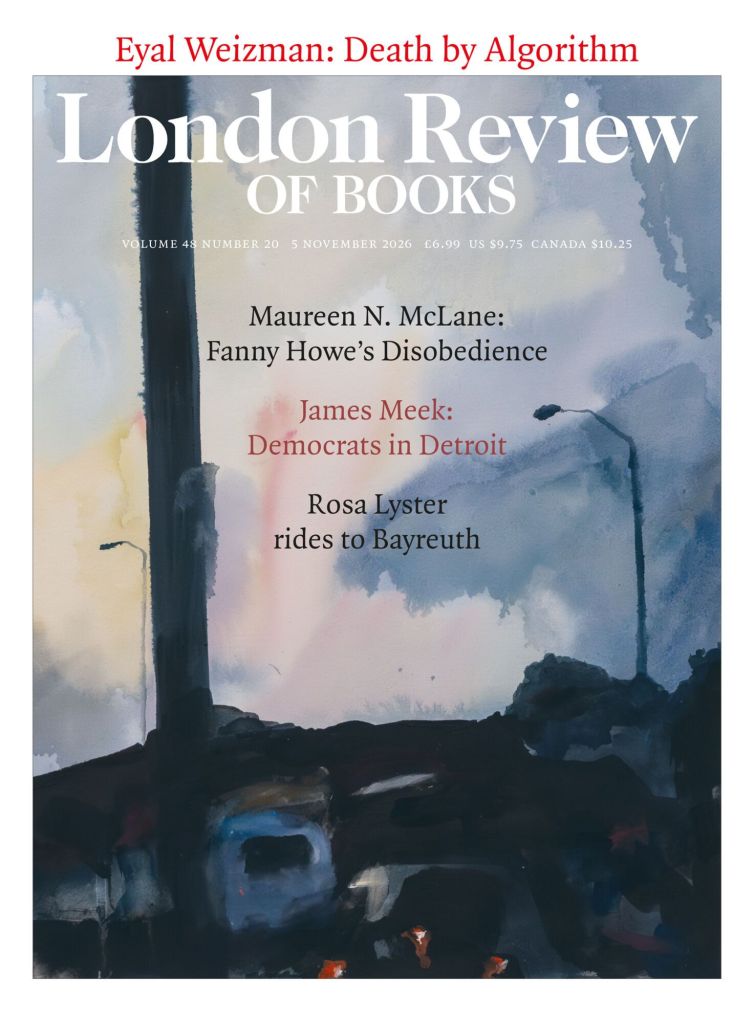
LONDON REVIEW OF BOOKS – NOVEMBER 5, 2026 PREVIEW

LONDON REVIEW OF BOOKS: The latest issue features  Fanny Howe’s Disobedience by Maureen N. McLane; Democrats in Detroit by James Meek; and Rosa Lyster rides to Bayreuth….

Democrats in Detroit

‘To win the Senate, the Democrats need to hold on to the one Michigan seat (out of two) that is up for grabs, and have chosen a new candidate, Abdul El-Sayed, a moderate leftist in European terms, a “communist loser who hates Jews and Israel” according to Trump, “very, very evil”, per J.D. Vance.’ By James Meek

Is curiosity good for us?

‘The superego – and its precursor, conscience – refers to the part of us that has no curiosity about ourselves. It’s the saboteur of curiosity about ourselves. And that part of us, like a narrow-minded fascist, has only one project: to destroy our pleasures in being alive by trying to kill our curiosity (or by making us frightened of our curiosity, which amounts to the same thing).’ By Adam Phillips

Death by Algorithm

Eyal Weizman on NAZA

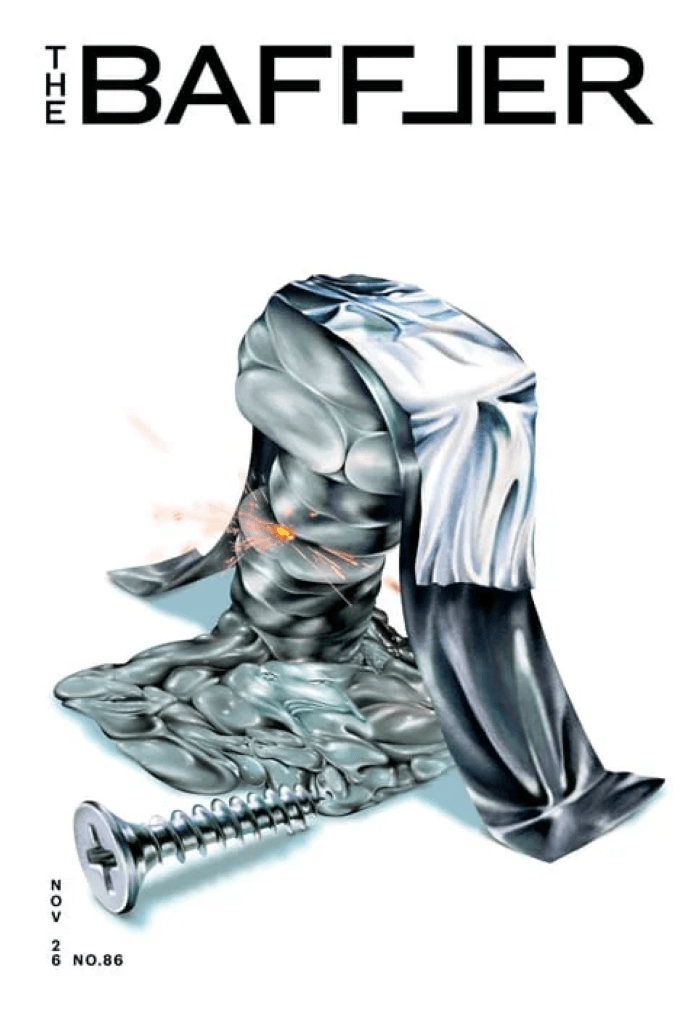
‘Israel’s automated targeting system allows for the responsibility for “industrialised annihilation” to be shared between coders, operators, legal officers who pre-set the level of collateral damage, officers who approve the strike, officers who choose the bomb and the pilots or drone operators who launch it. “I am just a small screw in the system,” one of the interviewees says, quoting Eichmann’s defence during his trial in Jerusalem. The system that begins with a phone number being put into a computer system ends with an entire family crushed under the rubble.’

THE NEW STATESMAN MAGAZINE – OCT. 30, 2026

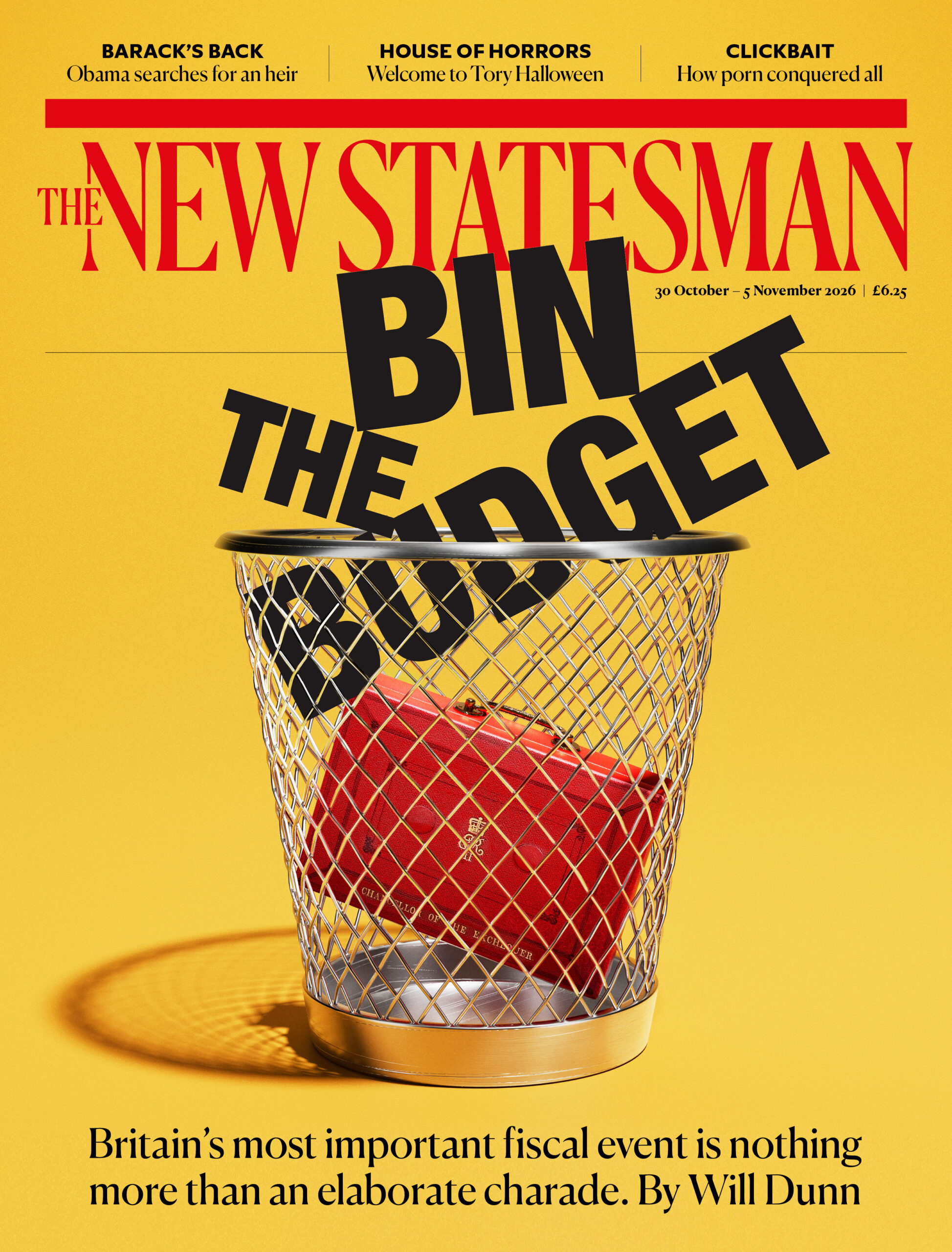
Bin the Budget

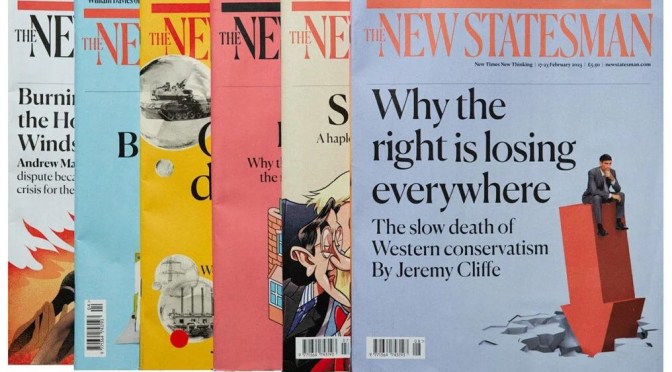
THE NEW STATESMAN: The latest issue features Tom McTague defending the magazine’s radical spirit, arguing that every publication needs a driving project. Emily Lawford examines the modern Conservative party, noting that true believers remain undeterred by recent electoral failures. Nicholas Harris uses Cornish nationalism as a mirror for broader British politics, while Andrew Marr warns Labour against falling for opposition election strategies. Internationally, JS Rafaeli critiques the Israeli state following an arrest in the West Bank. Finally, the collection includes a public letters feature emphasizing legal equality.

Bin the Budget – Every magazine needs a project

In defence of the New Statesman’s capital-R Radical spirit

Last week’s open letter in support of Sally Rooney, calling for the Terrorism Act to be amended to protect free expression, generated an extraordinary response. Not all of it has been positive, of course. While many readers wrote in to endorse the letter, others argued – reasonably and often forcefully – that it was Rooney who was to blame for the situation, not the government. She has chosen, of her own volition, to self-censor by going out of her way to breach a law that, irrespective of its merits, should be followed because it is the result of a democratic process. One reader, Peter O’Halloran, from Cavan, Ireland, was among many who got in touch to make this point: “While taking a moral stance is, of course, to be admired, surely the law is the law?”

Abolish the Budget

It is an inherently dishonest way to run a country By Will Dunn

In recent decades, a sinister new force has assumed power in Westminster. They can appear in any political party. They are formidable at converting politicians to their cause. They’re not the Blob, or the Deep State, or the Lizard People. They’re worse. They are the Budgetarians, and no matter which party is in power, they are running the country.

The government must resist Gogglebox politics

Don’t try to read the mind of the British Everyman By Anoosh Chakelian

Every few weeks, I am surveyed for my opinions – not as a journalist, but as a human – by a polling firm. Five years ago, our household was chosen by whatever magical selection process these companies concoct to be part of a polling panel, answering questions about everything from pension literacy to the state of our neighbourhood to how we feel on an emotional scale about heat pumps.

I sometimes wonder how to answer. Should I tick “yes” that I’ve heard of political buzz terms such as “levelling up” or “net zero”? Would someone of my demographic have come across them if it hadn’t been for having a job like mine? And am I being misleading about my media habits if I tick that I read every newspaper, multiple times a month, even if it’s only for work?

TIMES LITERARY SUPPLEMENT – OCTOBER 30, 2026

TIMES LITERARY SUPPLEMENT: The latest issue features ‘ART HISTORY ISSUE’ – Monet’s water lilies, Vermeer’s afterlife and Anni Albers, pioneer….

‘Our guide into the darkness’

Edgar Allan Poe’s downward trajectory By Frances Wilson

Love at first bite

The subversive sexuality of the literary vampire By A. K. Blakemore

A patch of yellow wall

The modern cult of Vermeer By James Hall

On repeat

Reflections on writing, addiction and Monet’s water lilies By Marie Darrieussecq

THE BAFFLER MAGAZINE – NOVEMBER 2026 PREVIEW

THE BAFFLER MAGAZINE: The latest issue features ‘Tight Ship’….

Pay as You Go

The socialist cash that collected capitalist trash by David I. Backer

Today, the crossroads of socialism and barbarism meet in cities across America. In New York, Seattle, and Chicago, organizers have seized local and state authority, empowering mayors Zohran Mamdani, Katie Wilson, and Brandon Johnson—and a nonnegligible number of other politicians—to pursue the left project municipally. These local victories, won in the years since 2020, have kicked off a positive feedback loop and inspired yet more socialists to run for office in our time. The candidates tell us they want to collectivize the relations of production. Can they?

Bridges and Bullets

The militarization of Mexico by López Cordero

Last winter, the Mexican Army killed its main foe. Nemesio Oseguera Cervantes was spending a Sunday in Tapalpa, a tourist town just south of Guadalajara, the capital of Jalisco. Maybe Oseguera, a cartel leader who rose to international infamy over the past two decades, was there to visit the sixteenth-century chapel that’s nestled behind the main square, or maybe he wanted to admire the town’s snake-decorated fountains. In all likelihood, he was confident that authorities in that part of the country would ignore him spending time in the state that gave its name to his organization, Cártel de Jalisco Nueva Generación.

Jack Squat

On reality television, all tenants are squatters by Michael Friedrich

A bouncer-looking guy with a steel-wool goatee lies his way into a woman’s Washington State home, posing as an inspector. He moves from room to drywall-covered room, testing smoke alarms. The home’s occupant, a quiet, middle-aged woman named Sally Barton Jeffries, offers the guy a glass of water. Her place looks cozy enough, furnished with an orange sectional, a checkered rug, and a table in the eat-in kitchen. She mentions that she has lived there for nine months.

The Pollycrisis

Feral parakeets flock to London by David Wingrave

Before we saw a single parakeet, we heard them: a disembodied static that grew louder as we approached Hither Green Cemetery in southeast London. It was an early evening in late June, and we had come to witness an invasion. By the time my friend and I reached the cemetery’s western edge, the clamor was all-encompassing. We hopped the fence and picked our way across the gravestones. Above us now were the birds themselves, their kryptonite-green plumage, scab-red beaks, pearly black collars, and trailing tail feathers unmistakable: Psittacula krameri, the ring-necked parakeet.

BOSTON REVIEW MAGAZINE FALL 2026 PREVIEW

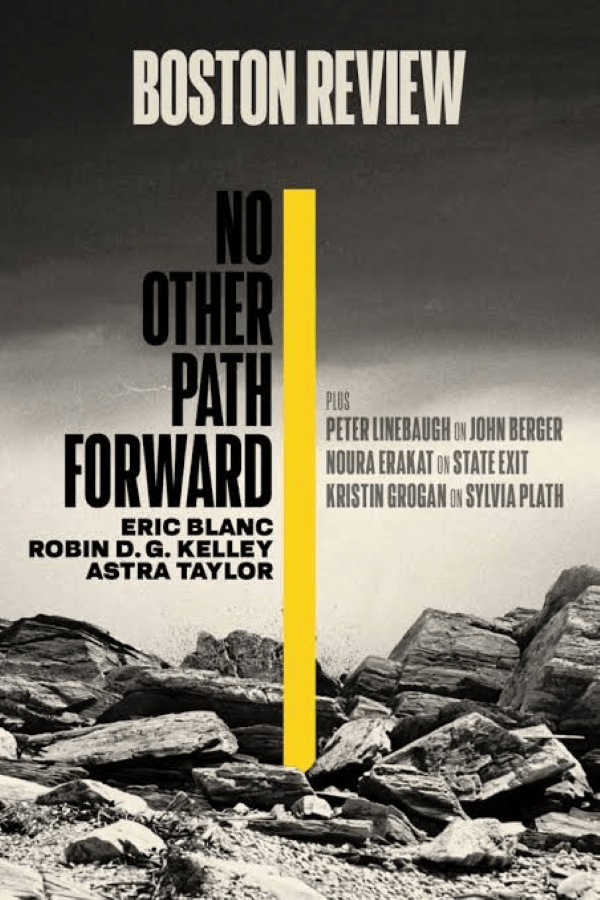
BOSTON REVIEW MAGAZINE: The latest issue features ‘NO OTHER PATH FORWARD’ – Eric Blanc on organizing the left, Robin D. G. Kelley on the defund movement, Astra Taylor on the data center backlash, and more.

Mencken Agonistes

Misrepresented by the right and misunderstood by the left, the Sage of Baltimore delivered scathing—and still bracing—indictments of American injustice. By Andrew Holter

Slavery Pure and Simple

A recent bombshell report documents brutal cases of forced labor in Mexico. Why can’t the government take it seriously? By Claudio Lomnitz

The Rise and Fall of Tech Worker Power

Crushing our union drive at Twitter opened the floodgates for Silicon Valley’s assault on labor. By JS Tan and Clarissa Redwine

no other path forward

The Left’s Achilles’ Heel
Can we out-organize the right?
Eric Blanc

The Price of the Ticket
The long arc of the defund movement.
Robin D. G. Kelley

Who Wants AI?
Lessons from the data center backlash.
Lily Hu, Robinson Meyer, Nicholas Rabb, and Astra Taylor

Working Like a Dog
The future of animal rights.
Aaron Neber


features

Gleaner, Cobbler, Commons
Re-establishing the human with John Berger.
Peter Linebaugh

Is It the Phones?
Anatomy of a moral panic.
Lorna Finlayson

A Bigger Hell
Slavery returns to Mexico.
Claudio Lomnitz

Exit and Exception
The Board of Peace as template for a new world order.
Noura Erakat

WORLD LITERATURE TODAY NOVEMBER 2026 PREVIEW

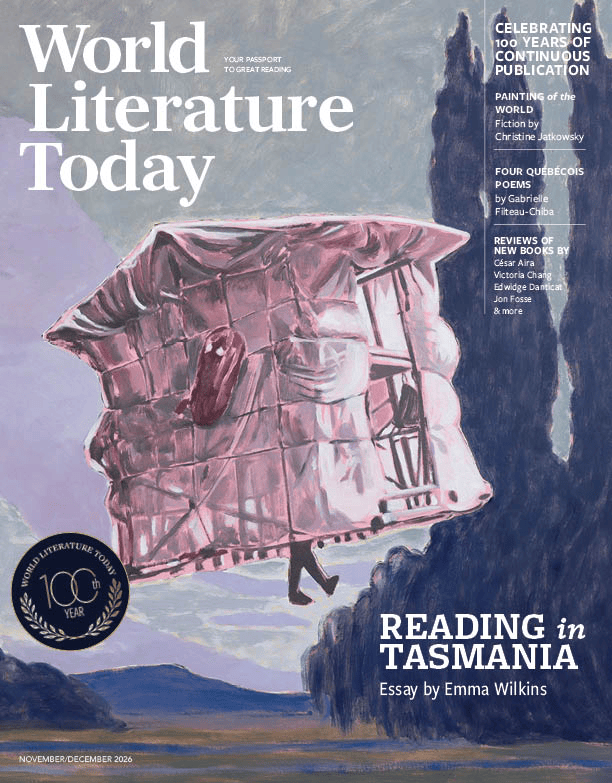
WORLD LITERATURE TODAY: The latest issue features ‘Reading in Tasmania’. The 100th year of continuous publication gifts readers all their favorite genres—a profusion of essays, poetry, book reviews, creative nonfiction, fiction, interviews, a booklist for Trans Awareness Month, a postcard from Colombia, and more. Emma Wilkins’s essay on Tasmanian literature provides the cover feature, and translated work from China, Egypt, Mexico, Quebec, and Russia enlivens the issue. Reviews of new books by Solvej Balle, Emmanuel Carrère, Victoria Chang, Edwidge Danticat, Jon Fosse, and dozens more round out the year with essential reading-list titles.


50 Years Ago in These Pages

by The Editors of WLT

The Ancient Nutrients Sustaining Cali, Colombia

by Erik Gleibermann

A Field Guide to Global Trans Literature: 7 Books for Trans Awareness Month

by Alton Melvar M. Dapanas

72 Years Ago Not in These Pages

by Rafael Heliodoro Valle

“The Garden of My Soul”: Edith Wharton’s Living Legacy in France

by Laura Sheahen

Why I Am Not an Indian English Writer

An Essay by Aruni Kashyap

Introduction: Eyes of the Pen, Voices of the Camera

by Yousef Khanfar

Writing on War’s Edge

by Yousri Alghoul

They Call It Displacement—In Reality, It’s Hell (This Is My Story)

by Nour Abo-Rokb

Ghost

by Basem Nabres

Ringtones of My Mobile Phone

by Omar Hammash

THE NEW YORKER MAGAZINE NOVEMBER 2, 2026 PREVIEW

Donald Trump stands next to a trash can labeled Vote Here.

THE NEW YORKER MAGAZINE: The latest issue cover features Barry Blitt’s “Polling Place” – An election strategy.

The Republicans’ Remarkably Bad Midterm Campaigns

Things were going poorly even before Vivek Ramaswamy’s campaign ran the most offensive ad of the year. By Benjamin Wallace-Wells

Charles Kushner and the MAGA Ambassador’s Playbook

Since taking up his post in Paris, Kushner has become known for lobbing provocations onto France’s domestic scene at sensitive moments. As he put it, “Nobody has the courage to say what I say.” By Lauren Collins

The State Officials Defending the Midterms from the President

Donald Trump has tried to purge voter rolls nationwide. Deidre Henderson, the Republican lieutenant governor of Utah, is among the chief election officers standing in his way. By Barton Gellman

How Jim Morrison Surmounted Tragedy and Skied Down Everest

The mountaineer and his partner, Hilaree Nelson, planned a first-ever descent. After her death, he pushed on. By Nick Paumgarten

THE NEW YORK TIMES MAGAZINE-OCTOBER 25, 2026

Current cover

THE NEW YORK TIMES MAGAZINE:  The 10.25.26 Issue Michael Steinberger on how California’s ultrarich are fighting against the world’s first billionaire tax; Charles Homans on who runs the Democratic party; Matthew Shaer on the director Sterlin Harjo; and more.

Some Tabloid Headline Staples Are Fun. Then There’s ‘Breaks Silence.’

It’s a term like “bombshell” or “flop,” but it often implies a more sinister set of assumptions the press has about celebrities. By Nitsuh Abebe

What This Democrat’s Surge in Texas Says About the Midterms


Gina Hinojosa, the Democratic nominee for governor, on her appeal to MAGA voters and her refusal to engage in the “culture wars.” By Lulu Garcia-Navarro

50 Years In, What’s the Point of U2? Bono and the Edge Have Answers.

The longtime friends and creative partners on what U2 still means — and what would make them call it quits.

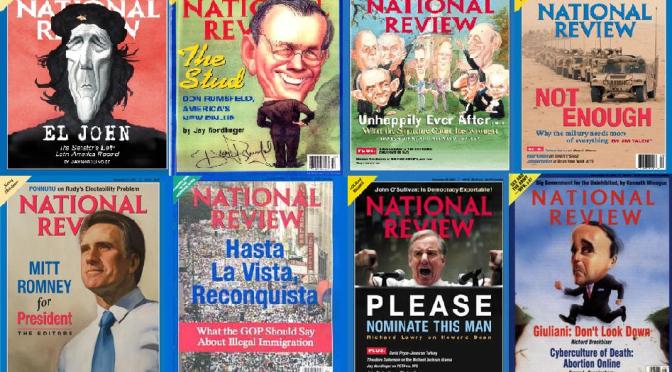
NATIONAL REVIEW MAGAZINE – DECEMBER 2026 PREVIEW

NATIONAL REVIEW: The latest issue features ‘LOOMING DISASTER’…

Bracing for Two Years of Trench Warfare

What to expect in the midterms’ wake. By Jim Geraghty

All other things being equal, Donald Trump would rather have a Republican-controlled House and Senate than Democrats in charge of either.

But if the Democrats win a majority in the U.S. House of Representatives in November — which appears likely as of this writing — it may not change the dynamics of this presidency much at all. Trump already acts as if the primary purpose of the House is to applaud during his State of the Union address, and that’s when he has a largely compliant and loyal Republican majority. He has always preferred to do things through executive orders. Passing legislation is arduous and time-consuming and often requires compromise.

The Democrats Are Coming

Start worrying now about 2028. By Charles C. W. Cooke

Can Susan Collins Part the Blue Wave?

The Maine Republican has surely benefited from turbulence on the Democratic side of the race. By Charles Hilu

How the West Won Teddy Roosevelt

What’s a presidential library doing in the North Dakota badlands? By Judson Berger

Medora, N.D. — Spend enough time in Medora, an Old West outpost that leans into a Theodore Roosevelt theme with the approximate restraint of a Cracker Barrel decorator, and you’re bound to encounter the quote: “I never would have been president if it had not been for my experiences in North Dakota.”