Donald Trump’s behavior cannot be called unexpected at this point. What was noteworthy last week, however, was the way that the media responded. By Jelani Cobb
My father dedicated his life to studying the Guna people of Panama, and they may soon allow unprecedented development through their land. I went on a trek through the jungle to find out why. By Ben Ryder Howe and Federico Rios
The week in technology, sorted · Signal · Money · Noise · The Long Wave
Sunday, September 27, 2026 · Issue No. 1
SIGNAL — WHAT WILL STILL MATTER IN FIVE YEARS
1
The virtual wall that watched people die
Over 25 years, the U.S. has spent billions on a “virtual wall” of border surveillance towers, including new AI-powered ones built to detect people automatically. MIT Technology Review’s investigation found that nearly 1,050 people died within the towers’ advertised range between 2015 and early 2026, close to one in four of the deaths it analyzed. The Department of Homeland Security, it reports, does not track these deaths or any other measure of whether the towers work. Two days later, Rep. Delia Ramirez (D-Ill.) proposed ending the program.
Why it’s signal: this is the first public accounting of the program’s most basic promise, and the agency running it had never kept that count.
2
A mouse whose cortex is human
At Stanford, Sergiu Pașca’s team bred mice that could not grow their own cortex. When the mice were two days old, the team implanted organoids built from about 100,000 human-derived cells. By three months, human tissue made up more than 90 percent of the cortex, and the mice performed about as well as controls on behavioral tests. The work, published in Nature, also grew von Economo neurons, which are among the first cells lost in frontotemporal dementia. That gives researchers a new way to study the disease.
Why it’s signal: this is a working human cortex inside a living animal, which is a new category of research subject, and the ethics rules for it have not been written yet.
3
Why women with power in tech aren’t famous for it
In “The Search for Silicon Valley’s Most Powerful Woman”, WIRED’s Lauren Goode starts from a paradox: women hold some of the most consequential jobs in technology, yet none has become a cult figure the way the industry’s male founders have. The story leads WIRED’s special issue on tech and gender. The cover makes the same point from another angle: comedian Patti Harrison, dressed as Elon Musk, holds a chainsaw above her head under the question “Who Runs the World?” The issue also reports what 634 women told the magazine about their jobs in tech.
Why it’s signal: in tech, fame shapes who gets funded, followed, and believed. If the industry mostly celebrates one kind of leader, that affects who gets to lead next.
FOLLOW THE MONEY — WHERE INVESTORS ARE BETTING
AI starts replacing enterprise software
Ema, which sells teams of “AI employees” that run multistep work in HR, IT, and finance, raised a $77 million Series B. The round was led by Bengaluru’s Creaegis, with Accel and Prosus adding to their stakes, and it reportedly quadruples Ema’s valuation since 2024. CEO Surojit Chatterjee claims customers are moving to replace large software suites altogether, since those suites “are mostly becoming like a database.” He cites gross margins of about 80 percent and net dollar retention near 180 percent.
Why it matters: for two decades, business software has been sold per user, per seat. Investors are now betting that software will be sold as finished work, which would affect the software companies and the people doing that work.
NOISE — LOUD THIS WEEK, NOT NEW
“God told them to sell crypto”
Denver pastor Eli Regalado and his wife Kaitlyn raised more than $3 million from over 500 investors for INDXcoin. The coin’s exchange collapsed within hours of launching. A judge ordered them to pay $3.4 million, and they now face 40 felony counts. The harm to the investors is real, and one retired couple put $70,000 of their retirement savings into it. We file it under Noise because the only new element is the blockchain. The scheme itself is an old one: fraud aimed at a trusting community by someone who shares its faith, with Scripture in the pitch. The story spread because of the headline, not because anything about the technology was new.
iC
THE LONG WAVE
This week, technology kept ahead of the systems meant to account for it. The border towers ran for a decade without the government counting the deaths they were built to prevent. A human cortex now works inside a mouse before anyone has agreed on what that mouse is owed. Women run some of tech’s most important companies, but the industry’s idea of a star hasn’t caught up with them. Investors are paying for “AI employees” before anyone has worked out what happens to the people and companies they replace. The engineering works in every case. What lags is the accounting: the rule, the measure, even the list of names.
THE QUESTION FOR THE WEEK
Pick a technology you use every day. Who, if anyone, is keeping count of what it costs?
Sourced this week from MIT Technology Review, WIRED, and TechCrunch.
THE LONDON MAGAZINE: Despair – its causes, symptoms and consequences – becomes something of a theme across the issue. At least according to its etymological root, to despair is to be without hope (de-sperare), and in Mavis Gallant’s 1965 story ‘Paola and Renata’, published in the issue, mothers have no hope of controlling their inscrutable, insolent daughters.
‘While it must be stressed that Rankine’s lyric practice is capacious and stylistically thrilling, that her insights are always valuable in isolation, I am left slightly unsure of what Triage’s greater intentions are.’
‘Partly due to critical neglect, partly due to the single-minded determination to be a poet who survived on nothing but his poetry, Harrison’s prose is doomed to be a footnote in his career.’
‘Might there be something, beyond backwater nihilism, in the vanishing of the Tree at Sycamore Gap that speaks to us about a country increasingly unable to protect its social and civic structures in the most basic ways?’
Nikole Hannah-Jones, creator of the “1619 Project,” recently scored rare bipartisan plaudits.
As Trump’s popularity plummets, House Democratic target emerges in red Indiana
Rep. Victoria Spartz (R-IN) should be coasting to reelection in the House district to which she was first elected in 2020, covering northern Indianapolis suburbs and part of central Indiana.
Instead, Spartz is facing what appears to be a surprisingly tough race against Democrat J.D. Ford, Indiana’s first openly gay state senator. It’s the kind of seat that can emerge on an out-party’s political target list in a wave election year with an unpopular president.
The European Commission president, Ursula von der Leyen, last week extended an unprecedented offer to Canada, inviting it to become the EU’s first “associate member”.
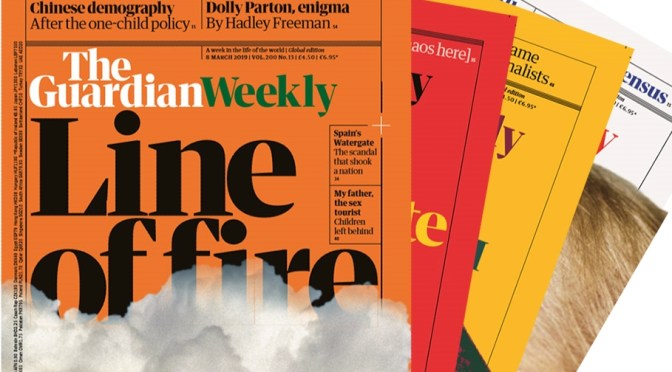
For our big story this week, Brussels correspondent Jennifer Rankin explores what the proposed alliance might mean. While there is a lot of common ground for the two parties, she writes, their agreement raises many questions and is clouded in uncertainty.
Meanwhile, senior correspondent Lisa O’Carroll examines the possible implications for the UK – asking whether it offers a blueprint for Britain, or a reminder it is out in the cold.
Then, former White House speechwriter Ted Widmer says Canadian prime minister Mark Carney’s remarks before the European parliament set out what a new west might look like, without its most powerful member – the US.
Spotlight| Yemeni families’ flight Fierce fighting has forced people to abandon their homes, leaving everything behind to seek shelter in refugee camps. Nasser Al-Sakkaf reports from Taiz
Science| ‘A map is never neutral’ The cartographers who took on centuries of western bias with the new Equal Earth projection speak to Oliver Holmes,Ana Lucía González Paz and Pablo Gutiérrez about their alternative to the 16th-century Mercator display
Feature| How to fight end times fascism An unholy alliance is working toward an apocalyptic future from which only a chosen few will emerge unscathed. It’s becoming clear how we stop them, say Naomi Klein and Astra Taylor
Opinion| This Israeli election could be the country’s last Spend time on the ground and you see how high the stakes are for next month’s contest – for Israelis and Palestinians alike, writes Jonathan Freedland
Culture| Present and correct Author Jonathan Franzen talks to Sophie McBain about a new TV adaptation of his bestseller The Corrections, the future of reading and why creating new work is “horrible”