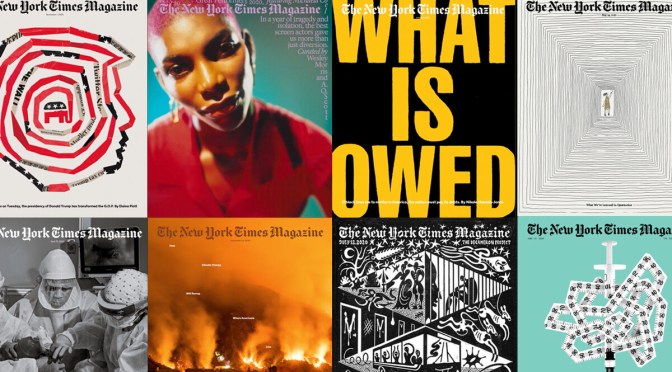
Since taking up his post in Paris, Kushner has become known for lobbing provocations onto France’s domestic scene at sensitive moments. As he put it, “Nobody has the courage to say what I say.” By Lauren Collins
Donald Trump has tried to purge voter rolls nationwide. Deidre Henderson, the Republican lieutenant governor of Utah, is among the chief election officers standing in his way. By Barton Gellman
THE NEW YORK TIMES MAGAZINE: The 10.25.26 Issue Michael Steinberger on how California’s ultrarich are fighting against the world’s first billionaire tax; Charles Homans on who runs the Democratic party; Matthew Shaer on the director Sterlin Harjo; and more.
Gina Hinojosa, the Democratic nominee for governor, on her appeal to MAGA voters and her refusal to engage in the “culture wars.” By Lulu Garcia-Navarro
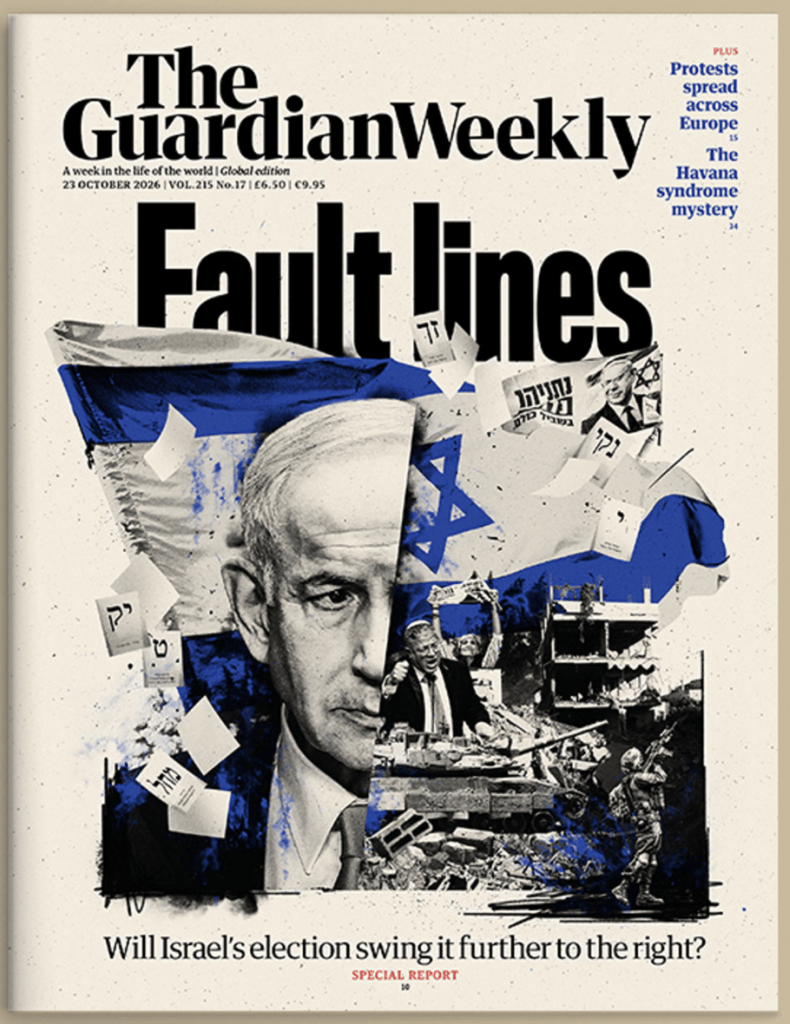
Israel is holding national elections next week, giving its citizens their first chance to pass judgment on Benjamin Netanyahu and his coalition since the Hamas-led attacks of 7 October 2023.
For our big story this week, chief Middle East correspondent Emma Graham-Harrison says that whether or not the prime minister can hold on to power, a more rightwing Knesset is expected to be voted in. More than half a million Israelis have reached voting age since the last election in 2022 and, according to polls, three-quarters of first-time Jewish voters define themselves as right or centre-right.
Peter Beaumont profiles opposition candidate Gadi Eisenkot. The former general contrasts with Netanyahu when it comes to style and character, he writes, yet on key policy points retains a studied ambiguity.
Then Israeli pollster and political analyst Dahlia Scheindlin argues that after three disastrous years, Israel needs to rethink itself, but only a clear opposition victory would let the country begin to heal, strengthen democracy and establish Palestinian rights.
Spotlight| ‘We are suffocating’ As protests that have convulsed Spain and France in recent weeks spill over to Italy and Portugal, Sam Jones reports on the rising wave of anger over the housing crisis and cost of living
Science| Taking a shot Could a drug to prevent shingles also protect our brains against dementia? The possibility, writes Ian Sample, is driving a boom in vaccinations
Feature| The Havana syndrome mystery Dozens of CIA officers have been afflicted by debilitating symptoms over the past decade. Are they the result of “mass hysteria” or are they from attacks with an energy weapon, asks Shaun Walker
Opinion| Another EU referendum? Not just yet The omertà on the UK rejoining has now been broken, but it would be folly to move too soon, says Polly Toynbee
Culture| Shygirl’s slog to the top She has opened for Beyoncé, writhed in a cubicle for Madonna – and is poised to take over the mainstream with her new rock sound. The pop auteur talks to Simran Hans about cash, class – and finding true love
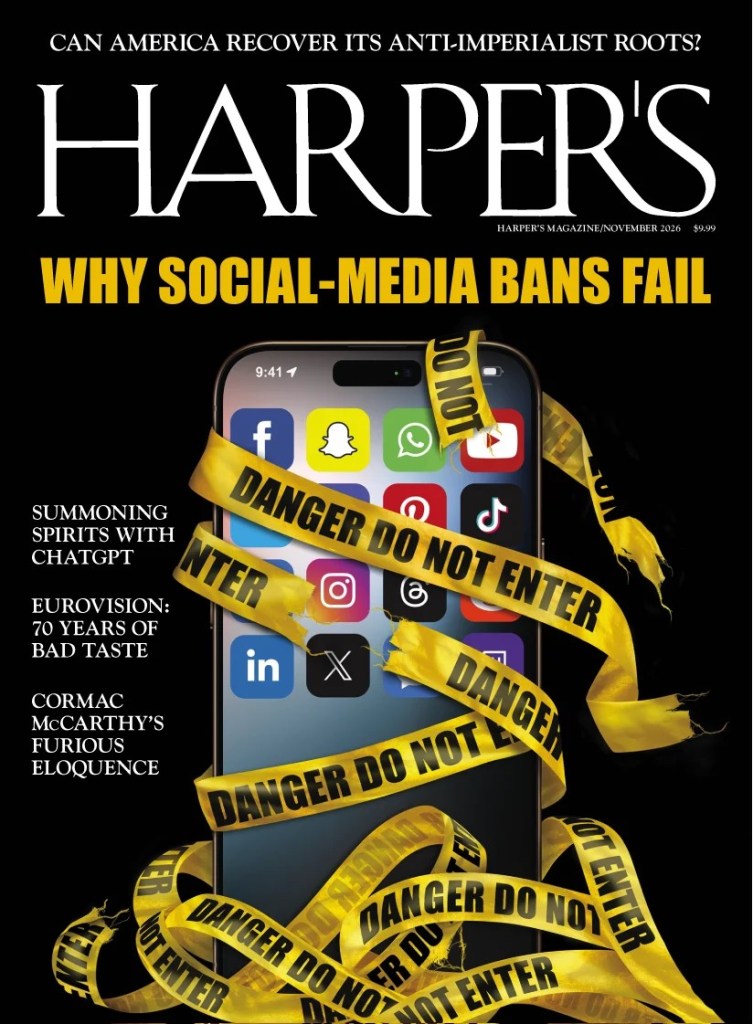
HARPER’S MAGAZINE: The latest issue features ‘WHY SOCIAL MEDIA BANS FAIL’, contemporary regulatory, ideological, and cultural shifts by featuring Oscar Schwartz’s investigative report on the making of Australia’s social-media restrictions, Jackson Lears’s historical essay advocating for a return to the nation’s foundational anti-imperialist principles, Sam Kestenbaum’s miscellany piece examining the intersection of artificial intelligence and spirituality at the dawn of a large language model New Age, a retrospective commemorating seventy years of bad taste at the Eurovision Song Contest, and a critical evaluation of Cormac McCarthy’s furious eloquence.
The making of Australia’s social-media ban by Oscar Schwartz
When I arrived last September at Northcote High, a public school perched on the grassy banks of Melbourne’s Merri Creek, I was surprised by how little had changed in the twenty years since I’d graduated from a high school nearby. The scene was intensely familiar: The girls with their long ponytails, hunched together in tight semicircles of avid conversation. The boys with their pimply faces, kicking balls or slouching against redbrick walls, their hands thrust deep into their pockets. The occasional shrieks, the awkward glances, the sexual frustration, the dim threat of violence—it was all the same.
Recovering America’s anti-imperialist roots by Jackson Lears
For many of the Founders of the American republic, the worst fate imaginable for the state they were envisioning was for it to become an empire. Republics and empires were fundamentally incompatible, they believed. Opposition to empire, in fact, was the keystone of their thought—but one would never know that from the hoopla surrounding America’s two-hundred-fiftieth birthday. The occasion provides an opportunity to celebrate the Founders’ ingenuity in fashioning a system of checks and balances and their audacity in claiming a universal right to “life, liberty, and the pursuit of happiness” in 1776—as well as to condemn their hypocrisy, especially with regard to racial equality. But in all the tumult of commemoration, rarely, if at all, have we heard of the Founders’ anti-imperialism.
Onstage before us is a man dressed in baggy raver pants, his blond hair slicked back. He has just sauntered in, waving, smiling, greeting the crowd of several hundred, and now stands in front of a dark-purple curtain that undulates in the air-conditioning. He settles into his seat and prepares to address the topic of today’s panel: artificial intelligence and the future of humanity.
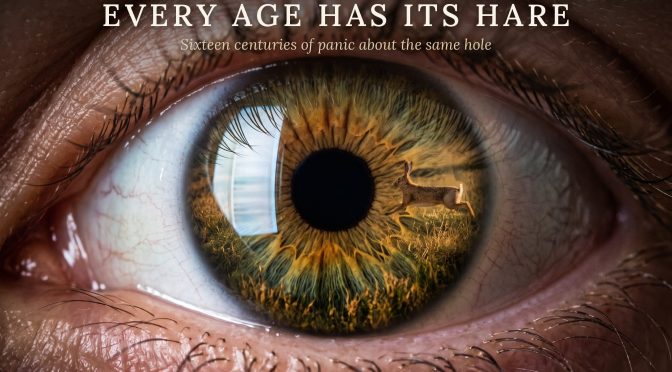
Put your phone face down and read to the end of this paragraph without touching it. Sixteen centuries ago a bishop in North Africa confessed that a dog chasing a hare across a field had turned him from some great thought. This month Scientific American asked how we get sober from the feed in our pockets. Every age has panicked about its hare, and no panic has ended in sobriety.
A hare in the field of an eye, running for the pupil, made for the essay.
WHY WE’RE POINTING YOU THERE
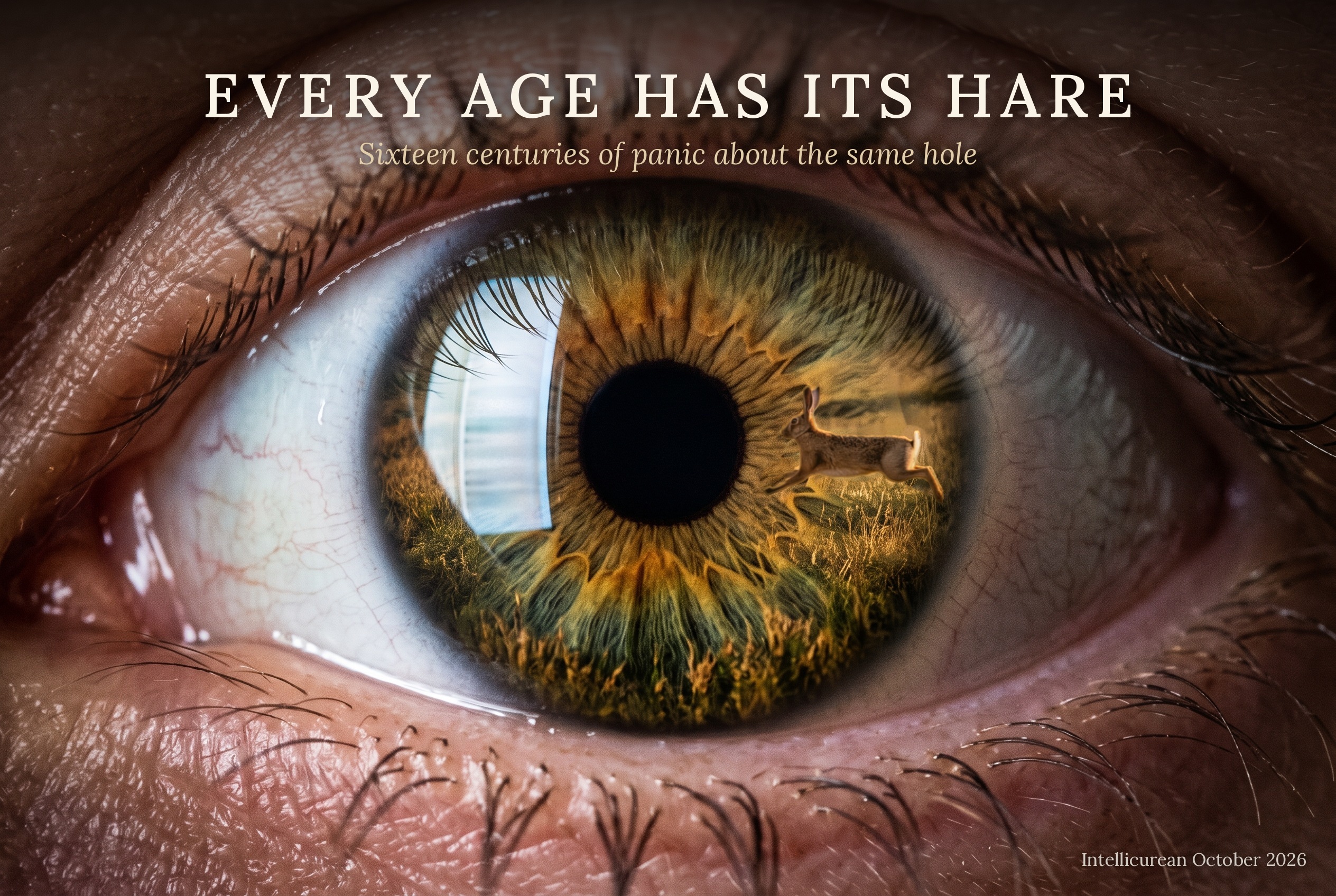
This month Scientific American asked whether we are addicted to social media and how we might get sober. Intellicurean’s essay answers by going back to the start of the complaint. It opens at the Roman games, on a young man who swore he would keep his eyes shut and was undone by the roar of the crowd. Then it follows the same hole through the centuries: a girl drowned in the river at Weimar in 1778, and the town blamed Goethe’s novel; London’s coffee houses, which a king tried to close and gave up on in eleven days; Dostoevsky at the roulette wheel, and the first slot machine; New York’s thirty-four-year ban on pinball; and a test account on TikTok that never searched for anything and was fitted to sadness in a little over half an hour.
It finds every earlier panic right about a few people and wrong about the many, and it finds the hole as old as the eye. What is new, it argues, is not the hole. It doesn’t scold anyone for their screen time, and it doesn’t pretend history hands us an easy answer.
The old holes became the floor. The new one is in the hand. Made for the essay.
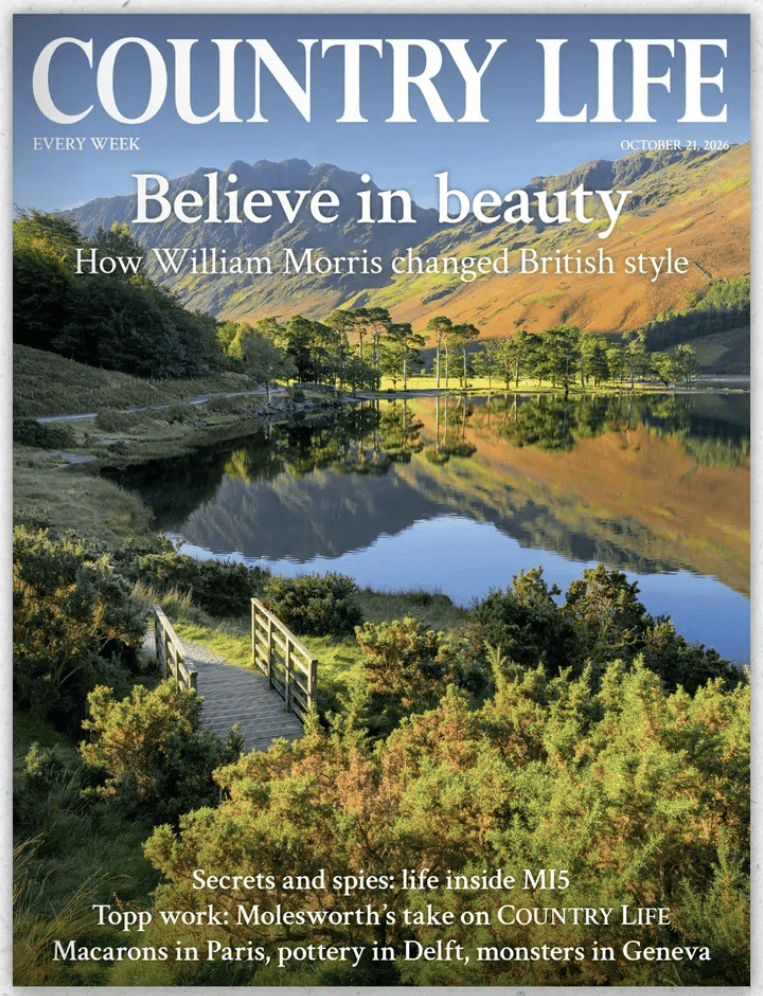
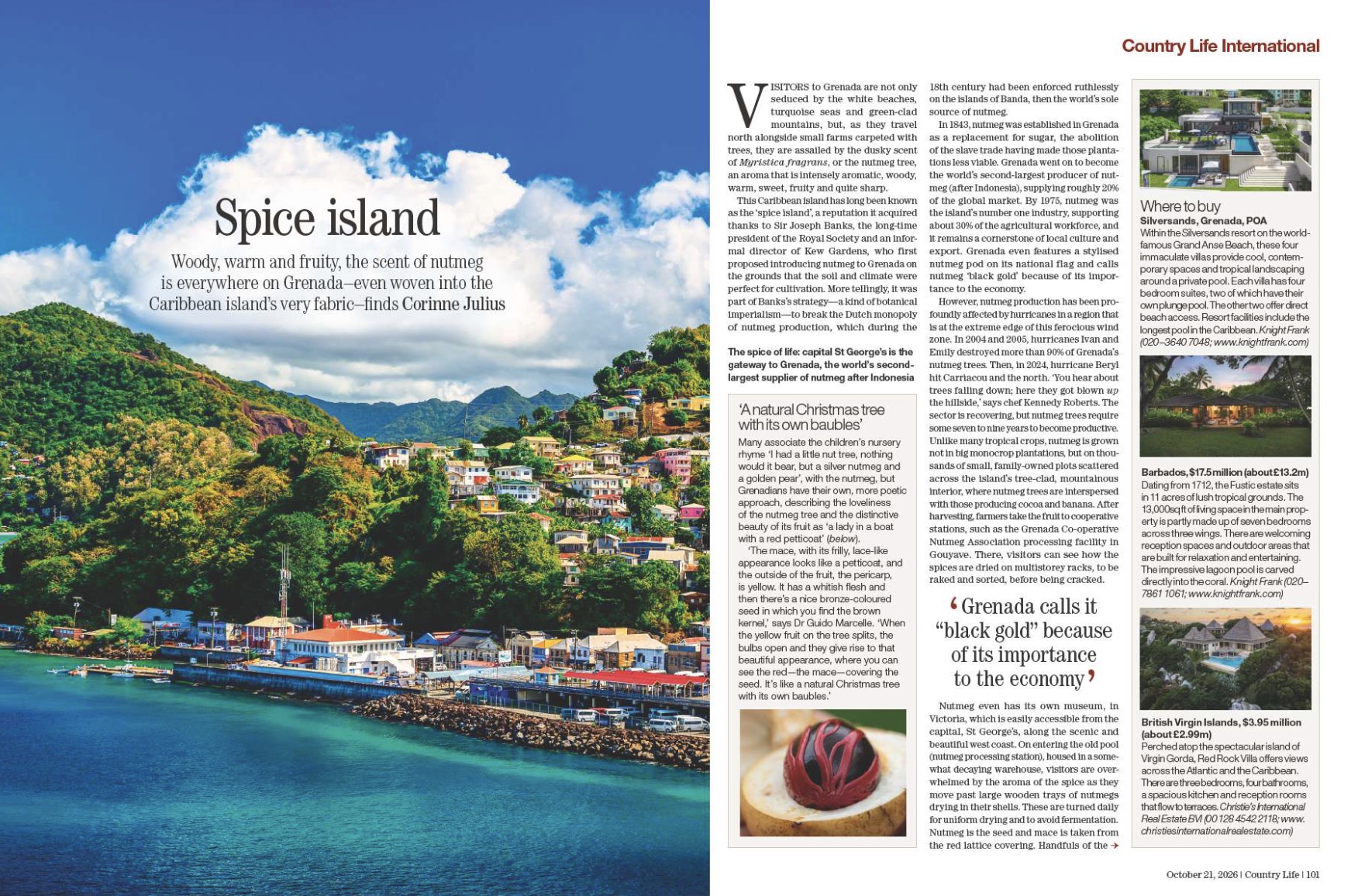
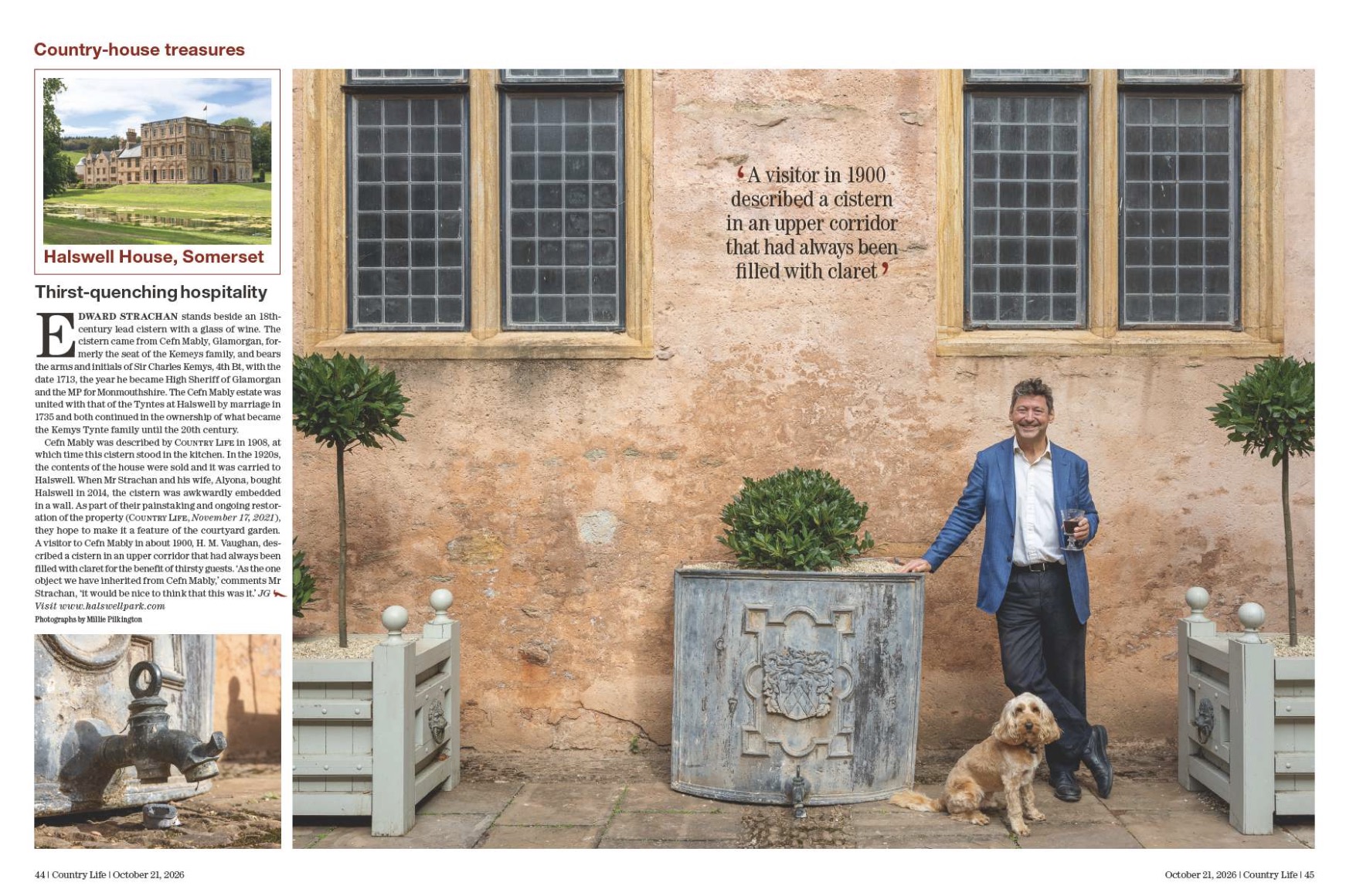
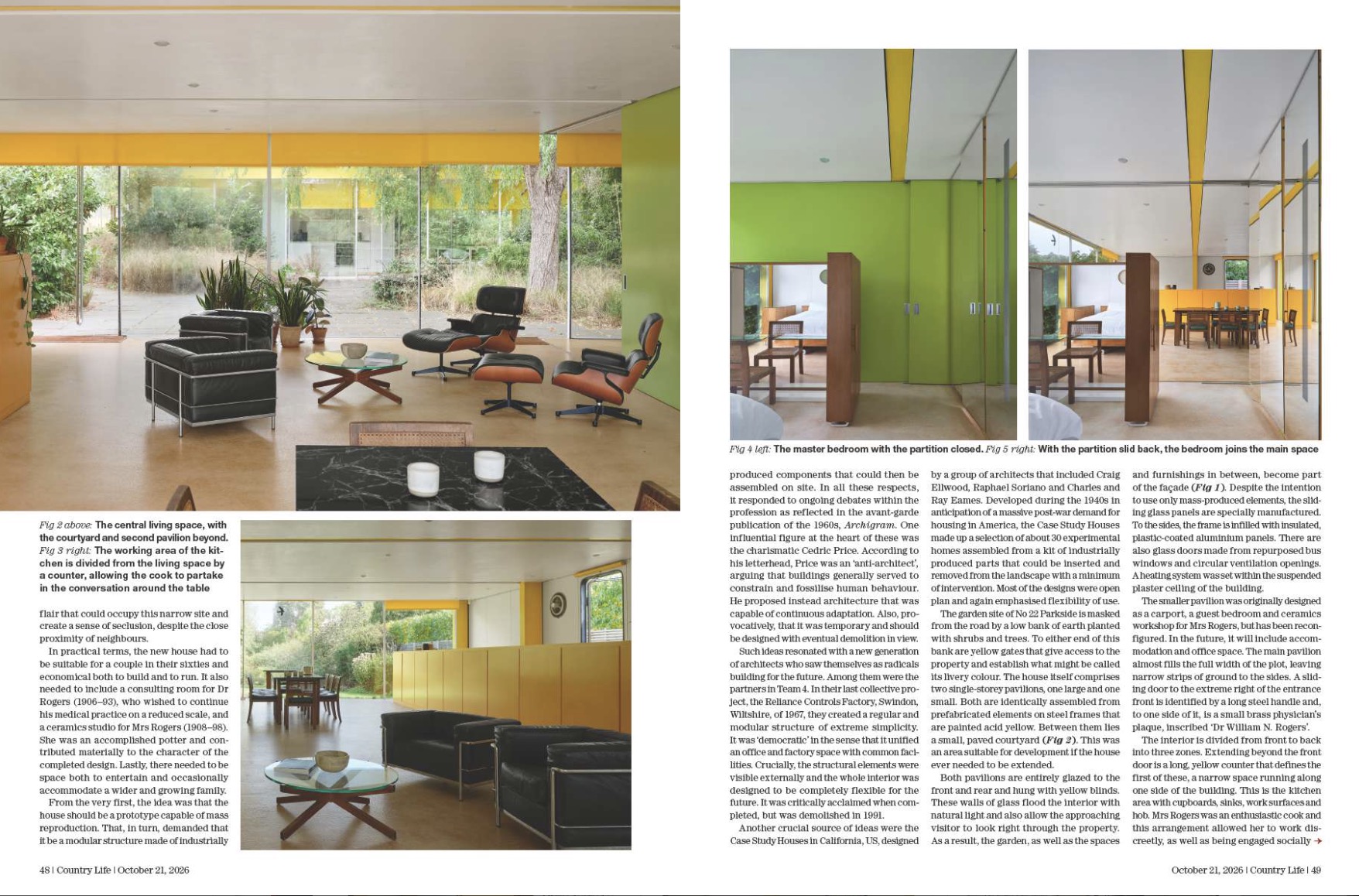
COUNTRY LIFE MAGAZINE: The latest issue features a diverse array of articles, including Emma Hughes’s tribute to Ronald Searle, a unique leader piece by Nigel Molesworth, and a dive into MI5’s secret archives, alongside international travel and luxury features, an analysis of William Morris, structural and artistic highlights like No 22 Parkside and Elizabeth Lady Templetown’s Wedgwood designs, and practical guides on country-house history, interior lighting, seasonal fashion, and culinary traditions.
The legacy
Emma Hughes hails Ronald Searle, creator of Molesworth, the Curse of St Custard’s ; plus in the leader article, Nigel Molesworth shares his observations on Country Life in his own inimitable style
Can you keep a secret?
A new book on MI5’s archives reveals a world of subterfuge and untold stories for Emma Hughes
Country LifeInternational
Julie Harding visits the historic Delft factory, Harry Pearson samples the best of Parisian macarons and confronts the monsters of Lake Geneva, Claire Jackson tunes up for the Concours de Genève, Corinne Julius finds the spice of life in Grenada and Holly Kirkwood highlights top properties for sale in sun-loving cities
A man of contradictions
A new exhibition examines the complex character of designer William Morris, reports Mary Miers
James Peill’s favourite painting
The Garter King of Arms picks the portrait of a man of means
Country-house treasure
John Goodall toasts the thirst-quenching cistern in residence at Halswell House in Somerset
Rule the roast
Who first cooked up our famous Sunday lunch, asks David Ellis
Luxury
Justine Picardie admires the hum-orous style of Elsa Schiaparelli and Amie Elizabeth White seeks shades of suede for autumn
High-tech as history
John Goodall tours the yellow, Modernist masterpiece No 22 Parkside in London, recently acquired by the National Trust
Interiors
Arabella Youens takes a shine to warm lighting in a utility room and Amelia Thorpe eyes lovely lamps
Weaving dreams
Tilly Ware meets the designer of the mesmerising perennial meadow at Shillies Barn, Suffolk
She sells sea salt by the seashore
Jane Wheatley visits Halen Môn on Anglesey and finds a thriving family empire well worth its salt
Countryside mysteries
Broomrape, toothwort and other such parasitic plants catch the ever-curious eye of John Wright
Travel
Richard MacKichan sails the Indonesian Flores Sea in style
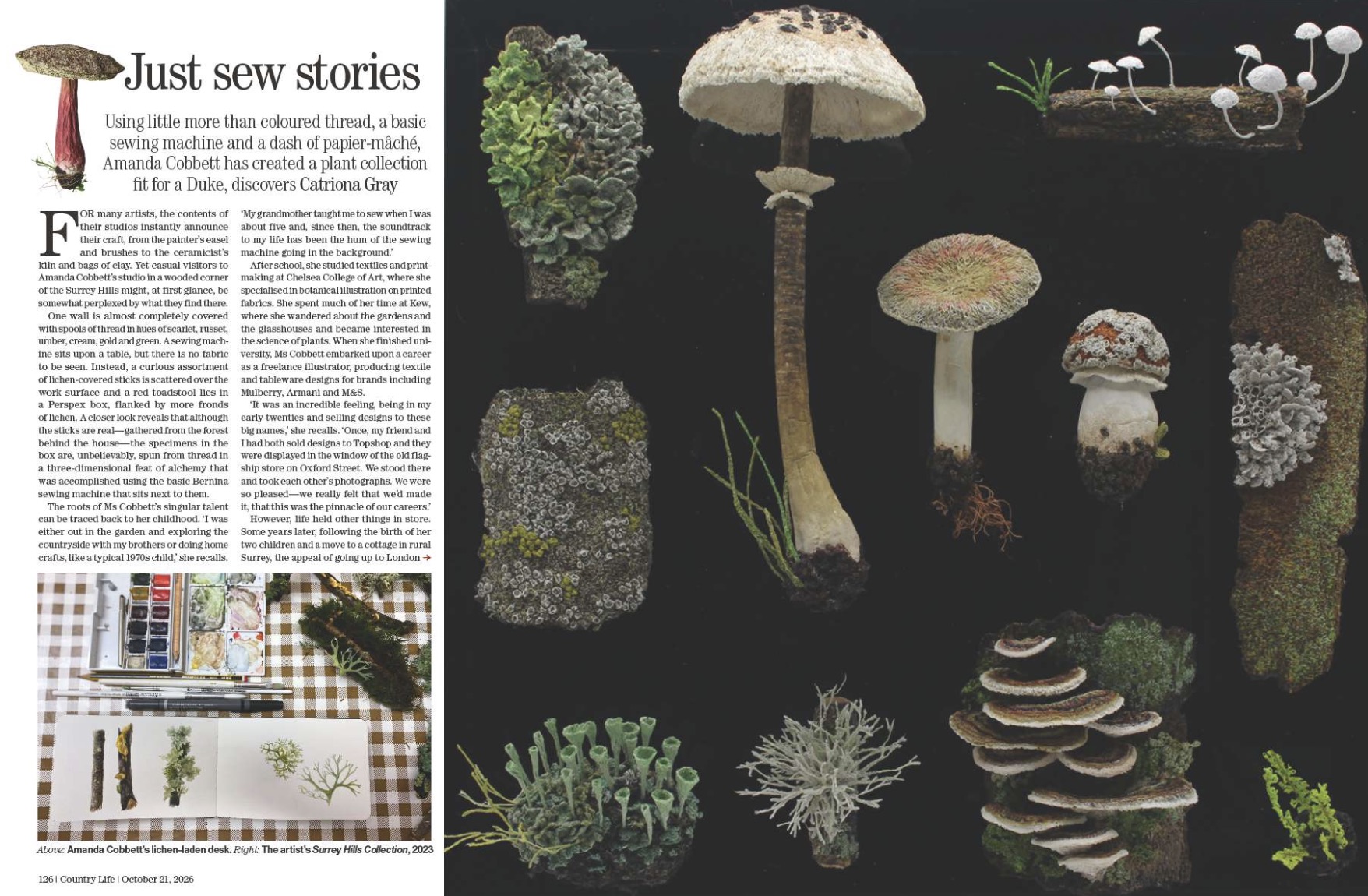
Just sew stories
The fungi and lichen of the Surrey Hills are the source of artistic inspiration for Amanda Cobbett, as she explains to Catriona Gray
Arts & antiques
Carla Passino explores how the charming designs of Elizabeth, Lady Templetown helped her become the darling of Wedgwood
Setting the standard
James Graham serves up the best new play of the year as Michael Billington applauds a star-studded stage offering
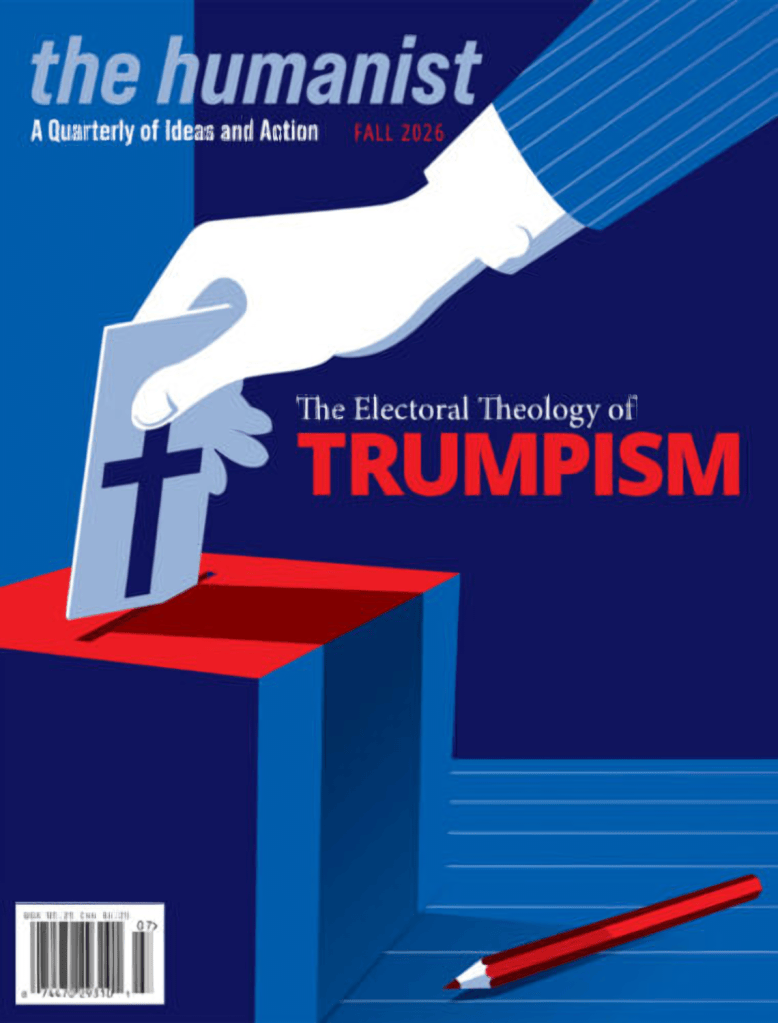
How White Evangelical Voters Made Trump’s Victory Possible—and Helped Legitimize Government by Certainty by Gordon Gamm
Donald Trump’s 2024 victory depended heavily on White evangelical or born-again Christian voters. National exit polling estimated that they constituted approximately 23 percent of voters and supported Trump over Kamala Harris by 82 percent to 17 percent.¹ Trump won the national popular vote by only about 1.5 percentage points—49.81 percent to Harris’s 48.34 percent.²
At the foot of burning Mount Doom, Samwise the gardener kneels beside his friend, Frodo, who can no longer walk. Frodo has been carrying a great weight– the One Ruling Ring, which grows heavier with every step. As Sam watches his friend press onward at a crawl, he knows he…
This piece was awarded first place in the Humanists of Greater Portland’s annual essay contest for high school seniors seeking funding for post-high school education. Every day reminds me how much we rely on tiny lines…
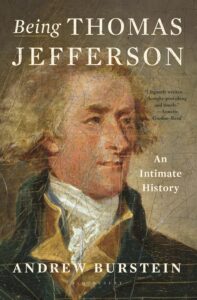
An Intimate Look at the Life of Thomas Jefferson in This Anniversary Year
“Being Thomas Jefferson: An Intimate History”by Andrew Burstein
Over a long life encompassed by countless books while a student, professor or a researcher, it is only “once in a blue moon,” this reviewer encountered a magnificent book. One such is Andrew Burstein’s latest, “Being Thomas Jefferson: An Intimate History.” I can only sing praises of this monograph. I had difficulty putting it down. This poignant book is a must read for those wishing to learn more about the author of several significant achievements that still ring the cause of freedom in the United States of America. Particularly in this 250th anniversary year of Jefferson’s Declaration of Independence, “well-armed with pulsating phrases,” one should spend time getting reacquainted with this man of particular talent and devotion to the cause of liberty. It is also the 200th anniversary of Jefferson’s death. Between these two anniversaries lie a testament to greatness, and devotion to his country. There are numerous history book offerings in this anniversary year, but surely this book stands apart from many others.
They power our phones, cars, dishwashers—and the A.I. systems that prop up the economy. They’re also at the heart of fierce geopolitical rivalry. By Gideon Lewis-Kraus
Alarm about declining interest in books is perpetual. But, as bookselling reaches unexpected heights, James Daunt, the chief executive of Barnes & Noble, thinks a different future is at hand. By Nathan Heller
The cases of Christa Pike and Nidal Hasan show how vanishingly fine the line is between a routine execution and an unbearable one. By Amy Davidson Sorkin
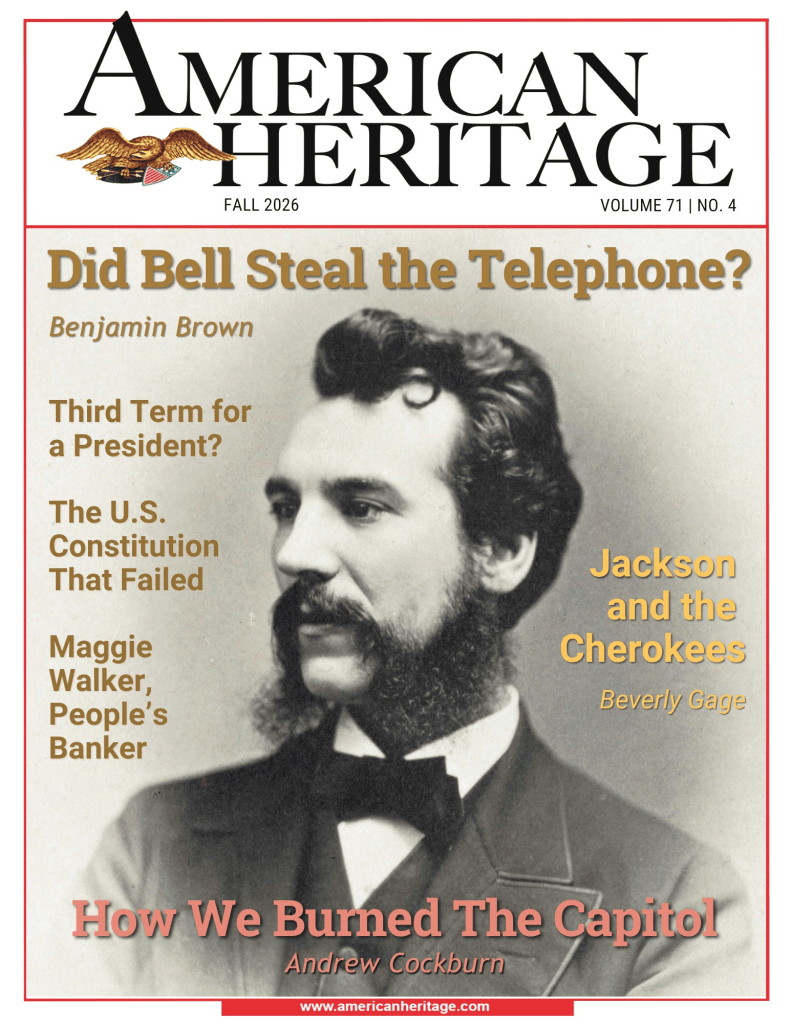
AMERICAN HERITAGE MAGAZINE: The Fall 2026 issue of American Heritage magazine features articles that address historic debates and legacies, including new evidence regarding whether Alexander Graham Bell stole the telephone patent from Elisha Gray, an ancestor’s account of Admiral Cockburn burning Washington while freeing 6,000 slaves, a guide to Southeast historic sites evaluating the complex democratic and brutal legacy of Andrew Jackson, an analysis of perceived ambiguities in the 22nd Amendment regarding presidential term limits, and the story of Maggie Walker, the first Black woman to open a bank to help underserved individuals.
New evidence finally settles the 150-year-old debate as to whether Alexander Graham Bell or Elisha Gray first invented the telephone. Benjamin Lathrop Brown
Museums and historic sites across the Southeast help us better understand Andrew Jackson, who helped define American democracy but also championed the brutal treatment of indigenous peoples. Beverly Gage
Maggie Walker, the first Black woman to open a bank, helped thousands of individuals who could not borrow from traditional lenders. Norah O’Donnell, Kate Brower Andersen
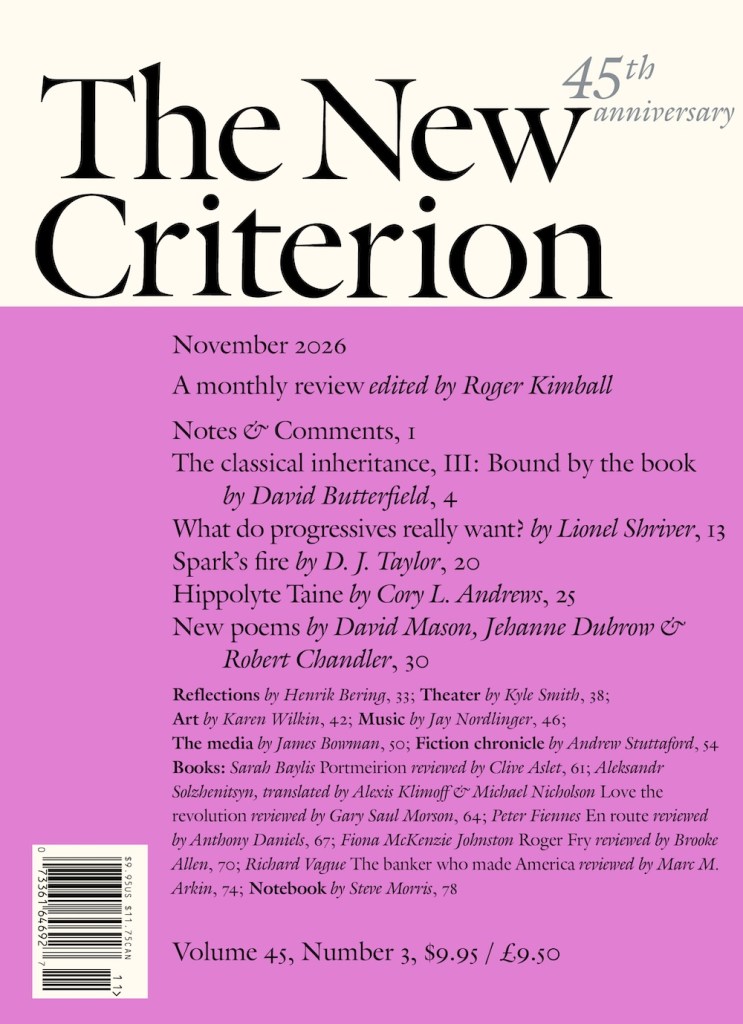
THE NEW CRITERION:The November 2026 issue, edited by Roger Kimball, features major pieces including “Notes & Comments,” David Butterfield’s “The classical inheritance, III: Bound by the book,” Lionel Shriver’s “What do progressives really want?,” D. J. Taylor’s “Spark’s fire,” Cory L. Andrews’s “Hippolyte Taine,” and a collection of “New poems” by David Mason, Jehanne Dubrow, and Robert Chandler, alongside dedicated columns covering reflections, theater, art, music, media, fiction, book reviews, and a notebook segment.
Bound by the book by David Butterfield
What do progressives really want? by Lionel Shriver
Spark’s fire by D. J. Taylor
Hippolyte Taine & the haunting persistence of history by Cory L. Andrews
News, Views and Reviews For The Intellectually Curious