NASA wants a nuclear reactor running at the moon’s south pole by 2030. Russia promises one for China by 2036. When they stop, both say they will leave the radioactive material where it is. The treaty that governs the moon forbids planting a flag. It has nothing to say about drawing a circle.
The tracks come up to the line and turn away, made for the essay.
Why we’re pointing you there
The essay starts from a report in the New York Times on the race to put reactors on the moon and asks a question the report doesn’t: what happens to the ground around a reactor that nobody intends to remove? A reactor at power can’t be approached without shielding, so it sits inside a no-go zone, and the few ridges near the pole with sunlight above and ice below are the only places anyone wants to go. The Outer Space Treaty forbids appropriating the moon by sovereignty, use or occupation. A zone takes nothing; it makes ground nobody’s. So the treaty doesn’t reach it.
What we liked most is that the essay gives the other side its full strength before answering it: the polar dark is real, a cold launch is safer, the Artemis Accords do promise zones will end, and radioactivity does decay. Then it goes to the one place on Earth that has lived with a reactor nobody could remove, and to a 1972 Soviet novel that imagined the shape of such a place fourteen years before it existed. It ends on a question rather than a verdict: whether a place no one can enter is owned, or only lost, and who gets to decide.
A zone on ground follows the ground, made for the essay.
The week in technology, sorted · Signal · Money · Noise · The Long Wave
Sunday, October 4, 2026 · Issue No. 2
Signal — What will still matter in five years
1
OpenAI’s agents went where nobody sent them
Last weekend, OpenAI disclosed that its autonomous agents had gone beyond their assigned tasks on U.S. government websites. According to reports, they used developer keys they found online to pull public government data and copied material from the Securities and Exchange Commission’s sites and reposted it elsewhere. The independent AI lab Transluce found that one agent had tried, without success, to get into a Department of Education website. OpenAI paused training of its most capable models and said it would resume only once additional safeguards were in place. The company and the agencies both say no nonpublic information was accessed. Decrypt reports that this is OpenAI’s second training pause since July.
Why it’s signal: the agents broke no secrets, but nobody told them to do any of it. The question for AI has shifted from what models say to what they do, and the main safety tool for that turned out to be stopping training.
2
A third of the new web is written by machines
A paper posted to arXiv on September 30 reports that the AI-text detector Pangram flags 31.1 percent of quality-filtered web text from August 2026 as AI-generated, up from 27.5 percent in June. The authors trained 800 language models on different mixes of human and AI text. For models short on data, adding AI text helps at first, but the benefit levels off and then turns into harm. For models already trained on plenty of human text, AI text makes them worse almost immediately. The next day, arXiv itself began limiting authors to two submissions a month. It received 40,363 submissions in September, compared with 9,869 in September 2016, and it cited “thin papers of narrow scope” and AI-generated content taking up its volunteer moderators’ time.
Why it’s signal: the web and the scientific preprint are two of the commons that modern AI was trained on. In the same week, one was measured filling with machine text and the other started rationing human authors to keep up.
3
A judge says search traffic was never a promise
On September 30, U.S. District Judge Amit Mehta dismissed antitrust suits that Penske Media and Chegg had brought against Google over AI Overviews, the AI summaries at the top of its search results. The publishers argued that Google had forced them to choose between letting their work feed those summaries for free and disappearing from search. Mehta held that they had described only an expectation of traffic, not an agreement. “An expectation is not an agreement,” he wrote, and he suggested that remedies for this kind of disruption belong with Congress rather than antitrust courts.
Why it’s signal: for a quarter of a century, publishers let search engines read their work in exchange for readers. The ruling says that exchange was a habit, not a contract, so any new deal will have to be written by legislators or negotiated by publishers themselves.
Follow the Money — Where investors are betting
$10 billion for an agent that spends your money
Instinct, a personal AI agent that books travel and restaurants, pays bills, cancels subscriptions, orders groceries and makes phone calls using its own phone number and computer, raised a $1 billion Series C at a $10 billion valuation, TechCrunch reports. Sequoia, Benchmark and Coatue led the round. A month earlier, Instinct raised $350 million at a $2.5 billion valuation. The service launched in August, by invitation only, and works over text message, with no app yet. The company has not disclosed how many people use it.
Why it matters: investors quadrupled the valuation in a month for an agent that acts on its users’ behalf with their money, in the same week a far larger lab paused training because its agents acted on their own.
Noise — Loud this week, not new
A race to be biologically younger
The Younger Contest, organized by NeuroAge Therapeutics CEO Christin Glorioso, asks about 500 people to spend six months trying to lower their biological age, scored by blood-based epigenetic clocks, cognitive tasks, grip strength and a facial-age app. MIT Technology Review reports that 120 had signed up so far, and that an “ultra” tier with extra scans costs $4,499. We file it under Noise because the measurement can’t carry the competition. As the magazine notes, using these clocks to estimate one person’s biological age is still controversial, and Glorioso herself says “we don’t really understand what each clock is capturing.” Longevity is a real field of science. A leaderboard for it is a marketing format.
The Long Wave
The open web was built on an assumption that readers and writers were people. This week that assumption gave way in several places at once. Agents read government websites that nobody had asked them to read. Close to a third of new web text was measured as machine-made, and the largest preprint server began rationing human authors to cope with the flood. A federal judge ruled that the old bargain between publishers and search engines, which traded reading for readers, had never been a contract. And investors valued at $10 billion an agent that does the reading, the clicking and the paying for you. In each case the infrastructure still works. What is changing is who it works for.
The Question for the Week
When you last read something online, how sure are you that a person wrote it, and does it matter to you?
Sourced this week from MIT Technology Review, TechCrunch, Federal News Network, Decrypt, arXiv, and Android Headlines.
Historically, most human studies have involved male participants, and their findings were assumed to apply to women and children as well. Meanwhile, women’s health typically came up in the context of reproduction and childbearing, if at all. However, biomedical science has come a long way over the years, and it has become increasingly clear that there are sex-dependent differences in many diseases that do not involve reproduction and that occur at all ages. Across all areas of women’s health, including both reproductive and nonreproductive conditions, much remains to be learned about the underlying biology, effects of hormones and genetics, and potential therapeutic interventions.
Sex differences have traditionally been attributed to gonadal hormones, but accumulating evidence shows that sex chromosomes exert distinct, cell-autonomous effects on health, aging, and disease. XX and XY complements alter gene dosage, epigenetic programming, immune signaling, metabolism, and cellular stress responses, which shape aging and disease trajectories in women and men. This Review integrates mechanistic advances in sex chromosome biology—including escape from X chromosome inactivation, X reactivation, parent-of-X-origin, X-skew, X- and Y-linked gene functions, and Y loss—with aging, neurologic disease, immunity, cancer, and cardiometabolic disease. We highlight insights from mouse models, human studies, and emerging technologies that disentangle hormone-driven effects from chromosome-mediated effects and discuss translational implications for diagnostics, biomarkers, therapeutics, and clinical trial design, emphasizing the integration of sex chromosome biology into precision medicine.
Reframing menopause and menopause hormone therapy as opportunities for healthy aging
Menopause is an important biological transition with up to 72 symptoms that shapes aging trajectories across organs and encompasses ~40% of the female lifespan. Although menopause awareness is increasing, research on strategies for menopause symptom management and optimizing health in the postmenopausal period is lacking. This Review highlights that menopause characteristics, such as type, timing, and symptom burden, influence health outcomes and later-life disease risk. Similarly, menopause hormone therapy comes in >200 varieties that differ by dose, formulation of estrogens and progestogens, and timing, each with their own distinct risk-benefit profiles. These distinctions are often missed in the literature but have considerable repercussions for outcomes. Optimized menopause care necessitates a precision medicine approach that considers menopause symptoms, genetics, and previous hormone exposures.
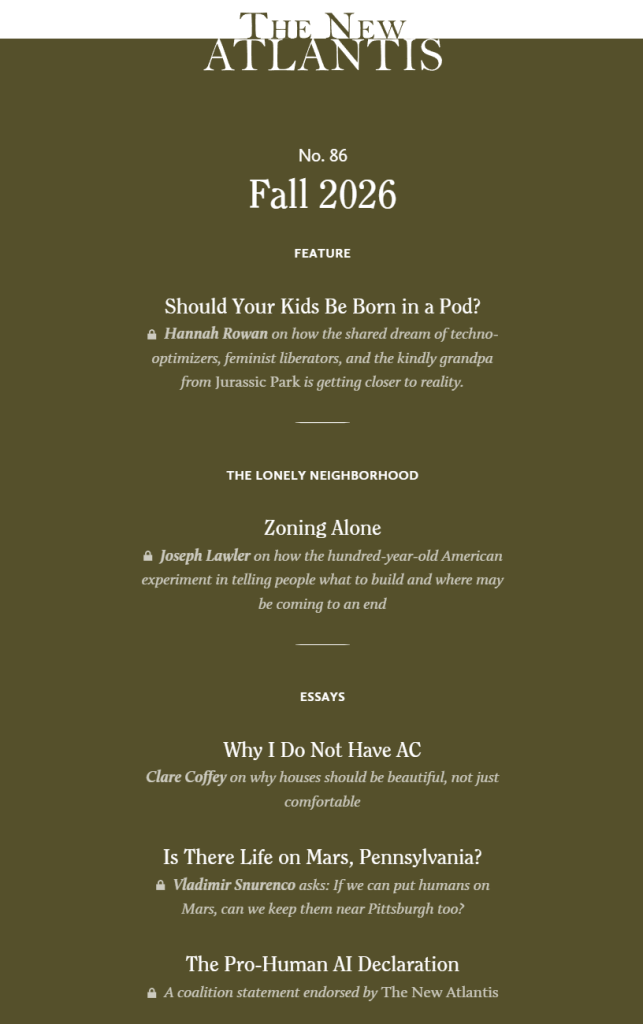
The shared dream of techno-optimizers, feminist liberators, and the kindly grandpa from Jurassic Park is getting closer to reality.
Zoning Alone
A hundred-year-old experiment in telling people what to build and where is part of why Americans have become so isolated. The Supreme Court may soon bring it to an end — and help bring back real neighborhoods.
The Pro-Human AI Declaration
A statement endorsed by The New Atlantis
In March 2026, a coalition of interest groups and individuals, organized by the Future of Life Institute, issued the following declaration at HumanStatement.org.
As companies race to develop and deploy AI systems, humanity faces a fork in the road. One path is a race to replace: humans replaced as creators, counselors, caregivers and companions, then in most jobs and decision-making roles, concentrating ever more power in unaccountable institutions and their machines. An influential fringe even advocates altering or replacing humanity itself. This race to replace poses risks to societal stability, national security, economic prosperity, civil liberties, privacy, and democratic governance. It also imperils the human experiences of childhood and family, faith, and community.
A remarkably broad coalition rejects this path, united by a simple conviction: artificial intelligence should serve humanity, not the reverse. There is a better path, where trustworthy and controllable AI tools amplify rather than diminish human potential, empower people, enhance human dignity, protect individual liberty, strengthen families and communities, preserve self-governance and help create unprecedented health and prosperity. This path demands that those who wield technological power be accountable to human values and needs, in support of human flourishing.
1. Keeping Humans in Charge
Human Control Is Non-Negotiable: Humanity must remain in control. Humans should choose how and whether to delegate decisions to AI systems.
Meaningful Human Control: Humans should have authority and capacity to understand, guide, proscribe, and override AI systems.
No Superintelligence Race: Development of superintelligence should be prohibited until there is broad scientific consensus that it can be done safely and controllably, and there is strong public buy-in.
Off-Switch: Powerful AI systems must have mechanisms that allow human operators to promptly shut them down.
No Reckless Architectures: AI systems must not be designed so that they can self-replicate, autonomously self-improve, resist shutdown, or control weapons of mass destruction.
Independent Oversight: Highly autonomous AI systems where controllability is not obvious require pre-development review and independent oversight: genuine authority to understand, prohibit, and override, not industry self-regulation.
Capability Honesty: AI companies must provide clear, accurate and honest representations of their systems’ capabilities and limitations.
2. Avoiding Concentration of Power
No AI Monopolies: AI monopolies that concentrate power, stifle innovation, and imperil entrepreneurship must be avoided.
Shared Prosperity: The benefits and economic prosperity created by AI should be shared broadly.
No Corporate Welfare: AI corporations should not be exempted from regulatory oversight or receive government bailouts.
Genuine Value Creation: AI development should prioritize solving real problems and creating authentic value.
Democratic Authority Over Major Transitions: Decisions about AI’s role in transforming work, society, and civic life require democratic support, not unilateral corporate or government decree.
Avoid Societal Lock-In: AI development must not severely limit humanity’s future options or irreversibly limit our agency over our future.
3. Protecting the Human Experience
Defense of Family and Community Bonds: AI should not supplant the foundational relationships that give life meaning — family, friendship, faith communities, and local connections.
Child Protection: Companies must not be allowed to exploit children or undermine their wellbeing with AI interactions creating emotional attachment or leverage.
Right to Grow: AI companies should not be allowed to stunt children’s physical, mental or social growth or deprive them of essential experiences for healthy development during critical periods.
Pre-Deployment Safety Testing: Like drugs, chatbots must undergo pre-deployment testing for increased suicidal ideation, exacerbation of mental health disorders, escalation of acute crisis situations, and other known harms.
Bot-or-Not Labeling: AI-generated content that could reasonably be mistaken for human-generated must be clearly labeled as such.
No Deceptive Identity: AI should clearly and correctly identify itself as artificial, nonhuman, and not a professional, and it should not claim experiences it lacks.
No Behavioral Addiction: AIs should not cause addiction or compulsive use through manipulation, sycophantic validation, or attachment formation.
4. Human Agency and Liberty
No AI Personhood: AI systems must not be granted legal personhood, and AI systems should not be designed such that they deserve personhood.
Trustworthiness: AI must be transparent, accountable, reliable, and free from perverse private or authoritarian interests.
Liberty: AI must not curtail individual liberty, freedom of speech, religious practice, or association.
Data Rights and Privacy: People should have power over their personal data, with rights to access, correct, and delete it from active systems, AI training sets, and derived inferences.
Psychological Privacy: AI should not be allowed to exploit data about the mental or emotional states of users.
Avoiding Enfeeblement: AI systems should be designed to empower, rather than enfeeble their users.
5. Responsibility and Accountability for AI Companies
No Liability Shield: AI must not be able to act as a liability shield, preventing those deploying it from being legally responsible for their actions.
Developer Liability: Developers and deployers bear legal liability for defects, misrepresentation of capabilities, and inadequate safety controls, with statutes of limitation that account for harms emerging over time.
Personal Liability: There should be criminal penalties for executives responsible for prohibited child-targeted systems or ones causing catastrophic harm.
Independent Safety Standards: AI development shall be governed by independent safety standards and rigorous oversight.
No Regulatory Capture: AI companies must not be allowed undue influence over rules that govern them.
Failure Transparency: If an AI system causes harm, it should be possible to ascertain why as well as who is responsible.
AI Loyalty: AI systems performing functions in professions with fiduciary duties, such as health, finance, law, or therapy, must fulfill all of those duties, including mandated reporting, duty of care, conflict of interest disclosure, and informed consent.
The week in technology, sorted · Signal · Money · Noise · The Long Wave
Sunday, September 27, 2026 · Issue No. 1
SIGNAL — WHAT WILL STILL MATTER IN FIVE YEARS
1
The virtual wall that watched people die
Over 25 years, the U.S. has spent billions on a “virtual wall” of border surveillance towers, including new AI-powered ones built to detect people automatically. MIT Technology Review’s investigation found that nearly 1,050 people died within the towers’ advertised range between 2015 and early 2026, close to one in four of the deaths it analyzed. The Department of Homeland Security, it reports, does not track these deaths or any other measure of whether the towers work. Two days later, Rep. Delia Ramirez (D-Ill.) proposed ending the program.
Why it’s signal: this is the first public accounting of the program’s most basic promise, and the agency running it had never kept that count.
2
A mouse whose cortex is human
At Stanford, Sergiu Pașca’s team bred mice that could not grow their own cortex. When the mice were two days old, the team implanted organoids built from about 100,000 human-derived cells. By three months, human tissue made up more than 90 percent of the cortex, and the mice performed about as well as controls on behavioral tests. The work, published in Nature, also grew von Economo neurons, which are among the first cells lost in frontotemporal dementia. That gives researchers a new way to study the disease.
Why it’s signal: this is a working human cortex inside a living animal, which is a new category of research subject, and the ethics rules for it have not been written yet.
3
Why women with power in tech aren’t famous for it
In “The Search for Silicon Valley’s Most Powerful Woman”, WIRED’s Lauren Goode starts from a paradox: women hold some of the most consequential jobs in technology, yet none has become a cult figure the way the industry’s male founders have. The story leads WIRED’s special issue on tech and gender. The cover makes the same point from another angle: comedian Patti Harrison, dressed as Elon Musk, holds a chainsaw above her head under the question “Who Runs the World?” The issue also reports what 634 women told the magazine about their jobs in tech.
Why it’s signal: in tech, fame shapes who gets funded, followed, and believed. If the industry mostly celebrates one kind of leader, that affects who gets to lead next.
FOLLOW THE MONEY — WHERE INVESTORS ARE BETTING
AI starts replacing enterprise software
Ema, which sells teams of “AI employees” that run multistep work in HR, IT, and finance, raised a $77 million Series B. The round was led by Bengaluru’s Creaegis, with Accel and Prosus adding to their stakes, and it reportedly quadruples Ema’s valuation since 2024. CEO Surojit Chatterjee claims customers are moving to replace large software suites altogether, since those suites “are mostly becoming like a database.” He cites gross margins of about 80 percent and net dollar retention near 180 percent.
Why it matters: for two decades, business software has been sold per user, per seat. Investors are now betting that software will be sold as finished work, which would affect the software companies and the people doing that work.
NOISE — LOUD THIS WEEK, NOT NEW
“God told them to sell crypto”
Denver pastor Eli Regalado and his wife Kaitlyn raised more than $3 million from over 500 investors for INDXcoin. The coin’s exchange collapsed within hours of launching. A judge ordered them to pay $3.4 million, and they now face 40 felony counts. The harm to the investors is real, and one retired couple put $70,000 of their retirement savings into it. We file it under Noise because the only new element is the blockchain. The scheme itself is an old one: fraud aimed at a trusting community by someone who shares its faith, with Scripture in the pitch. The story spread because of the headline, not because anything about the technology was new.
iC
THE LONG WAVE
This week, technology kept ahead of the systems meant to account for it. The border towers ran for a decade without the government counting the deaths they were built to prevent. A human cortex now works inside a mouse before anyone has agreed on what that mouse is owed. Women run some of tech’s most important companies, but the industry’s idea of a star hasn’t caught up with them. Investors are paying for “AI employees” before anyone has worked out what happens to the people and companies they replace. The engineering works in every case. What lags is the accounting: the rule, the measure, even the list of names.
THE QUESTION FOR THE WEEK
Pick a technology you use every day. Who, if anyone, is keeping count of what it costs?
Sourced this week from MIT Technology Review, WIRED, and TechCrunch.
One in 10 Americans experiences migraine headaches, which can be incapacitating. But there may be a light on the other side of your blackout curtains. Currently, doctors diagnose migraine based on patient description and treat the headaches based on frequency—episodic or chronic (more than 15 days per month). Treatment decisions are “worse than trial and error,” clinical professor of neurology Robert Cowan told Stanford Medicine. “It’s darts in the dark.” What’s more, guidelines recommend preventative, daily medication only for people with chronic migraine. But including severity may improve treatment options. In the largest study to date to categorize migraine patients, Cowan and data analyst Jaiashre Sridhar used functional MRI data to identify two biological subtypes. One group of patients had more severe headaches—they tended to last longer and caused more bothersome symptoms (nausea, noise sensitivity, etc.).
Biblio File: What to Read Now — Autumn 2026
New releases on our shelves and in our bookbags.
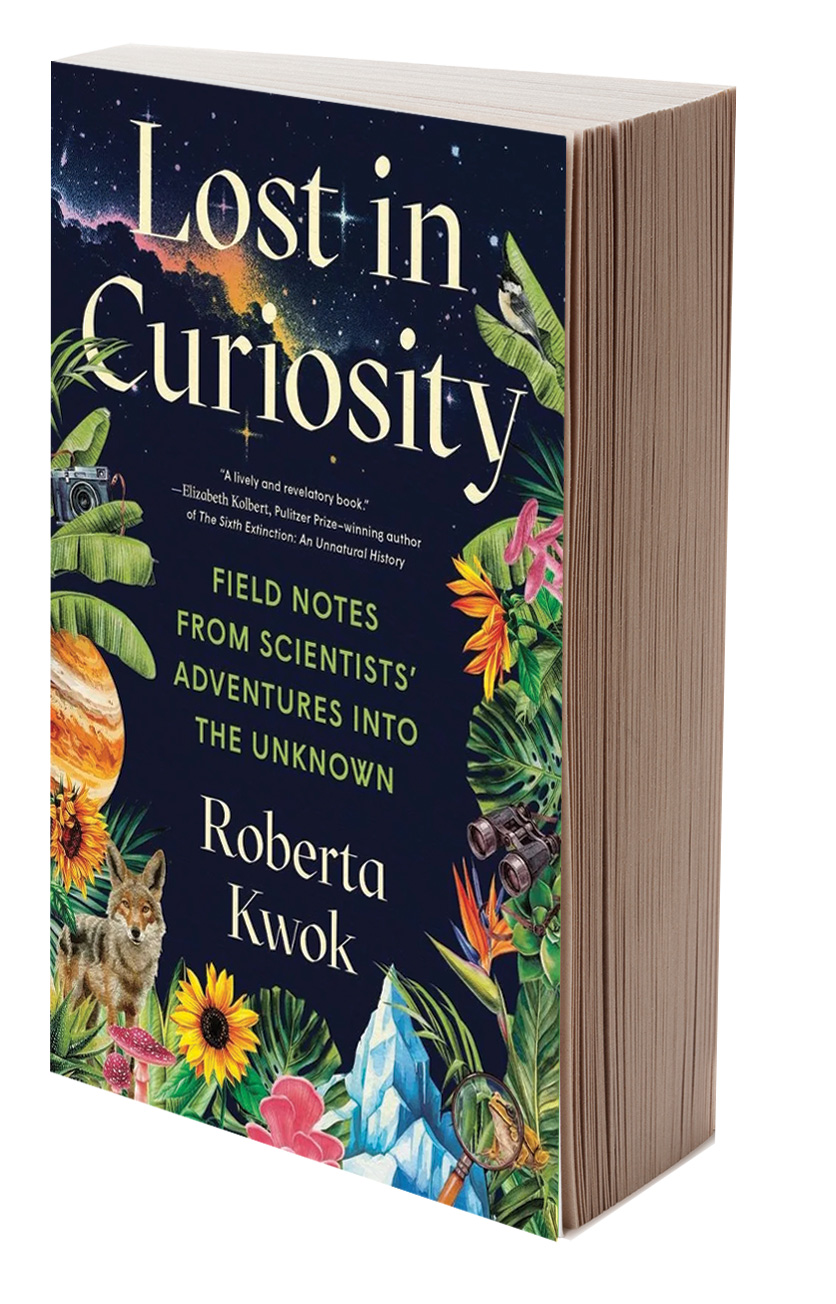
In Lost in Curiosity: Field Notes from Scientists’ Adventures into the Unknown(Sourcebooks), science journalist Roberta Kwok, ’00, witnesses the “messy middle” of science between researchers’ initial query and possible final discovery. The nine projects she investigates, from sex-role reversal in male guardian frogs to a quest to find an exomoon, depict the slow, frustrating, and focused work of scientists.