Category Archives: Arts & Literature

LOS ANGELES REVIEW OF BOOKS – FALL 2026

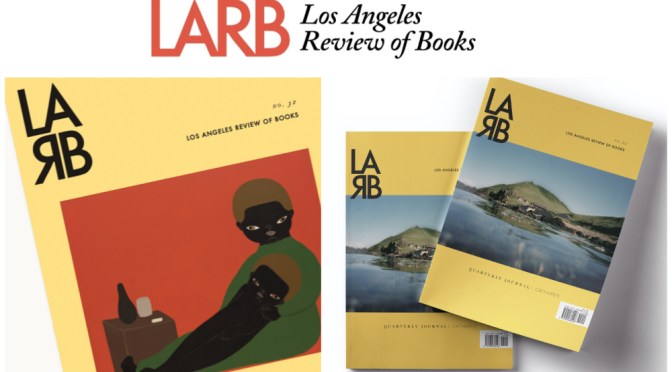
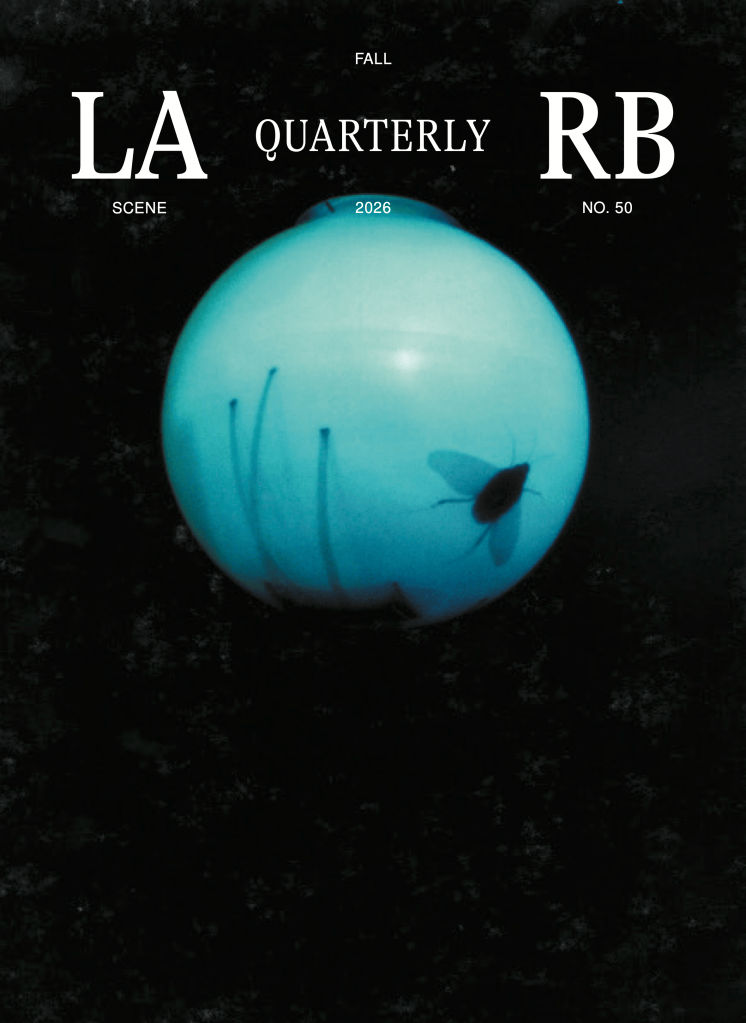
LOS ANGELES REVIEW OF BOOKS: The latest issue of LARB Quarterly, no 50: Scene, is here, featuring essays, poetry, fiction, excerpts, and a special bonus: one-act scenes.

Let’s Keep It for Ourselves

On ‘Unmuzzled OX’—a cult journal that seduced the best writers and artists in North America. Alex Kitnick

Everywhere and Nowhere All at Once

On Afghanistan, empire, and American amnesia on the 25th anniversary of the US invasion. Leila Christine Nadir

  • Armando Ledezma writes on voguing with the House of Ruber in Caracas.
  • Alex Kitnick profiles Unmuzzled OX, a cult journal that seduced the best writers and artists in America.
  • Samuel Chu reports on Operation Yellowbird, the Umbrella Movement, and the dissidents of Hong Kong.
  • Andie Eisen considers the women taking over the funeral industry.
  • Jonah C. Sirott probes how the right stole the flying saucers and the Democrats lost the weirdos.
  • Michel Chaouli reflects on the history—and pleasures—of traveling and reading.
  • Essays by Amber Bal and Doyle D. Calhoun on a misunderstood masterpiece of African cinema, Rachel Cusk on the art of Joan Snyder, Issa Quincy on the 60th annual Angola Prison Rodeo, Yael Segalovitz on slumber, and Negar Azimi on Iranian art in the 2000s.
  • Fiction by Ingeborg Bachmann (transl. Philip Boehm and Tess Lewis). Scenes by Maya C. Popa, Sophia Le Fraga, Yuri Herrera, Jason Porter, Brandon Harris, and Sarah Ruhl.
  • I Come Here Often by Sarah Wang. Double Feature by Eugene Kotlyarenko. Poetry by Sara Eliza Johnson, Jose Hernandez Diaz, Jessica Fisher, Keith S. Wilson, Eileen G’Sell, Mary Jo Bang, and Eduardo Martínez-Leyva.

Join today!

THE NEW YORKER MAGAZINE – OCTOBER 12, 2026 PREVIEW

The cover of the October 12 2026 issue of The New Yorker which features a muscular man jogging in Central Park with his...

THE NEW YORKER MAGAZINE: The latest issue cover features “Peter de Sève’s “Lapdog” – Trying to keep up. By Françoise MoulyArt by Peter de Sève

The Battle for the Post-Trump Right

For decades, the Heritage Foundation was a conservative powerhouse. Can it stay relevant in the influencer age? By Emma Green

ICE Is Everywhere and Acting with Impunity

Arrests have reached a record high—nearly fifty-one thousand in August alone—with agents conducting operations nationwide at hospitals, at airports, and outside schools. By Jonathan Blitzer

The Battle to Pass a Billionaire Tax

Most Democratic voters say that they favor a wealth tax, but a California ballot initiative has plenty of liberal opponents. By Nicholas Lemann

CAN JANE EYRE FREE CHINA?

The Intellitake
ONE ARGUMENT · TWO SIDES · ONE VERDICT · DAILY
Saturday, October 3, 2026 · The Jane Eyre Debate
“

It should provide some hope, though, that Chinese officials have done something without meaning to.

THE THESIS — PHILIP HENSHER, UNHERD

THE ARGUMENT

This fall, China made Charlotte Brontë’s Jane Eyre compulsory reading for 14- and 15-year-olds across the country. Writing in UnHerd, the novelist Philip Hensher notes the official reasoning, as reported in the Party-backed press: “the innocent, budding stage of first love is a crucial period for shaping a well-rounded personality.”

Hensher thinks Beijing has assigned more than a love story. Jane is the orphan who tells her cruel aunt that “the very thought of you makes me sick,” and she grows into a woman who answers to her own conscience rather than to the man with power over her. Those are dangerous lessons, he suggests, to hand every teenager in a country that ranks 178th of 180 in the World Press Freedom Index.

His conclusion is hopeful. A state that assigns a book about speaking the truth may be teaching it.

vs
THE ANSWER

The reporting tells a different story. China has had Jane Eyre for a century. A Chinese translation appeared in 1925, and a 1979 British film adaptation played in Chinese theaters as the country reopened after the Cultural Revolution (New York Times). Generations have read it, and the system has stood.

The choice also looks deliberate. Beijing Daily pitched the novel as a counterweight to social media’s “superficial notions about appearance and wealth” (CNN). UC San Diego scholar Ping Zhu told the Times that Jane is “an independent woman, but she’s not too outrageous in her challenge of patriarchal power.” She ends the book married and a mother, which fits a government urging young people to start families.

On this view, Beijing didn’t assign a rebel by accident. It chose a heroine whose independence ends in a home.

iC
THE INTELLITAKE

Both sides are reading the same novel and stopping at different chapters. Beijing assigned Jane Eyre for its ending: the marriage, the home, love that money can’t buy. Hensher is betting on its beginning: the child who talks back and the young woman who walks away from Thornfield with nothing rather than betray herself.

Notice what the two arguments share. Each assumes a book does what its readers are told it does. A ministry can set the exam question, but not the moment a 15-year-old reaches Jane’s declaration, “I am no bird; and no net ensnares me.” A novel doesn’t topple a government. It builds an inner life, and inner lives are the one thing no curriculum fully controls.

There is something worth admiring in the choice itself. A nation that wants its teenagers to value character over wealth reached for a Victorian Englishwoman’s conscience, and trusted 14-year-olds with it. Whatever Beijing intends, it has given millions of young readers a heroine who insists on choosing for herself.

TODAY’S PROVOCATION

Can a government assign a book without assigning what it means?

— THE EDITORS, INTELLICURIOUS —

THE BURLINGTON MAGAZINE – OCTOBER 2026 PREVIEW

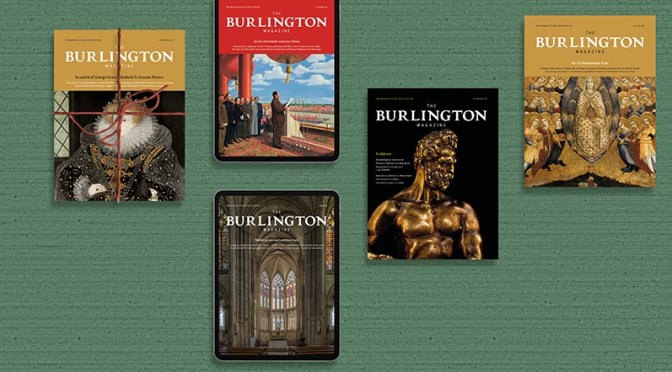
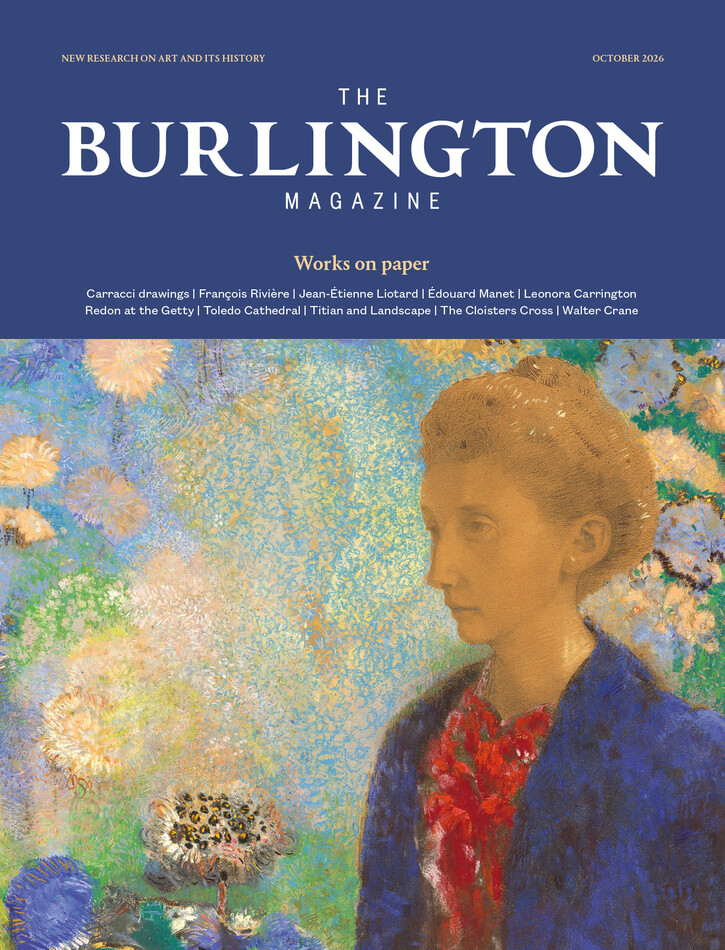
The Burlington Magazine: The latest issue features standout articles exploring a 1762 portrait of Marie-Antoinette by Jean-Étienne Liotard, watermarks on Carracci drawings, François Rivière’s rediscovered Ottoman drawing, and the Thompson collection of modern Chinese woodblock prints.

The RKD as a ‘knowledge centre’

What is the largest art-history library in the world? The answer to this question depends of course on how you measure size, but an institution that might reasonably claim such a status is the RKD in The Hague. The RKD has for decades been a vast and invaluable library and archive, carefully nurtured by expert librarians and archivists (or ‘curators’ as they have long been described).

A new drawing by Édouard Manet

A newly identified drawing in a private collection of a crouching girl is a characteristic example of the red-chalk life studies that Édouard Manet made in the 1860s, influenced by his close study of Renaissance draughtsmanship in Florence. Although squared for transfer, the drawing has not yet been linked to any known composition by the artist.

Mistaken identities: Liotard’s 1762 portrait of Marie-Antoinette

A refined portrait by Jean-Étienne Liotard in the Musée d’art et d’histoire, Geneva, has long been identified as depicting Marie-Antoinette as a child. New research establishes, however, that it is a drawing of another member of the imperial Habsburg family and also reveals a hitherto unidentified likeness of Marie-Antoinette.

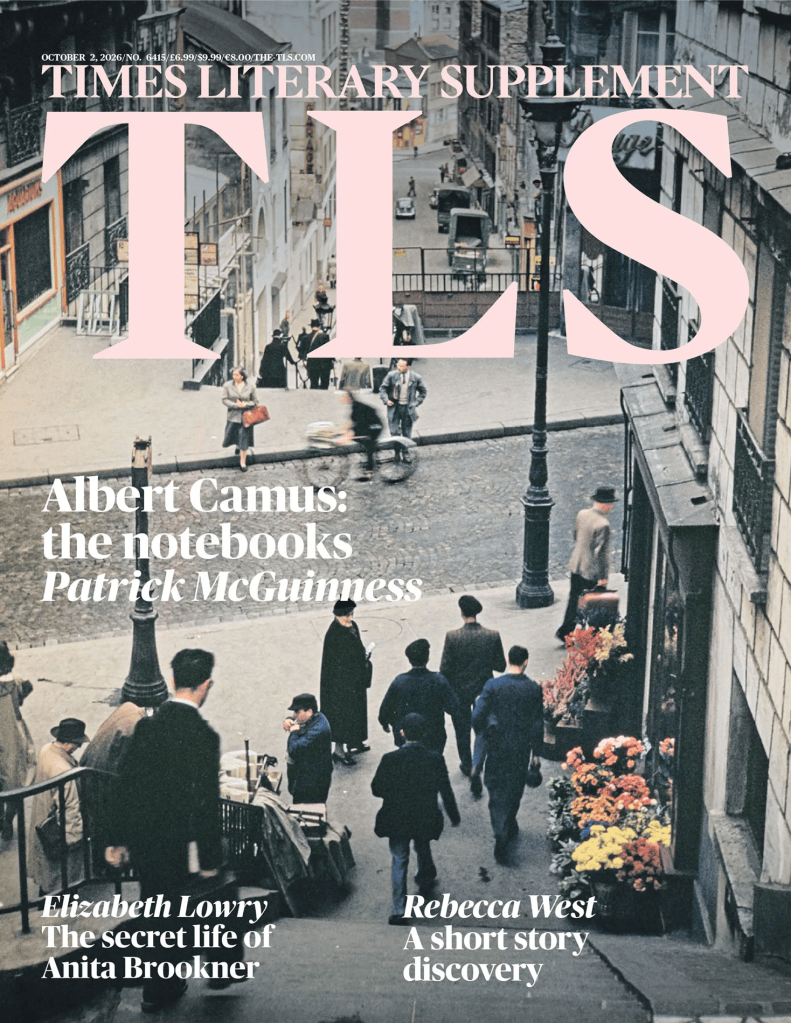
TIMES LITERARY SUPPLEMENT – OCTOBER 2, 2026

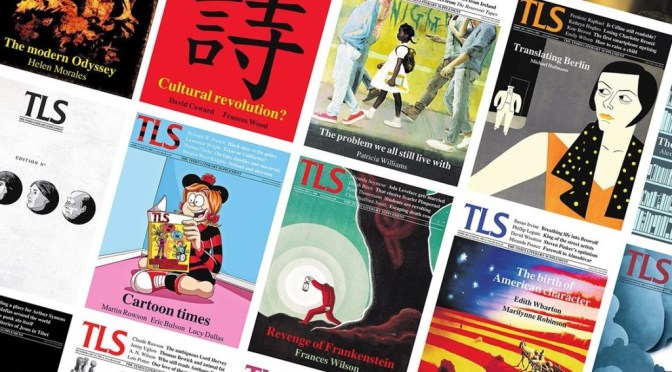
TIMES LITERARY SUPPLEMENT: The latest issue features ‘Albert Camus – The Notebooks’…

Camus contre Camus

The trials of a public intellectual By Patrick McGuinness

“Sadness of success”, writes Albert Camus in a notebook entry for June 25, 1947: “If everything were more difficult for me, as before, I’d have much more right to say what I say”. The success in question was winning the Prix des Critiques for La Peste (The Plague), published a fortnight earlier. It could be worse, the reader wants to tell him by way of consolation: you could have won the Nobel. Fast-forward ten years and the entry for October 17, 1957, reads: “Nobel. Strange feeling of overwhelming weight and melancholy. At 20 years old, poor and naked, I knew true glory. My mother”.

Infernal time machine

China Miéville’s anti-colonialist vision By Anna Aslanyan

Open season on Barbara

A romantic novelist who became a figure of fun By Nicola Shulman

One of the happy few?

How writing freed Anita Brookner from despair By Elizabeth Lowry

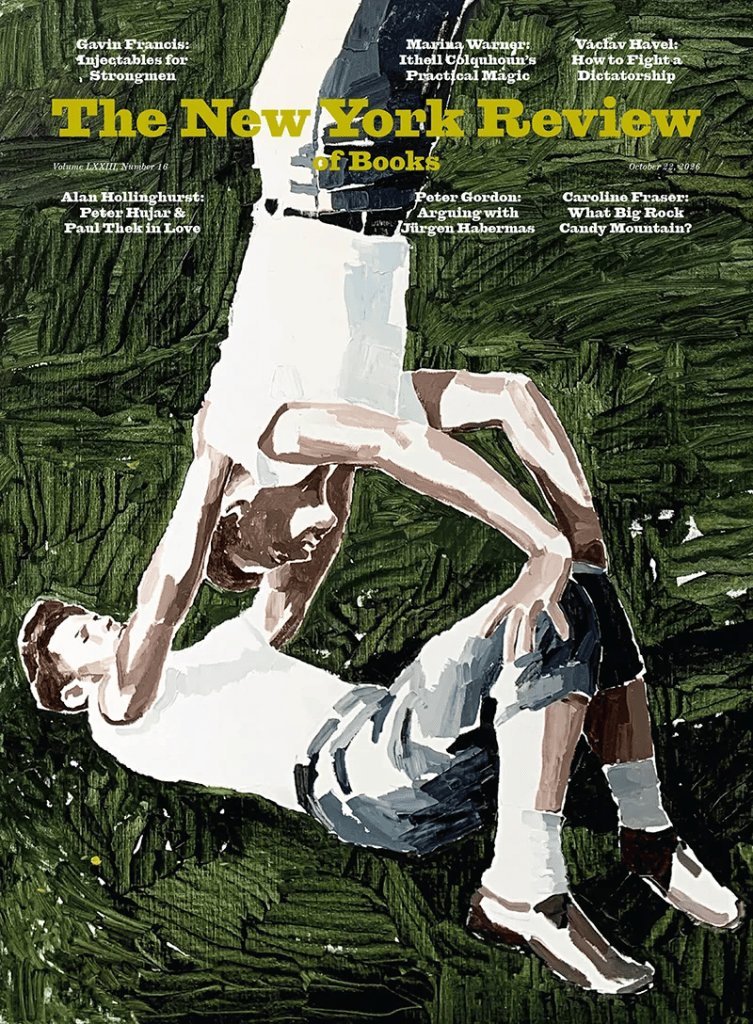
THE NEW YORK REVIEW OF BOOKS – OCTOBER 22, 2026

THE NEW YORK REVIEW OF BOOKS: The latest issue features Gavin Francis on musclemen, Caroline Fraser on hobos, Ben Tarnoff on our digital oligarchs, Alan Hollinghurst on Peter Hujar and Paul Thek, Howard W. French on the Chinese Internet, Matthew Aucoin on Philip Glass, Václav Havel on state repression, Jonathan Lethem on Wilfrid Sheed, Catherine Nicholson on ye olde VDs, Noah Feldman on the dangers of the unitary executive, Marina Warner on Ithell Colquhoun, Lola Seaton on Jonathan Buckley, poems by Ben Lerner and Elaine Equi, and much more.

Building a Real Man

From its origins in the classical physique and homoerotic spectacle, bodybuilding today often involves the use of steroids whose dangers are not properly understood.

When Fitness Went Global: The Rise of Physical Culture in the Nineteenth Century by Conor Heffernan

A Genealogy of Male Bodybuilding: From Classical to Freaky by Dimitris Liokaftos

Muscle Works: Physical Culture and the Performance of Masculinity by Broderick D.V. Chow

How Tech Rules

The AI boom is only the latest stage in Silicon Valley’s long history of creating and expanding intellectual monopolies.

The Rulers: Corporate Power in the Age of AI and the Cloud by Cecilia Rikap

Silicon Empires: The Fight for the Future of AI by Nick Srnicek

Let a Hundred Websites Bloom

The Internet and the smartphone have become formidable tools for the Chinese government to maintain tight control over society.

The Wall Dancers: Searching for Freedom and Connections on the Chinese Internet by Yi-Ling Liu

The Highest Exam: How the Gaokao Shapes China by Ruixue Jia and Hongbin Li with Claire Cousineau

LITERARY REVIEW MAGAZINE – OCTOBER 2026 PREVIEW

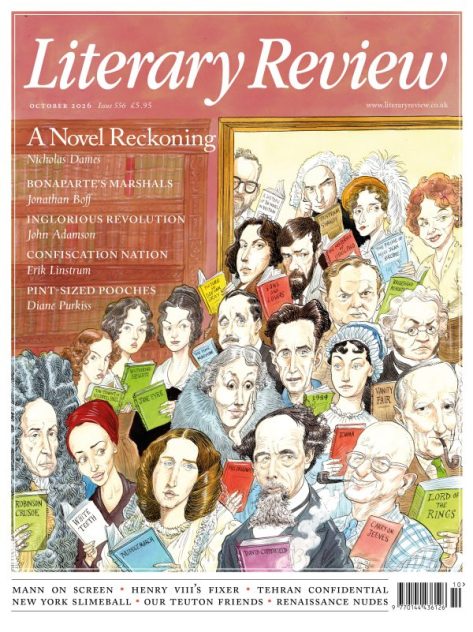
LITERARY REVIEW : The latest issue features ‘A Novel Reckoning’…

Catchpole to the King

King’s Secretary: William Paget and the Last Years of the Reign of Henry VIII By Andrew Johnston

Tudor history buffs and attentive readers of Hilary Mantel’s Wolf Hall trilogy will recognise the name William Paget. Others will require some words of introduction. Paget (1505/6–63) was an able and influential diplomat and administrator who rose to become principal secretary to Henry VIII. ‘Rose’ is the operative word. Paget, like his predecessor and mentor Thomas Cromwell, was a self-made man, though his father, a sergeant serving the sheriff of London, was able to provide him with a grammar school and Cambridge education.

1688 and All That

The Last Invasion of England: 1688 and the Dutch Armada By Arthur der Weduwen

Much is exceptional about the Bayeux Tapestry currently on magnificent display in the British Museum, but nothing is quite so exceptional as the event itself. As the museum’s website reminds us, 1066 ‘was the last time England was successfully invaded’. Our sea-girt immunity from foreign invasion has been at the centre of ‘Our Island Story’ ever since, with the Channel confounding the hubris of Philip II in 1588 and 1596, of Napoleon in 1803 and of Hitler in 1940.

Scavenger Hunt

Imperial Predator: Britain and the Destruction of the Ottoman Empire By David S Tonge

In his survey of the collapse of the Ottoman Empire in the late 19th and early 20th centuries, David S Tonge sees Britain as an aggressive superpower, hence the title of his excellent book. My one quibble is zoological. ‘Predator’ may not be quite the right word. For in much of Tonge’s story Britain is less lion than vulture: what zoologists call an obligate scavenger – or a necrophagous power – feeding on carrion. The Ottoman carcass had already been wounded by Russian aggression, nationalist revolt, indebtedness and internal decay. There were exceptions, and Britain could be predatory when circumstances demanded, notably in Cyprus and Alexandria, but its more characteristic pose was to sniff the odour of mortality and arrive in time for lunch.

LONDON REVIEW OF BOOKS – OCTOBER 8, 2026 PREVIEW

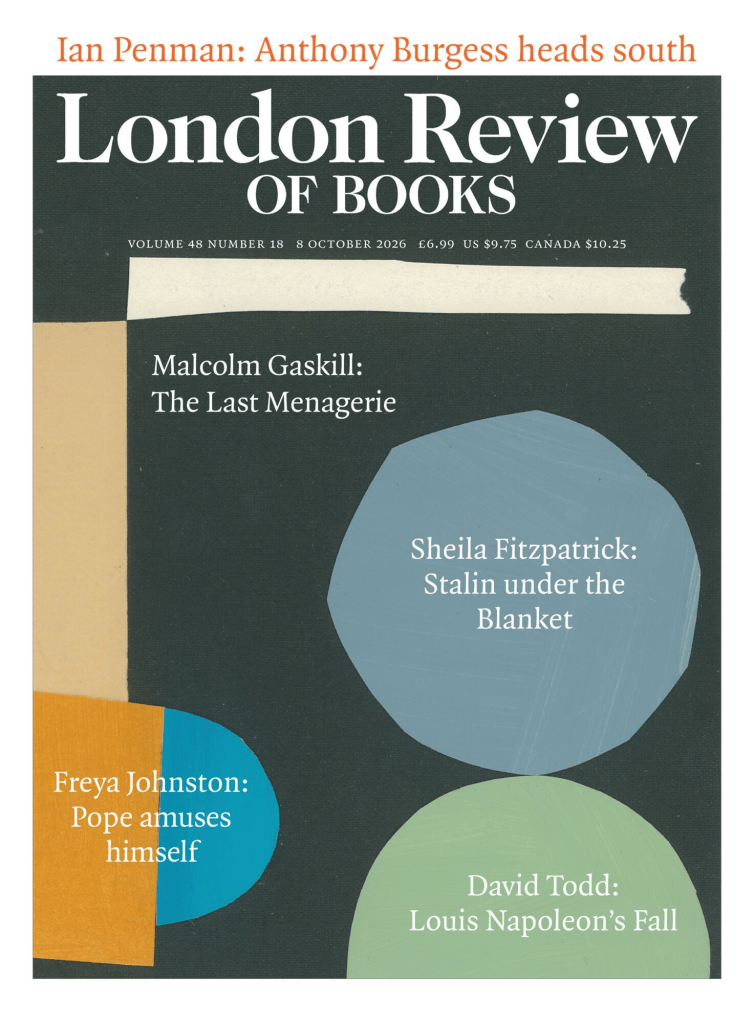
LONDON REVIEW OF BOOKS: The latest issue features major critical reviews and essays spanning Soviet history, geopolitical war gaming, 20th-century literary figures, and avant-garde art.

History & Geopolitics

  • Sheila Fitzpatrick on Stalinism: Fitzpatrick examines Irina Paperno’s Always under Siege: Olga Freidenberg’s Diary-Theory and the Everyday Terror of Stalinism, analyzing how classicist Olga Freidenberg’s secret writings framed the Siege of Leningrad and Soviet surveillance as a totalizing domestic regime.
  • Tom Stevenson on NATO and Russia: Stevenson reviews Carlo Masala’s If Russia Wins: A Scenario and Thomas Newman and John Pierson’s Atlantic Resolve: The War for Estonia, analyzing contemporary Western military simulations and anxieties regarding Baltic security.

Literary Studies & Biography

  • Edmund Gordon on William Golding: Reviewing William Golding: The Faber Letters edited by Tim Kendall, Gordon details the editorial tensions between Golding and Charles Monteith, focusing on substantial cuts to the original draft of Lord of the Flies.
  • Freya Johnston on Alexander Pope: Johnston explores Henry Power’s edition of Alexander Pope: The Major Works, charting the Augustan poet’s biting satire, anxieties, and self-fashioning.
  • Ian Penman on Anthony Burgess: Penman re-evaluates Burgess’s 1966 espionage satire Tremor of Intent, dissecting its baroque style and its uneasy relationship with James Bond.

Art & Culture

Columns and Short Cuts: Additional pieces include Peter Geoghegan on democratic funding reform and Blake Morrison on Luke Kennard’s poetry collection Black Bag.

Em Hogan on Hujar and Thek: Hogan reviews Andrew Durbin’s dual biography The Wonderful World that Almost Was: A Life of Peter Hujar and Paul Thek, profiling the turbulent lives of the photographer and artist against 1960s–1980s New York and the onset of the AIDS crisis.

Dexter Dalwood on Jasper Johns: Dalwood contributes a review of Johns’s exhibition at the Guggenheim Bilbao, evaluating his enduring postwar artistic motifs and printmaking legacy.

ART MONTHLY MAGAZINE – OCTOBER 2026 PREVIEW

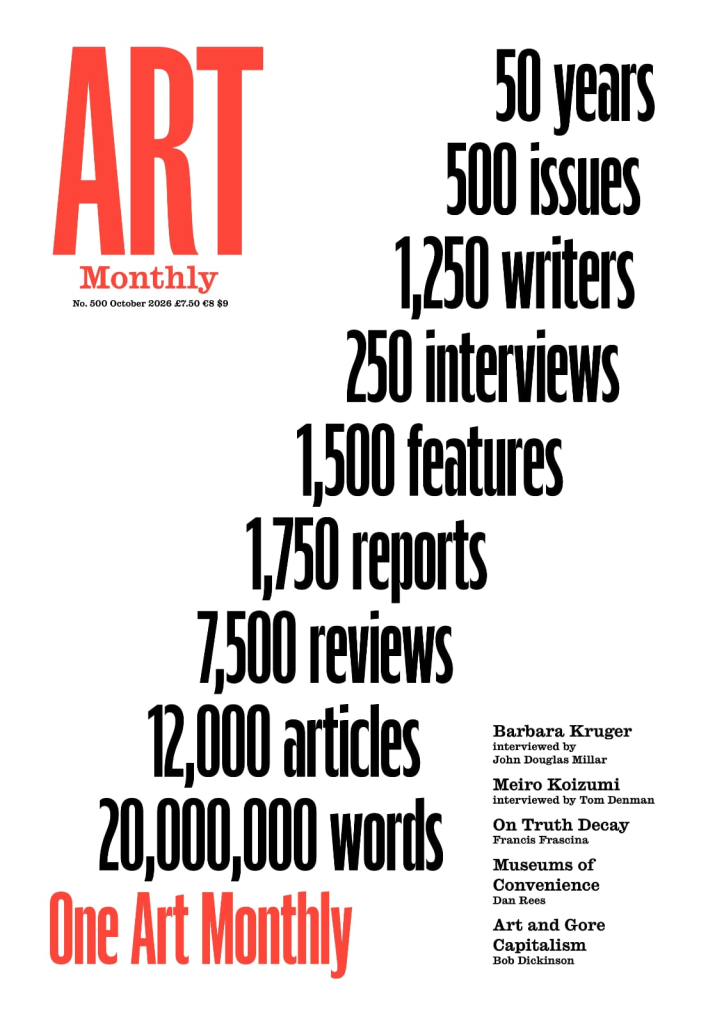
ART MONTHLY MAGAZINE: The latest issue features the magazine’s 50th anniversary and 500th publication, major interviews with Barbara Kruger and Meiro Koizumi alongside feature articles on disinformation and museum expansion. . The historic edition also includes a 50-year retrospective of the Artlaw column and exclusive artist contributions.

Museums of Convenience

For Dan Rees, the maritime ‘flag of convenience’ system provides an apt metaphor for the expansion abroad of ‘flagship’ museum franchises

When experience becomes the primary value of the art encounter, the subject is increasingly encouraged to perceive themselves as an accumulator of experiences.

Dangerous Times

Barbara Kruger interviewed by John Douglas Millar

My work was hot, not cool. The address was forthright rather than withholding. I was never cool enough to be cool. That’s still the case.

On Truth Decay

Francis Frascina looks at the ways artists can combat the decay of truth in reportage and representation

Processes of monetised personal interiorisation symbolise the shift from what Frankfurt School theorists warned about the addictive ‘drug’ of corporate television in the 1950s and 1960s to contemporary algorithmic induced ‘doom scrolling’ – all fertile ground for truth decay.

APOLLO MAGAZINE – OCTOBER 2026

October 2026 issue

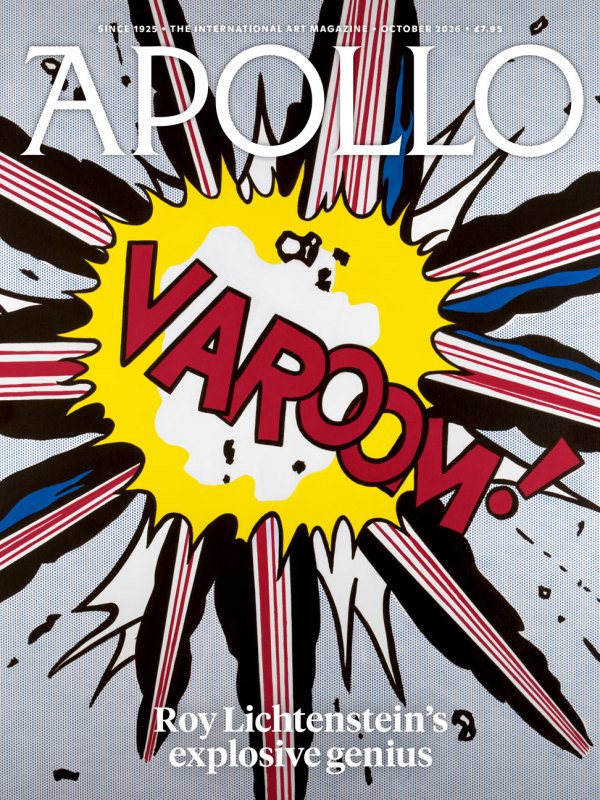
APOLLO MAGAZINE: The latest issue features ‘ROY LICHTENSTEIN’S EXPLOSIVE GENIUS’| France’s grandest interior designer | the birth of the London art scene | why dinosaurs rule at auction

Roy Lichtenstein’s explosive genius

The artist’s bold work arrived with a bang, but the American Pop artist was also responding to earlier revolutions

Does democracy have an architecture of its own?

Jan-Werner Müller’s new book explores the question of how we might design truly democratic spaces, but perhaps the answer lies in our own behaviour

What to see at Art Basel Paris

The vibrant modern and contemporary fair is showing no signs of slowing down

Charting the expanding market for historical maps

From early atlases of the Americas to the oldest surviving town plan of London, interest in important significant maps is spreading