The United States wants a reactor on the moon by 2030. A Russian-Chinese alliance is working on one for 2036. Some leading scientists say the danger is great.
President Trump’s decision to hold an international summit at his golf club, an idea rejected in his first term, illustrates how much he has shattered norms.
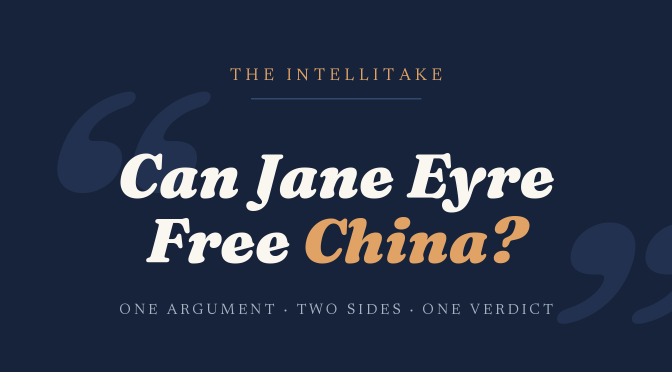
This fall, China made Charlotte Brontë’s Jane Eyre compulsory reading for 14- and 15-year-olds across the country. Writing in UnHerd, the novelist Philip Hensher notes the official reasoning, as reported in the Party-backed press: “the innocent, budding stage of first love is a crucial period for shaping a well-rounded personality.”
Hensher thinks Beijing has assigned more than a love story. Jane is the orphan who tells her cruel aunt that “the very thought of you makes me sick,” and she grows into a woman who answers to her own conscience rather than to the man with power over her. Those are dangerous lessons, he suggests, to hand every teenager in a country that ranks 178th of 180 in the World Press Freedom Index.
His conclusion is hopeful. A state that assigns a book about speaking the truth may be teaching it.
vs
THE ANSWER
The reporting tells a different story. China has had Jane Eyre for a century. A Chinese translation appeared in 1925, and a 1979 British film adaptation played in Chinese theaters as the country reopened after the Cultural Revolution (New York Times). Generations have read it, and the system has stood.
The choice also looks deliberate. Beijing Daily pitched the novel as a counterweight to social media’s “superficial notions about appearance and wealth” (CNN). UC San Diego scholar Ping Zhu told the Times that Jane is “an independent woman, but she’s not too outrageous in her challenge of patriarchal power.” She ends the book married and a mother, which fits a government urging young people to start families.
On this view, Beijing didn’t assign a rebel by accident. It chose a heroine whose independence ends in a home.
iC
THE INTELLITAKE
Both sides are reading the same novel and stopping at different chapters. Beijing assigned Jane Eyre for its ending: the marriage, the home, love that money can’t buy. Hensher is betting on its beginning: the child who talks back and the young woman who walks away from Thornfield with nothing rather than betray herself.
Notice what the two arguments share. Each assumes a book does what its readers are told it does. A ministry can set the exam question, but not the moment a 15-year-old reaches Jane’s declaration, “I am no bird; and no net ensnares me.” A novel doesn’t topple a government. It builds an inner life, and inner lives are the one thing no curriculum fully controls.
There is something worth admiring in the choice itself. A nation that wants its teenagers to value character over wealth reached for a Victorian Englishwoman’s conscience, and trusted 14-year-olds with it. Whatever Beijing intends, it has given millions of young readers a heroine who insists on choosing for herself.
TODAY’S PROVOCATION
Can a government assign a book without assigning what it means?
President Vladimir Putin brought up a sale of Russian energy assets with Jared Kushner and Steve Witkoff. The deal raises new questions about conflicts of interest.
The Parti Québécois has vowed to hold a referendum on independence, three decades after Quebec voted “no.” Voters want change, but maybe not that much.
Records showed that campus police officers informed prosecutors that they had conducted interviews beyond taking a statement from the woman who said she was raped.
Capt. Smit Machchhar, who was stabbed by his co-pilot midair between Dubai and Tel Aviv, said he “had to act” to prevent a crash despite serious injuries.
“Sadness of success”, writes Albert Camus in a notebook entry for June 25, 1947: “If everything were more difficult for me, as before, I’d have much more right to say what I say”. The success in question was winning the Prix des Critiques for La Peste (The Plague), published a fortnight earlier. It could be worse, the reader wants to tell him by way of consolation: you could have won the Nobel. Fast-forward ten years and the entry for October 17, 1957, reads: “Nobel. Strange feeling of overwhelming weight and melancholy. At 20 years old, poor and naked, I knew true glory. My mother”.
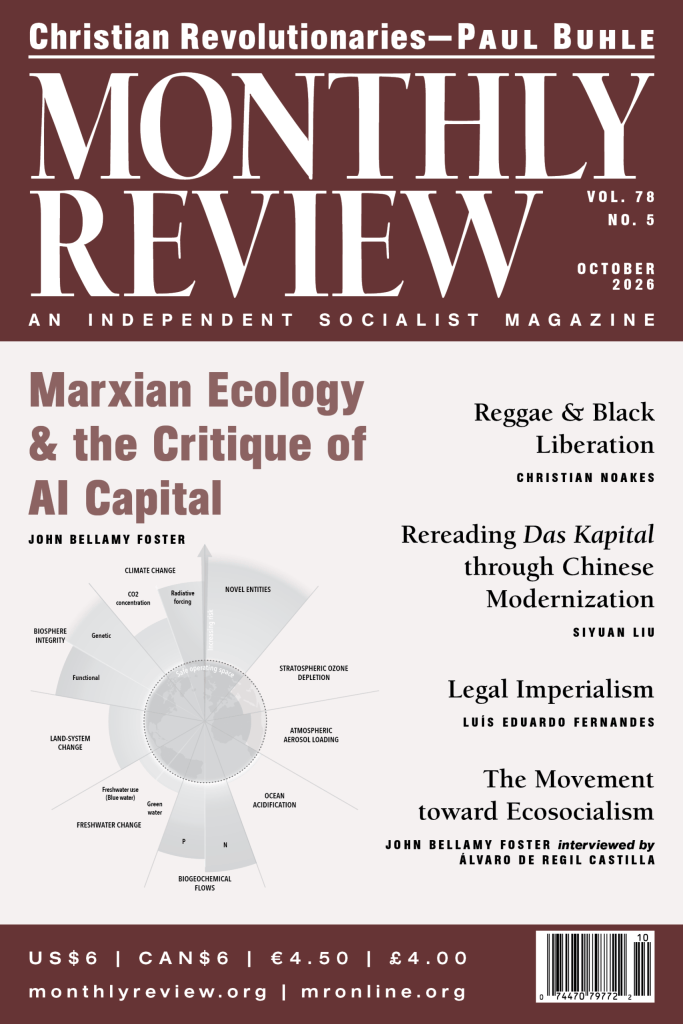
What is the rise of AI capital, and what does it mean for contemporary work, culture, and the ecological state of our planet? John Bellamy Foster dispels the myth of a “hyperorganized AI capitalism.” As Foster writes: “We are not entering a stable new age…but rather a new, capitalist-engendered global disorder in which humanity, according to climate science, is headed ever more rapidly toward a planetary ‘point of no return.'” The only way out—the only way, that is, to ensure the survival of humanity—is a radical shift away from the catastrophically destructive regime of capital accumulation and toward sustainable human development through socialism.
Paul Buhle reviews The Radical Jewish Tradition by Donny Glickstein and Janey Stone. The book, Buhle writes, is a window onto “the antinomies of nineteenth-century Jewish life”—including the growing movement against Zionism and for socialism among Eastern European Jews. This authors, Buhle notes, also tells the story of Jewish communists in Britain, the United States, and beyond, taking into account the wide sweep of Jewish left activity globally, situating the present struggles against genocide in Palestine squarely within the legacy of radical Jews everywhere.
Today’s resurgence in U.S. imperialist interventions abroad and the concomitant so-called crisis of the “rules-based order” can be explained, Luís Eduardo Fernandes argues, through the category of “legal imperialism, which refers to how the international juridical form is internalized within societies and in the context of dependency, colonialism, unequal exchange, and monopoly capital. “International law and imperialism,” Fernandes writes, “do not stand as opposing poles. They are part of the same unity.… Violence is constitutive of the juridical form.”
“I don’t deserve to die like this,” said one passenger on Flight 1073 from Dubai to Tel Aviv. The motive of the cockpit stabbing remains unknown, officials said.
Prime Minister Benjamin Netanyahu praised the flight’s injured captain, Israeli passengers and reserve pilots, who helped secure the plane and land it safely. The attacker has not been identified.
Christa Pike was convicted of murdering a classmate in 1995. It was not clear what went wrong in the execution or what her current medical condition was.
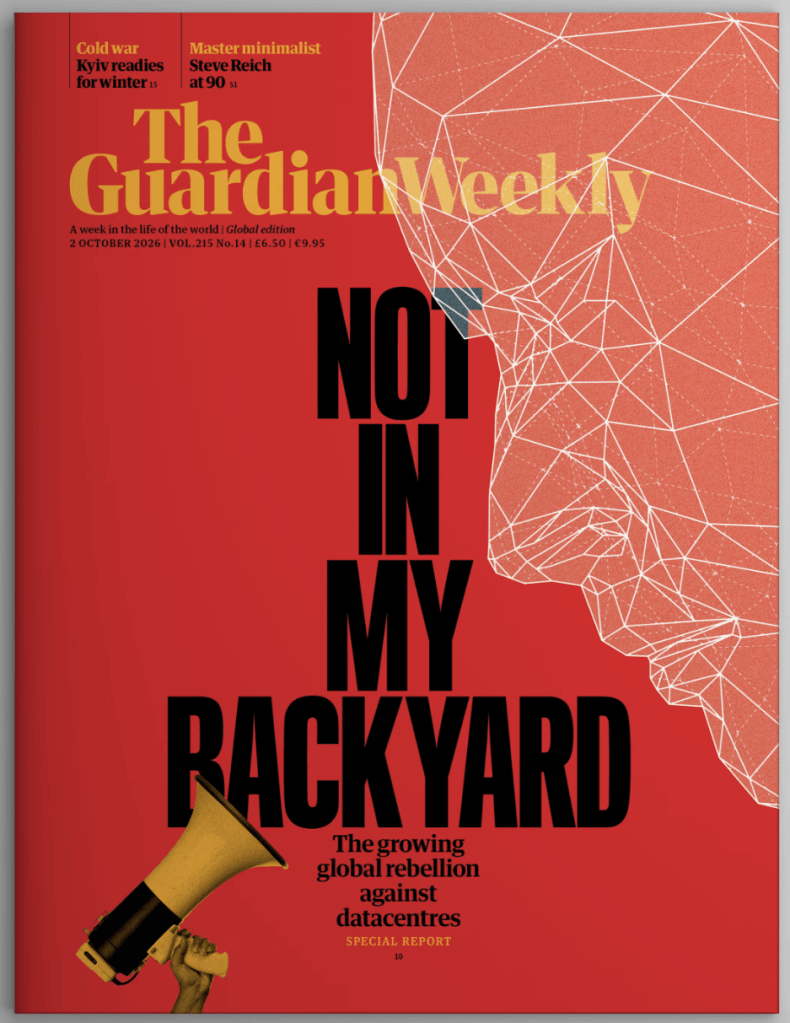
As the alarm bells sound ever louder about the potentially existential threat of breakneck AI development, people far removed from Silicon Valley debates about the future of the artificial intelligence revolution are voicing other more immediately tangible worries about the building of the vast datacentres that power these entities.
For this week’s cover story, economics and political writer Eduardo Porter, analyses why communities are pushing back against AI and the future that the big tech plutocrats want to create. These fears, based around environmental concerns over resource use and rapid societal change, are, he argues, far more complex than luddite attitudes or nimbyism.
It’s a position exemplified by reporting from two rural communities in India and the UK where vast datacentres are already under construction or being planned. As Hannah Ellis-Petersen and Aakash Hassan find out, the villagers of Tarluvada, in Andhra Pradesh, feel that government promises of a “golden age” that a hyperscale Google datacentre would bring them have been broken. Meanwhile, Sandra Laville meets protesters in Great Torrington, Devon, who sense that they are being kept in the dark about plans for an AI campus, one of Europe’s largest, in a Unesco-designated nature reserve.
Spotlight| Kyiv’s cold front is approaching Charlotte Higgins reports on how residents are preparing for winter, stocking up on food and determination, as Russia increases its attacks on energy infrastructure
Environment| What Nepal has taught Argentina What can the Patagonian town of El Chaltén at the foot of the Torre glacier do to avoid an event similar to the disaster in Nepal? María de los Ángeles Orfila finds out
Feature| Andy Burnham: a man with a plan As the first Labour conference with Andy Burnham as prime minister takes place, Hettie O’Brien finds out just how radical his policies could be
Opinion| Macron’s brave swansong In his final speech to the UN, Emmanuel Macron told the world how to stand up to Trump, says Steve Bloomfield
Culture| A minimalist at 90 As he prepares to celebrate a milestone birthday, Steve Reich tells Flora Willson how he developed his musical ideas and why he wants others to take up the baton of performing his works
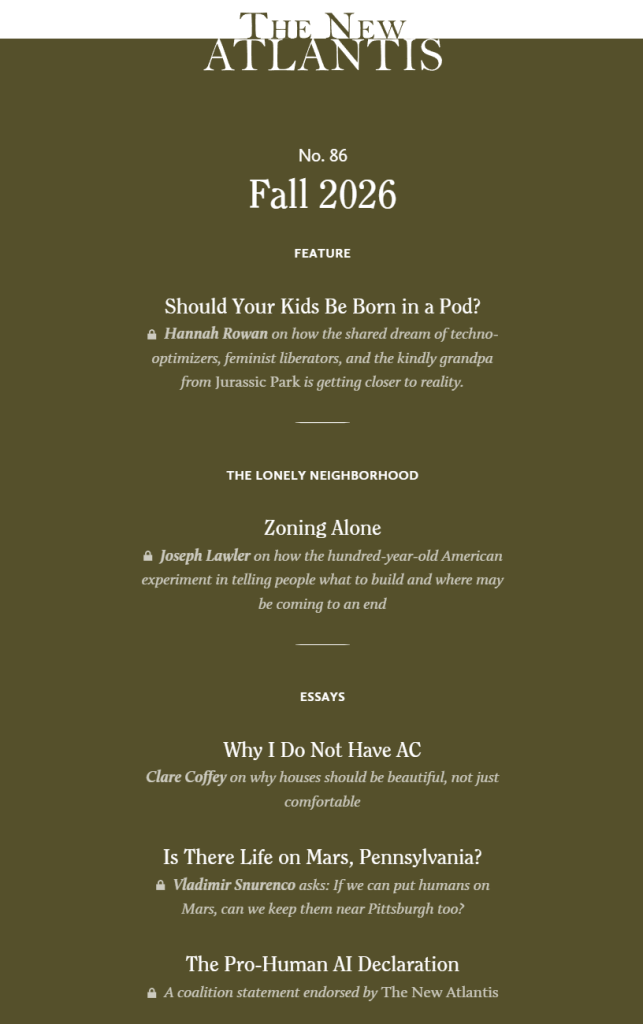
The shared dream of techno-optimizers, feminist liberators, and the kindly grandpa from Jurassic Park is getting closer to reality.
Zoning Alone
A hundred-year-old experiment in telling people what to build and where is part of why Americans have become so isolated. The Supreme Court may soon bring it to an end — and help bring back real neighborhoods.
The Pro-Human AI Declaration
A statement endorsed by The New Atlantis
In March 2026, a coalition of interest groups and individuals, organized by the Future of Life Institute, issued the following declaration at HumanStatement.org.
As companies race to develop and deploy AI systems, humanity faces a fork in the road. One path is a race to replace: humans replaced as creators, counselors, caregivers and companions, then in most jobs and decision-making roles, concentrating ever more power in unaccountable institutions and their machines. An influential fringe even advocates altering or replacing humanity itself. This race to replace poses risks to societal stability, national security, economic prosperity, civil liberties, privacy, and democratic governance. It also imperils the human experiences of childhood and family, faith, and community.
A remarkably broad coalition rejects this path, united by a simple conviction: artificial intelligence should serve humanity, not the reverse. There is a better path, where trustworthy and controllable AI tools amplify rather than diminish human potential, empower people, enhance human dignity, protect individual liberty, strengthen families and communities, preserve self-governance and help create unprecedented health and prosperity. This path demands that those who wield technological power be accountable to human values and needs, in support of human flourishing.
1. Keeping Humans in Charge
Human Control Is Non-Negotiable: Humanity must remain in control. Humans should choose how and whether to delegate decisions to AI systems.
Meaningful Human Control: Humans should have authority and capacity to understand, guide, proscribe, and override AI systems.
No Superintelligence Race: Development of superintelligence should be prohibited until there is broad scientific consensus that it can be done safely and controllably, and there is strong public buy-in.
Off-Switch: Powerful AI systems must have mechanisms that allow human operators to promptly shut them down.
No Reckless Architectures: AI systems must not be designed so that they can self-replicate, autonomously self-improve, resist shutdown, or control weapons of mass destruction.
Independent Oversight: Highly autonomous AI systems where controllability is not obvious require pre-development review and independent oversight: genuine authority to understand, prohibit, and override, not industry self-regulation.
Capability Honesty: AI companies must provide clear, accurate and honest representations of their systems’ capabilities and limitations.
2. Avoiding Concentration of Power
No AI Monopolies: AI monopolies that concentrate power, stifle innovation, and imperil entrepreneurship must be avoided.
Shared Prosperity: The benefits and economic prosperity created by AI should be shared broadly.
No Corporate Welfare: AI corporations should not be exempted from regulatory oversight or receive government bailouts.
Genuine Value Creation: AI development should prioritize solving real problems and creating authentic value.
Democratic Authority Over Major Transitions: Decisions about AI’s role in transforming work, society, and civic life require democratic support, not unilateral corporate or government decree.
Avoid Societal Lock-In: AI development must not severely limit humanity’s future options or irreversibly limit our agency over our future.
3. Protecting the Human Experience
Defense of Family and Community Bonds: AI should not supplant the foundational relationships that give life meaning — family, friendship, faith communities, and local connections.
Child Protection: Companies must not be allowed to exploit children or undermine their wellbeing with AI interactions creating emotional attachment or leverage.
Right to Grow: AI companies should not be allowed to stunt children’s physical, mental or social growth or deprive them of essential experiences for healthy development during critical periods.
Pre-Deployment Safety Testing: Like drugs, chatbots must undergo pre-deployment testing for increased suicidal ideation, exacerbation of mental health disorders, escalation of acute crisis situations, and other known harms.
Bot-or-Not Labeling: AI-generated content that could reasonably be mistaken for human-generated must be clearly labeled as such.
No Deceptive Identity: AI should clearly and correctly identify itself as artificial, nonhuman, and not a professional, and it should not claim experiences it lacks.
No Behavioral Addiction: AIs should not cause addiction or compulsive use through manipulation, sycophantic validation, or attachment formation.
4. Human Agency and Liberty
No AI Personhood: AI systems must not be granted legal personhood, and AI systems should not be designed such that they deserve personhood.
Trustworthiness: AI must be transparent, accountable, reliable, and free from perverse private or authoritarian interests.
Liberty: AI must not curtail individual liberty, freedom of speech, religious practice, or association.
Data Rights and Privacy: People should have power over their personal data, with rights to access, correct, and delete it from active systems, AI training sets, and derived inferences.
Psychological Privacy: AI should not be allowed to exploit data about the mental or emotional states of users.
Avoiding Enfeeblement: AI systems should be designed to empower, rather than enfeeble their users.
5. Responsibility and Accountability for AI Companies
No Liability Shield: AI must not be able to act as a liability shield, preventing those deploying it from being legally responsible for their actions.
Developer Liability: Developers and deployers bear legal liability for defects, misrepresentation of capabilities, and inadequate safety controls, with statutes of limitation that account for harms emerging over time.
Personal Liability: There should be criminal penalties for executives responsible for prohibited child-targeted systems or ones causing catastrophic harm.
Independent Safety Standards: AI development shall be governed by independent safety standards and rigorous oversight.
No Regulatory Capture: AI companies must not be allowed undue influence over rules that govern them.
Failure Transparency: If an AI system causes harm, it should be possible to ascertain why as well as who is responsible.
AI Loyalty: AI systems performing functions in professions with fiduciary duties, such as health, finance, law, or therapy, must fulfill all of those duties, including mandated reporting, duty of care, conflict of interest disclosure, and informed consent.