Tag Archives: Essays

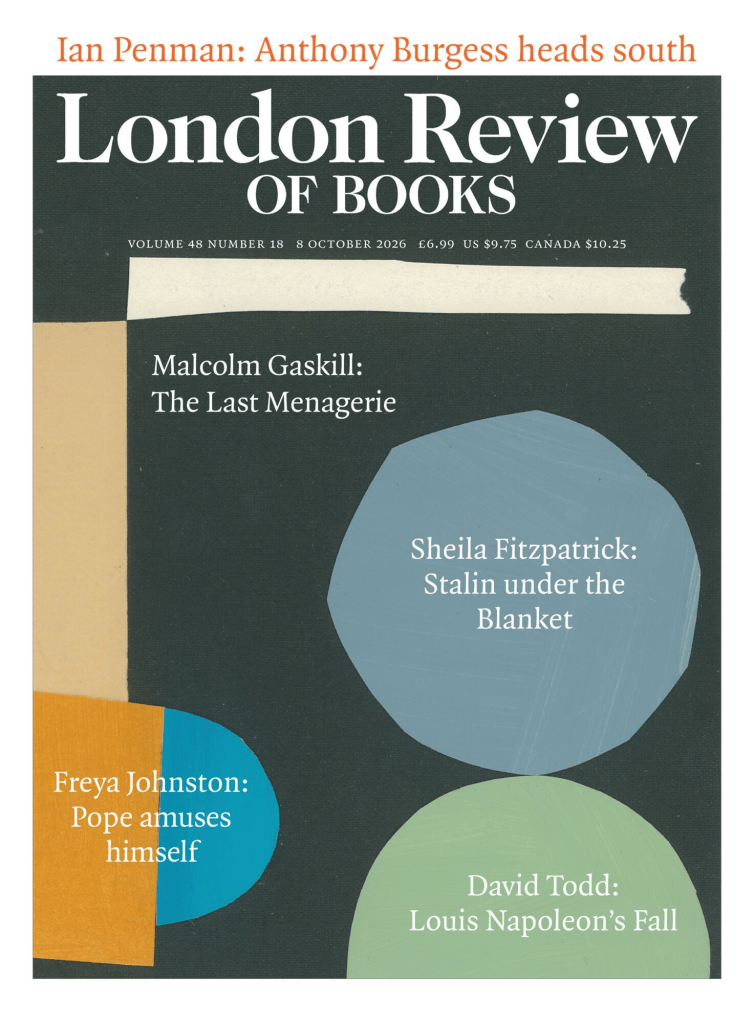
LONDON REVIEW OF BOOKS – OCTOBER 8, 2026 PREVIEW

LONDON REVIEW OF BOOKS: The latest issue features major critical reviews and essays spanning Soviet history, geopolitical war gaming, 20th-century literary figures, and avant-garde art.

History & Geopolitics

  • Sheila Fitzpatrick on Stalinism: Fitzpatrick examines Irina Paperno’s Always under Siege: Olga Freidenberg’s Diary-Theory and the Everyday Terror of Stalinism, analyzing how classicist Olga Freidenberg’s secret writings framed the Siege of Leningrad and Soviet surveillance as a totalizing domestic regime.
  • Tom Stevenson on NATO and Russia: Stevenson reviews Carlo Masala’s If Russia Wins: A Scenario and Thomas Newman and John Pierson’s Atlantic Resolve: The War for Estonia, analyzing contemporary Western military simulations and anxieties regarding Baltic security.

Literary Studies & Biography

  • Edmund Gordon on William Golding: Reviewing William Golding: The Faber Letters edited by Tim Kendall, Gordon details the editorial tensions between Golding and Charles Monteith, focusing on substantial cuts to the original draft of Lord of the Flies.
  • Freya Johnston on Alexander Pope: Johnston explores Henry Power’s edition of Alexander Pope: The Major Works, charting the Augustan poet’s biting satire, anxieties, and self-fashioning.
  • Ian Penman on Anthony Burgess: Penman re-evaluates Burgess’s 1966 espionage satire Tremor of Intent, dissecting its baroque style and its uneasy relationship with James Bond.

Art & Culture

Columns and Short Cuts: Additional pieces include Peter Geoghegan on democratic funding reform and Blake Morrison on Luke Kennard’s poetry collection Black Bag.

Em Hogan on Hujar and Thek: Hogan reviews Andrew Durbin’s dual biography The Wonderful World that Almost Was: A Life of Peter Hujar and Paul Thek, profiling the turbulent lives of the photographer and artist against 1960s–1980s New York and the onset of the AIDS crisis.

Dexter Dalwood on Jasper Johns: Dalwood contributes a review of Johns’s exhibition at the Guggenheim Bilbao, evaluating his enduring postwar artistic motifs and printmaking legacy.
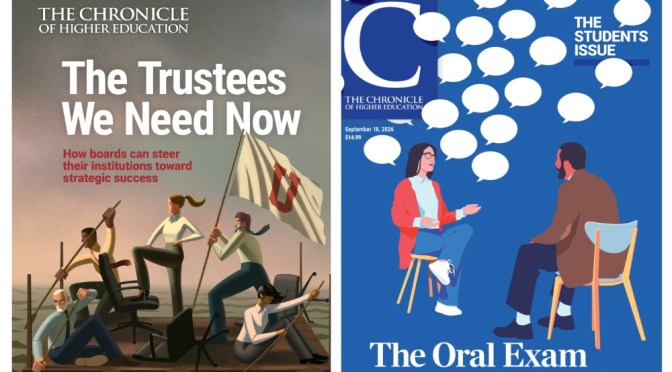
THE CHRONICLE OF HIGHER EDUCATION – OCTOBER 2026

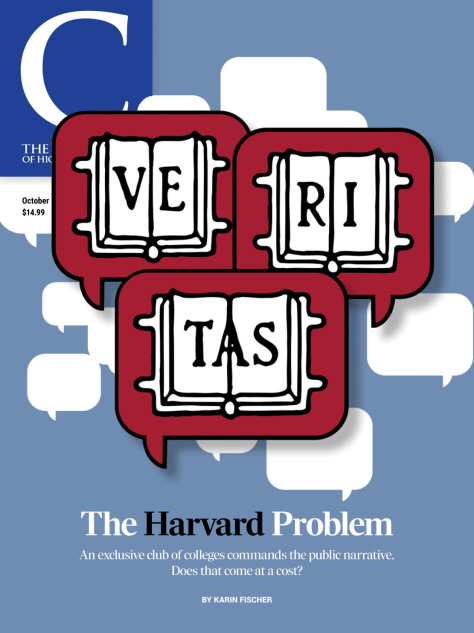
THE CHRONICLE OF HIGHER EDUCATION: The latest issue features ‘The Harvard Problem’ – An exclusive club of colleges commands the public narrative. Does that come at a cost?

Higher Ed’s Harvard Problem

An exclusive club of colleges commands the public narrative. Does that come at a cost? By Karin Fischer

The Face-Time Ultimatum

When faculty are required to be on campus, even to teach online, they may just quit. By Adrienne Lu

Colleges Need Students. They’re Trying to Find Them in Texas.

The Lone Star State is teeming with students — and with college recruiters fighting to win them over. By Taylor Swaak

Neil Gross Knows What Broke College

How political polarization became the organizing logic of academic life. By Evan Goldstein, Len Gutkin

The London Magazine – October/November 2026

THE LONDON MAGAZINE: Despair – its causes, symptoms and consequences – becomes something of a theme across the issue. At least according to its etymological root, to despair is to be without hope (de-sperare), and in Mavis Gallant’s 1965 story ‘Paola and Renata’, published in the issue, mothers have no hope of controlling their inscrutable, insolent daughters.

Review | Comfort and Its Discontents by Devki Panchmatia

‘While it must be stressed that Rankine’s lyric practice is capacious and stylistically thrilling, that her insights are always valuable in isolation, I am left slightly unsure of what Triage’s greater intentions are.’

Essay | The Scale Against Poetry: Tony Harrison’s Prose by Dane Holt

‘Partly due to critical neglect, partly due to the single-minded determination to be a poet who survived on nothing but his poetry, Harrison’s prose is doomed to be a footnote in his career.’

Essay | It’s a Devil of a Gap by Alex Niven

‘Might there be something, beyond backwater nihilism, in the vanishing of the Tree at Sycamore Gap that speaks to us about a country increasingly unable to protect its social and civic structures in the most basic ways?’

ANOTHER MAN’S ELOQUENCE

Intellicurean Essays

New on Intellicurean

Another Man’s Eloquence

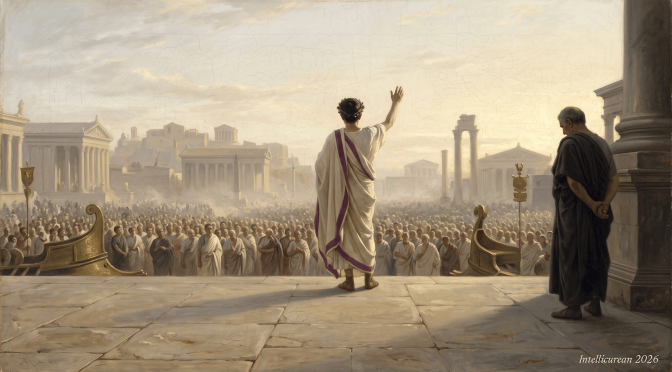
In the autumn of 54 a boy emperor praised a dead man, and the crowd smiled at the wrong moment. The sentences were Seneca’s. What happens to a philosopher who spends eight years as someone else’s voice?

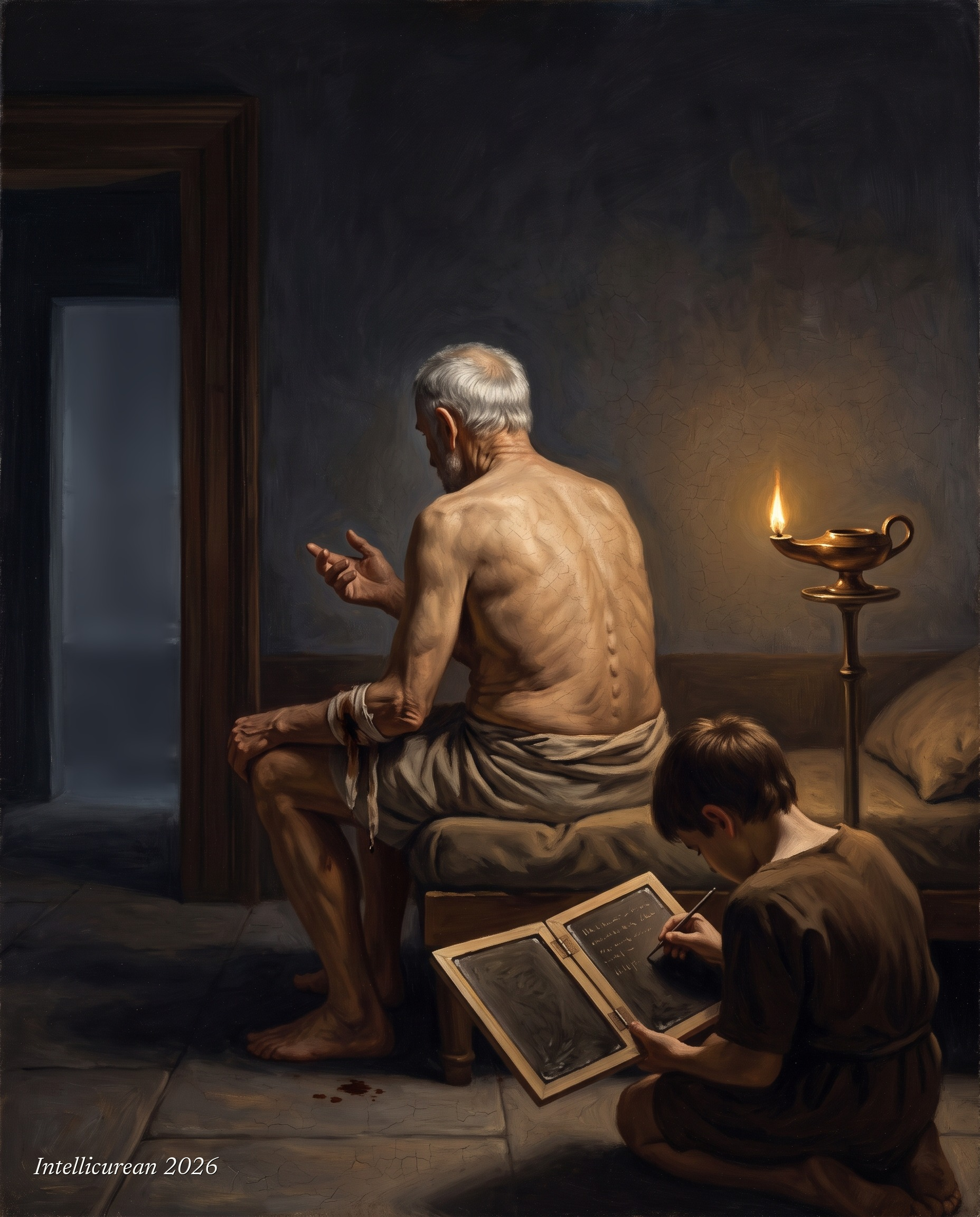
Seneca, seen from behind by lamplight, dictating to a single scribe

The dictation, AD 65, as the essay imagines it. A generated image, not a record.

Tacitus says the old men in the Forum noticed something new that day: Nero was the first ruler of Rome to need another man’s eloquence. Five years later the same man wrote the letter that explained a mother’s murder to the Senate, and the city blamed the ghost, not the emperor. Three years after that, the charge that ended his career was that he had claimed the credit. And in the first year he owned his own mouth, he wrote the most famous opening in Roman philosophy: set yourself free for your own sake.

Why we’re pointing you there

Michael Cummins follows the voice through four dates, 54, 59, 62 and 65, and finds one word doing the work: aliena, “another’s,” the word Tacitus used for Nero’s borrowed speech and the word Seneca used, in his own letters, for everything a man does not own. The essay makes one guess about what the throne cost him, grades it, and prints the two hostile witnesses who say it cost him nothing. It ends with the one text Seneca dictated as unmistakably his own, on the night he died, and why we don’t have it.

Every speechwriter since is Seneca, and the letter after the crime still gets written.

Read the essay at Intellicurean →

Intellicurious points to the best of what we read and make. The full essay, with its sources and colophon, lives at intellicurean.com.

THE ECONOMIST MAGAZINE – SEPTEMBER 26, 2026

THE ECONOMIST MAGAZINE: The latest issue features ‘When America walks away’…

When America walks away

For decades America has enjoyed hegemony over the Middle East. That is about to end

Why house prices may be in trouble

In a big serving of bad news, there are crumbs of comfort

Brazil turns its back on the future

The looming election will not bring the change the country needs

Back and shoulder surgery is often worse than useless

Millions of operations should be scrapped

WHO PAID FOR VENUS?

Intellicurean Essays on Intellicurious

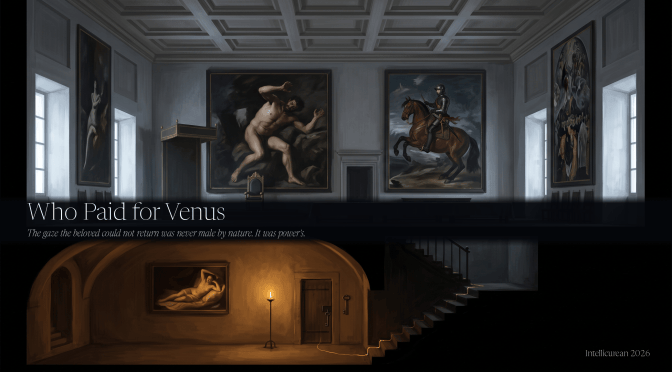
Two rooms, one painter, two very different buyers. In 1549 a queen hung Titian’s tormented giants to greet the future king of Spain. A few years later that king hung Titian’s nudes for himself. The essay asks who was doing the looking, and finds it was never simply the men.

Why we’re pointing you there

Everyone who took an art-history survey met John Berger’s line about men looking and women being looked at. Michael Cummins takes that line to the Prado, where the museum’s new volumes on women and the Spanish collections show something the slogan can’t hold: Mary of Hungary commissioning, Christina of Sweden collecting, Isabella Farnese marking her paintings with a lily like a brand on cattle. Power looked, and power was often a woman. The essay does not overturn Berger. It finds the room he left out.

What we liked most is the discipline. Every claim about who owned what rests on an inventory, and where the record gives only a later opinion rather than a fact, the essay says so and moves on. It is also the first piece in the series with no artificial intelligence in it at all, which is the point: Intellicurean was always a project about judgment, and here the judgment is a queen’s. Read it for Binche in 1549, and for a Sisyphus who turns out to have been a political statement.

Read the full essay at Intellicurean →

Essays & Reviews for the Intellectually Curious

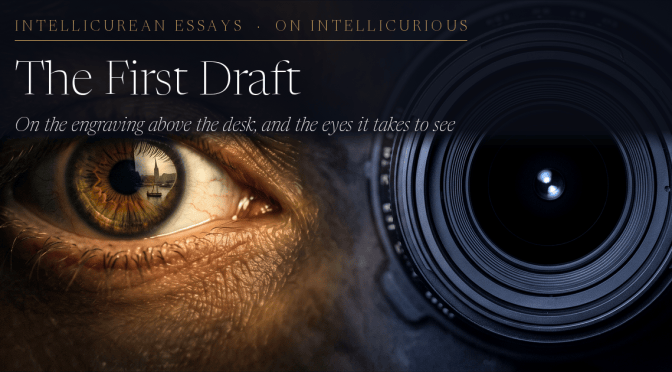
THE FIRST DRAFT

Intellicurean Essays, on Intellicurious
Above the publisher’s desk at The New York Times hangs an engraving of Manhattan in 1851 — cobblestones, low buildings, a harbor full of sails, a church spire the tallest thing on the island. Someone stood there and looked. That, it turns out, is the whole question.

Why we’re pointing you there

The Times marked its 175th anniversary this week with an essay on fifteen million “first drafts of history.” The same week, an investigation exposed a company buying real online publications, firing the writers, and filling them with machine-written articles — bylined to experts who were never born, and overseen by an editor whose age dropped from 77 to 75 in the space of three days. Intellicurean sets the two side by side and asks what a first draft is worth when no one was there to draft it.

The answer turns on a name the Times left out: Earl Caldwell, the only reporter at the Lorraine Motel when King was shot, who said afterward that you don’t see everything — you get a sliver of what came past you, and that sliver is the basis for everything. A machine can generate a flawless eyewitness account of any event. It can never have been there. This is the fourth in Intellicurean’s series on what the machine lacks — and the one with the strongest floor beneath it.

Read the full essay at Intellicurean → Essays & Reviews for the Intellectually Curious

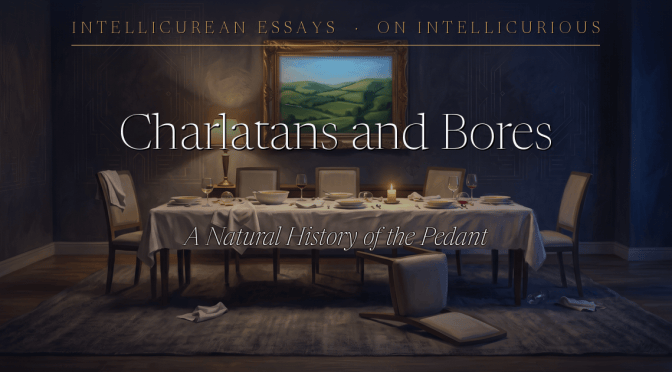
CHARLATANS AND BORES

Every age invents its know-it-all — the Renaissance humanist drowning in citations, the “well, actually” of the comment thread. What, exactly, is the pedant missing? He has the facts. He is not lying. And yet he is unbearable.

Why we’re pointing you there

Intellicurean sets the poet-scholar A.E. Housman — who spent thirty years on a bad Latin poem and knew precisely how tedious it looked — against the philosopher H.P. Grice, who worked out the unwritten rules that make conversation bearable. The pedant, it turns out, obeys the rule of truth and tramples every rule of mercy. He tells you true things you never needed, and mistakes the telling for a gift.

Then the essay springs its trap. The AI chatbot is the perfect pedant — infinite recall, immaculate manners, and no judgment at all about which of its thousand true sentences you actually wanted. In lacking the one faculty, it shows us what that faculty always was: not knowledge, but the taste to know what, of all you could say, is worth another person’s finite time.

Read the full essay at Intellicurean → Essays & Reviews for the Intellectually Curious

THE ECONOMIST MAGAZINE – SEPTEMBER 19, 2026

THE ECONOMIST MAGAZINE: The latest issue features ‘Can the AI arms race be stopped?‘


Can the AI arms race be stopped?

America will struggle to make the technology safe while staying ahead of China

Markets are waking up to the rich world’s reckless borrowing

Governments are still, alas, asleep

In praise of Democrats’ disunity

Republicans show that party unity is overrated

How AI is creating jobs

The apocalypse is postponed. A mini boom is at hand

Why schoolchildren are getting dimmer

Machines are getting brighter; teenagers are not

The age of the orator

The transmission of ideas is moving away from text and back to the spoken word

COMMENTARY MAGAZINE – OCTOBER 2026 PREVIEW

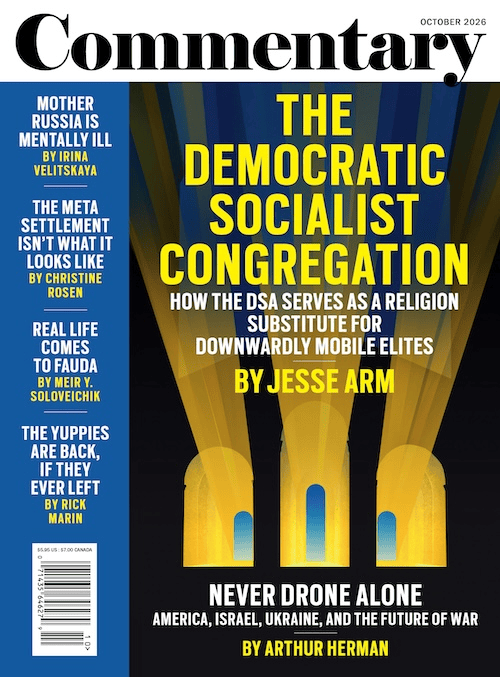
COMMENTARY MAGAZINE: The latest issue features ‘The Democratic Socialist Congregation’ – How The DSA Serves As A Religion Substitute For Downwardly Mobile Elites….

The Democratic Socialist Congregation

How the DSA serves as a religion substitute for downwardly mobile elites by Jesse Arm

Never Drone Alone

What our history and Ukraine’s strategies can teach us about the future of war by Arthur Herman

The Jewish PRIZE

A five-point plan to fight anti-Semitism in court—and win by Jeffrey Lax

Mother Russia Is Mentally Ill

Russia’s real enemy isn’t Ukraine. It’s helplessness by Irina Velitskaya