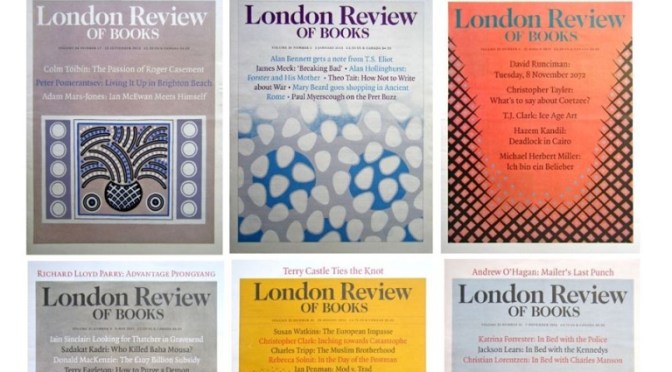
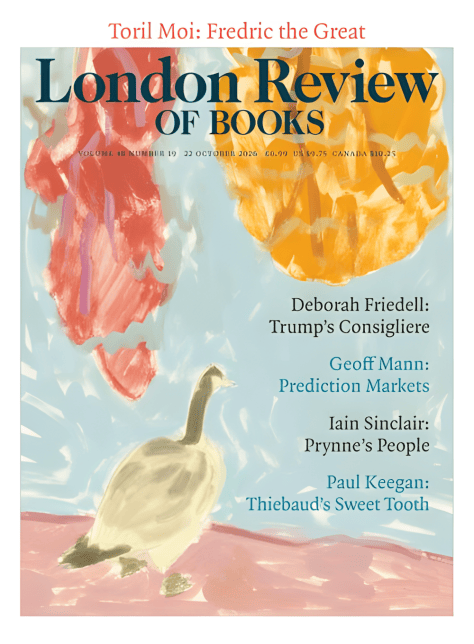
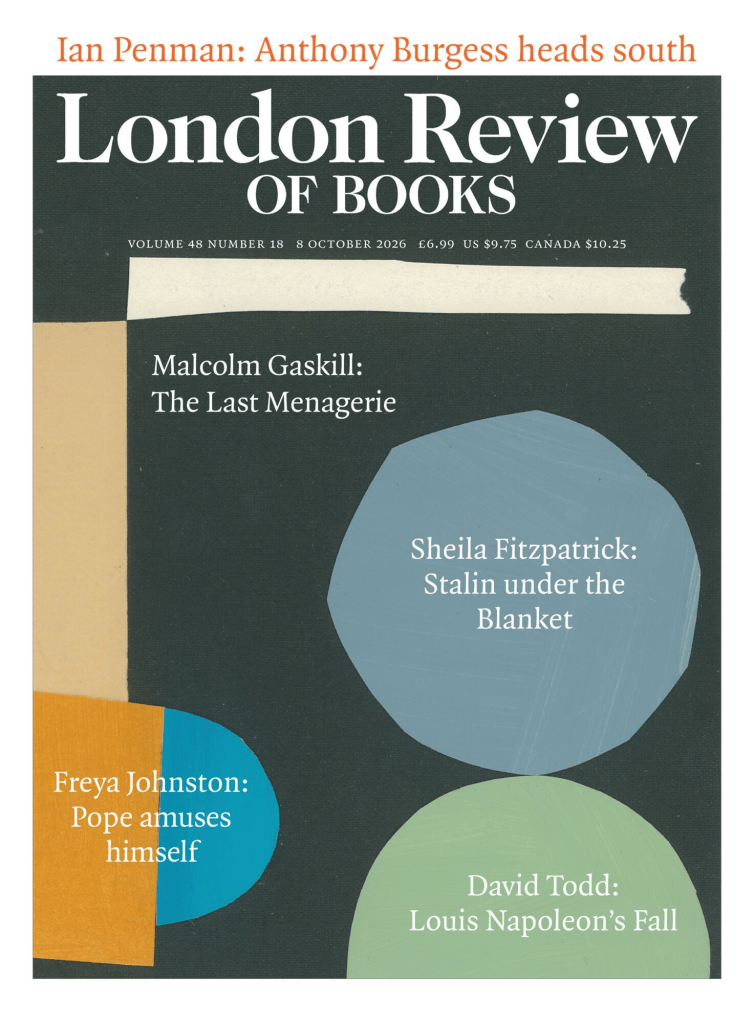
LONDON REVIEW OF BOOKS: The latest issue featuresFredric the Great by Toril Moi; Trump’s Consigliere by Deborah Friedell; Prediction Markets by Geoff Mann; Prynne’s People by Iain Sinclair; and Theibaud’s Sweet Tooth by Paul Keegan….
Fredric Jameson seemed to me to have read absolutely everything. He was the very antithesis of the intellectual type I think of as an empty theoriser, by which I mean someone who endlessly conjectures without having a genuine command of any relevant archive. To look at Fred as a reader of literature is not to reduce the scope of his work, but rather to try to understand its origins.
If the coming election does result in a blue wave, Trump will be faced with the fact of his diminishment. The rest of us will be faced with the wreckage. By David Remnick
The F.B.I. director’s hockey team, the Dons, faced their rivals in a beer league. With rogue slap shots and hovering security agents, Patel was in the zone—or, at least, next to it. By Richie McGinniss
My Education on the Border of the Syrian War
In the last Turkish town on the road to Aleppo, jihadis and spies mixed with reporters trying to prove themselves. By Ben Taub
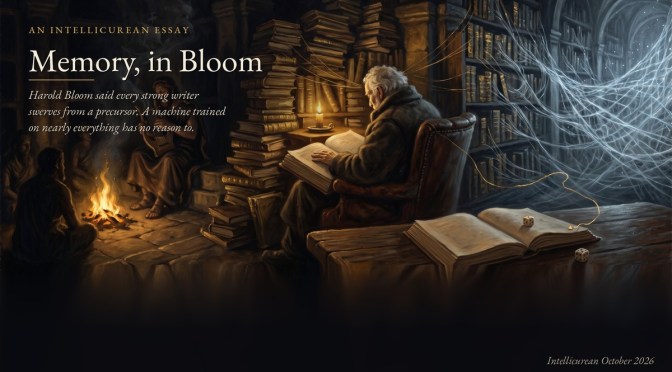
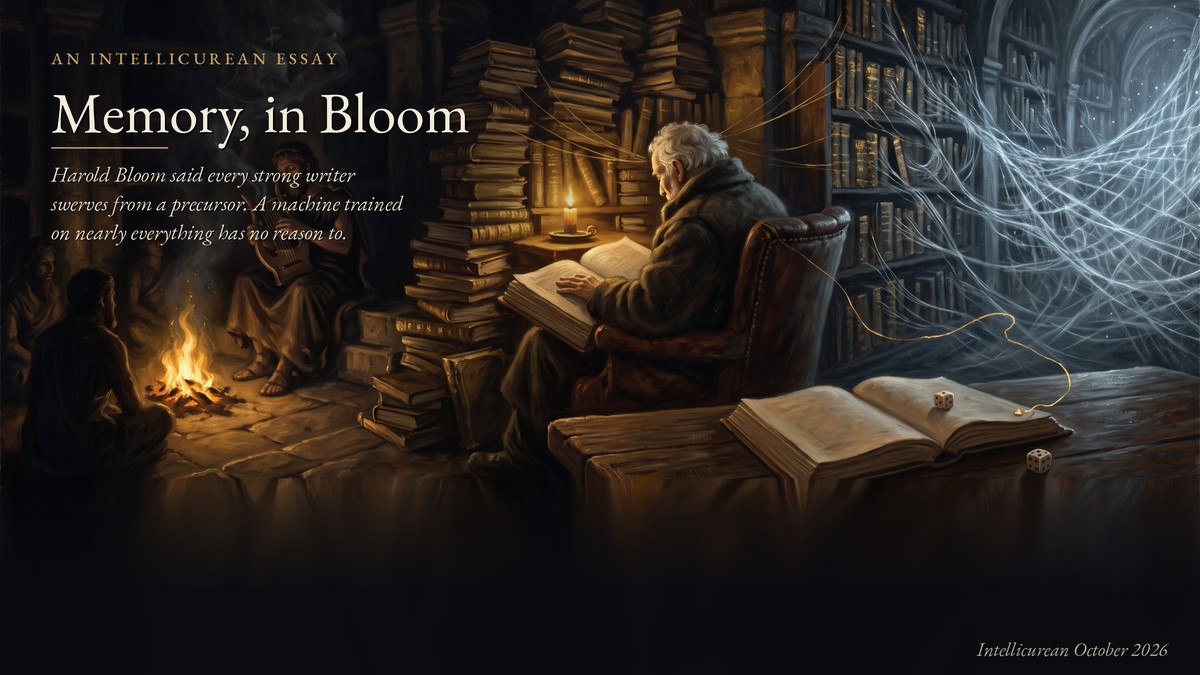
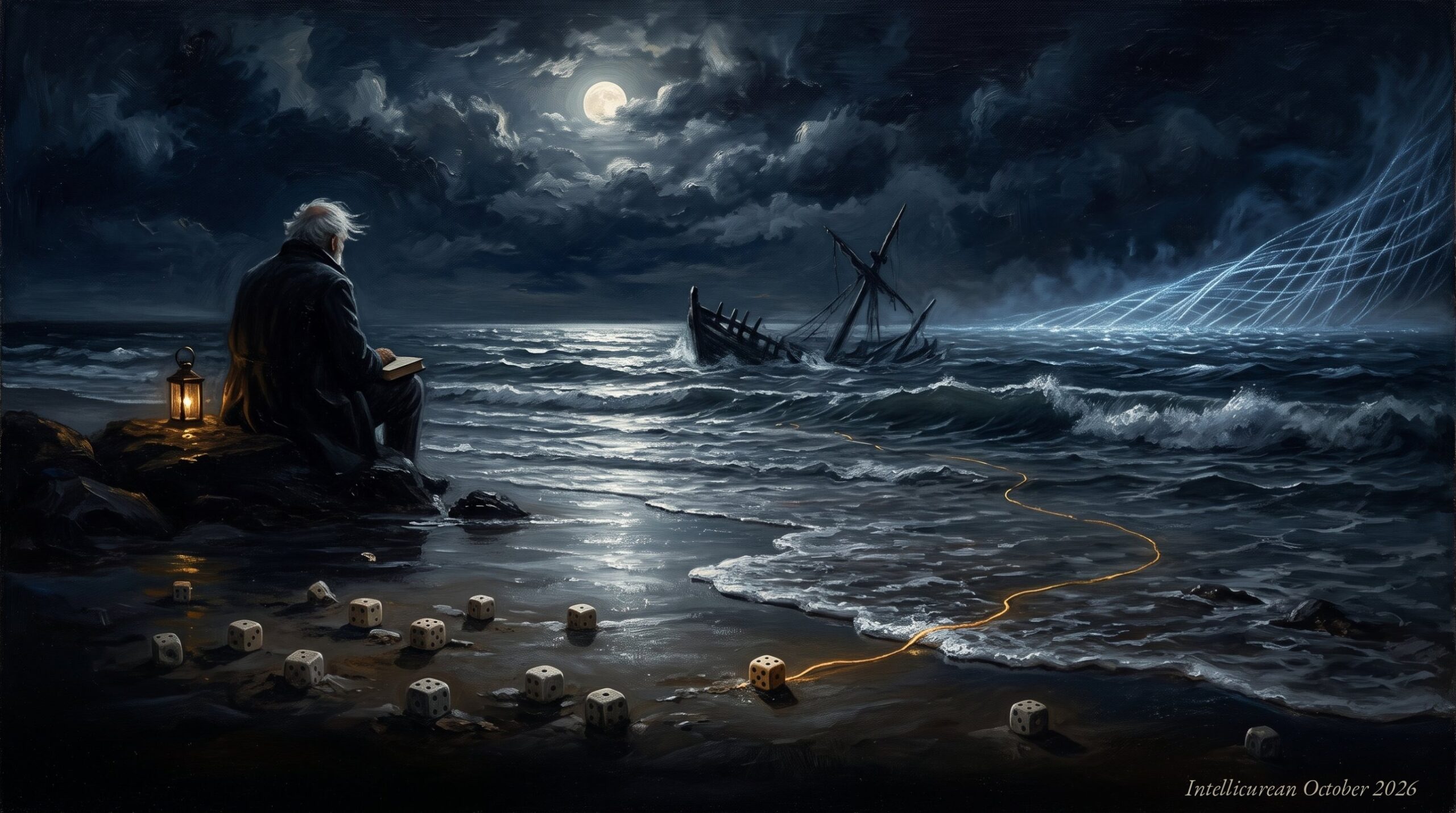
Nothing reliable is known about the life of Homer, yet two founding poems of Western literature bear his name. Harold Bloom, who said he could read and absorb a 400-page book in an hour, left a monument made not of poems but of memory. A new essay sets them face to face, with a third reader between them.
The singer, the reader and the lattice: three ages of memory in one room, made for the essay.
Why we’re pointing you there
Bloom held that every strong writer survives the past by misreading it on purpose, swerving from a precursor to make room for something new. Michael Cummins sets that theory against a reader Bloom never met: a language model, trained on a large share of everything written. The essay moves through scenes rather than abstractions. In 1926 the editor of Poetry asked Hart Crane, whose poems were the first book Bloom ever owned, to explain how dice could “bequeath an embassy,” and Crane’s answer became a defense of the unlikely line. A singer in 1930s Yugoslavia swore he sang a song “word for word and line for line,” and the recordings showed he hadn’t. In 2023 a chatbot supplied a federal court decision, signed with a real judge’s name, that no judge had ever written.
Along the way come Benjamin Franklin rebuilding essays from The Spectator, Helen Keller’s trial over a story she didn’t know she remembered, BloomBloom’s one novel and the precursor he couldn’t escapersquo;s one novel and the precursor that haunted it, and a singer in the Odyssey pleading for his life: “Self-taught am I.” The essay says plainly that it was drafted with Claude. It leaves one question open: when a writer can ask, at any hour, for the likeliest next line of anything, will that writer still learn to want the line no one else could have written?
The dice of drowned men’s bones, after Hart Crane, made for the essay.
On Afghanistan, empire, and American amnesia on the 25th anniversary of the US invasion. Leila Christine Nadir
Armando Ledezma writes on voguing with the House of Ruber in Caracas.
Alex Kitnick profiles Unmuzzled OX, a cult journal that seduced the best writers and artists in America.
Samuel Chu reports on Operation Yellowbird, the Umbrella Movement, and the dissidents of Hong Kong.
Andie Eisen considers the women taking over the funeral industry.
Jonah C. Sirott probes how the right stole the flying saucers and the Democrats lost the weirdos.
Michel Chaouli reflects on the history—and pleasures—of traveling and reading.
Essays by Amber Bal and Doyle D. Calhoun on a misunderstood masterpiece of African cinema, Rachel Cusk on the art of Joan Snyder, Issa Quincy on the 60th annual Angola Prison Rodeo, Yael Segalovitz on slumber, and Negar Azimi on Iranian art in the 2000s.
Fiction by Ingeborg Bachmann (transl. Philip Boehm and Tess Lewis). Scenes by Maya C. Popa, Sophia Le Fraga, Yuri Herrera, Jason Porter, Brandon Harris, and Sarah Ruhl.
I Come Here Often by Sarah Wang. Double Feature by Eugene Kotlyarenko. Poetry by Sara Eliza Johnson, Jose Hernandez Diaz, Jessica Fisher, Keith S. Wilson, Eileen G’Sell, Mary Jo Bang, and Eduardo Martínez-Leyva.
Arrests have reached a record high—nearly fifty-one thousand in August alone—with agents conducting operations nationwide at hospitals, at airports, and outside schools. By Jonathan Blitzer
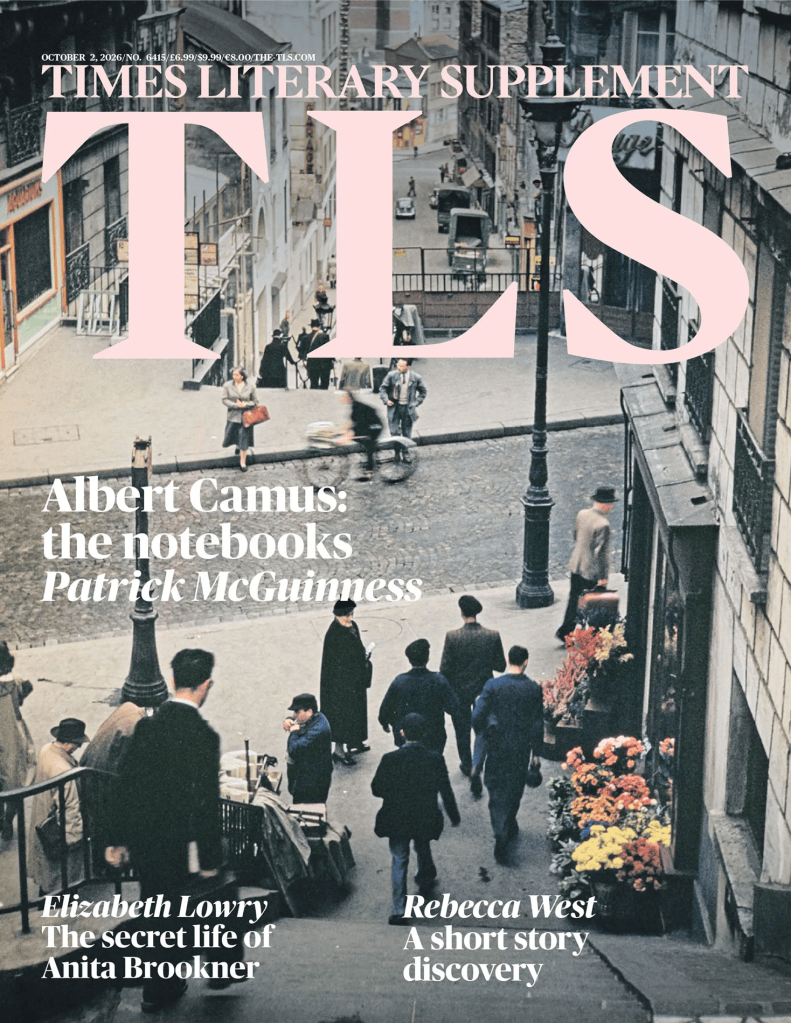
“Sadness of success”, writes Albert Camus in a notebook entry for June 25, 1947: “If everything were more difficult for me, as before, I’d have much more right to say what I say”. The success in question was winning the Prix des Critiques for La Peste (The Plague), published a fortnight earlier. It could be worse, the reader wants to tell him by way of consolation: you could have won the Nobel. Fast-forward ten years and the entry for October 17, 1957, reads: “Nobel. Strange feeling of overwhelming weight and melancholy. At 20 years old, poor and naked, I knew true glory. My mother”.
From its origins in the classical physique and homoerotic spectacle, bodybuilding today often involves the use of steroids whose dangers are not properly understood.
When Fitness Went Global: The Rise of Physical Culture in the Nineteenth Century by Conor Heffernan
A Genealogy of Male Bodybuilding: From Classical to Freaky by Dimitris Liokaftos
Muscle Works: Physical Culture and the Performance of Masculinity by Broderick D.V. Chow
King’s Secretary: William Paget and the Last Years of the Reign of Henry VIII By Andrew Johnston
Tudor history buffs and attentive readers of Hilary Mantel’s Wolf Hall trilogy will recognise the name William Paget. Others will require some words of introduction. Paget (1505/6–63) was an able and influential diplomat and administrator who rose to become principal secretary to Henry VIII. ‘Rose’ is the operative word. Paget, like his predecessor and mentor Thomas Cromwell, was a self-made man, though his father, a sergeant serving the sheriff of London, was able to provide him with a grammar school and Cambridge education.
The Last Invasion of England: 1688 and the Dutch Armada By Arthur der Weduwen
Much is exceptional about the Bayeux Tapestry currently on magnificent display in the British Museum, but nothing is quite so exceptional as the event itself. As the museum’s website reminds us, 1066 ‘was the last time England was successfully invaded’. Our sea-girt immunity from foreign invasion has been at the centre of ‘Our Island Story’ ever since, with the Channel confounding the hubris of Philip II in 1588 and 1596, of Napoleon in 1803 and of Hitler in 1940.
Imperial Predator: Britain and the Destruction of the Ottoman Empire By David S Tonge
In his survey of the collapse of the Ottoman Empire in the late 19th and early 20th centuries, David S Tonge sees Britain as an aggressive superpower, hence the title of his excellent book. My one quibble is zoological. ‘Predator’ may not be quite the right word. For in much of Tonge’s story Britain is less lion than vulture: what zoologists call an obligate scavenger – or a necrophagous power – feeding on carrion. The Ottoman carcass had already been wounded by Russian aggression, nationalist revolt, indebtedness and internal decay. There were exceptions, and Britain could be predatory when circumstances demanded, notably in Cyprus and Alexandria, but its more characteristic pose was to sniff the odour of mortality and arrive in time for lunch.
Sheila Fitzpatrick on Stalinism: Fitzpatrick examines Irina Paperno’s Always under Siege: Olga Freidenberg’s Diary-Theory and the Everyday Terror of Stalinism, analyzing how classicist Olga Freidenberg’s secret writings framed the Siege of Leningrad and Soviet surveillance as a totalizing domestic regime.
Tom Stevenson on NATO and Russia: Stevenson reviews Carlo Masala’s If Russia Wins: A Scenario and Thomas Newman and John Pierson’s Atlantic Resolve: The War for Estonia, analyzing contemporary Western military simulations and anxieties regarding Baltic security.
Literary Studies & Biography
Edmund Gordon on William Golding: Reviewing William Golding: The Faber Letters edited by Tim Kendall, Gordon details the editorial tensions between Golding and Charles Monteith, focusing on substantial cuts to the original draft of Lord of the Flies.
Freya Johnston on Alexander Pope: Johnston explores Henry Power’s edition of Alexander Pope: The Major Works, charting the Augustan poet’s biting satire, anxieties, and self-fashioning.
Ian Penman on Anthony Burgess: Penman re-evaluates Burgess’s 1966 espionage satire Tremor of Intent, dissecting its baroque style and its uneasy relationship with James Bond.
Art & Culture
Columns and Short Cuts: Additional pieces include Peter Geoghegan on democratic funding reform and Blake Morrison on Luke Kennard’s poetry collection Black Bag.
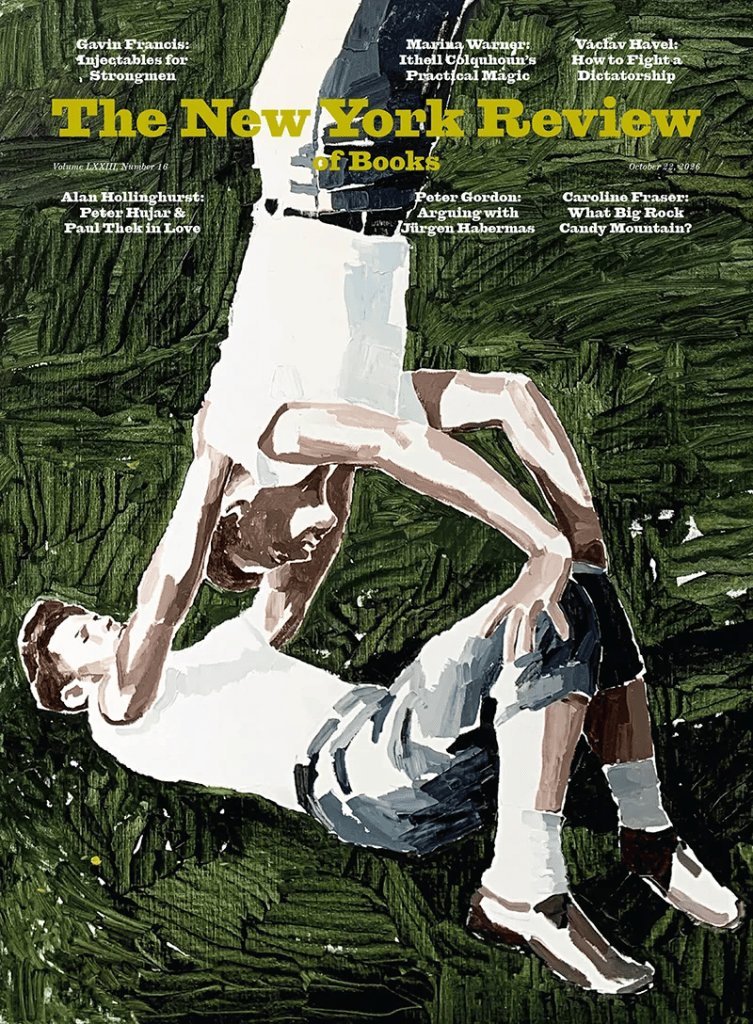
Em Hogan on Hujar and Thek: Hogan reviews Andrew Durbin’s dual biography The Wonderful World that Almost Was: A Life of Peter Hujar and Paul Thek, profiling the turbulent lives of the photographer and artist against 1960s–1980s New York and the onset of the AIDS crisis.
Dexter Dalwood on Jasper Johns: Dalwood contributes a review of Johns’s exhibition at the Guggenheim Bilbao, evaluating his enduring postwar artistic motifs and printmaking legacy.
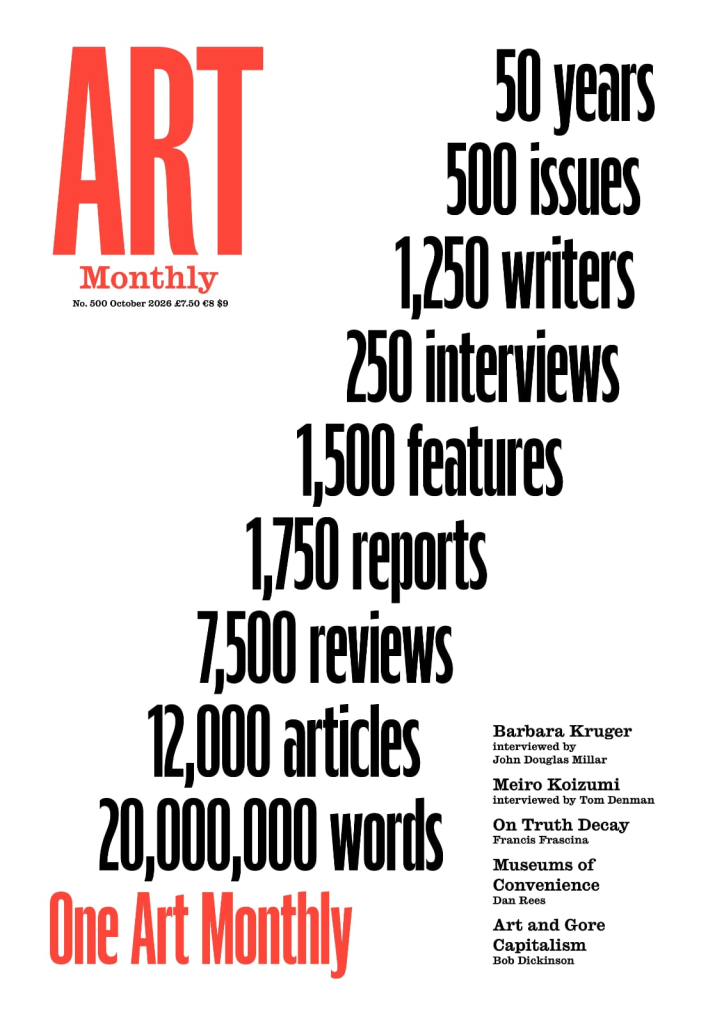
For Dan Rees, the maritime ‘flag of convenience’ system provides an apt metaphor for the expansion abroad of ‘flagship’ museum franchises
When experience becomes the primary value of the art encounter, the subject is increasingly encouraged to perceive themselves as an accumulator of experiences.
Dangerous Times
Barbara Kruger interviewed by John Douglas Millar
My work was hot, not cool. The address was forthright rather than withholding. I was never cool enough to be cool. That’s still the case.
On Truth Decay
Francis Frascina looks at the ways artists can combat the decay of truth in reportage and representation
Processes of monetised personal interiorisation symbolise the shift from what Frankfurt School theorists warned about the addictive ‘drug’ of corporate television in the 1950s and 1960s to contemporary algorithmic induced ‘doom scrolling’ – all fertile ground for truth decay.
News, Views and Reviews For The Intellectually Curious