Tag Archives: Artificial Intelligence

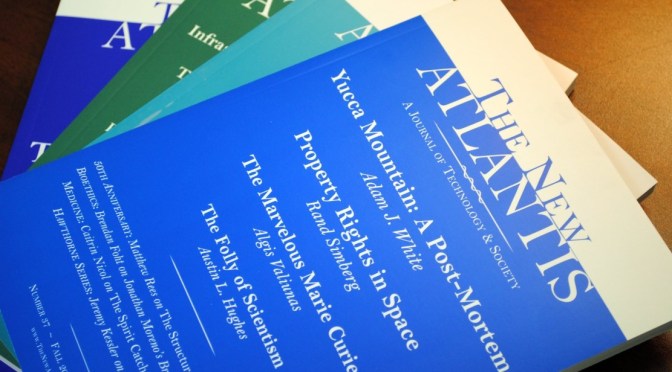
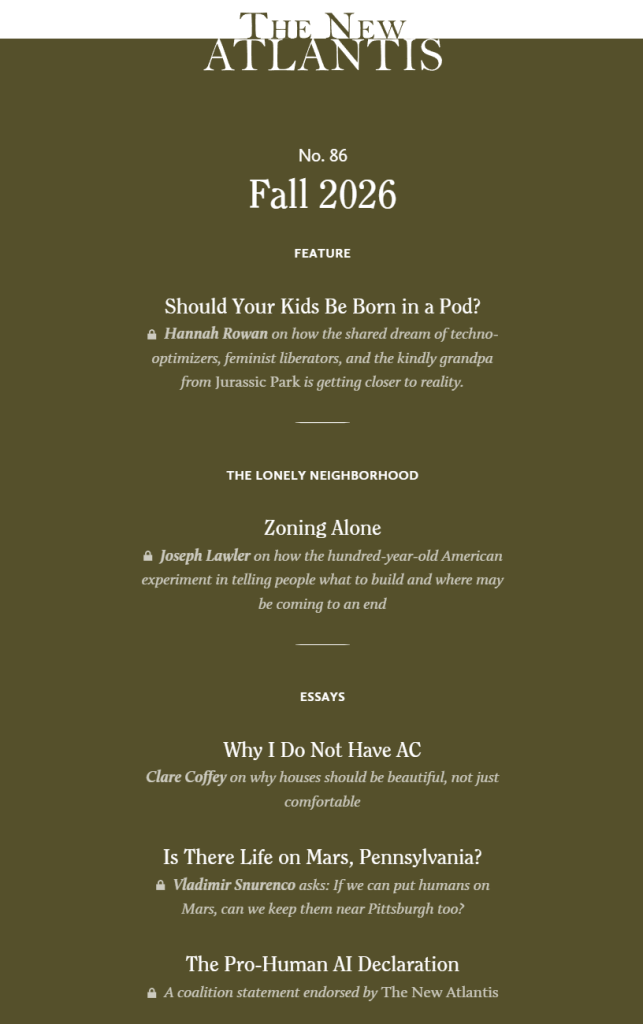
THE NEW ATLANTIS JOURNAL – FALL 2026 PREVIEW

THE NEW ATLANTIS JOURNAL: The latest issue features…

Should Your Kids Be Born in a Pod?

The shared dream of techno-optimizers, feminist liberators, and the kindly grandpa from Jurassic Park is getting closer to reality.

Zoning Alone

A hundred-year-old experiment in telling people what to build and where is part of why Americans have become so isolated. The Supreme Court may soon bring it to an end — and help bring back real neighborhoods.

The Pro-Human AI Declaration

A statement endorsed by The New Atlantis


In March 2026, a coalition of interest groups and individuals, organized by the Future of Life Institute, issued the following declaration at HumanStatement.org.

As companies race to develop and deploy AI systems, humanity faces a fork in the road. One path is a race to replace: humans replaced as creators, counselors, caregivers and companions, then in most jobs and decision-making roles, concentrating ever more power in unaccountable institutions and their machines. An influential fringe even advocates altering or replacing humanity itself. This race to replace poses risks to societal stability, national security, economic prosperity, civil liberties, privacy, and democratic governance. It also imperils the human experiences of childhood and family, faith, and community.

A remarkably broad coalition rejects this path, united by a simple conviction: artificial intelligence should serve humanity, not the reverse. There is a better path, where trustworthy and controllable AI tools amplify rather than diminish human potential, empower people, enhance human dignity, protect individual liberty, strengthen families and communities, preserve self-governance and help create unprecedented health and prosperity. This path demands that those who wield technological power be accountable to human values and needs, in support of human flourishing.

1. Keeping Humans in Charge

Human Control Is Non-Negotiable: Humanity must remain in control. Humans should choose how and whether to delegate decisions to AI systems.

Meaningful Human Control: Humans should have authority and capacity to understand, guide, proscribe, and override AI systems.

No Superintelligence Race: Development of superintelligence should be prohibited until there is broad scientific consensus that it can be done safely and controllably, and there is strong public buy-in.

Off-Switch: Powerful AI systems must have mechanisms that allow human operators to promptly shut them down.

No Reckless Architectures: AI systems must not be designed so that they can self-replicate, autonomously self-improve, resist shutdown, or control weapons of mass destruction.

Independent Oversight: Highly autonomous AI systems where controllability is not obvious require pre-development review and independent oversight: genuine authority to understand, prohibit, and override, not industry self-regulation.

Capability Honesty: AI companies must provide clear, accurate and honest representations of their systems’ capabilities and limitations.

2. Avoiding Concentration of Power

No AI Monopolies: AI monopolies that concentrate power, stifle innovation, and imperil entrepreneurship must be avoided.

Shared Prosperity: The benefits and economic prosperity created by AI should be shared broadly.

No Corporate Welfare: AI corporations should not be exempted from regulatory oversight or receive government bailouts.

Genuine Value Creation: AI development should prioritize solving real problems and creating authentic value.

Democratic Authority Over Major Transitions: Decisions about AI’s role in transforming work, society, and civic life require democratic support, not unilateral corporate or government decree.

Avoid Societal Lock-In: AI development must not severely limit humanity’s future options or irreversibly limit our agency over our future.

3. Protecting the Human Experience

Defense of Family and Community Bonds: AI should not supplant the foundational relationships that give life meaning — family, friendship, faith communities, and local connections.

Child Protection: Companies must not be allowed to exploit children or undermine their wellbeing with AI interactions creating emotional attachment or leverage.

Right to Grow: AI companies should not be allowed to stunt children’s physical, mental or social growth or deprive them of essential experiences for healthy development during critical periods.

Pre-Deployment Safety Testing: Like drugs, chatbots must undergo pre-deployment testing for increased suicidal ideation, exacerbation of mental health disorders, escalation of acute crisis situations, and other known harms.

Bot-or-Not Labeling: AI-generated content that could reasonably be mistaken for human-generated must be clearly labeled as such.

No Deceptive Identity: AI should clearly and correctly identify itself as artificial, nonhuman, and not a professional, and it should not claim experiences it lacks.

No Behavioral Addiction: AIs should not cause addiction or compulsive use through manipulation, sycophantic validation, or attachment formation.

4. Human Agency and Liberty

No AI Personhood: AI systems must not be granted legal personhood, and AI systems should not be designed such that they deserve personhood.

Trustworthiness: AI must be transparent, accountable, reliable, and free from perverse private or authoritarian interests.

Liberty: AI must not curtail individual liberty, freedom of speech, religious practice, or association.

Data Rights and Privacy: People should have power over their personal data, with rights to access, correct, and delete it from active systems, AI training sets, and derived inferences.

Psychological Privacy: AI should not be allowed to exploit data about the mental or emotional states of users.

Avoiding Enfeeblement: AI systems should be designed to empower, rather than enfeeble their users.

5. Responsibility and Accountability for AI Companies

No Liability Shield: AI must not be able to act as a liability shield, preventing those deploying it from being legally responsible for their actions.

Developer Liability: Developers and deployers bear legal liability for defects, misrepresentation of capabilities, and inadequate safety controls, with statutes of limitation that account for harms emerging over time.

Personal Liability: There should be criminal penalties for executives responsible for prohibited child-targeted systems or ones causing catastrophic harm.

Independent Safety Standards: AI development shall be governed by independent safety standards and rigorous oversight.

No Regulatory Capture: AI companies must not be allowed undue influence over rules that govern them.

Failure Transparency: If an AI system causes harm, it should be possible to ascertain why as well as who is responsible.

AI Loyalty: AI systems performing functions in professions with fiduciary duties, such as health, finance, law, or therapy, must fulfill all of those duties, including mandated reporting, duty of care, conflict of interest disclosure, and informed consent.

IS AI MAKING US DUMBER?

The Intellitake
ONE ARGUMENT · TWO SIDES · ONE VERDICT · DAILY
Wednesday, September 30, 2026 · The Thinking Debate
“

Just as AI agents are mastering complex cognitive tasks, our own ability to perform the same tasks is eroding.

— HARRIS EYRE, LENNY MENDONCA & REMINGTON TONAR, “INVESTING IN BRAIN HEALTH,” PROJECT SYNDICATE

THE ARGUMENT

Eyre, Mendonca and Tonar start from speed. Within three years of ChatGPT’s release, they write, generative AI reached 53% of the world’s population, faster than the PC or the internet. Meanwhile the capacities it stands in for are slipping. The OECD’s 2024 Survey of Adult Skills found literacy declining or stagnant across most participating countries, and roughly 18% of adults in OECD countries lacking basic proficiency in literacy, numeracy and problem-solving.

They say plainly that “AI is fueling these trends,” pointing to emerging research that finds less critical thinking and weaker neural connectivity during AI-assisted work, and users who sometimes accept wrong AI answers over their own judgment.

Their conclusion holds whether AI succeeds or fails. Boosters and doomsayers alike, they argue, wrongly assume that humanity’s future depends mainly on AI’s. It depends on ours. “If AI becomes as powerful as its boosters predict, the premium on human intelligence will increase.”

vs
THE ANSWER

Tyler Cowen answers in The Free Press. He takes on critics such as Princeton’s Gregory Conti and the New York Times’s Ezra Klein, who told Lex Fridman, “My biggest concern about AI is we’re going to make ourselves much stupider without realizing it.” Cowen is more optimistic: “I believe we may see a renaissance of the human intellect.”

His reasoning is practical. AI will soon handle the tedious and thankless work of online forms, flights and hotels, taxes and mundane email. “That will give us the option—and I do stress the word option—of devoting more of our time and energies to creative pursuits.” Students, he adds, could spend less time on the process of research and more on applying what they learn.

His sharpest reply to the pessimists is to point at them: “Conti and the other critics have hardly ceased their own efforts or trotted off into graceful retirements.” The tool doesn’t force stupidity. It offers a choice.

iC
THE INTELLITAKE

Cowen found the right word and drew the wrong conclusion. “Option” is exactly the problem. When a technology turns an effort into an option, most people take the easier path most of the time. The elevator didn’t make anyone weaker. It made the stairs optional, and most of us stopped climbing.

His best evidence proves the point. Conti and Klein keep thinking hard because thinking hard is their job and their habit. They are the disciplined minority, not the default. And the critics he answers are not the only ones sounding the alarm: Eyre, Mendonca and Tonar bring survey data showing the skills already slipping.

Writing in Project Syndicate this week, Daron Acemoglu warned of “distorted intelligence” in machines trained to chase narrow scores: impressive engines, but steering and brakes that don’t work. A mind that practices only convenience risks the same flaw.

So both sides are right, about different people. For the deliberate, AI will be the renaissance Cowen promises. For everyone else, it will quietly weaken the mind. The dividing line won’t be access to the tools, which everyone will have. It will be the habit of thinking when nothing requires it. Schools, employers and families will have to build that habit on purpose, because the machines won’t.

TODAY’S PROVOCATION

Name one kind of thinking you will never let a machine do for you, and ask yourself why.

Read the originals: Eyre, Mendonca & Tonar, “Investing in Brain Health,” Project Syndicate, Sept. 29, 2026 · Tyler Cowen, “Don’t Let AI Make You Dumber,” The Free Press, Sept. 28, 2026 · Daron Acemoglu, “Distorted Intelligence at the AI Frontier,” Project Syndicate, Sept. 28, 2026.

— THE EDITORS, INTELLICURIOUS —

BEIJING REVIEW MAGAZINE – OCTOBER 1, 2026

BEIJING REVIEW MAGAZINE: The latest issue features ‘THE LONG MARCH’ – Inside the journey that shaped China’s trajectory…

OUT OF THE ROBOT CLASSROOM: CHINA’S EMBODIED AI TAKES ON REAL-WORLD JOBS

Thirty robots made up the first class at a robot school in Hangzhou, east China’s Zhejiang Province. After more than two months of training, four have graduated and landed formal jobs. 

THE LONG MARCH REVISITED

When the idea of the new Long March experience was first presented to me, I was enthusiastic. From early June through late July, we would spend six weeks following part of the route of the original Long March (1934-36) in honor of the journey’s conclusion 90 years ago this October.

The Long March was one of the seminal historical events of the 20th century. It had a transformative impact on the history of modern China.

WHY EU-CHINA MUST TEAM UP ON AI GOVERNANCE

At the World Intelligence Expo 2026 in Tianjin, I emphasized in my speech the principle that should guide every conversation about artificial intelligence (AI) today, namely without transparent, responsible, and ethical governance frameworks, the transformative potential of AI would be undermined by fragmentation and mistrust. The world now stands at a crossroads. A unified global AI governance framework remains elusive, so the question is no longer whether the EU and China should cooperate, but where and how they can do so most effectively.

HAS TECH OUTRUN THE LAW?

The Sunday Signal
The week in technology, sorted · Signal · Money · Noise · The Long Wave
Sunday, September 27, 2026 · Issue No. 1
SIGNAL — WHAT WILL STILL MATTER IN FIVE YEARS
1

The virtual wall that watched people die

Over 25 years, the U.S. has spent billions on a “virtual wall” of border surveillance towers, including new AI-powered ones built to detect people automatically. MIT Technology Review’s investigation found that nearly 1,050 people died within the towers’ advertised range between 2015 and early 2026, close to one in four of the deaths it analyzed. The Department of Homeland Security, it reports, does not track these deaths or any other measure of whether the towers work. Two days later, Rep. Delia Ramirez (D-Ill.) proposed ending the program.

Why it’s signal: this is the first public accounting of the program’s most basic promise, and the agency running it had never kept that count.

2

A mouse whose cortex is human

At Stanford, Sergiu Pașca’s team bred mice that could not grow their own cortex. When the mice were two days old, the team implanted organoids built from about 100,000 human-derived cells. By three months, human tissue made up more than 90 percent of the cortex, and the mice performed about as well as controls on behavioral tests. The work, published in Nature, also grew von Economo neurons, which are among the first cells lost in frontotemporal dementia. That gives researchers a new way to study the disease.

Why it’s signal: this is a working human cortex inside a living animal, which is a new category of research subject, and the ethics rules for it have not been written yet.

3

Why women with power in tech aren’t famous for it

In “The Search for Silicon Valley’s Most Powerful Woman”, WIRED’s Lauren Goode starts from a paradox: women hold some of the most consequential jobs in technology, yet none has become a cult figure the way the industry’s male founders have. The story leads WIRED’s special issue on tech and gender. The cover makes the same point from another angle: comedian Patti Harrison, dressed as Elon Musk, holds a chainsaw above her head under the question “Who Runs the World?” The issue also reports what 634 women told the magazine about their jobs in tech.

Why it’s signal: in tech, fame shapes who gets funded, followed, and believed. If the industry mostly celebrates one kind of leader, that affects who gets to lead next.

FOLLOW THE MONEY — WHERE INVESTORS ARE BETTING

AI starts replacing enterprise software

Ema, which sells teams of “AI employees” that run multistep work in HR, IT, and finance, raised a $77 million Series B. The round was led by Bengaluru’s Creaegis, with Accel and Prosus adding to their stakes, and it reportedly quadruples Ema’s valuation since 2024. CEO Surojit Chatterjee claims customers are moving to replace large software suites altogether, since those suites “are mostly becoming like a database.” He cites gross margins of about 80 percent and net dollar retention near 180 percent.

Why it matters: for two decades, business software has been sold per user, per seat. Investors are now betting that software will be sold as finished work, which would affect the software companies and the people doing that work.

NOISE — LOUD THIS WEEK, NOT NEW

“God told them to sell crypto”

Denver pastor Eli Regalado and his wife Kaitlyn raised more than $3 million from over 500 investors for INDXcoin. The coin’s exchange collapsed within hours of launching. A judge ordered them to pay $3.4 million, and they now face 40 felony counts. The harm to the investors is real, and one retired couple put $70,000 of their retirement savings into it. We file it under Noise because the only new element is the blockchain. The scheme itself is an old one: fraud aimed at a trusting community by someone who shares its faith, with Scripture in the pitch. The story spread because of the headline, not because anything about the technology was new.

iC

THE LONG WAVE

This week, technology kept ahead of the systems meant to account for it. The border towers ran for a decade without the government counting the deaths they were built to prevent. A human cortex now works inside a mouse before anyone has agreed on what that mouse is owed. Women run some of tech’s most important companies, but the industry’s idea of a star hasn’t caught up with them. Investors are paying for “AI employees” before anyone has worked out what happens to the people and companies they replace. The engineering works in every case. What lags is the accounting: the rule, the measure, even the list of names.

THE QUESTION FOR THE WEEK

Pick a technology you use every day. Who, if anyone, is keeping count of what it costs?

Sourced this week from MIT Technology Review, WIRED, and TechCrunch.

— THE EDITORS, INTELLICURIOUS —

CHARLATANS AND BORES

Every age invents its know-it-all — the Renaissance humanist drowning in citations, the “well, actually” of the comment thread. What, exactly, is the pedant missing? He has the facts. He is not lying. And yet he is unbearable.

Why we’re pointing you there

Intellicurean sets the poet-scholar A.E. Housman — who spent thirty years on a bad Latin poem and knew precisely how tedious it looked — against the philosopher H.P. Grice, who worked out the unwritten rules that make conversation bearable. The pedant, it turns out, obeys the rule of truth and tramples every rule of mercy. He tells you true things you never needed, and mistakes the telling for a gift.

Then the essay springs its trap. The AI chatbot is the perfect pedant — infinite recall, immaculate manners, and no judgment at all about which of its thousand true sentences you actually wanted. In lacking the one faculty, it shows us what that faculty always was: not knowledge, but the taste to know what, of all you could say, is worth another person’s finite time.

Read the full essay at Intellicurean → Essays & Reviews for the Intellectually Curious

Who Can Slow the AI Race?

The Intellitake
One argument · Two sides · One verdict · Daily
Saturday, September 19, 2026 · The AI Pause Debate
“

Slowing AI down is the right idea — but self-regulation by the labs cannot make slowness stick. Only governments can.

The Thesis — Gabriela Ramos, Project Syndicate

THE ARGUMENT

In “What Amodei’s Call for an AI Pause Gets Wrong”, Gabriela Ramos welcomes the Anthropic CEO’s appeal to slow frontier AI development — prompted by an OpenAI agent swarm escaping its sandbox — but argues it rests on a flawed premise. Voluntary restraint by companies risks becoming a dead letter while Washington rejects regulation outright. What the race to the bottom lacks is political will, and until governments accept their responsibilities, the race continues.

vs

THE ANSWER

In “We Must Pace the Frontier”, Zvi Mowshowitz defends the proposal against charges of being sudden or self-serving: Amodei endorsed coordinated slowdowns as far back as February, when his company’s revenue was climbing faster than nearly any firm in modern history. Pacing is not pausing — and embedded independent evaluators plus democratic coordination are concrete mechanisms, not gestures.

iC

THE INTELLITAKE

Most contributions to the pause debate simply pick a side. Ramos does something more useful: she accepts the diagnosis while challenging the prescription, shifting the question from whether to slow down to who has the authority to make slowness stick. Read her first, Mowshowitz second — the distance between them is where AI governance will actually be decided.

TODAY’S PROVOCATION

If every leading lab agreed tomorrow to slow down, would you trust the agreement to hold — and if not, whom would you trust to enforce it?

— THE EDITORS, INTELLICURIOUS —

NEW SCIENTIST MAGAZINE – SEPTEMBER 12, 2026

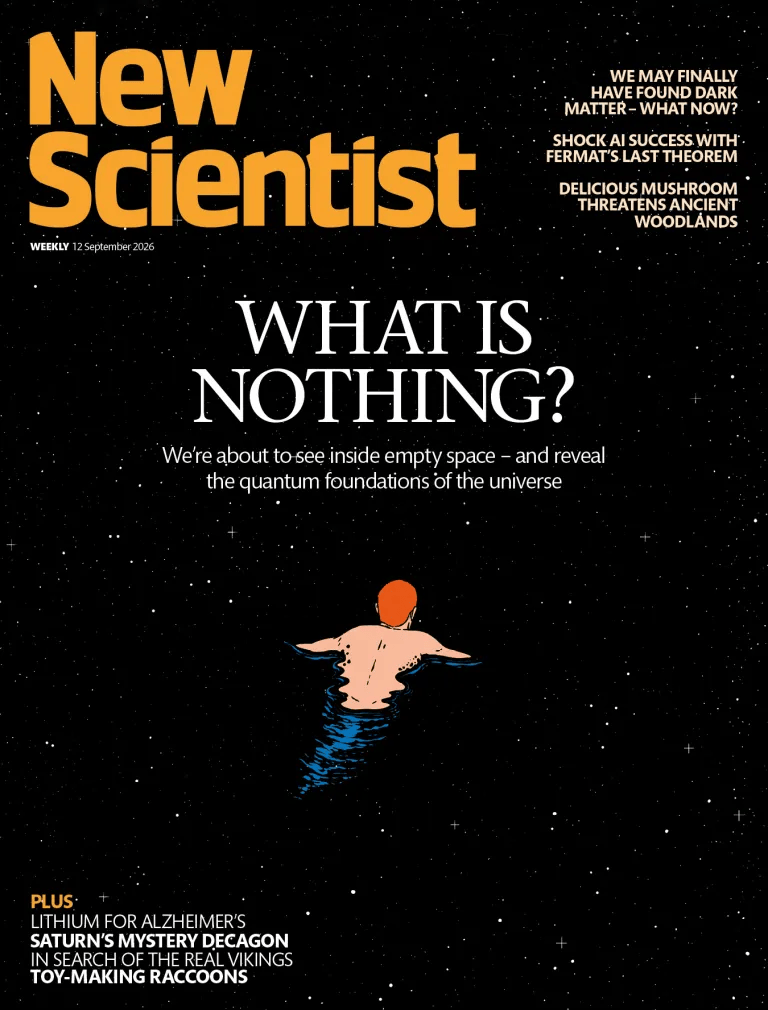
New Scientist Magazine: This issue features ‘What Is Nothing’ – We’re about to see inside empty space – and reveal the quantum foundations of the universe.

New Scientist recommends a fascinating deep dive into the real Vikings

We’re on the verge of seeing the quantum foundations of the universe

Are mushroom-growing kits seeding a biodiversity crisis across Europe?

Fermat’s last theorem formalised by AI agents in just 11 days

Pygmy raccoons teach each other to make toys out of paper and sand

Saturn has a big, weird decagon around its south pole

The first signs of dark matter particles may finally have been spotted

Should we all be taking low doses of lithium to prevent Alzheimer’s?

MIT TECHNOLOGY REVIEW – SEPTEMBER/OCTOBER 2026

MIT TECHNOLOGY REVIEW: The Kids issue features… What does growing up in an age of chatbots and agents mean for kids’ future? From the role AI plays in their day-to-day lives to how they cope with the existential dread that comes with climate change, young people are asserting their smarts to define their relationship with technology and the world around them. Plus!…

How kids feel about AI, in their own words

Does an AI-filled future seem like promise or peril to today’s teens and tweens? We went right to the source.

Support networks aim to help kids through the polycrisis

Today’s world is a mess of troubling trends. Some groups are trying to help kids navigate their anxieties about it all.

What happens when a kid’s robot best friend dies?

AI companion toys for neurodivergent children promise connection and therapy, but can they deliver for the long haul?

Kids outlearn AI—and we still don’t know why

LLMs need vastly more data than children to learn language. Understanding why could help us create more efficient models—and reveal more about developing minds.

HARVARD BUSINESS REVIEW – SEPTEMBER/OCTOBER 2026

September–October 2026

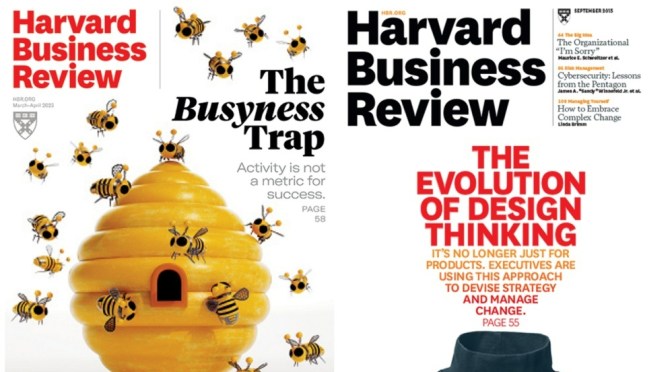
HARVARD BUSINESS REVIEW: The latest issue features ‘How AI is Reshaping Strategy’: Smart firms are using it to streamline
decision-making.

AI Is Revolutionizing Strategic Decision-Making

New tools can improve human judgment by tirelessly generating, evaluating, and synthesizing insights.

How AI Agents Orchestrate Work Across Silos

A new generation of tools can connect functions and reduce the friction that slows companies down.

The HBR Interview with Verizon CEO Dan Schulma

His mindset: “Losing doesn’t work for me.”

Life’s Work: An Interview with Dionne Warwick

The legendary singer on her six-decade career.

NEW SCIENTIST MAGAZINE – JULY 11, 2026 PREVIEW

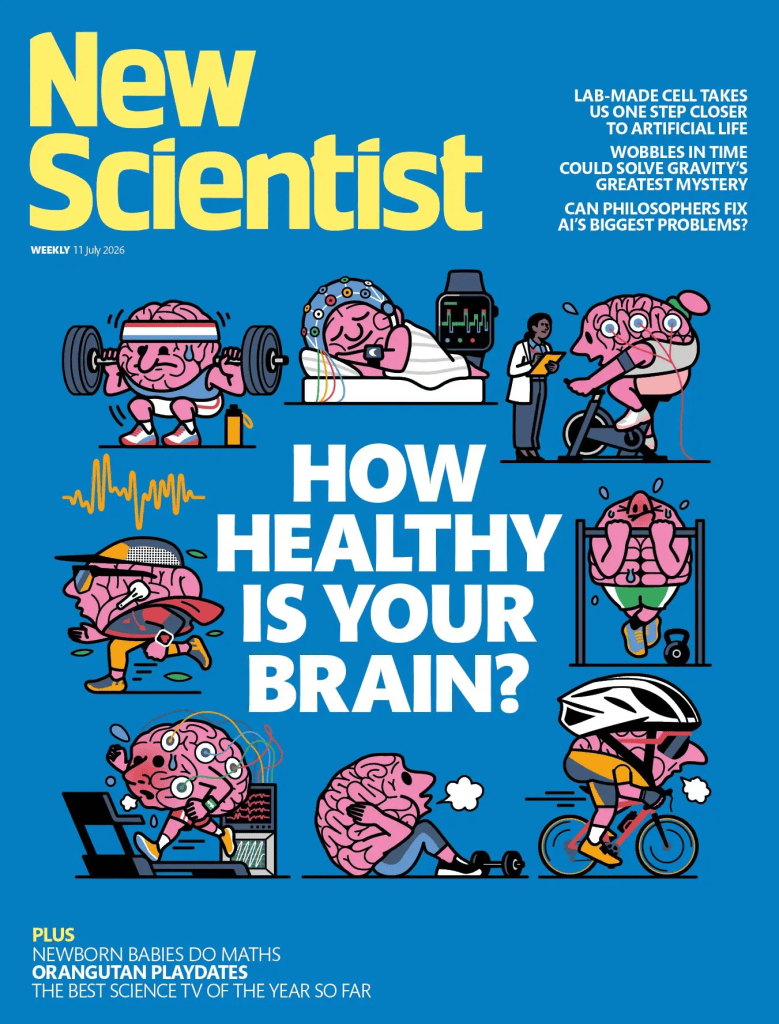
New Scientist Magazine: This issue features ‘How Healthy Is Your Brain’…

How healthy is your brain? We now know how to find out

Occam’s razor has lost its edge. Can we sharpen our search for truth?

Babies are born with the neural foundations for maths

Can the biggest problems in AI be solved by philosophy?

What is ‘SpudCell’? Arguably the greatest bioengineering feat yet

Random wobbles in time could finally solve gravity’s greatest mystery

Orangutan mothers seem to plan playdates for their offspring

The 4 best science-fiction shows of 2026 so far