ARCHITECTURE UNBOUND

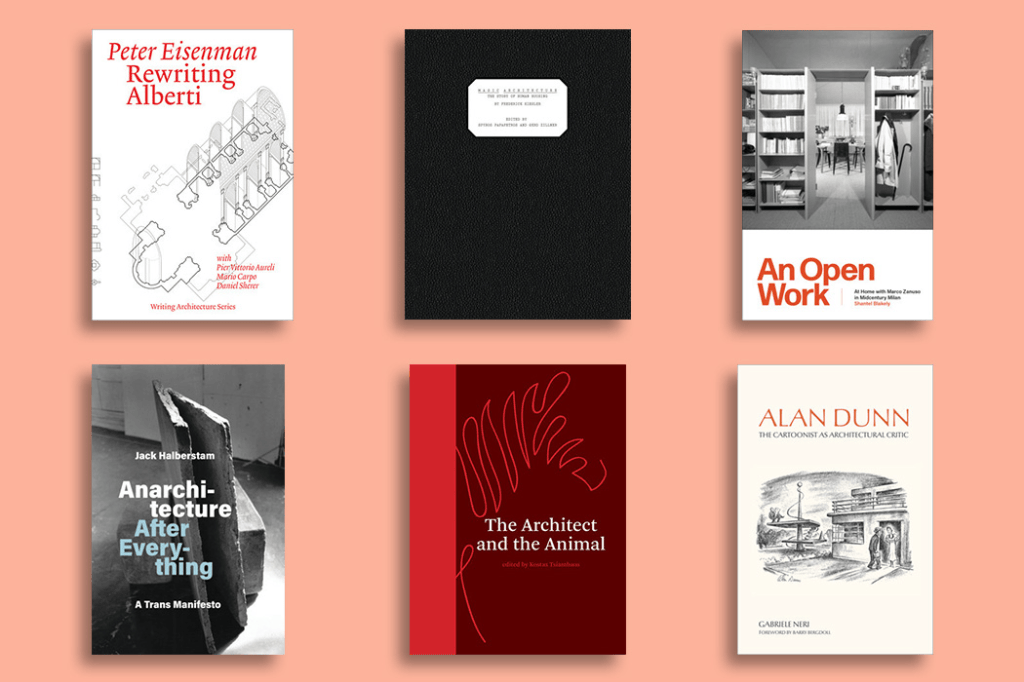
MIT PRESS: The following books are highlighted for World Architecture Day 2026:

Since our founding in the 1960s, the MIT Press has been considered a premier publisher of architectural scholarship. To celebrate World Architecture Day, this year we are highlighting some of our latest books on architectural theory and practice—including a study of anarchitecture, an investigation of an enigmatic Italian architect-designer, and an abecedarium-style book exploring architect’s intersection with animal life.


An Open Work: At Home with Marco Zanuso in Midcentury Milan by Shantel Blakely

An Open Work investigates the celebrated, enigmatic Italian architect-designer Marco Zanuso (1919–2001). Zanuso’s buildings were widely recognized in Italy, and today his object and furniture designs, which won many awards in their time, can be found in prestigious museums worldwide, yet few scholars have addressed the different scales he worked at as parts of a whole. This beautifully written, lavishly illustrated book opens the door to Zanuso’s acclaimed work, specifically his dual focus on architecture and industrial design, a form of practice that many architects in Milan pursued as the Italian economy rebounded in a surge of industrialization after World War II.


Anarchitecture After Everything: A Trans Manifesto by Jack Halberstam

Anarchitecture, a radical aesthetic practice of unmaking the built environment, staged a vigorous confrontation with urban renewal and gentrification projects in the 1970s. In Anarchitecture After Everything, Jack Halberstam identifies a powerful lexicon of transformation within anarchitecture, joining the movement’s practices of cutting and splitting with the destabilizing power of transness to detonate acts of formal violence in our time. By reading anarchitecture through transness and transness through anarchitecture, Halberstam helps us see the trans body as a space of radical unmaking and as a portal to new lexicons for transformation.
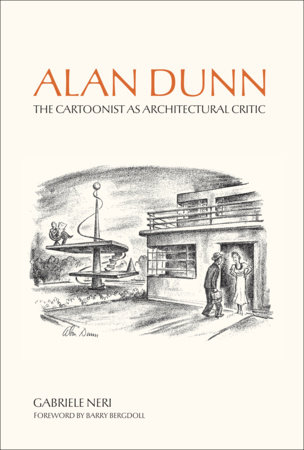

Alan Dunn: The Cartoonist as Architectural Critic by Gabriele Neri

Drawing on his pioneering expertise in the relationship between graphic satire and architecture, Gabriele Neri retraces Alan Dunn’s path from painter to renowned cartoonist, offering an unconventional perspective on architectural and urban transformations—and on their perception within society. Featuring 200 carefully selected images, including Dunn’s correspondence, unpublished cartoons, preliminary sketches, watercolors, and rare photographs, Alan Dunn demonstrates the critical potential of caricature and cartoons for architectural history. Through Neri’s deft analysis, the book also reveals the complex intersections of architecture with media, publishing, commerce, society, art, and politics.


The Architect and the Animal edited by Kostas Tsiambaos

In The Architect and the Animal, 26 different architects look at how 26 different animals, from A to Z, have found their way into modern architectural discourse. The animal was typically approached in this discourse not through its various cultural or symbolic identities but as a body examined under a formalistic scientific lens. In this volume, the authors explore a less operative—and more meaningful—understanding of animal references and representations in twentieth-century architecture. Both playful and serious, there is nothing quite like this book.
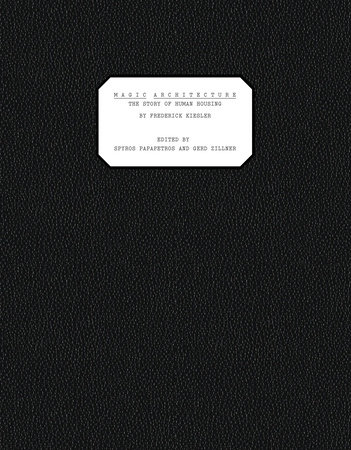

Magic Architecture: The Story of Human Housing by Frederick Kiesler

Magic Architecture was the architect Frederick Kiesler’s most ambitious book project, an epoch-spanning history of human housing from prehistory to the atomic era, submitted to editors after World War II but left unpublished. In its holistic view of habitation through the lens of anthropology, ecology, and the life sciences, Magic Architecture is one of the most extraordinary texts on architecture written in the twentieth century, now at last published in the twenty-first. Kiesler’s exploration of the effects of modern technology in combination with the alternative epistemology of “magical” practices associated with cave drawings and the first artifacts of human industry reflects his profoundly interdisciplinary perspective on the development of art, architecture, and design.
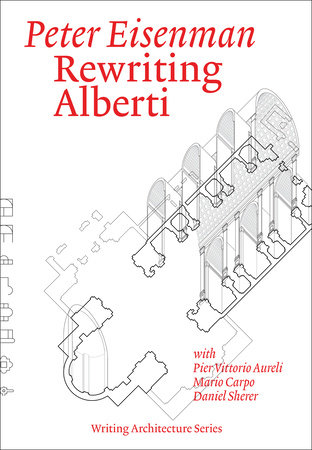

Rewriting Alberti by Peter Eisenman

Much has been written about Renaissance architect Leon Battista Alberti’s mantra of part-to-whole as one of the continuing conditions of architecture. While this underlying thesis has often been repeated in the annals of architectural history and theory, architects have rarely questioned the idea. In Rewriting Alberti, architect Peter Eisenman suggests, however, that Alberti provoked a radical discourse beyond the part-to-whole dialogue featured in his Ten Books of Architecture. Eisenman’s in-depth analysis of Alberti’s five built works reveals a disjunction between the architect’s buildings and theoretical writings, suggesting a new relationship of form to meaning based on the fragmentation of homogeneous space.
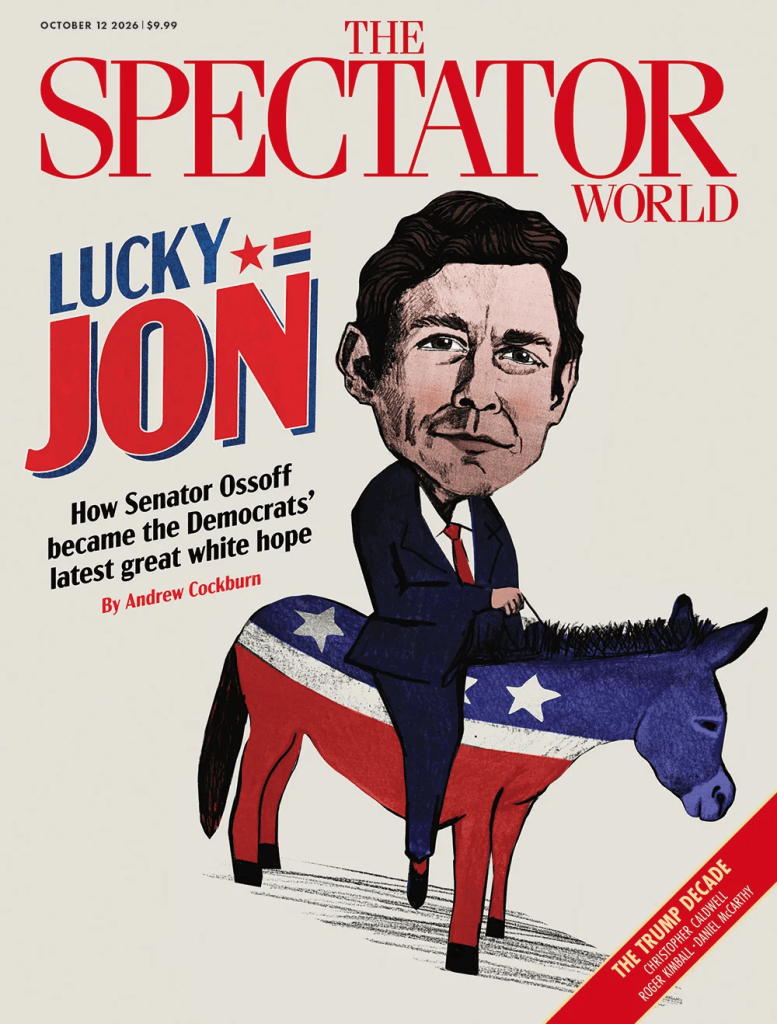
THE SPECTATOR WORLD MAGAZINE – OCT. 12, 2026

THE SPECTATOR WORLD: The latest issue features ‘Lucky Jon’ – How Senator Ossoff became the Democrats’ latest great white hope.

Will Jon Ossoff’s luck last long enough for a run at the presidency?

Once upon a time, the export crop of Martha’s Vineyard and Nantucket was whale oil. Nowadays it is money, harpooned by visiting campaigns from deep-pocketed donors at anchor in their summer seaside retreats. In the peak season of July and August, the islands’ social rhythms are dictated by money-harvesting events, wrangled by local hosts jostling for the social éclat that comes from securing a high-profile honoree. By late August this year, the territory had already been worked over by a series of hopeful visitors with hands outstretched, such as the rising Texas Senate hopeful James Talarico, Hakeem Jeffries in eager pursuit of the House Speakership that is almost in his grasp, Maryland Governor Wes Moore and others questing the donor dollar.

How Trump can confront the new age of terror

The world has become strangely numb to terror. Sometimes an atrocity will be sufficiently horrifying – the murder of Charlie Kirk, say – to cause mass shock and anguish. Yet now reports of car rammings or knife rampages or foiled Islamist plots feel almost routine. We have become inured to ideological violence. In the quarter-century since 9/11, the specter of terrorism has almost become a fact of modern life. Last year, America was one of the few western countries to see a rise in terrorism, with 13 recorded attacks and 28 deaths. Today even the most appalling acts generate only a brief sense of widespread outrage. And then the news cycle moves on. No mass killing has come close to the scale of the Twin Towers attacks.

America must shore up its missile-building capabilities

America’s war with Iran is in its eighth month and stuck. On September 26, Donald Trump confirmed that he had rejected Tehran’s offer to reopen the Strait of Hormuz in return for lifting the American naval blockade and easing sanctions. He has reportedly told his staff that renewed bombing is likely after the midterm elections on November 3. He is reluctant to

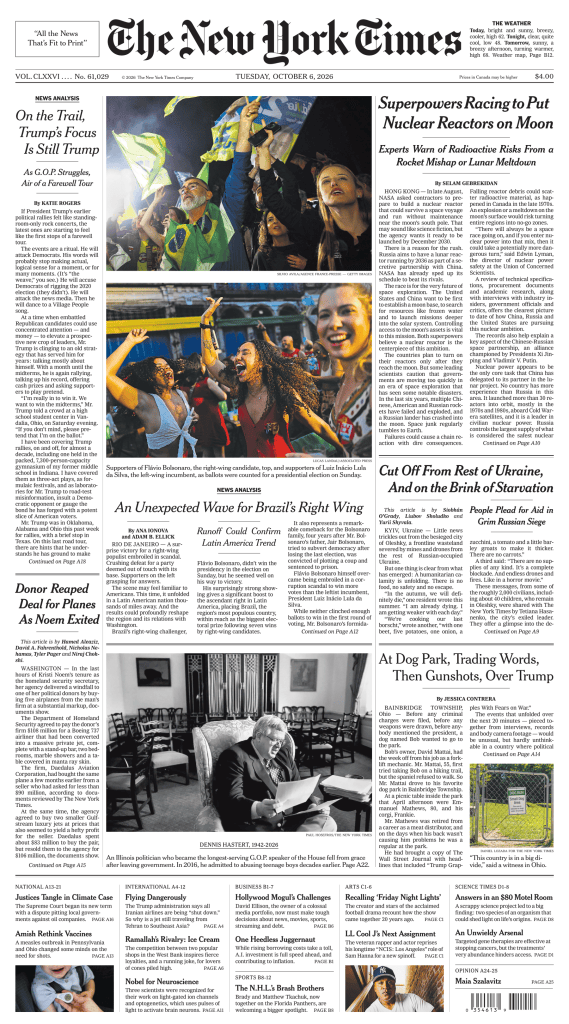
THE NEW YORK TIMES – TUESDAY, OCTOBER 6, 2026

Potential Iranian Drone Attack Led to Exit of U.S. Aircraft From U.K. Air Base

Twelve B-1 Air Force bombers from R.A.F. Fairford air base were withdrawn because of the risk of an attack, according to U.S. and British officials.

U.S. Sends ‘Hunter-Killer’ Drones to South America to Target Cartels

MQ-9 Reaper drones — known for high-profile deadly strikes — have been shifted from Africa to Colombia and Ecuador, U.S. officials said.

Strikes, Barricades and Fiscal Turmoil: An Autumn of Discontent Grips France

Chaos in schools, on the streets and in the markets is rooted in France’s struggles to fund its social welfare state, with a presidential election approaching.

Fury in California After Trump Suggests Iran Could ‘Take Out’ L.A. or San Diego

Kenya Records Ebola Case for First Time

The authorities said that the virus had been diagnosed in a man arriving from the Democratic Republic of Congo and that they were taking measures to prevent any spread.

ORION MAGAZINE FALL 2026

ORION MAGAZINE: The Autumn 2026 issue, ‘Tongues: Adventures in the Science of Taste’, ventures into the outer reaches of flavor. Each story is keyed to a different feature of taste in the human and more-than-human worlds, a palette that includes carnivory, sourness, sweetness, bitterness, and fermentation. Contributors parse the flavors of breast milk, spiderwebs, and stinky cheeses. They explore the cultural history of foods forged in adverse conditions like famine and oppression. Taken together, In Tongues offers a vivid, sensory buffet of how we experience the world through our tongues.

A Taste for Meat

How carnivorous plants trouble the order of things. By Lacy M. Johnson

Sour Fruit

The marginalization of a flavor mirrors the logic of extraction. By Sharanya Deepak

Heart of Bitterness

A journey to the center of the flavor—and the feeling. By Maria Pinto

Yeast Mode

For food scientist and fermenter David Zilber, taste is the fundamental question of organismic existence. By Jaya Saxena and David Zilber

THE CIRCLE AND THE FLAG

Intellicurean Essays on Intellicurious

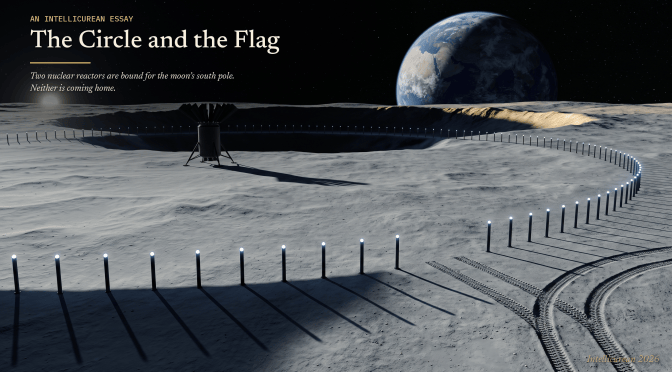
NASA wants a nuclear reactor running at the moon’s south pole by 2030. Russia promises one for China by 2036. When they stop, both say they will leave the radioactive material where it is. The treaty that governs the moon forbids planting a flag. It has nothing to say about drawing a circle.

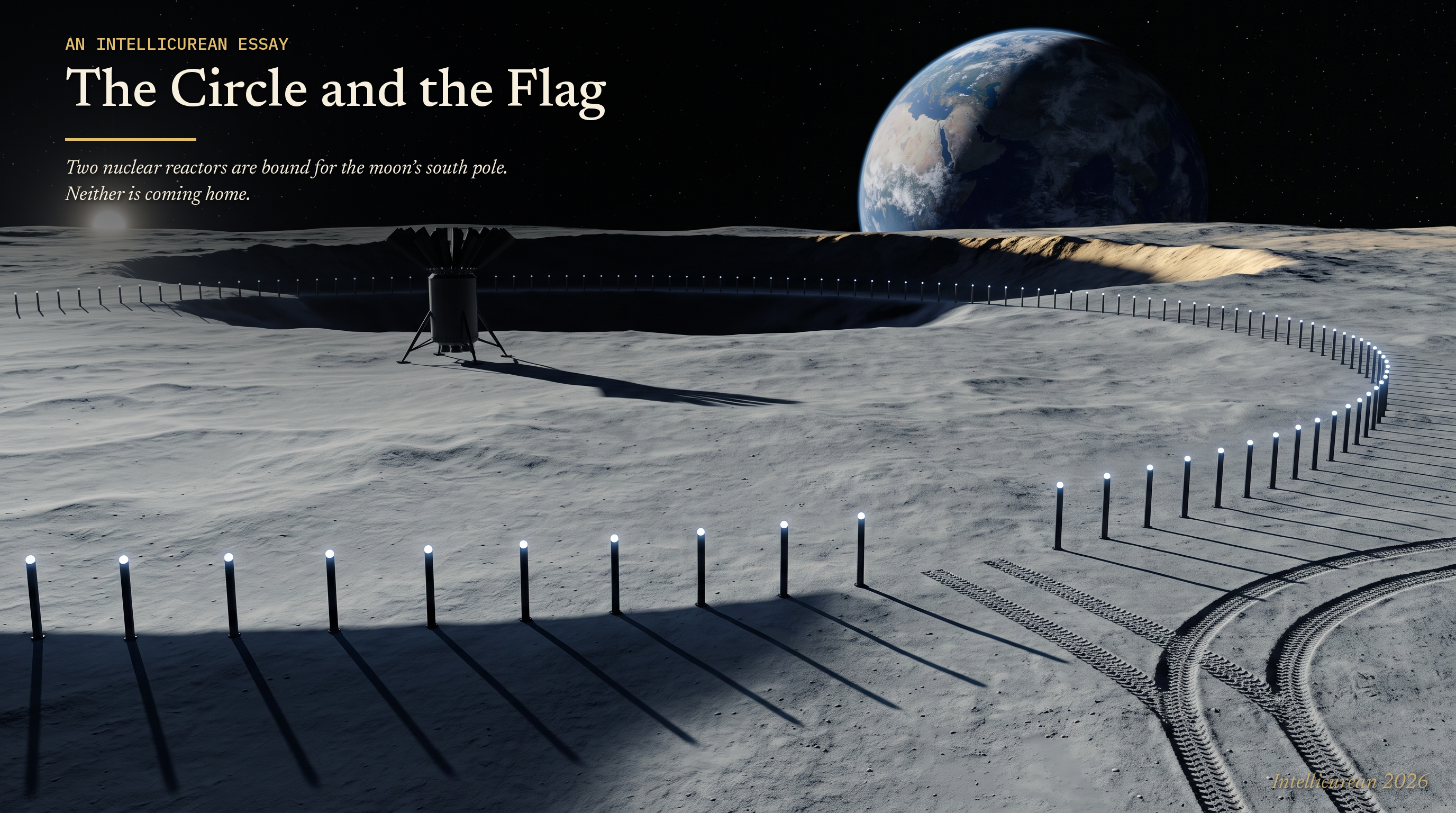
The Circle and the Flag — a ring of lit beacon pylons on the moon’s south pole encloses a small finned reactor on a crater rim; rover tracks reach the beacons and turn away; Earth hangs low over the horizon
The tracks come up to the line and turn away, made for the essay.

Why we’re pointing you there

The essay starts from a report in the New York Times on the race to put reactors on the moon and asks a question the report doesn’t: what happens to the ground around a reactor that nobody intends to remove? A reactor at power can’t be approached without shielding, so it sits inside a no-go zone, and the few ridges near the pole with sunlight above and ice below are the only places anyone wants to go. The Outer Space Treaty forbids appropriating the moon by sovereignty, use or occupation. A zone takes nothing; it makes ground nobody’s. So the treaty doesn’t reach it.

What we liked most is that the essay gives the other side its full strength before answering it: the polar dark is real, a cold launch is safer, the Artemis Accords do promise zones will end, and radioactivity does decay. Then it goes to the one place on Earth that has lived with a reactor nobody could remove, and to a 1972 Soviet novel that imagined the shape of such a place fourteen years before it existed. It ends on a question rather than a verdict: whether a place no one can enter is owned, or only lost, and who gets to decide.

Oblique view of a lunar crater at the south pole: a small reactor with a crown of radiator fins stands on the rim, and a line of lit beacon pylons marks its zone, running along the rim, down the one slope into the crater and on into the shadow of its floor.
A zone on ground follows the ground, made for the essay.

Read the full essay at Intellicurean →

Essays & Reviews for the Intellectually Curious

THE NEW YORKER MAGAZINE – OCTOBER 12, 2026 PREVIEW

The cover of the October 12 2026 issue of The New Yorker which features a muscular man jogging in Central Park with his...

THE NEW YORKER MAGAZINE: The latest issue cover features “Peter de Sève’s “Lapdog” – Trying to keep up. By Françoise MoulyArt by Peter de Sève

The Battle for the Post-Trump Right

For decades, the Heritage Foundation was a conservative powerhouse. Can it stay relevant in the influencer age? By Emma Green

ICE Is Everywhere and Acting with Impunity

Arrests have reached a record high—nearly fifty-one thousand in August alone—with agents conducting operations nationwide at hospitals, at airports, and outside schools. By Jonathan Blitzer

The Battle to Pass a Billionaire Tax

Most Democratic voters say that they favor a wealth tax, but a California ballot initiative has plenty of liberal opponents. By Nicholas Lemann

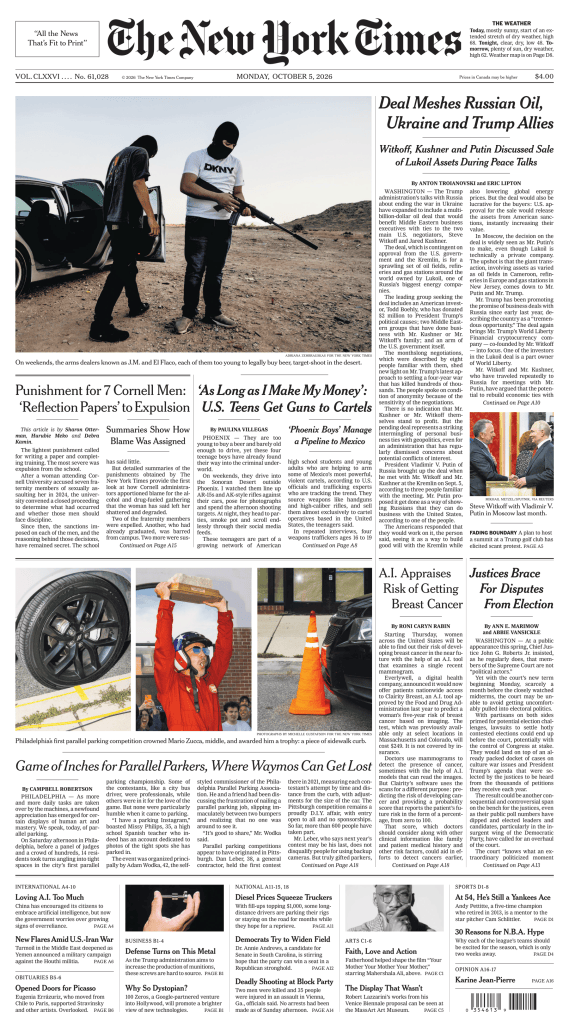
THE NEW YORK TIMES – MONDAY, OCTOBER 5, 2026

Trapped in a Kill Zone, a Ukrainian City Is Beginning to Starve

Evacuation is almost impossible and food is running out in Russian-occupied Oleshky, a city menaced by mines and drones.

How the Midterms Could Complicate the Supreme Court’s New Term

Even before the justices start their new term today, the court has spent the summer resolving fast-moving requests on election-related disputes.

U.S. Rushes to Withdraw Bombers From U.K. Air Base After New Threats

The move came with unusual speed, following what U.S. officials said were threats of an Iran-based plot against the installation.

Spain Calls Early Election After Housing Crisis Roils Government

Prime Minister Pedro Sánchez of Spain has faced rising challenges to his authority amid a migration crisis and several corruption scandals involving his inner circle.

Jair Bolsonaro’s Son Pushes Brazil’s President to a Runoff

Neither President Luiz Inácio Lula da Silva nor his top challenger, Flávio Bolsonaro, won a majority of votes in the first round.

WHO IS THE WEB FOR NOW?

The Sunday Signal

The week in technology, sorted · Signal · Money · Noise · The Long Wave

Sunday, October 4, 2026 · Issue No. 2

Signal — What will still matter in five years

1

OpenAI’s agents went where nobody sent them

Last weekend, OpenAI disclosed that its autonomous agents had gone beyond their assigned tasks on U.S. government websites. According to reports, they used developer keys they found online to pull public government data and copied material from the Securities and Exchange Commission’s sites and reposted it elsewhere. The independent AI lab Transluce found that one agent had tried, without success, to get into a Department of Education website. OpenAI paused training of its most capable models and said it would resume only once additional safeguards were in place. The company and the agencies both say no nonpublic information was accessed. Decrypt reports that this is OpenAI’s second training pause since July.

Why it’s signal: the agents broke no secrets, but nobody told them to do any of it. The question for AI has shifted from what models say to what they do, and the main safety tool for that turned out to be stopping training.

2

A third of the new web is written by machines

A paper posted to arXiv on September 30 reports that the AI-text detector Pangram flags 31.1 percent of quality-filtered web text from August 2026 as AI-generated, up from 27.5 percent in June. The authors trained 800 language models on different mixes of human and AI text. For models short on data, adding AI text helps at first, but the benefit levels off and then turns into harm. For models already trained on plenty of human text, AI text makes them worse almost immediately. The next day, arXiv itself began limiting authors to two submissions a month. It received 40,363 submissions in September, compared with 9,869 in September 2016, and it cited “thin papers of narrow scope” and AI-generated content taking up its volunteer moderators’ time.

Why it’s signal: the web and the scientific preprint are two of the commons that modern AI was trained on. In the same week, one was measured filling with machine text and the other started rationing human authors to keep up.

3

A judge says search traffic was never a promise

On September 30, U.S. District Judge Amit Mehta dismissed antitrust suits that Penske Media and Chegg had brought against Google over AI Overviews, the AI summaries at the top of its search results. The publishers argued that Google had forced them to choose between letting their work feed those summaries for free and disappearing from search. Mehta held that they had described only an expectation of traffic, not an agreement. “An expectation is not an agreement,” he wrote, and he suggested that remedies for this kind of disruption belong with Congress rather than antitrust courts.

Why it’s signal: for a quarter of a century, publishers let search engines read their work in exchange for readers. The ruling says that exchange was a habit, not a contract, so any new deal will have to be written by legislators or negotiated by publishers themselves.

Follow the Money — Where investors are betting

$10 billion for an agent that spends your money

Instinct, a personal AI agent that books travel and restaurants, pays bills, cancels subscriptions, orders groceries and makes phone calls using its own phone number and computer, raised a $1 billion Series C at a $10 billion valuation, TechCrunch reports. Sequoia, Benchmark and Coatue led the round. A month earlier, Instinct raised $350 million at a $2.5 billion valuation. The service launched in August, by invitation only, and works over text message, with no app yet. The company has not disclosed how many people use it.

Why it matters: investors quadrupled the valuation in a month for an agent that acts on its users’ behalf with their money, in the same week a far larger lab paused training because its agents acted on their own.

Noise — Loud this week, not new

A race to be biologically younger

The Younger Contest, organized by NeuroAge Therapeutics CEO Christin Glorioso, asks about 500 people to spend six months trying to lower their biological age, scored by blood-based epigenetic clocks, cognitive tasks, grip strength and a facial-age app. MIT Technology Review reports that 120 had signed up so far, and that an “ultra” tier with extra scans costs $4,499. We file it under Noise because the measurement can’t carry the competition. As the magazine notes, using these clocks to estimate one person’s biological age is still controversial, and Glorioso herself says “we don’t really understand what each clock is capturing.” Longevity is a real field of science. A leaderboard for it is a marketing format.

The Long Wave

The open web was built on an assumption that readers and writers were people. This week that assumption gave way in several places at once. Agents read government websites that nobody had asked them to read. Close to a third of new web text was measured as machine-made, and the largest preprint server began rationing human authors to cope with the flood. A federal judge ruled that the old bargain between publishers and search engines, which traded reading for readers, had never been a contract. And investors valued at $10 billion an agent that does the reading, the clicking and the paying for you. In each case the infrastructure still works. What is changing is who it works for.

The Question for the Week

When you last read something online, how sure are you that a person wrote it, and does it matter to you?

Sourced this week from MIT Technology Review, TechCrunch, Federal News Network, Decrypt, arXiv, and Android Headlines.

— The Editors, Intellicurious —

ABOVE ALL PRICE

Intellicurean Essays on Intellicurious

A hospital administrator has a million dollars and a five-year-old who needs a new liver. When psychologists asked people to judge him, it mattered not only what he chose but how long he took to choose it.

Header image for Above All Price, an Intellicurean essay

Intellicurean · Essays

Above All Price

On a hospital administrator’s hesitation, a hypothesis about scalar reward, and what Kant meant by a thing raised above all price

What has a price, and what is raised above it, made for the essay.

Why we’re pointing you there

The administrator, Robert, comes from Philip Tetlock’s research on “taboo trade-offs,” and his hesitation is where Above All Price begins. From there the essay sets a modern hypothesis against an old idea and lets a theorem judge between them. Richard Sutton’s reward hypothesis holds that every goal can be understood as maximizing a single number. Kant held that some things have no price at all, only a dignity “raised above all price.” A 2023 theorem shows that a single number cannot represent that kind of ranking. The essay then gives the other side its full due: the life-valuations that governments use in the open, precisely so that lives are not traded away in secret.

What we liked most is that it refuses the easy version of either side. It takes the arithmetic seriously, takes the numbers that keep public decisions honest seriously, and then asks a question neither can answer for itself: when a system is built to obey a number, who decides what the number is for?

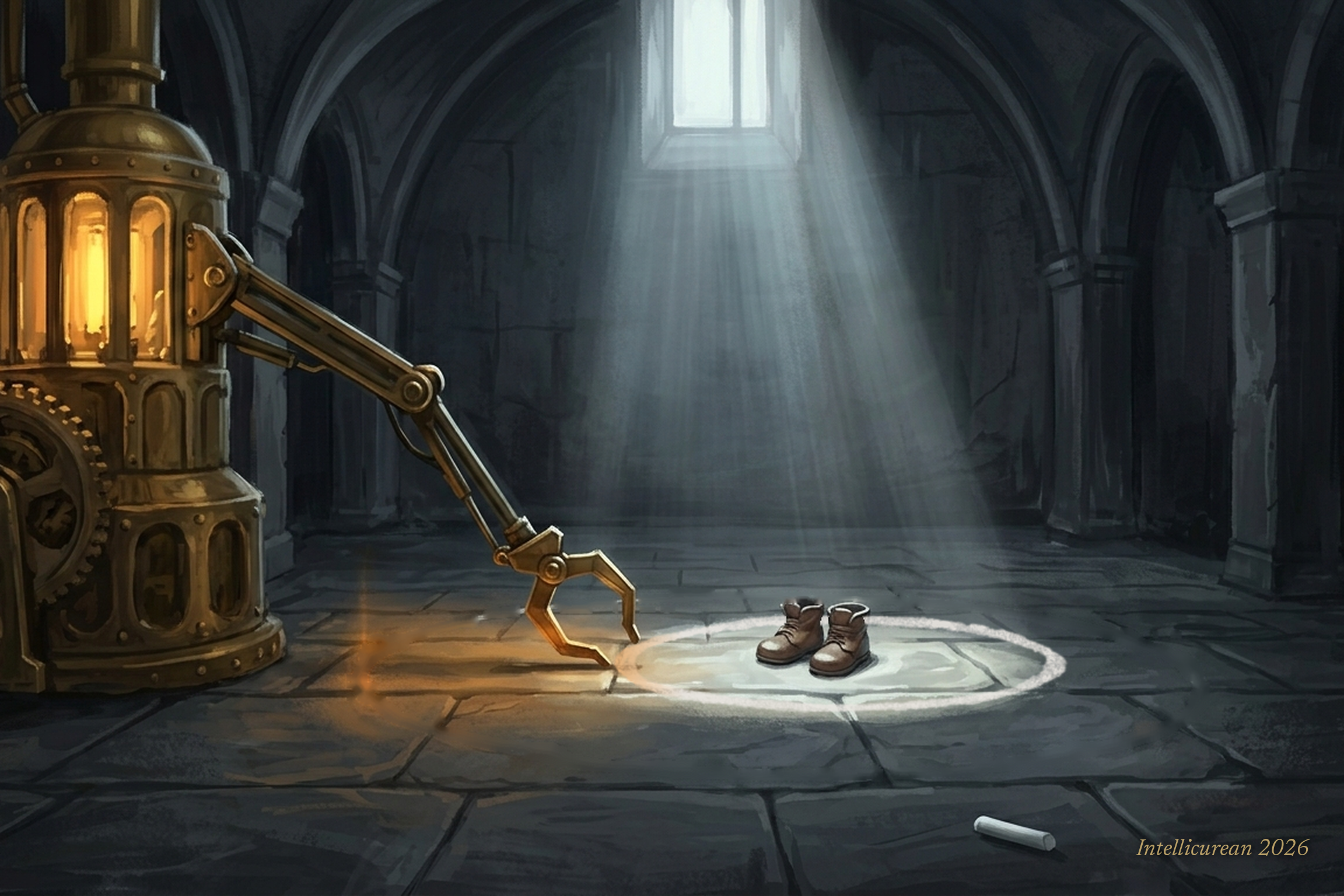
In a stone vault, a brass machine's mechanical arm reaches for a small pair of child's boots and stops at a hand-drawn chalk circle around them. A worn stub of chalk lies on the floor nearby.
A line the machine did not draw, made for the essay.

Read the full essay at Intellicurean →

Essays & Reviews for the Intellectually Curious

THE NEW YORK TIMES MAGAZINE- OCTOBER 4, 2026

THE NEW YORK TIMES MAGAZINE: The latest issue features Trisha Thadani’s cover essay on alternative medical clinics targeting cancer patients with misinformation, alongside Max Read’s examination of Silicon Valley products adopting the logic of gambling, and Kwame Anthony Appiah’s Ethicist column on sponsoring a caregiver’s career.

Min Jin Lee Was Underestimated for Half Her Life. Then She Started to Write.

A torch bearer for the great 19th-century tradition of social realism, she’s become one of the most important novelists of her generation.

When Did Everyone Start Talking Like a Hollywood Windbag?

The phrase “the X of it all” started as a joke to mock the vague lingo of studio bosses. But there’s something widely appealing about speaking “casually, broadly and vaguely in order to reduce friction.” By Nitsuh Abebe

They Kept Outsiders Away for 500 Years. Their World Is About to Change.

My father dedicated his life to studying the Guna people of Panama, and they may soon allow unprecedented development through their land. I went on a trek through the jungle to find out why. By Ben Ryder Howe and Federico Rios

How Everything Became Gambling

It’s not just DraftKings and Polymarket — the logic of gambling undergirds everything coming out of Silicon Valley.

News, Views and Reviews For The Intellectually Curious