The Mysteries of the Universe by Anna Badkhen: “I see now what this is about. I’m a professor and author in America, she’s in a war zone: to her, I’m rich and happy. How is she supposed to know about the cancer, the medical debt, Ksyusha’s student loans? So, I try to deflect.”
Encyclopedia of Botany by Jane Marchant: A daughter’s closely observed catalog of the flora around her Bay Area home, and of her family’s complex history of identity.
Glint of Sport by Angie Sijun Lou: “I don’t know if this story is true. You can’t divide truth from kitsch in this place…”
Eulogy by William Hawkins: In the wake of a funeral, a dead father’s legacy hangs over his surviving adult sons as they trudge into the lukewarm waters of the lake by the family pier.
The Eye by Elodie Saint-Louis: “When Theo spoke, she thought, you could see all of these places on his body. Vyros, Hymettus, Loutro, Parnitha. The land was in him. It was the river running out of his mouth. The words that bumped into each other gently but never spilled over, petering out into a gentle sway.”
Plus more fiction by Perry Janes, David Hayden (there be strange happenings in a dilapidated insurance building in Chicago), and Wendy Elizabeth Wallace.
Nonfiction
Jane Marchant on the flora around her Bay Area home—and her family’s complex history of identity.
Poetry
Jason Allen-Paisant, Dan Alter, Allison Benis White, Ricardo Cázares, E.G. Cunningham, Peter LaBerge, Joyce Mansour, Maria Zoccola
The Walk Street Videos (May 1, 2023) – Siem Reap, a resort town in northwestern Cambodia, is the gateway to the ruins of Angkor, the seat of the Khmer kingdom from the 9th–15th centuries. Angkor’s vast complex of intricate stone buildings includes preserved Angkor Wat, the main temple, which is pictured on Cambodia’s flag. Giant, mysterious faces are carved into the Bayon Temple at Angkor Thom.
The Globalist, May 2, 2023: Monocle Radio’s Georgina Godwin brings us today’s edition of ‘The Globalist’, with Agnes Poirier on newspapers and the latest technology news with Josh Cowls.
The bank’s rivals appear on firmer footing this time, in contrast with the widespread panic after the failures of Silicon Valley Bank and Signature Bank in March.
The unusually wet ground is one obstacle that the Ukrainian military, for all of its ingenuity, is finding difficult to overcome as it prepares for a counteroffensive against Russian forces.
Sotheby’s (May 1, 2023) – Returning each season to live and paint in Truro elevated Hopper’s art, allowing him to concentrate on the simplification of forms and the depth of both light and color woven into the surrounding landscape.
Both his technical approach to painting and his perception of the world from 1930 onwards are greatly informed by the Cape. Cobb’s Barns, South Truro derives its bright palette and topographical features from Hopper’s immediate environment, and is emblematic of the profound influence that life in South Truro had on his manner of painting.
Group of Houses, dated 1923-24, stems from a pivotal stage in the development of Edward Hopper’s career. Residential homes occupy much of Hopper’s subject matter in these early watercolors, and Group of Houses is no exception. These charming saltbox houses are typical for the Cape Ann region, whose architectural style reflects its coastal New England atmosphere.
The Battery, Charleston, S.C., dated 1929, is the result of Hopper’s three-week stay in the charming southern city, which is renowned for its Georgian-style architecture and cobblestone streets lined with lush palm trees. His Charlestown pictures possess an inherently tropical feeling, which sets them apart from his otherwise New England-focused oeuvre.
Red Barn in Autumn Landscape is among the limited number of watercolors that Hopper completed during the fall of 1927 in Vermont, and embodies the rustic quality of the New England scenery that drew Hopper to this region in the first place. Hopper routinely sketched his surroundings in coastal towns on the Cape or along the Maine shore, but Red Barn in Autumn Landscape is quite unique in that it captures a specific fall moment as the leaves gradually fade from green to burnt orange and red. The present work is emblematic of the simplicity and charm that characterize Hopper’s New England watercolors.
When in 1960 I first came across Osip Mandelstam’s poetry, nobody in the USSR had enjoyed access to his work since the early 1930s and few even knew of his existence, let alone of his death, as he had predicted, in Stalin’s Gulag. His books had been removed from libraries and bookshops.
‘Winnie and Nelson: Portrait of a Marriage’ By Jonny Steinberg
Under apartheid, aspiring South African writers frequently marketed themselves to the world as committed and heroic anti-apartheid activists. The enormous success of Alan Paton’s Cry, the Beloved Country (fifteen million copies sold and counting) showed the way, though Paton was the real McCoy, a committed liberal who suffered for his beliefs.
The Economist ‘Editor’s Picks’ Podcast (May 1, 2023) – A selection of three essential articles read aloud from the latest issue of The Economist. This week, Israel: the survivor nation at 75, is Sir Keir Starmer ready to govern Britain? (10:25) And why ChatGPT raises questions about how humans acquire language (19:05).
“People 50 and older hold the vast majority of wealth in the country, but we’re producing products and services for people who don’t have nearly as much money to spend…”
by Alexander Gelfand
April 27, 2023: Thanks to advances in medicine and public health, people are living longer, healthier lives. The world’s population of people 60 and older is growing five times faster than the population as a whole. Global life expectancy has doubled since 1900, and experts say that children born in developed countries now have a good chance of living to 100.
A “silver tsunami” is already sweeping the U.S. labor force: the Bureau of Labor Statistics projects that 36% of people ages 65–69 will remain on the job in 2024 — up significantly from the 22% who were working in 1994.
These longer-lived, longer-working individuals generate an ever-bigger slice of global GDP and control an expanding tranche of global wealth. In her recent book Stage (Not Age), Golden estimates that the “longevity economy” is worth more than $22 trillion — $8.3 trillion in the United States alone.
That may be a conservative figure: AARP (the organization formerly known as the American Association of Retired Persons) estimates that people over 50 already account for half of consumer spending worldwide, or $35 trillion. (This range of figures may have to do with how “older adult” is defined: The term is variously used to refer to people over the ages of 65, 60, or — sorry, Gen Xers — 50.)
“I would never in my life crack under pressure,” the recently declared independent says. “Why would they think I’m going to do it?”Credit…Ashley Gilbertson/VII for The New York Times
What the Arizona senator’s breakup with the Democrats means for American politics.
Kyrsten Sinema was standing a few yards from the border wall with four Republican members of Congress. The men were staring balefully at a row of nearby portable toilets, wondering aloud if they could hold out for a proper bathroom on the way back to the airport.
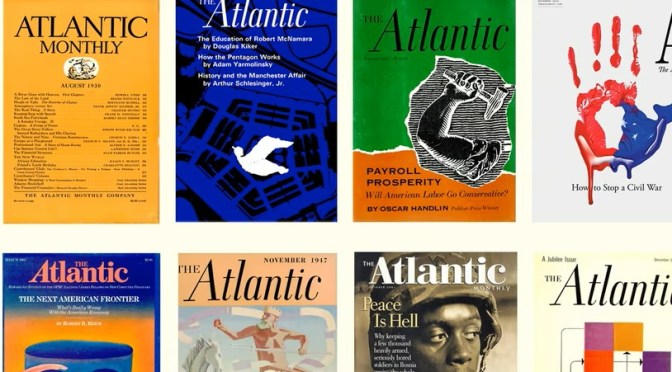
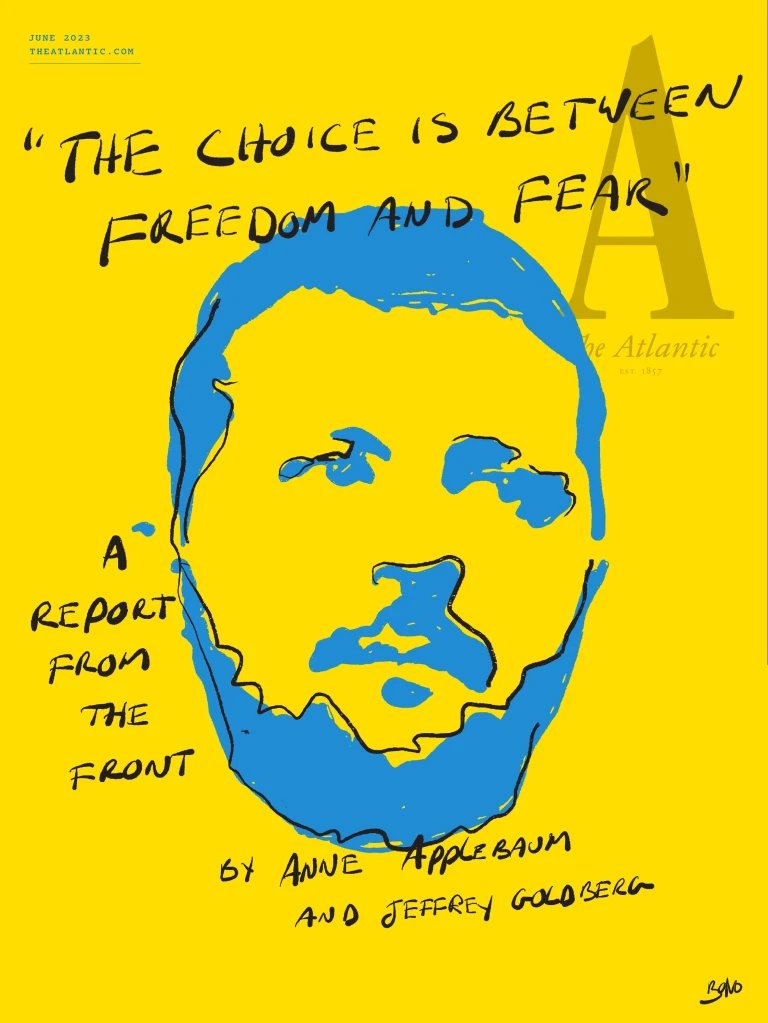
Bono illustrates President Zelensky for June cover
The Atlantic’s June cover is illustrated by U2’s lead singer, Bono, who sketches Zelensky and includes a quote from the Ukrainian president:
“The choice is between freedom and fear.”
In an editor’s note, also published today, Goldberg writes that, after learning Bono has a hobby of redesigning and reimagining Atlantic covers, he invited the singer and writer to create an original.
“Zelensky, a man we both admire, was a natural subject for his first go. Like Anne, Bono is preoccupied with issues of freedom and dignity, and, working with Oliver Munday, our associate creative director, he made a stunning cover that captures the resolve of Ukraine’s wartime president.”
News, Views and Reviews For The Intellectually Curious