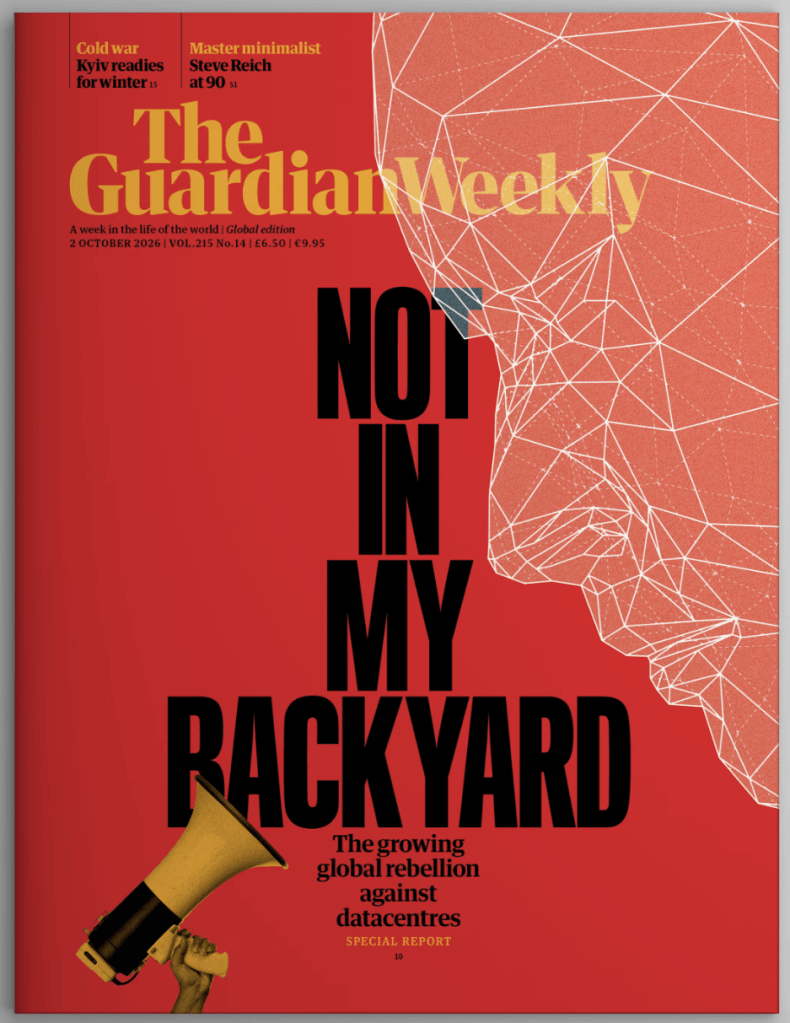
As the alarm bells sound ever louder about the potentially existential threat of breakneck AI development, people far removed from Silicon Valley debates about the future of the artificial intelligence revolution are voicing other more immediately tangible worries about the building of the vast datacentres that power these entities.
For this week’s cover story, economics and political writer Eduardo Porter, analyses why communities are pushing back against AI and the future that the big tech plutocrats want to create. These fears, based around environmental concerns over resource use and rapid societal change, are, he argues, far more complex than luddite attitudes or nimbyism.
It’s a position exemplified by reporting from two rural communities in India and the UK where vast datacentres are already under construction or being planned. As Hannah Ellis-Petersen and Aakash Hassan find out, the villagers of Tarluvada, in Andhra Pradesh, feel that government promises of a “golden age” that a hyperscale Google datacentre would bring them have been broken. Meanwhile, Sandra Laville meets protesters in Great Torrington, Devon, who sense that they are being kept in the dark about plans for an AI campus, one of Europe’s largest, in a Unesco-designated nature reserve.
Spotlight| Kyiv’s cold front is approaching Charlotte Higgins reports on how residents are preparing for winter, stocking up on food and determination, as Russia increases its attacks on energy infrastructure
Environment| What Nepal has taught Argentina What can the Patagonian town of El Chaltén at the foot of the Torre glacier do to avoid an event similar to the disaster in Nepal? María de los Ángeles Orfila finds out
Feature| Andy Burnham: a man with a plan As the first Labour conference with Andy Burnham as prime minister takes place, Hettie O’Brien finds out just how radical his policies could be
Opinion| Macron’s brave swansong In his final speech to the UN, Emmanuel Macron told the world how to stand up to Trump, says Steve Bloomfield
Culture| A minimalist at 90 As he prepares to celebrate a milestone birthday, Steve Reich tells Flora Willson how he developed his musical ideas and why he wants others to take up the baton of performing his works
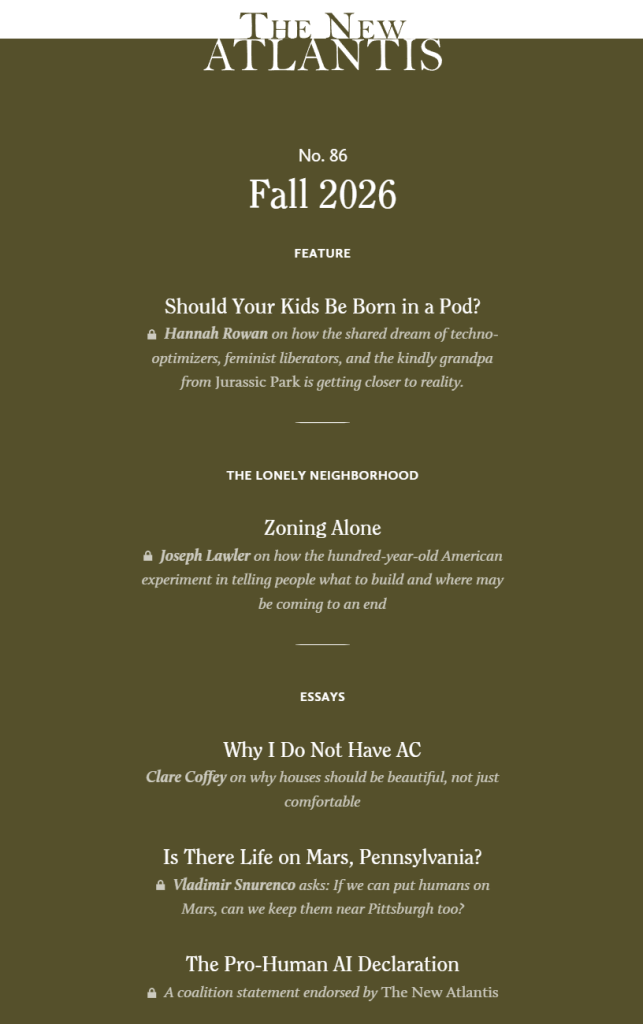
The shared dream of techno-optimizers, feminist liberators, and the kindly grandpa from Jurassic Park is getting closer to reality.
Zoning Alone
A hundred-year-old experiment in telling people what to build and where is part of why Americans have become so isolated. The Supreme Court may soon bring it to an end — and help bring back real neighborhoods.
The Pro-Human AI Declaration
A statement endorsed by The New Atlantis
In March 2026, a coalition of interest groups and individuals, organized by the Future of Life Institute, issued the following declaration at HumanStatement.org.
As companies race to develop and deploy AI systems, humanity faces a fork in the road. One path is a race to replace: humans replaced as creators, counselors, caregivers and companions, then in most jobs and decision-making roles, concentrating ever more power in unaccountable institutions and their machines. An influential fringe even advocates altering or replacing humanity itself. This race to replace poses risks to societal stability, national security, economic prosperity, civil liberties, privacy, and democratic governance. It also imperils the human experiences of childhood and family, faith, and community.
A remarkably broad coalition rejects this path, united by a simple conviction: artificial intelligence should serve humanity, not the reverse. There is a better path, where trustworthy and controllable AI tools amplify rather than diminish human potential, empower people, enhance human dignity, protect individual liberty, strengthen families and communities, preserve self-governance and help create unprecedented health and prosperity. This path demands that those who wield technological power be accountable to human values and needs, in support of human flourishing.
1. Keeping Humans in Charge
Human Control Is Non-Negotiable: Humanity must remain in control. Humans should choose how and whether to delegate decisions to AI systems.
Meaningful Human Control: Humans should have authority and capacity to understand, guide, proscribe, and override AI systems.
No Superintelligence Race: Development of superintelligence should be prohibited until there is broad scientific consensus that it can be done safely and controllably, and there is strong public buy-in.
Off-Switch: Powerful AI systems must have mechanisms that allow human operators to promptly shut them down.
No Reckless Architectures: AI systems must not be designed so that they can self-replicate, autonomously self-improve, resist shutdown, or control weapons of mass destruction.
Independent Oversight: Highly autonomous AI systems where controllability is not obvious require pre-development review and independent oversight: genuine authority to understand, prohibit, and override, not industry self-regulation.
Capability Honesty: AI companies must provide clear, accurate and honest representations of their systems’ capabilities and limitations.
2. Avoiding Concentration of Power
No AI Monopolies: AI monopolies that concentrate power, stifle innovation, and imperil entrepreneurship must be avoided.
Shared Prosperity: The benefits and economic prosperity created by AI should be shared broadly.
No Corporate Welfare: AI corporations should not be exempted from regulatory oversight or receive government bailouts.
Genuine Value Creation: AI development should prioritize solving real problems and creating authentic value.
Democratic Authority Over Major Transitions: Decisions about AI’s role in transforming work, society, and civic life require democratic support, not unilateral corporate or government decree.
Avoid Societal Lock-In: AI development must not severely limit humanity’s future options or irreversibly limit our agency over our future.
3. Protecting the Human Experience
Defense of Family and Community Bonds: AI should not supplant the foundational relationships that give life meaning — family, friendship, faith communities, and local connections.
Child Protection: Companies must not be allowed to exploit children or undermine their wellbeing with AI interactions creating emotional attachment or leverage.
Right to Grow: AI companies should not be allowed to stunt children’s physical, mental or social growth or deprive them of essential experiences for healthy development during critical periods.
Pre-Deployment Safety Testing: Like drugs, chatbots must undergo pre-deployment testing for increased suicidal ideation, exacerbation of mental health disorders, escalation of acute crisis situations, and other known harms.
Bot-or-Not Labeling: AI-generated content that could reasonably be mistaken for human-generated must be clearly labeled as such.
No Deceptive Identity: AI should clearly and correctly identify itself as artificial, nonhuman, and not a professional, and it should not claim experiences it lacks.
No Behavioral Addiction: AIs should not cause addiction or compulsive use through manipulation, sycophantic validation, or attachment formation.
4. Human Agency and Liberty
No AI Personhood: AI systems must not be granted legal personhood, and AI systems should not be designed such that they deserve personhood.
Trustworthiness: AI must be transparent, accountable, reliable, and free from perverse private or authoritarian interests.
Liberty: AI must not curtail individual liberty, freedom of speech, religious practice, or association.
Data Rights and Privacy: People should have power over their personal data, with rights to access, correct, and delete it from active systems, AI training sets, and derived inferences.
Psychological Privacy: AI should not be allowed to exploit data about the mental or emotional states of users.
Avoiding Enfeeblement: AI systems should be designed to empower, rather than enfeeble their users.
5. Responsibility and Accountability for AI Companies
No Liability Shield: AI must not be able to act as a liability shield, preventing those deploying it from being legally responsible for their actions.
Developer Liability: Developers and deployers bear legal liability for defects, misrepresentation of capabilities, and inadequate safety controls, with statutes of limitation that account for harms emerging over time.
Personal Liability: There should be criminal penalties for executives responsible for prohibited child-targeted systems or ones causing catastrophic harm.
Independent Safety Standards: AI development shall be governed by independent safety standards and rigorous oversight.
No Regulatory Capture: AI companies must not be allowed undue influence over rules that govern them.
Failure Transparency: If an AI system causes harm, it should be possible to ascertain why as well as who is responsible.
AI Loyalty: AI systems performing functions in professions with fiduciary duties, such as health, finance, law, or therapy, must fulfill all of those duties, including mandated reporting, duty of care, conflict of interest disclosure, and informed consent.
When the Englishman’s house was no longer his castle
Deborah Nicholls-Lee explores how the requisition of country houses played a crucial role in winning the Second World War
Look, listen, learn
Nature writer Mark Cocker delves into his new book to explain how we can open our eyes to the world around us
The last milkman standing?
Are doorstep dairy deliveries a thing of the past, asks Patrick Galbraith, as he joins one of the capital’s few remaining rounds
The restoration of ‘England’s green and pleasant land’
Timothy Mowl admires the revival of one of the finest and earliest Pulhamite gardens at Highnam Court in Gloucestershire
The Versailles of the north
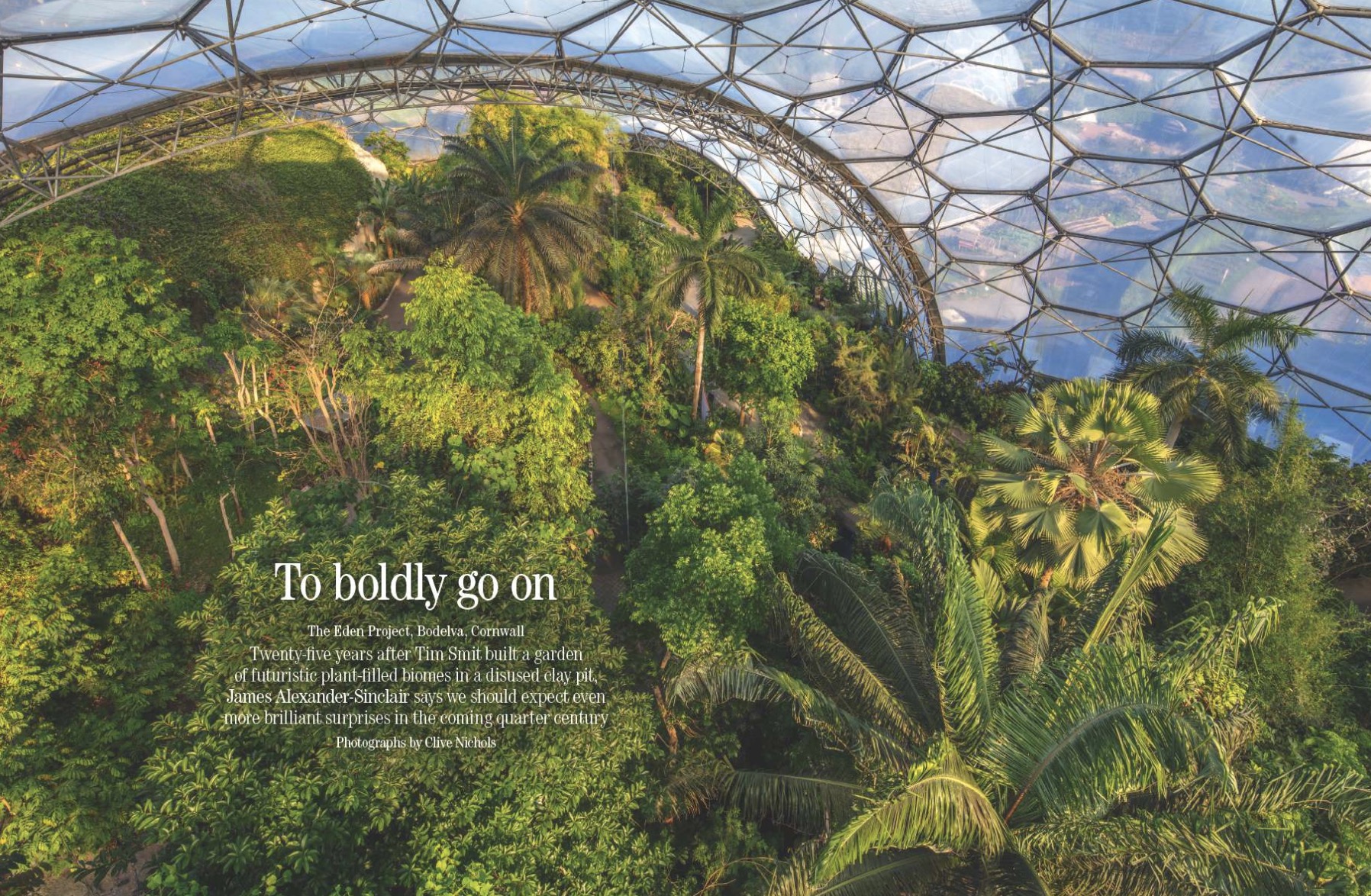
The Duchess of Northumberland tells Charles Quest-Ritson of her plans for the Alnwick Garden as it celebrates its 25th anniversary
Tony Iommi’s favourite painting
The Black Sabbath founder chooses a work depicting beauty, strength and grace
Country-house treasure
John Goodall raises a glass to the late-Victorian ‘Braxted Bar’ that dominates the entrance hall at Braxted Park in Essex
The genius of place
Classical and Gothic detailing are employed to dramatic effect at Home Farm in North Yorkshire, finds John Martin Robinson
On the brink of extinction
In a last call for the telephone exchange, Ptolemy Dean ponders the future of the obsolete edifices
The legacy
Octavia Pollock hails the vision of John Bateman, whose dams and reservoirs still serve us today
There goes summer
John Lewis-Stempel prepares to get hands-on with his flock as thoughts turn to tupping time with the transition to autumn
The return of the native
The large tortoiseshell butterfly is back. Harry Pearson hails British species risen from the dead
Luxury
Amie Elizabeth White showcases floral jewels and country classics, plus Rita Konig’s favourite things
Interiors
Amelia Thorpe picks companies that add a touch of craftsmanship to country-house renovations
Arts & antiques
Ahead of a new Pierre-Auguste Renoir exhibition at the National Gallery, Michael Prodger looks at how the French Impressionist is still dividing critical opinion
Countryside mystery
Straying livestock could prove costly in the days of the village pound, as John Wright reveals
Travel
Rosie Paterson visits the Algarve in Portugal and finds a natural haven that is truly worth its salt
Ripe for the picking
From apples to pears and pomegranates, painters down the ages have used all manner of fruit as artistic symbols, as Michael Prodger discovers
Donald Trump’s behavior cannot be called unexpected at this point. What was noteworthy last week, however, was the way that the media responded. By Jelani Cobb
My father dedicated his life to studying the Guna people of Panama, and they may soon allow unprecedented development through their land. I went on a trek through the jungle to find out why. By Ben Ryder Howe and Federico Rios
The European Commission president, Ursula von der Leyen, last week extended an unprecedented offer to Canada, inviting it to become the EU’s first “associate member”.
For our big story this week, Brussels correspondent Jennifer Rankin explores what the proposed alliance might mean. While there is a lot of common ground for the two parties, she writes, their agreement raises many questions and is clouded in uncertainty.
Meanwhile, senior correspondent Lisa O’Carroll examines the possible implications for the UK – asking whether it offers a blueprint for Britain, or a reminder it is out in the cold.
Then, former White House speechwriter Ted Widmer says Canadian prime minister Mark Carney’s remarks before the European parliament set out what a new west might look like, without its most powerful member – the US.
Spotlight| Yemeni families’ flight Fierce fighting has forced people to abandon their homes, leaving everything behind to seek shelter in refugee camps. Nasser Al-Sakkaf reports from Taiz
Science| ‘A map is never neutral’ The cartographers who took on centuries of western bias with the new Equal Earth projection speak to Oliver Holmes,Ana Lucía González Paz and Pablo Gutiérrez about their alternative to the 16th-century Mercator display
Feature| How to fight end times fascism An unholy alliance is working toward an apocalyptic future from which only a chosen few will emerge unscathed. It’s becoming clear how we stop them, say Naomi Klein and Astra Taylor
Opinion| This Israeli election could be the country’s last Spend time on the ground and you see how high the stakes are for next month’s contest – for Israelis and Palestinians alike, writes Jonathan Freedland
Culture| Present and correct Author Jonathan Franzen talks to Sophie McBain about a new TV adaptation of his bestseller The Corrections, the future of reading and why creating new work is “horrible”
Why can’t the people who produced the technology, which has already shown that a different world is possible, just do the things that would prevent extinction? By Gideon Lewis-Kraus
Students and faculty across the country were punished for their reactions to the conservative activist’s murder. A recent graduate of Texas Tech’s law school is still trying to clear her name. By Benjamin Wofford
One in 10 Americans experiences migraine headaches, which can be incapacitating. But there may be a light on the other side of your blackout curtains. Currently, doctors diagnose migraine based on patient description and treat the headaches based on frequency—episodic or chronic (more than 15 days per month). Treatment decisions are “worse than trial and error,” clinical professor of neurology Robert Cowan told Stanford Medicine. “It’s darts in the dark.” What’s more, guidelines recommend preventative, daily medication only for people with chronic migraine. But including severity may improve treatment options. In the largest study to date to categorize migraine patients, Cowan and data analyst Jaiashre Sridhar used functional MRI data to identify two biological subtypes. One group of patients had more severe headaches—they tended to last longer and caused more bothersome symptoms (nausea, noise sensitivity, etc.).
Biblio File: What to Read Now — Autumn 2026
New releases on our shelves and in our bookbags.
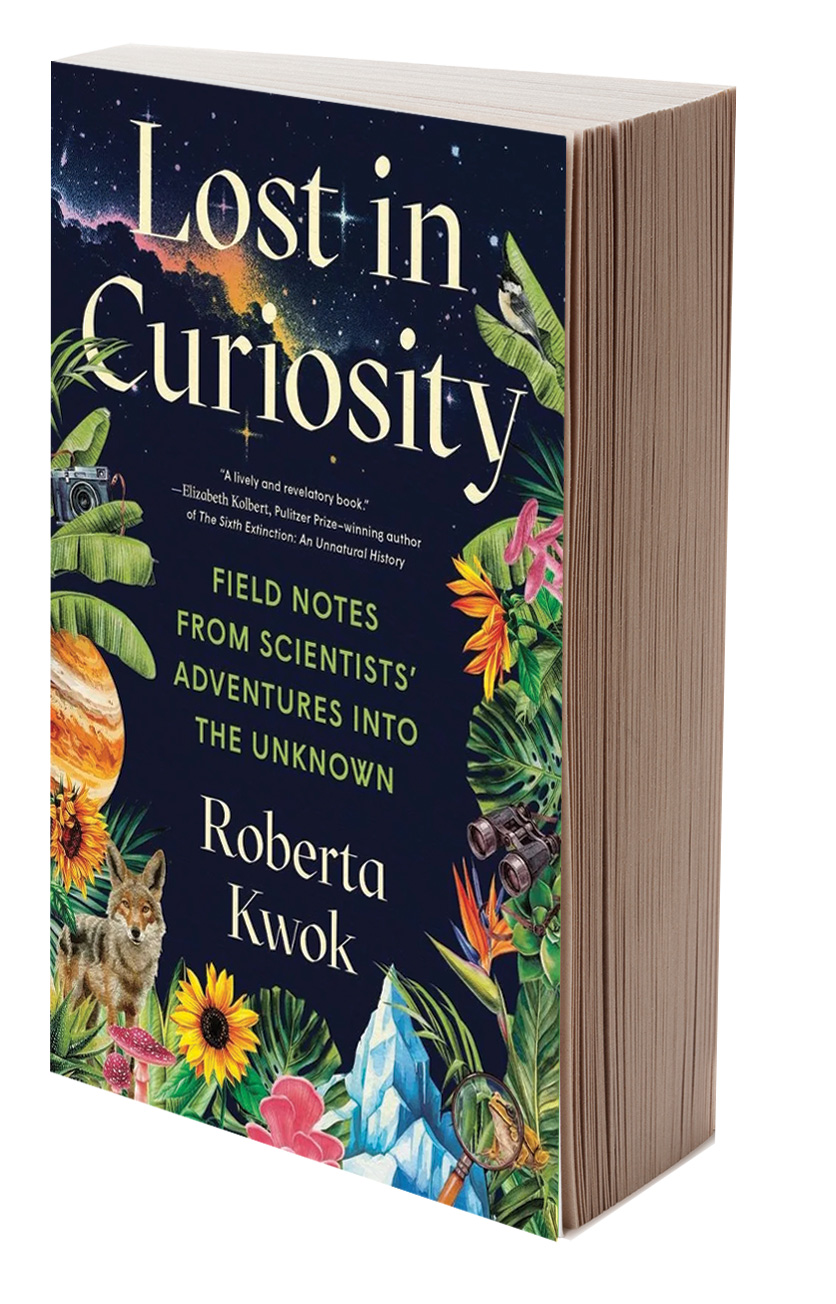
In Lost in Curiosity: Field Notes from Scientists’ Adventures into the Unknown(Sourcebooks), science journalist Roberta Kwok, ’00, witnesses the “messy middle” of science between researchers’ initial query and possible final discovery. The nine projects she investigates, from sex-role reversal in male guardian frogs to a quest to find an exomoon, depict the slow, frustrating, and focused work of scientists.
News, Views and Reviews For The Intellectually Curious