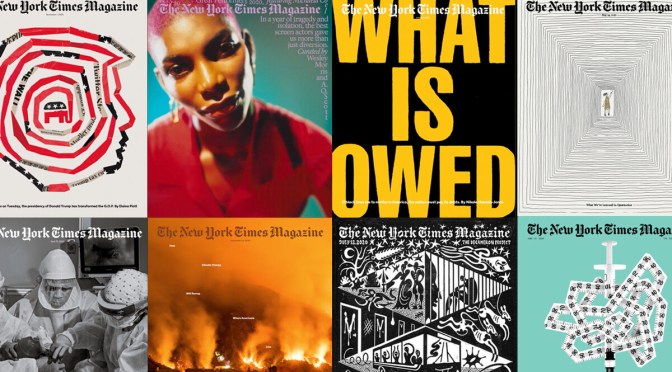
THE NEW YORK TIMES MAGAZINE: The 10.11.26 Issue features Daniel Kolitz on the rise of microdramas; Janet Reitman on a group of Texans accused of being Antifa terrorists; Marcela Valdes on the author Min Jin Lee; and more.
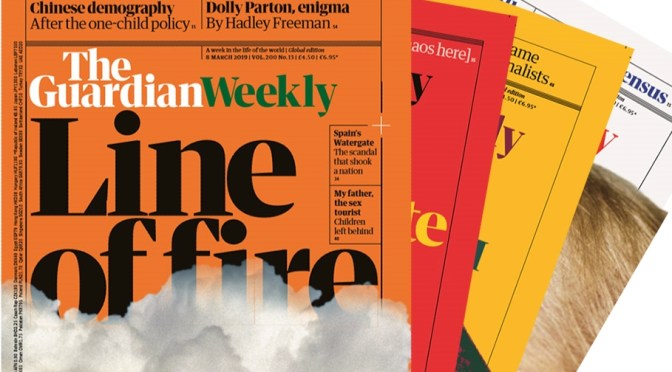
With fewer than 30 days until the US midterm elections, Donald Trump seems determined to still be centre stage despite poll fears that after 3 November he may end up a lame-duck president as a Democratic blue wave sweeps the country. Our Washington bureau chief, David Smith, has been watching how the president is playing to Republican voters at the start of a blitz of cross-country rallies. It’s, at best, a mixed picture.
As David reports, Trump’s self-belief and message to voters to “pretend” his name is on the ballot reveal a man out of touch with ordinary Americans’ worries about the cost of living and whose promises that the war with Iran will soon be over ring ever more hollow. And then there are the candidates, more of whom are shying away from their earlier allegiances to a president whose approval ratings continue to slide.
Spotlight| An education crisis in France As school and university protests intensify, Paris correspondent Angelique Chrisafis finds out why students feel the government is ignoring their complaints about the state of education
Spotlight| Greendivision and diversion Peter Walker reports on the English and Welsh Green party’s annual conference in which a motion equating Zionism with racism was passed, and analyses how this reveals weaknesses in the way the party is run
Feature| The big business of porn Why not analyse the porn industry just like any journalist would the oil business? That was the premise behind Patricia Nilsson’s new book. An approach that, as Amelia Gentleman finds out, yields new insights into how pornography’s imperatives have seeped into all our online lives
Opinion| Putin won’t bomb Ukraine into submission Kyiv may now be under almost constant attack but, says Rajan Menon, history shows that bombing doesn’t crush morale
Culture| There’s beauty in bits and pieces A novel exhibition in Florence puts broken sculptures on display and, as Philip Oltermann discovers, reveals their profound allure
Once upon a time, the export crop of Martha’s Vineyard and Nantucket was whale oil. Nowadays it is money, harpooned by visiting campaigns from deep-pocketed donors at anchor in their summer seaside retreats. In the peak season of July and August, the islands’ social rhythms are dictated by money-harvesting events, wrangled by local hosts jostling for the social éclat that comes from securing a high-profile honoree. By late August this year, the territory had already been worked over by a series of hopeful visitors with hands outstretched, such as the rising Texas Senate hopeful James Talarico, Hakeem Jeffries in eager pursuit of the House Speakership that is almost in his grasp, Maryland Governor Wes Moore and others questing the donor dollar.
The world has become strangely numb to terror. Sometimes an atrocity will be sufficiently horrifying – the murder of Charlie Kirk, say – to cause mass shock and anguish. Yet now reports of car rammings or knife rampages or foiled Islamist plots feel almost routine. We have become inured to ideological violence. In the quarter-century since 9/11, the specter of terrorism has almost become a fact of modern life. Last year, America was one of the few western countries to see a rise in terrorism, with 13 recorded attacks and 28 deaths. Today even the most appalling acts generate only a brief sense of widespread outrage. And then the news cycle moves on. No mass killing has come close to the scale of the Twin Towers attacks.
America’s war with Iran is in its eighth month and stuck. On September 26, Donald Trump confirmed that he had rejected Tehran’s offer to reopen the Strait of Hormuz in return for lifting the American naval blockade and easing sanctions. He has reportedly told his staff that renewed bombing is likely after the midterm elections on November 3. He is reluctant to
Arrests have reached a record high—nearly fifty-one thousand in August alone—with agents conducting operations nationwide at hospitals, at airports, and outside schools. By Jonathan Blitzer
A hospital administrator has a million dollars and a five-year-old who needs a new liver. When psychologists asked people to judge him, it mattered not only what he chose but how long he took to choose it.
Intellicurean · Essays
Above All Price
On a hospital administrator’s hesitation, a hypothesis about scalar reward, and what Kant meant by a thing raised above all price
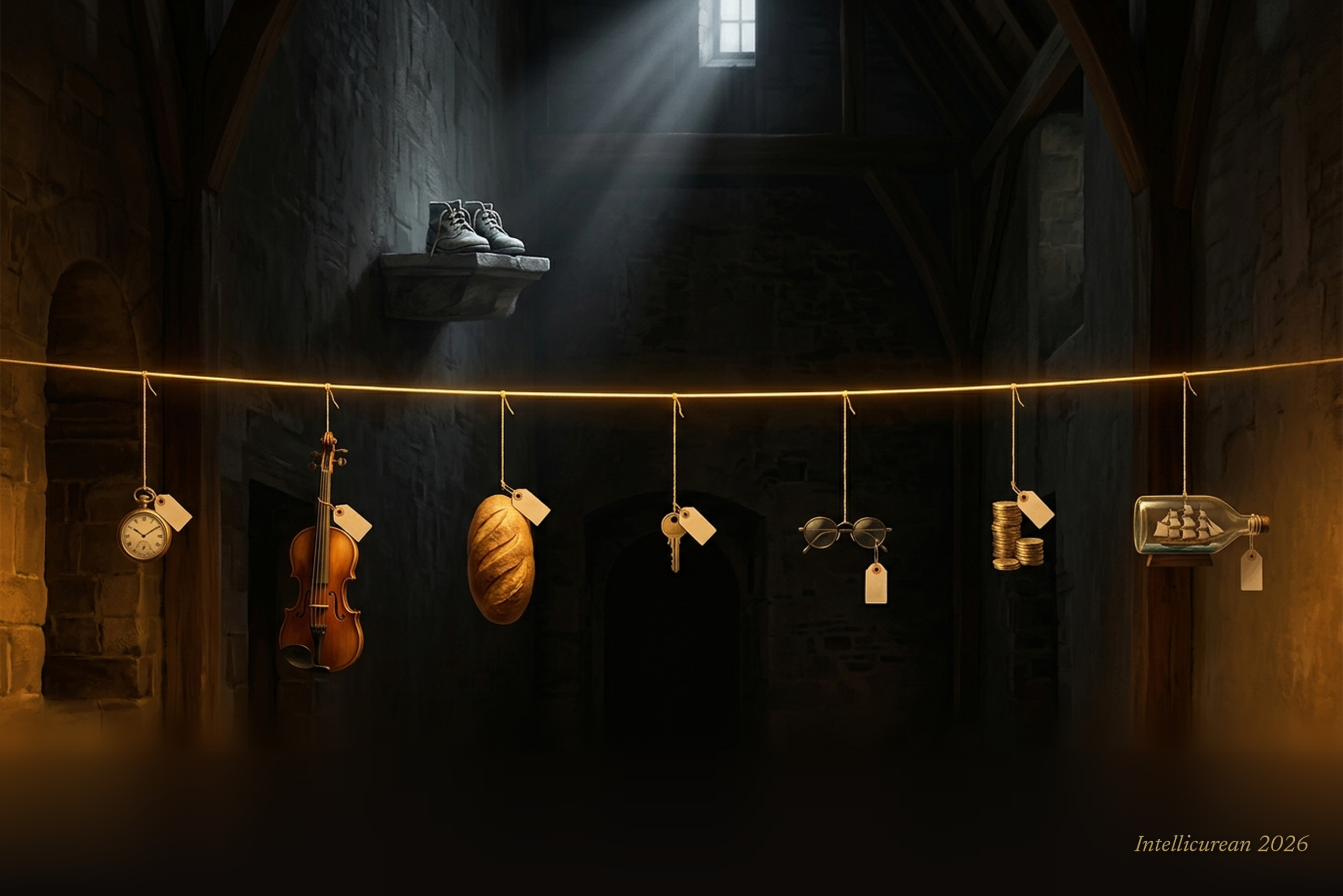
What has a price, and what is raised above it, made for the essay.
Why we’re pointing you there
The administrator, Robert, comes from Philip Tetlock’s research on “taboo trade-offs,” and his hesitation is where Above All Price begins. From there the essay sets a modern hypothesis against an old idea and lets a theorem judge between them. Richard Sutton’s reward hypothesis holds that every goal can be understood as maximizing a single number. Kant held that some things have no price at all, only a dignity “raised above all price.” A 2023 theorem shows that a single number cannot represent that kind of ranking. The essay then gives the other side its full due: the life-valuations that governments use in the open, precisely so that lives are not traded away in secret.
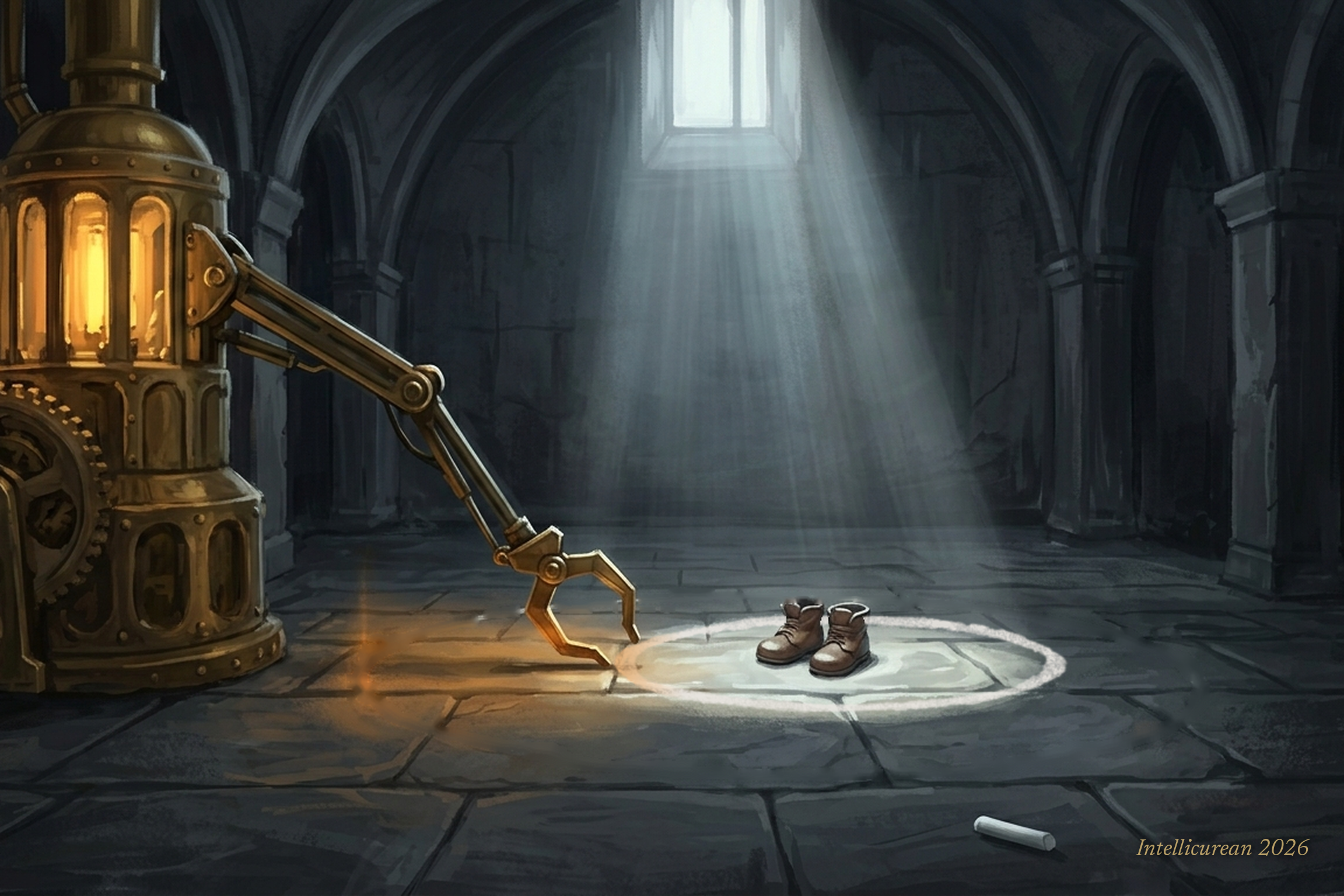
What we liked most is that it refuses the easy version of either side. It takes the arithmetic seriously, takes the numbers that keep public decisions honest seriously, and then asks a question neither can answer for itself: when a system is built to obey a number, who decides what the number is for?
A line the machine did not draw, made for the essay.
The phrase “the X of it all” started as a joke to mock the vague lingo of studio bosses. But there’s something widely appealing about speaking “casually, broadly and vaguely in order to reduce friction.” By Nitsuh Abebe
My father dedicated his life to studying the Guna people of Panama, and they may soon allow unprecedented development through their land. I went on a trek through the jungle to find out why. By Ben Ryder Howe and Federico Rios
How Everything Became Gambling
It’s not just DraftKings and Polymarket — the logic of gambling undergirds everything coming out of Silicon Valley.
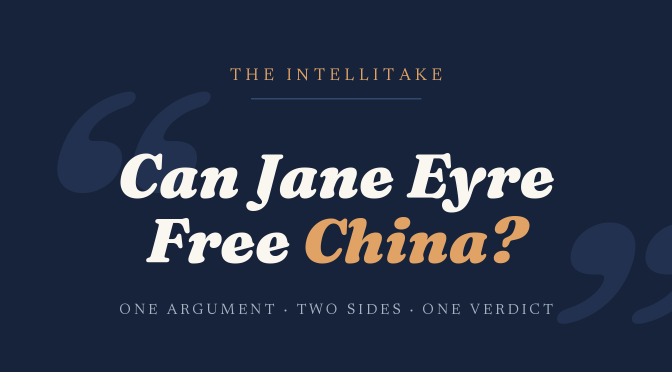
This fall, China made Charlotte Brontë’s Jane Eyre compulsory reading for 14- and 15-year-olds across the country. Writing in UnHerd, the novelist Philip Hensher notes the official reasoning, as reported in the Party-backed press: “the innocent, budding stage of first love is a crucial period for shaping a well-rounded personality.”
Hensher thinks Beijing has assigned more than a love story. Jane is the orphan who tells her cruel aunt that “the very thought of you makes me sick,” and she grows into a woman who answers to her own conscience rather than to the man with power over her. Those are dangerous lessons, he suggests, to hand every teenager in a country that ranks 178th of 180 in the World Press Freedom Index.
His conclusion is hopeful. A state that assigns a book about speaking the truth may be teaching it.
vs
THE ANSWER
The reporting tells a different story. China has had Jane Eyre for a century. A Chinese translation appeared in 1925, and a 1979 British film adaptation played in Chinese theaters as the country reopened after the Cultural Revolution (New York Times). Generations have read it, and the system has stood.
The choice also looks deliberate. Beijing Daily pitched the novel as a counterweight to social media’s “superficial notions about appearance and wealth” (CNN). UC San Diego scholar Ping Zhu told the Times that Jane is “an independent woman, but she’s not too outrageous in her challenge of patriarchal power.” She ends the book married and a mother, which fits a government urging young people to start families.
On this view, Beijing didn’t assign a rebel by accident. It chose a heroine whose independence ends in a home.
iC
THE INTELLITAKE
Both sides are reading the same novel and stopping at different chapters. Beijing assigned Jane Eyre for its ending: the marriage, the home, love that money can’t buy. Hensher is betting on its beginning: the child who talks back and the young woman who walks away from Thornfield with nothing rather than betray herself.
Notice what the two arguments share. Each assumes a book does what its readers are told it does. A ministry can set the exam question, but not the moment a 15-year-old reaches Jane’s declaration, “I am no bird; and no net ensnares me.” A novel doesn’t topple a government. It builds an inner life, and inner lives are the one thing no curriculum fully controls.
There is something worth admiring in the choice itself. A nation that wants its teenagers to value character over wealth reached for a Victorian Englishwoman’s conscience, and trusted 14-year-olds with it. Whatever Beijing intends, it has given millions of young readers a heroine who insists on choosing for herself.
TODAY’S PROVOCATION
Can a government assign a book without assigning what it means?
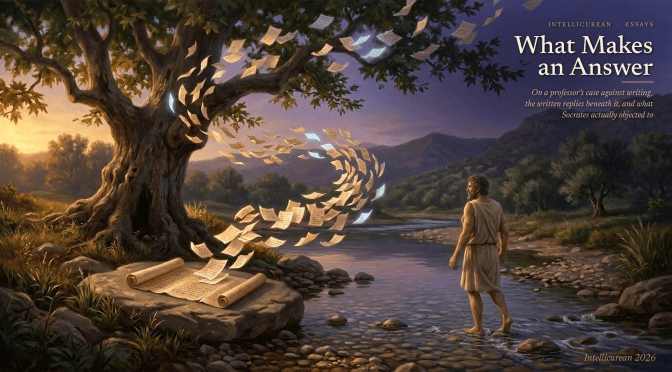
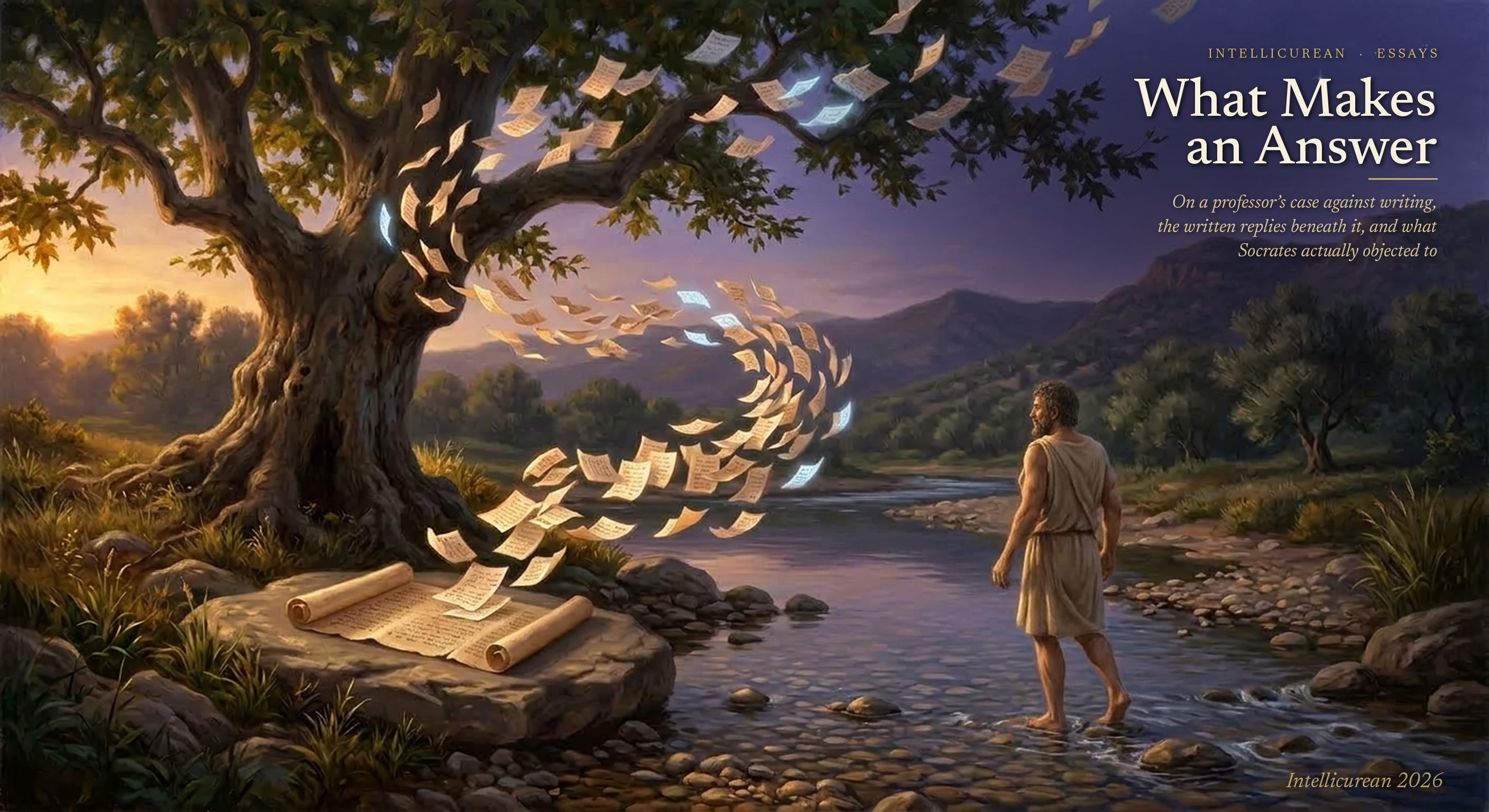
Socrates said written words can’t answer a question. Under a professor’s essay repeating his complaint, readers answered by the hundreds, and the professor answered them back, in writing.
Pages taking flight, and a man turned back at the stream, made for the essay.
Why we’re pointing you there
On September 29 The New York Times ran a guest essay by Joe Cruz, who chairs philosophy at Williams College, arguing that writing isn’t as important as we think. He leaned on Plato’s Phaedrus, where Socrates says a written text can’t answer questions or defend itself. Within a day about 1,200 readers had written back. Michael Cummins returns to the dialogue and finds three objections there, not one. He gives Cruz his due on the oral exam and on why universities love the essay. Then he follows the most-recommended reply in the thread: if at least half the class did better aloud, as many as half did not.
What we liked most is watching a thesis improve in public. Pressed by his commenters, Cruz conceded that writing is “no small thing,” perhaps one of the most profound tools we have for abstract thought, and he conceded it in writing. The essay goes on to defend the revision Cruz calls a refuge. It ends at the river in the Phaedrus, where Socrates turns back without anyone asking him to. A machine that will answer anything has met Socrates’ first objection. The essay asks whether it could ever meet that one.
Despite a hard-and-fast refusal to discuss Lilith for nearly six years on my social media platform, Jewitches, she remains the most popular question, request, and topic of discussion…Many know her as merely Adam’s first wife, the prequel to Eve, but her history is far more complex.
News, Views and Reviews For The Intellectually Curious