
Times Literary Supplement (July 17, 2024): The latest issue features ‘World at War’ – Humanity’s appetite for organized violence; Should we have babies; Posture panic; The boy on the burning deck and Wales…

Times Literary Supplement (July 17, 2024): The latest issue features ‘World at War’ – Humanity’s appetite for organized violence; Should we have babies; Posture panic; The boy on the burning deck and Wales…
The Globalist Podcast (July 17, 2024): Following Viktor Orbán’s ‘peace tour’ to Israel, Moscow and China, European politicians plan to boycott meetings held by the Hungarian leader during his country’s EU presidency.
We also have a dispatch from the second day of the Republican National Convention in Milwaukee and can the French left overcome their impasse and elect a new prime minister? Plus: a special interview with Brazil’s culture minister – and beloved singer – Margareth Menezes.
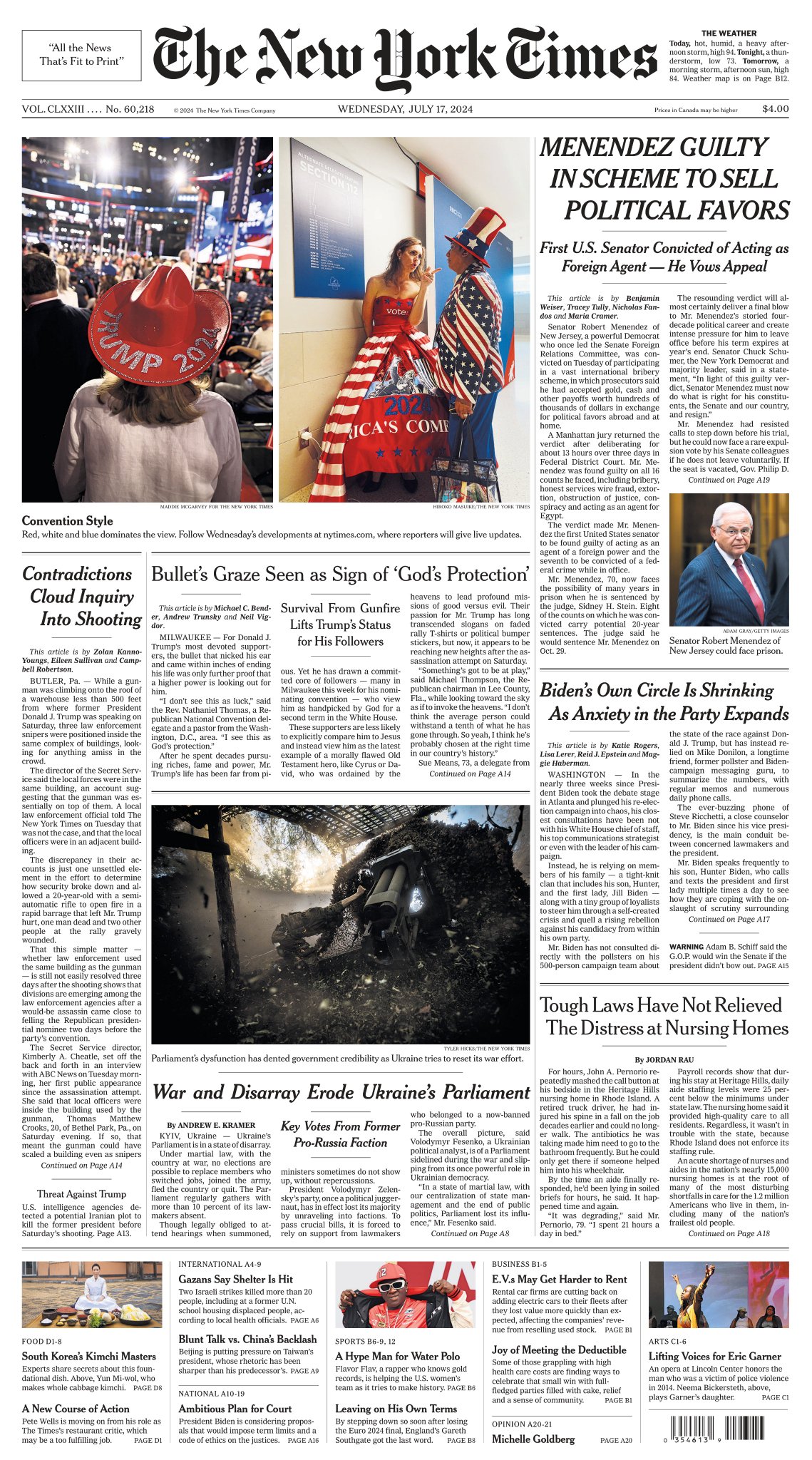
But a dispute over whether the local forces used the same building as the shooter is just one unsettled element in the effort to determine how security broke down.
Senator Robert Menendez, Democrat of New Jersey, was found guilty of bribery, conspiracy, extortion, obstruction of justice and acting as a foreign agent.
President Biden, increasingly isolated during the biggest political crisis of his presidency, is in a historic standoff with his party.
Some of Donald J. Trump’s followers had long viewed him as handpicked by God. The attempted assassination has only increased such quasi-religious devotion and rhetoric.


Country Life Magazine (July 16, 2024): The latest issue features ‘500 Shades of Green’ – Why is it the eye’s favorite hue; Rex Whistler’s triumph and tragedy; Big hearts and funny faces – the bull terrier and Alan Titchmarsh’s favorite flower show…
Our eyes can detect more of its shades than any other colour and its many hues are bound up with everything from jealousy to British racing cars—it’s all gone green for Lucien de Guise

‘Life is merrier when you live with a bull terrier’ owners tell Katy Birchall as she delves into the kindly and comic character beneath the muscular frame
Goodwill and gardening go hand in hand at the ‘beautifully formed’ Royal Windsor Flower Show—and Alan Titchmarsh wouldn’t miss it for the world
Rex Whistler refused to leave fighting the Second World War to ‘young boys’, but his courage and leadership was to cost him his life, as Allan Mallinson reveals
The Jersey chief minister picks a work that encapsulates the island’s spirit and determination
In the second of two articles, John Goodall investigates the 17th-century expansion that provided Lincoln College, Oxford, with a quite outstanding chapel

Music will ring around the Royal Albert Hall again this summer thanks to Henry Wood and his Proms, reveals Octavia Pollock
With more species around our shores than anywhere else in northern Europe, Ben Lerwill keeps his eyes peeled for porpoises, whales and dolphins
Hetty Lintell shells out on fine jewellery that is sure to impress
Debo Devonshire’s love of chic, chickens and Chatsworth in Derbyshire is celebrated in a new exhibition, discovers Kim Parker

Giles Kime explores large-scale wallpaper capable of transport-ing you to a whole new world
Tiffany Daneff marvels at the spectacular views that have been restored at the Old Rectory at Preston Capes, Northamptonshire

Crunchy fennel is a summer highlight for Melanie Johnson
Michael Billington is royally entertained as Shakespeare receives a modern, mirth-filled twist in Stratford and London


For centuries, the Seine River has been Paris’s dumping ground. A billion-dollar cleanup is trying to make it swimmable again.

The history of Paris is inextricably linked to the river that flows through its center—from Neolithic settlement to this year’s Olympic games.
The opening ceremony for the Paris 2024 Summer Olympics will take place on the fabled French waterway. But did you know it was named for a Gallo-Roman deity?
The Globalist Podcast (July 16, 2024): We discuss the mood and security measures at the Republican National Convention in Milwaukee, where Donald Trump made his first public appearance following the failed assassination attempt at a campaign event on Saturday.
Plus: Monocle’s foreign editor, Alexis Self, explains the UK and EU’s warming relations as government minister Nick Thomas-Symonds visits Brussels, Pakistan threatens to ban Imran Khan’s PTI party and Eurostar connects London to the Alps once again.
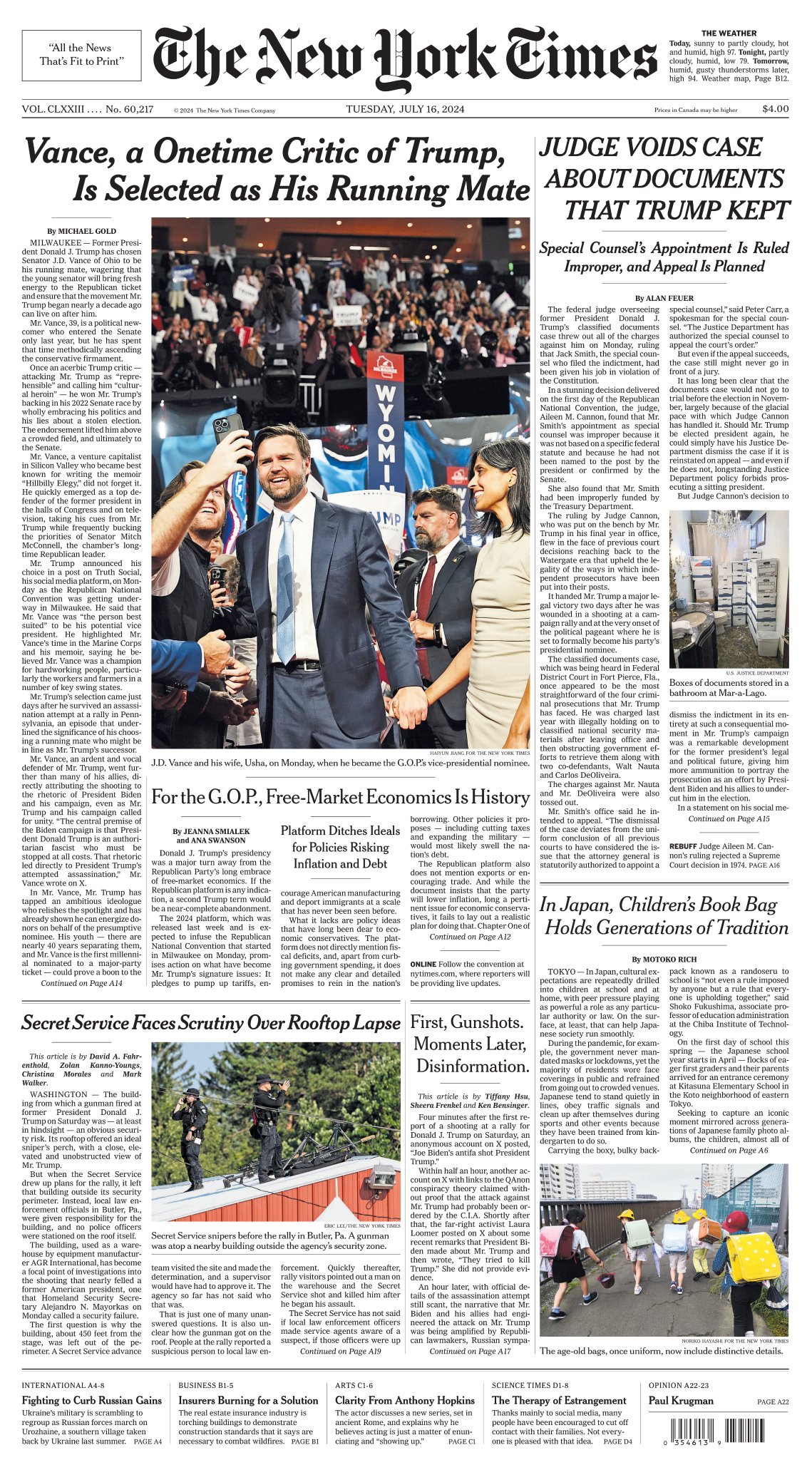
A political newcomer and former Trump critic turned ally, Senator Vance is an ambitious ideologue who relishes the spotlight and has already shown he can energize donors.
Judge Aileen Cannon ruled that the entire case should be thrown out because the appointment of the special counsel who brought the case, Jack Smith, had violated the Constitution. Mr. Smith’s office said he would appeal.
Overlapping investigations will focus on the decisions the protection agency made before and immediately after bullets nearly hit former President Trump directly.
Claims that President Biden and his allies ordered the attack on Donald J. Trump, or that Mr. Trump staged the attack, started quickly and spread fast across social media.

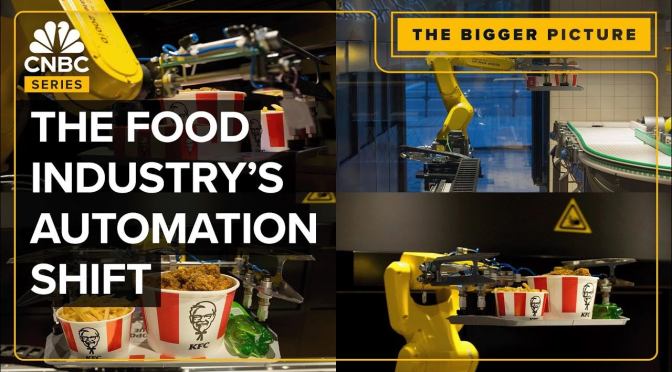
Chapters: 0:00 Introduction 2:34 CH 1. Digitizing food retail 5:35 CH 2. The risk and reward from robots 8:30 CH 3. What’s next?
The American consumer is starting to pull back on spending and rising food and labor costs are causing the food industry to invest more into automation to lower labor costs and improve sales, in order to stay competitive and take advantage of shifting consumer taste.
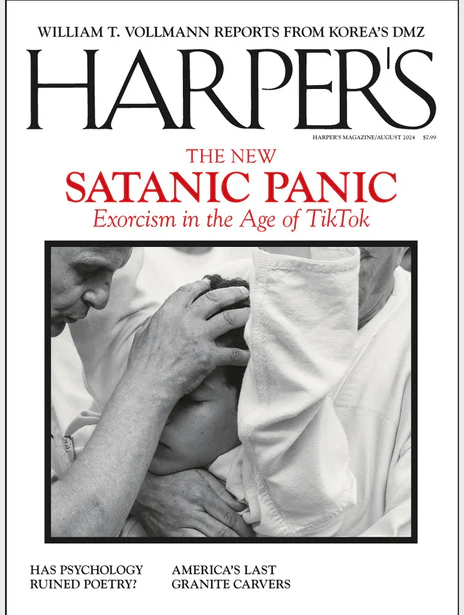

The new age of American exorcisms by Sam Kestenbaum
The pastor is pacing back and forth, a cordless microphone in one hand, the other extended before him. He says, “This is the awakening the American church has been waiting on,” and keeps pacing. He has readied himself before taking the elevated stage, donning a paisley shirt, top button undone, and speaks now from the wood pulpit of his revival tent.
Seamus Heaney and the end of the poetic career
The Letters of Seamus Heaney, edited by Christopher Reid. Farrar, Straus and Giroux. 848 pages. $45.
This buoyant anvil of a book has brought me to the edge of a nervous breakdown. Night after night I’m waking with Seamus Heaney sizzling through—not me, exactly, but the me I was thirty-four years ago when I first read him, in a one-windowed, mold-walled studio in Seattle, when night after night I woke with another current (is it another current?) sizzling through my circuits: ambition. Not ambition to succeed on the world’s terms (though that asserted its own maddening static) but ambition to find forms for the seethe of rage, remembrance, and wild vitality that seemed, unaccountably, like sound inside me, demanding language but prelinguistic, somehow. I felt imprisoned by these vague but stabbing haunt-songs that were, I sensed, my only means of freedom.

Less than six weeks before Democrats formally choose their nominee, the President is marching down a path of constant peril.
A network of well-funded far-right activists is preparing for the former President’s return to the White House. By Jonathan Blitzer

From the time of the Revolutionary War to the fires of the nineteen-seventies, the history of the borough has always been shaped by its in-between-ness.
By Ian Frazier