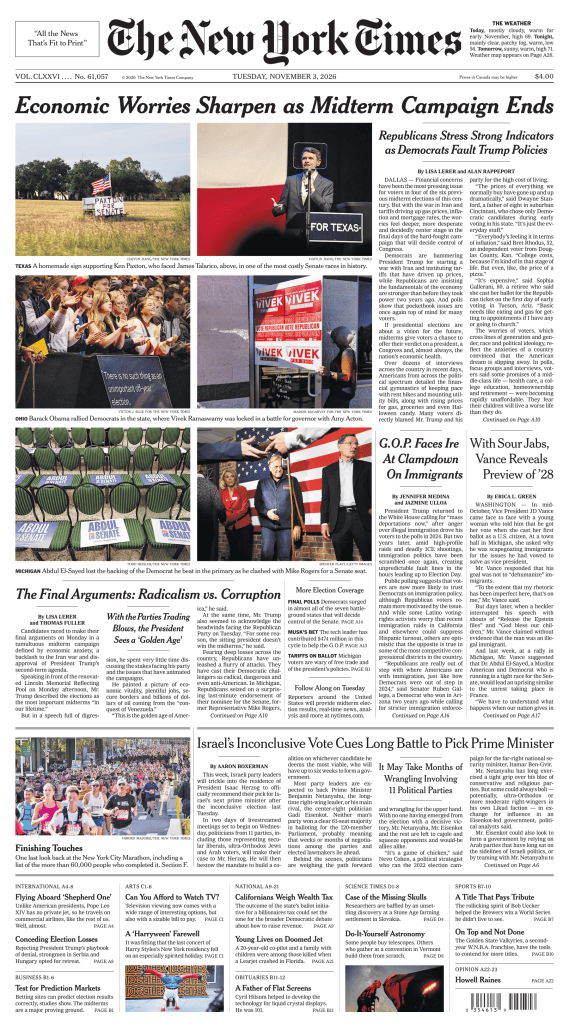
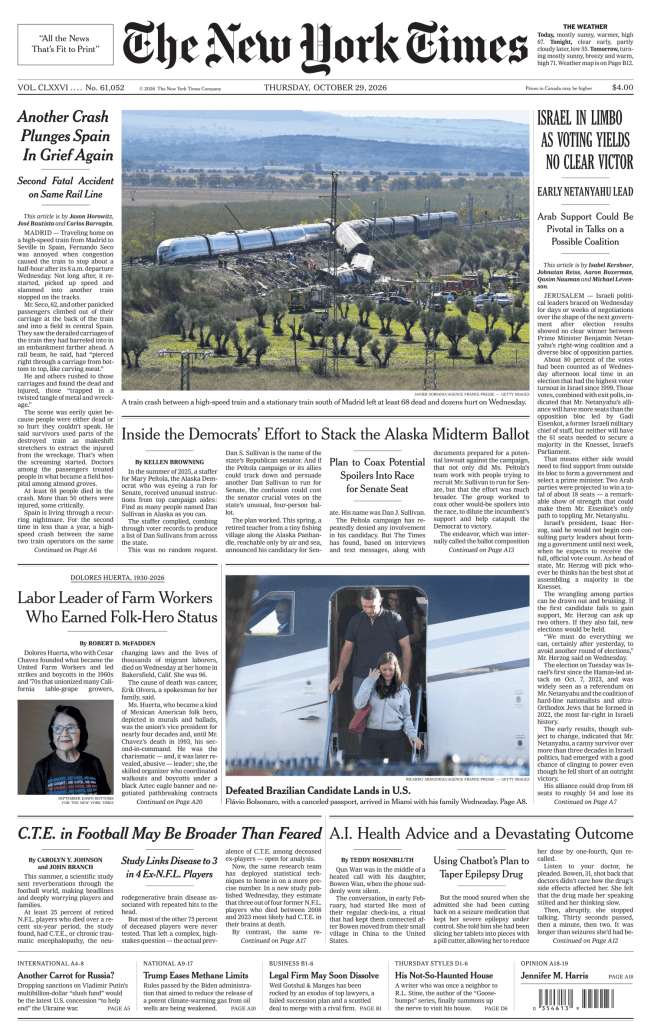
The midterm elections will offer the first nationwide verdict on President Trump’s second term. Tens of millions of early ballots have already been cast.
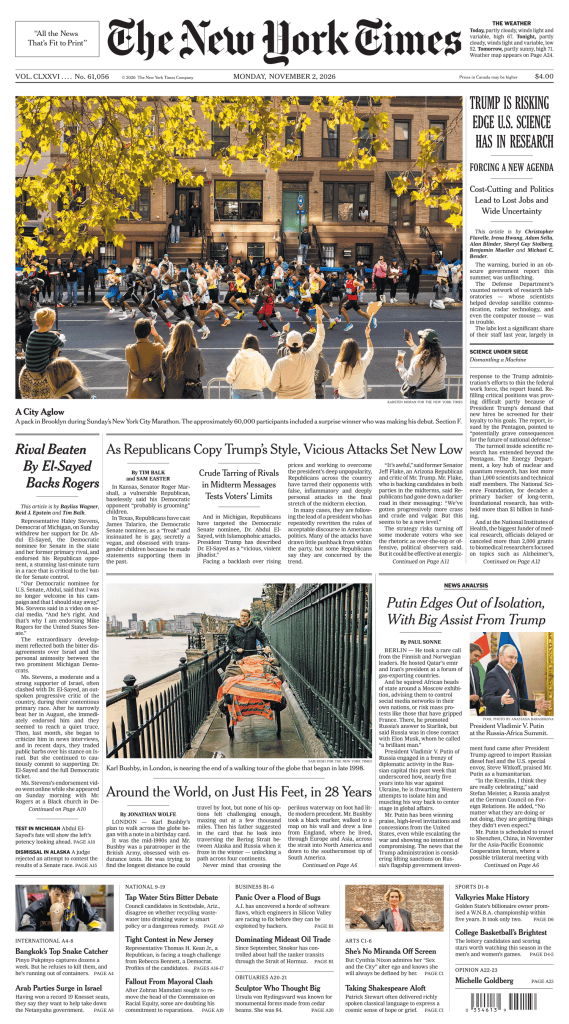
The energy-rich Gulf Arab countries are engaged in a flurry of mediation efforts to avert war between the U.S. and Iran, as many fear that the fighting will be worse this time around.
Party leaders will make competing cases to the Israeli president for either Benjamin Netanyahu or Gadi Eisenkot to get the first chance to build a governing coalition.
States like Saudi Arabia and the United Arab Emirates that have worked to rebalance from a dependence on energy have seen growth plunge in a year of strife.
Republicans, worried about losing control of Congress, are sending dire warnings about the opposing party. Democrats are keeping their focus on affordability, corruption and President Trump.
The Healers – Jason Baldes on Restoring the North American Buffalo
Returning the buffalo to its ecological role as a keystone species, bringing back plant and animal biodiversity, is in itself healing. We take care of the buffalo, the buffalo takes care of the land, and both take care of us. By Leath Tonino
Aage eighteen, Jason Baldes, a member of the Eastern Shoshone Tribe, traveled with his father, a US Fish and Wildlife Service biologist, from the Wind River Indian Reservation in Wyoming to the Serengeti Plain of East Africa. In addition to lions and zebras and hyenas, Baldes witnessed the migration of 1.5 million wildebeests—one of the planet’s last remaining examples of a huge population of terrestrial mammals roaming freely over the land. “That was the light bulb moment for me,” he says today, reflecting on his decades of effort as an ecologist and activist. Watching the beautiful and awe-inspiring spectacle, he understood that the mega herd represented a mere fraction of the number of bison—or buffalo, as Baldes prefers to call them—that would have been visible in North America a few short centuries ago, when they numbered in the tens of millions and inhabited the majority of the continent.
In popular tradition General Custer was the last to die, though there is no way to know the final sequence of events. He reportedly had been shot twice: once in the left temple and once just below the heart. ByCharles Hood
The first time US Army general George Armstrong Custer died was on Sunday, June 25, 1876, a centennial year in Anglo-European America. He died in the late afternoon along with 267 other soldiers, civilians, and Native American scouts in the Little Bighorn Valley of Montana. These deaths took place during what are now called the “Indian Wars,” although for most of American history it’s hard to think of a time when there wasn’t an Indian war.
The Seventh Cavalry, which Custer led, had split into multiple columns, and all came under attack, though only Custer’s portion—made up of five out of eleven total companies—was wiped out completely. That outcome was more or less inevitable, given that Custer had misjudged the size of the coalition of Lakota, Dakota, Sioux, and Northern Cheyenne his two-hundred-odd men were facing. Or maybe he hadn’t wanted to admit to himself that he was up against a combined force of at least a thousand, and perhaps as many as three or even five thousand, depending on which source you asked. Once the battle started, there was no way Custer and his men would not all be killed. The only question was whether they would die before or after they had used up all of their water and ammunition.
I walked back to my sister’s room and stood in the doorway and listened to her breathe. Maybe some of those seahorse facts weren’t even true. ByLaura Maylene Walter
After losing ground in Israel’s election, Prime Minister Benjamin Netanyahu must draw on decades of political capital and reckon with old foes if he is to build a governing coalition.
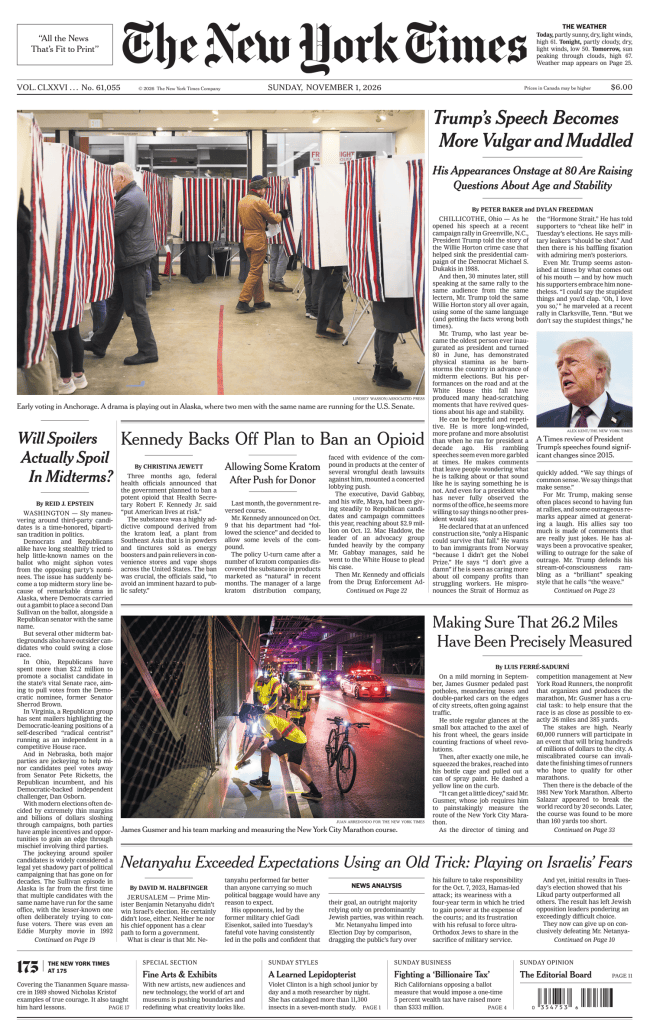
A Times review of President Trump’s public speeches found that he was more profane, more absolutist, longer-winded and less coherent than he was in 2016.
Notching wins from Washington, the Russian leader is talking with foreign leaders and could return to diplomatic center stage with possible summit meetings.
THE NEW YORK TIMES MAGAZINE: The 11.1.26 Issue features Marcela Valdes on the actor Penélope Cruz; Francesca D’annunzio McKenzie Funk and Kirsten Luce on a small town in Texas and a local deputy who became the face of deportation; Sophie Haigney on dark nutrition; Lisa Lerer on OB-GYNs in Idaho; and more.
A.I. will reshape our world. But does that mean the people who make the technology get to control our imagination, too? By Linda Kinstler
These days, the leading tech companies are not primarily fighting one another for market share or talent or computing power. The bigger battle is over who can claim to know the future.
In August, Meta’s chief executive, Mark Zuckerberg, published a manifesto titled “The Future Is for Everyone,” in which he argued that artificial intelligence will bring about “an abundance of personal agency” and other riches — but only if Meta is in charge. “If our beliefs and principles lead,” he wrote of his company, “then the balance of power will favor individuals and a better future for everyone.” In September, Sam Altman of OpenAI told the United Nations Security Council that A.I. could lead to either a society in which “more people can participate in the future” or one in which humans have lost “control of the future.” And in his recent call for the voluntary slowdown of A.I. development, Dario Amodei of Anthropic claimed it was imperative to stave off the future we are headed toward, if only for an “extra year or two.”
The writer-director Martin McDonagh has carved out a highly esteemed cinematic career as a chronicler of extreme, and often extremely bloody, behavior carried out on a relatively intimate scale. “The Banshees of Inisherin” (2022), to pick one of his films, was about two friends on a remote Irish island descending into a feud. “Three Billboards Outside Ebbing, Missouri” (2017), to pick another, looked at a mother’s attempt to get justice for her murdered daughter. That those movies, despite their dark setups, are often as vulgarly funny as they are emotionally affecting is evidence of McDonagh’s originality — and his skill too. (McDonagh was an enfant terrible of the British theatrical world before he turned to filmmaking.) The 56-year-old’s films have earned a cumulative 18 Academy Award nominations, and “Six Shooter” (2004) earned him an Oscar for best live-action short. By David Marchese
From France to Brazil, voters are railing against the status quo, even as the politics of disenchantment make lasting change nearly impossible. By David Wallace-Wells
Prime Minister Benjamin Netanyahu is jockeying to stay in power and President Trump is in a midterm fight, yet Iran does not expect a major shift in policy.
The largest cyber heist in history came as attackers increasingly use artificial intelligence and other advanced techniques to steal crypto and quickly launder the funds.
Deadlock is possible, as neither the bloc of Prime Minister Benjamin Netanyahu nor his main challenger have won a majority. But there are still paths to a new government.
The leading contenders, Prime Minister Benjamin Netanyahu and Gadi Eisenkot, aren’t substantially different in their approach to Israel’s security or in their opposition to a Palestinian state.
Gains for Arab-led parties have electrified Taibe, in central Israel, even as voters elsewhere in Israel say they have no place in any future government.
The largest cryptocurrency exchange said it was compromised in what could be the biggest crypto heist ever. One research lab attributed the theft to North Korea.
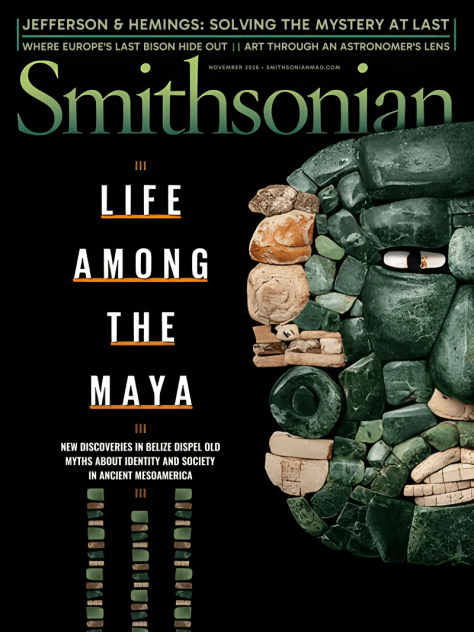
In the rainforest of Belize, archaeologists are uncovering neighborhoods, local markets and urban farms that shed new light on daily life in the ancient world By Ellen Ruppel Shell | Photographs by Neil Ever Osborne
A lock of hair, advances in genetic science and the Smithsonian’s 15-year quest to conclusively resolve an enduring question: Did Thomas Jefferson father Sally Hemings’ children? Dr. Richard Kurin, Ambassador at Large, Smithsonian Institution. Author, History by a Hair Portraits by Joshua Rashaad McFadden
Astronomers, astrophysicists and art historians are on a luminous quest to unlock the real-world secrets of classic paintings and literature By Michael Ray Taylor
After centuries of setbacks, the European bison faces a new challenge: surviving in a primeval forest that isn’t its true home By Marta Zaraska | Photographs by Kasia Strek
Deadlock is possible, as neither the bloc of Prime Minister Benjamin Netanyahu nor his main challenger appear likely to win a majority. But there are still paths to a new government.
The Israeli prime minister outperformed both expectations and his rivals by playing on Jewish voters’ fears of Arab political power and potential security threats.
France’s second city, five years into a presidential development plan, is grappling with the social strains that have fueled protests across the country.
A Chinese businesswoman who had a close relationship with Jensen Huang was found to be passing intelligence to Beijing. President Trump was briefed and took no action.
The move followed a Times report about the role Mary Peltola’s Senate campaign played in recruiting candidates to draw votes from the Republican incumbent.
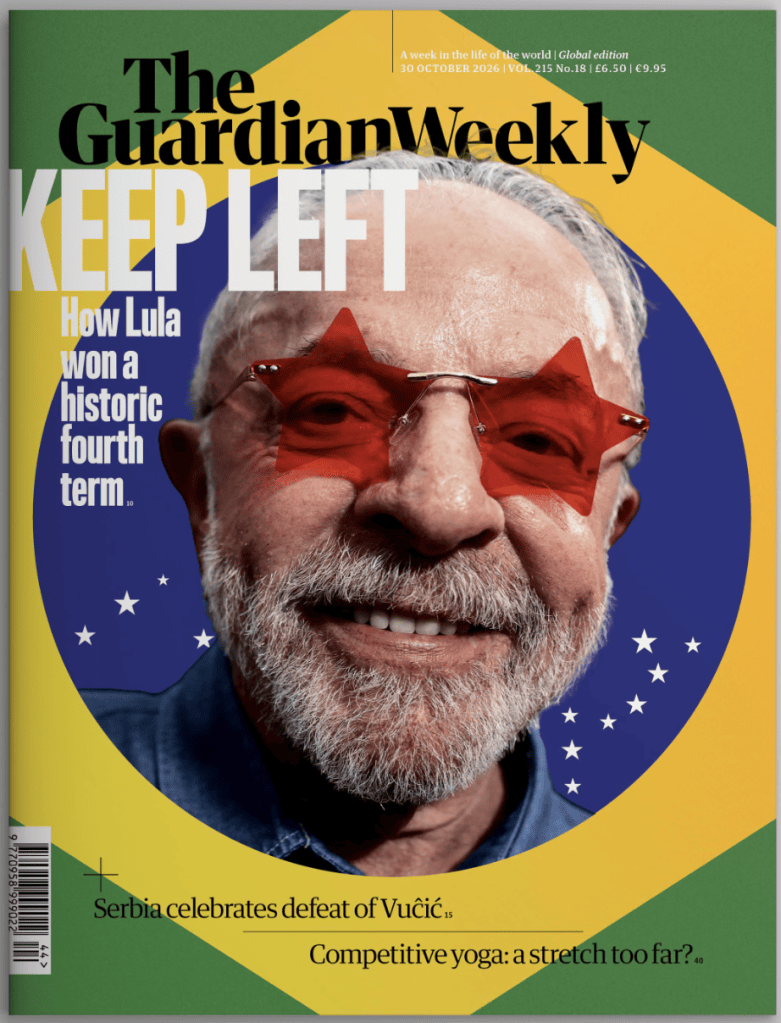
How many grinning faces, jubilant crowds and celebrating politicians can you fit into a single issue of the Guardian Weekly? That’s not a question that often troubles us, but the spectacular triumph of President Luiz Inácio Lula da Silva, winning a historic second-round vote after losing the first to rightwing opponent Flávio Bolsonaro, and the victory of the student-led campaign against autocrat Aleksandar Vučić in Serbia gave me a happy problem to solve this week. In an era when the right seems to be riding high in the world, popular pushbacks against strongmen politicians is something to celebrate.
For our Brazil cover story, Tom Phillips and Tiago Rogero report on the reaction to Lula’s victory and how he pulled eventual success from the jaws of what, until the first results came on Sunday evening, seemed a probable defeat. As government health minister Alexandre Padilha said that evening: “It’s a massive victory – not just for Brazil. It’s also an important signal to the rest of Latin America and to the world.” But, as commentator Jordana Timerman cautions, Brazil has been an exception in Latin America in successfully resisting Donald Trump’s attempt to achieve hegemony over the region.
Spotlight| ‘Pure arrogance’ Google has been in the dock in Finland over the illegal felling of hectares of woodland for its datacentres, reports Miranda Bryant
Science| Out of the blue Why are more planes encountering invisible air turbulence, what can they do about it and what effect will more frequent incidents have on travellers, asks Patrick Keneally
Feature| Bent out of shape? Competitive yoga may sound like anathema to some devotees of the ancient practice but, as Anita Chaudhuri discovers, there is a movement among some yogis to make it an Olympic sport
Opinion| Lame duck presidents can be dangerous beasts If Democratic midterm gains hamper Donald Trump at home, we should be very worried about what he might do abroad when foreign policy is his last bastion of power, says Steve Bloomfield
Culture| Stay faithful As the second series of Celebrity Traitors draws to its conclusion, Michael Hogan meets the people who made it the world’s biggest TV show and finds out why Claudia Winkleman never wants to leave the castle
News, Views and Reviews For The Intellectually Curious