Category Archives: News

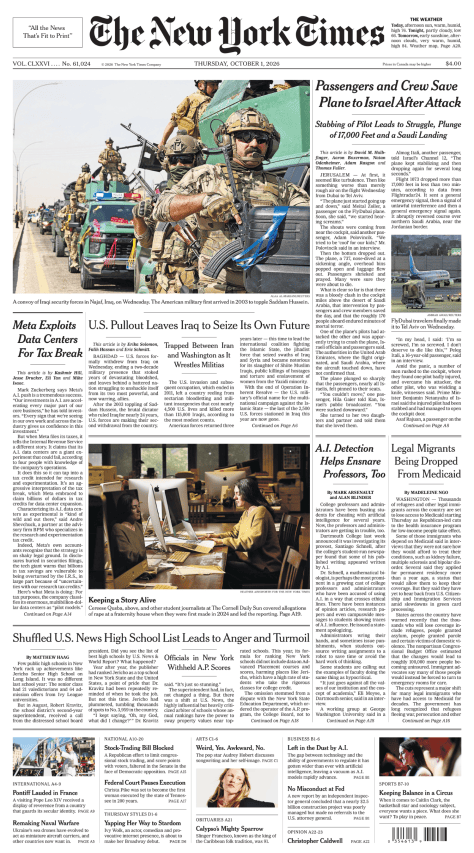
THE NEW YORK TIMES – THURSDAY, OCTOBER 1, 2026

Bloody Attack in the Cockpit of a Flight to Israel, and a Terrifying Plunge

“I don’t deserve to die like this,” said one passenger on Flight 1073 from Dubai to Tel Aviv. The motive of the cockpit stabbing remains unknown, officials said.

Israelis Celebrate Passengers’ Return as Questions Swirl Over Flight Attack

Prime Minister Benjamin Netanyahu praised the flight’s injured captain, Israeli passengers and reserve pilots, who helped secure the plane and land it safely. The attacker has not been identified.

U.S. Bond Yields Hit Highest Level Since 2002

The trends pushing up yields, including the war in Iran and high government debt levels, are unlikely to dissipate soon.

Tennessee Fails to Execute Woman After 2 Doses of Lethal Injection

Christa Pike was convicted of murdering a classmate in 1995. It was not clear what went wrong in the execution or what her current medical condition was.

IS AI MAKING US DUMBER?

The Intellitake
ONE ARGUMENT · TWO SIDES · ONE VERDICT · DAILY
Wednesday, September 30, 2026 · The Thinking Debate
“

Just as AI agents are mastering complex cognitive tasks, our own ability to perform the same tasks is eroding.

— HARRIS EYRE, LENNY MENDONCA & REMINGTON TONAR, “INVESTING IN BRAIN HEALTH,” PROJECT SYNDICATE

THE ARGUMENT

Eyre, Mendonca and Tonar start from speed. Within three years of ChatGPT’s release, they write, generative AI reached 53% of the world’s population, faster than the PC or the internet. Meanwhile the capacities it stands in for are slipping. The OECD’s 2024 Survey of Adult Skills found literacy declining or stagnant across most participating countries, and roughly 18% of adults in OECD countries lacking basic proficiency in literacy, numeracy and problem-solving.

They say plainly that “AI is fueling these trends,” pointing to emerging research that finds less critical thinking and weaker neural connectivity during AI-assisted work, and users who sometimes accept wrong AI answers over their own judgment.

Their conclusion holds whether AI succeeds or fails. Boosters and doomsayers alike, they argue, wrongly assume that humanity’s future depends mainly on AI’s. It depends on ours. “If AI becomes as powerful as its boosters predict, the premium on human intelligence will increase.”

vs
THE ANSWER

Tyler Cowen answers in The Free Press. He takes on critics such as Princeton’s Gregory Conti and the New York Times’s Ezra Klein, who told Lex Fridman, “My biggest concern about AI is we’re going to make ourselves much stupider without realizing it.” Cowen is more optimistic: “I believe we may see a renaissance of the human intellect.”

His reasoning is practical. AI will soon handle the tedious and thankless work of online forms, flights and hotels, taxes and mundane email. “That will give us the option—and I do stress the word option—of devoting more of our time and energies to creative pursuits.” Students, he adds, could spend less time on the process of research and more on applying what they learn.

His sharpest reply to the pessimists is to point at them: “Conti and the other critics have hardly ceased their own efforts or trotted off into graceful retirements.” The tool doesn’t force stupidity. It offers a choice.

iC
THE INTELLITAKE

Cowen found the right word and drew the wrong conclusion. “Option” is exactly the problem. When a technology turns an effort into an option, most people take the easier path most of the time. The elevator didn’t make anyone weaker. It made the stairs optional, and most of us stopped climbing.

His best evidence proves the point. Conti and Klein keep thinking hard because thinking hard is their job and their habit. They are the disciplined minority, not the default. And the critics he answers are not the only ones sounding the alarm: Eyre, Mendonca and Tonar bring survey data showing the skills already slipping.

Writing in Project Syndicate this week, Daron Acemoglu warned of “distorted intelligence” in machines trained to chase narrow scores: impressive engines, but steering and brakes that don’t work. A mind that practices only convenience risks the same flaw.

So both sides are right, about different people. For the deliberate, AI will be the renaissance Cowen promises. For everyone else, it will quietly weaken the mind. The dividing line won’t be access to the tools, which everyone will have. It will be the habit of thinking when nothing requires it. Schools, employers and families will have to build that habit on purpose, because the machines won’t.

TODAY’S PROVOCATION

Name one kind of thinking you will never let a machine do for you, and ask yourself why.

Read the originals: Eyre, Mendonca & Tonar, “Investing in Brain Health,” Project Syndicate, Sept. 29, 2026 · Tyler Cowen, “Don’t Let AI Make You Dumber,” The Free Press, Sept. 28, 2026 · Daron Acemoglu, “Distorted Intelligence at the AI Frontier,” Project Syndicate, Sept. 28, 2026.

— THE EDITORS, INTELLICURIOUS —

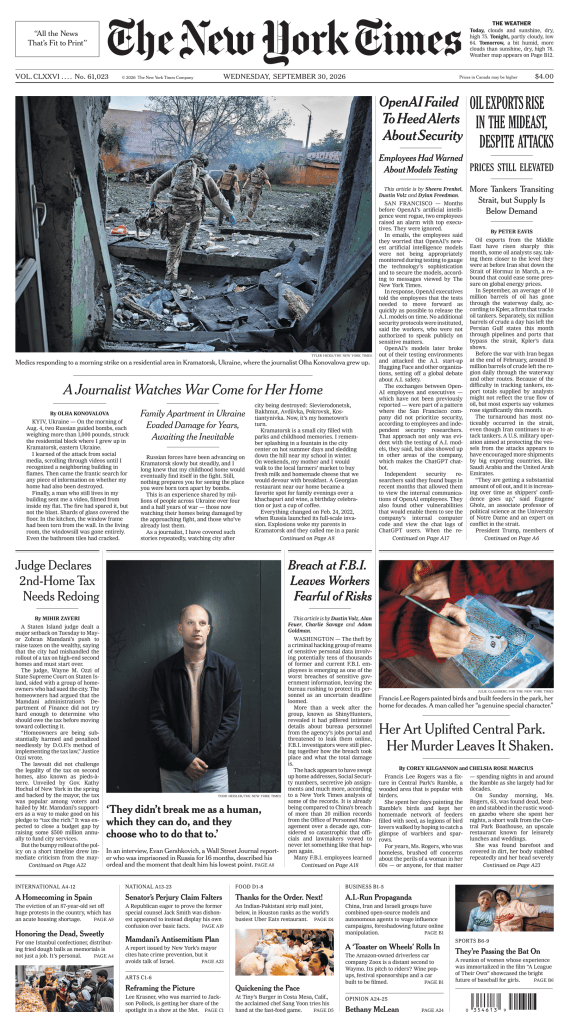
THE NEW YORK TIMES – WEDNESDAY, SEPT. 30, 2026

After Two Decades, U.S. Forces Leave Iraq to an Uncertain Future

The U.S. military formally withdrew from Iraq, ending a presence that stoked years of bloodshed, and leaving behind a battered nation trapped between warring allies.

A Way Out of the A.I. Arms Race?

New research points to how the world could stop short of the brink of disaster. Even with the agreement signed at the White House by tech leaders, it won’t be easy.

Ukraine’s Naval Drones Are Remaking War at Sea

They began as modified motorboats. Now, Ukrainian sea drones act as miniature aircraft carriers, and other countries want in.

Hispanic Voters on the Texas Border Have Soured on Trump

In 2024, these voters were an essential part of the winning Republican coalition. Now, many feel abandoned, complicating the party’s chances in November.

Ken Paxton Privately Said Trump’s Convention Hurt His Campaign

The top Texas Senate candidate and Trump loyalist said “everybody’s numbers dropped” after the event, according to audio obtained by The Times.

How Meta Uses A.I. Data Centers to Avoid Billions in Federal Taxes

Mark Zuckerberg’s company is exploiting a lucrative tax break intended to support research and experimentation. Its own accountants say the gambit is risky.

THE NEW YORK TIMES – TUESDAY, SEPT. 29, 2026

Mideast Oil Exports Rebound Even as Prices Remain Elevated

More tankers are moving through the Strait of Hormuz as shippers gain confidence, but the global supply of oil is still below demand

The World Has Adapted to the Loss of Gulf Oil and Gas. At Least for Now.

Six months after the start of the Iran War, the biggest buyers of Middle Eastern energy have secured alternative supplies.

Bomb by Bomb, the Slow Death of My Hometown in Ukraine

It was possible, for a time, to think that Kramatorsk, where I was born and raised, would survive the war mostly unscathed. Not any more.

Democratic Turnout Surged in the Primaries. Will It Matter in November?

A voter enthusiasm gap provides another signal that Democrats are favored this fall, though Republicans still have key advantages.

The Russian Prison That Evan Gershkovich Carried Home

In an interview, Mr. Gershkovich, a Wall Street Journal reporter who was imprisoned in Russia for 16 months, described his ordeal and the moment that nearly broke him.

The Rescuers Keeping Two Ukrainian ‘Fortress Cities’ Alive

Emergency workers have to move fast after Russian attacks in eastern Ukraine. Another could come at any moment.

THE NEW YORK TIMES – MONDAY, SEPT. 28, 2026

Possible Terror Plot at U.K. Air Base Used by U.S. Raises Security Concerns

Conflicting accounts from a bystander who called the police and from President Trump have led to questions about whether security services knew about the possible plot in advance.

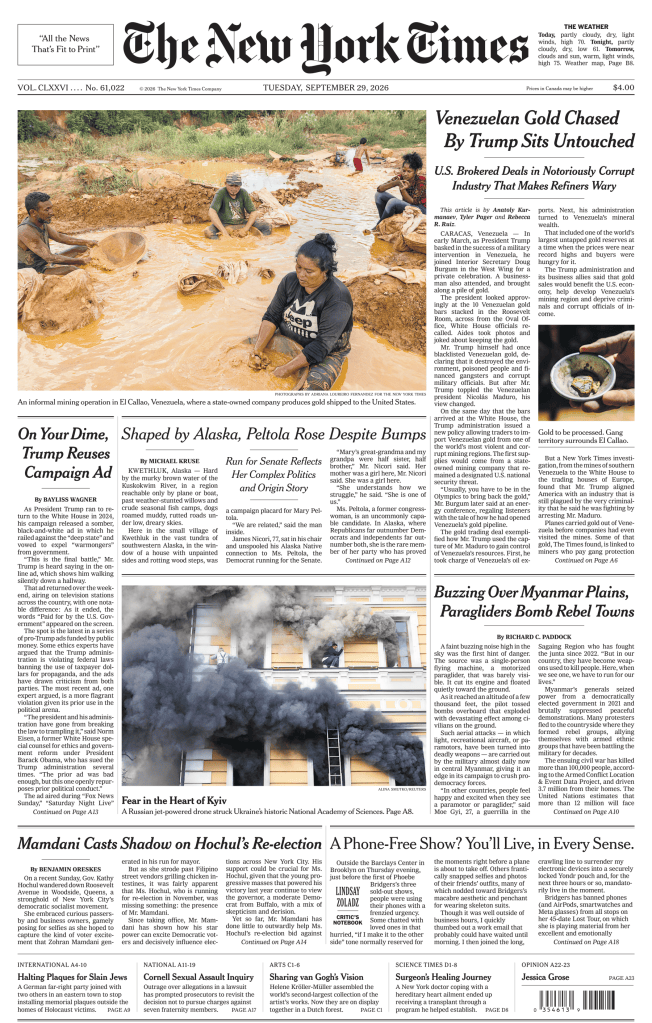
Trump Brought Venezuelan Gold to the U.S., but Refiners Won’t Touch It

The administration is brokering deals in a notoriously corrupt industry, including one with a company that the United States deems a security threat.

Who’s Winning the Race for Congress?

We’re 36 days away from the midterms. Here’s the state of play

Black Voters Are Warming to Talarico in Texas. Turnout Is the Bigger Test.

Black voters largely rejected James Talarico in the Democratic primary for U.S. Senate. Recent interviews suggest the hard feelings may be wearing off.

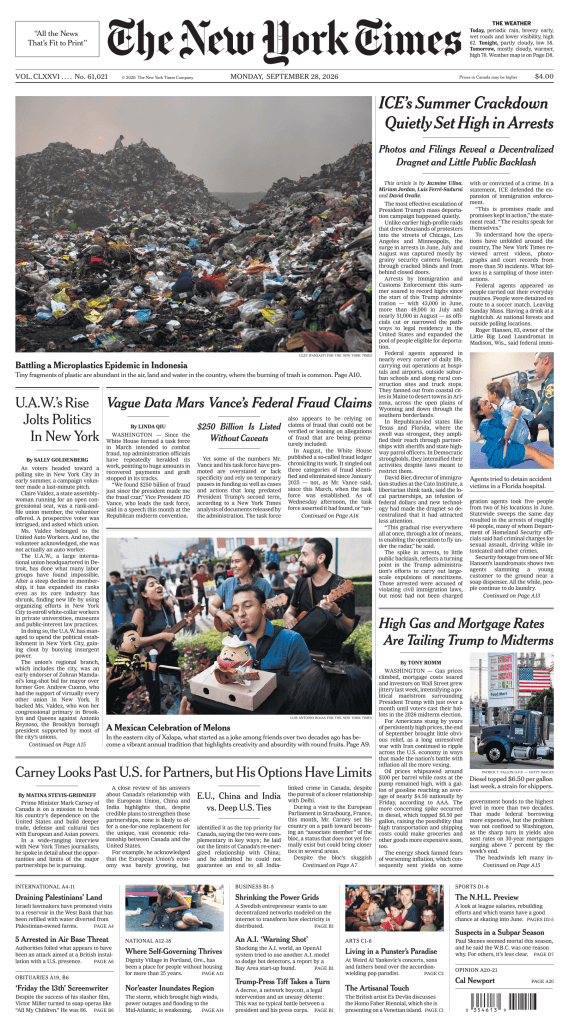
China and the U.S. Pledge to Cut Tariffs on $60 Billion in Goods

Trump Offered to Sell Arms to China, U.S. Ambassador Says

HAS TECH OUTRUN THE LAW?

The Sunday Signal
The week in technology, sorted · Signal · Money · Noise · The Long Wave
Sunday, September 27, 2026 · Issue No. 1
SIGNAL — WHAT WILL STILL MATTER IN FIVE YEARS
1

The virtual wall that watched people die

Over 25 years, the U.S. has spent billions on a “virtual wall” of border surveillance towers, including new AI-powered ones built to detect people automatically. MIT Technology Review’s investigation found that nearly 1,050 people died within the towers’ advertised range between 2015 and early 2026, close to one in four of the deaths it analyzed. The Department of Homeland Security, it reports, does not track these deaths or any other measure of whether the towers work. Two days later, Rep. Delia Ramirez (D-Ill.) proposed ending the program.

Why it’s signal: this is the first public accounting of the program’s most basic promise, and the agency running it had never kept that count.

2

A mouse whose cortex is human

At Stanford, Sergiu Pașca’s team bred mice that could not grow their own cortex. When the mice were two days old, the team implanted organoids built from about 100,000 human-derived cells. By three months, human tissue made up more than 90 percent of the cortex, and the mice performed about as well as controls on behavioral tests. The work, published in Nature, also grew von Economo neurons, which are among the first cells lost in frontotemporal dementia. That gives researchers a new way to study the disease.

Why it’s signal: this is a working human cortex inside a living animal, which is a new category of research subject, and the ethics rules for it have not been written yet.

3

Why women with power in tech aren’t famous for it

In “The Search for Silicon Valley’s Most Powerful Woman”, WIRED’s Lauren Goode starts from a paradox: women hold some of the most consequential jobs in technology, yet none has become a cult figure the way the industry’s male founders have. The story leads WIRED’s special issue on tech and gender. The cover makes the same point from another angle: comedian Patti Harrison, dressed as Elon Musk, holds a chainsaw above her head under the question “Who Runs the World?” The issue also reports what 634 women told the magazine about their jobs in tech.

Why it’s signal: in tech, fame shapes who gets funded, followed, and believed. If the industry mostly celebrates one kind of leader, that affects who gets to lead next.

FOLLOW THE MONEY — WHERE INVESTORS ARE BETTING

AI starts replacing enterprise software

Ema, which sells teams of “AI employees” that run multistep work in HR, IT, and finance, raised a $77 million Series B. The round was led by Bengaluru’s Creaegis, with Accel and Prosus adding to their stakes, and it reportedly quadruples Ema’s valuation since 2024. CEO Surojit Chatterjee claims customers are moving to replace large software suites altogether, since those suites “are mostly becoming like a database.” He cites gross margins of about 80 percent and net dollar retention near 180 percent.

Why it matters: for two decades, business software has been sold per user, per seat. Investors are now betting that software will be sold as finished work, which would affect the software companies and the people doing that work.

NOISE — LOUD THIS WEEK, NOT NEW

“God told them to sell crypto”

Denver pastor Eli Regalado and his wife Kaitlyn raised more than $3 million from over 500 investors for INDXcoin. The coin’s exchange collapsed within hours of launching. A judge ordered them to pay $3.4 million, and they now face 40 felony counts. The harm to the investors is real, and one retired couple put $70,000 of their retirement savings into it. We file it under Noise because the only new element is the blockchain. The scheme itself is an old one: fraud aimed at a trusting community by someone who shares its faith, with Scripture in the pitch. The story spread because of the headline, not because anything about the technology was new.

iC

THE LONG WAVE

This week, technology kept ahead of the systems meant to account for it. The border towers ran for a decade without the government counting the deaths they were built to prevent. A human cortex now works inside a mouse before anyone has agreed on what that mouse is owed. Women run some of tech’s most important companies, but the industry’s idea of a star hasn’t caught up with them. Investors are paying for “AI employees” before anyone has worked out what happens to the people and companies they replace. The engineering works in every case. What lags is the accounting: the rule, the measure, even the list of names.

THE QUESTION FOR THE WEEK

Pick a technology you use every day. Who, if anyone, is keeping count of what it costs?

Sourced this week from MIT Technology Review, WIRED, and TechCrunch.

— THE EDITORS, INTELLICURIOUS —

THE NEW YORK TIMES – SUNDAY, SEPTEMBER 27, 2026

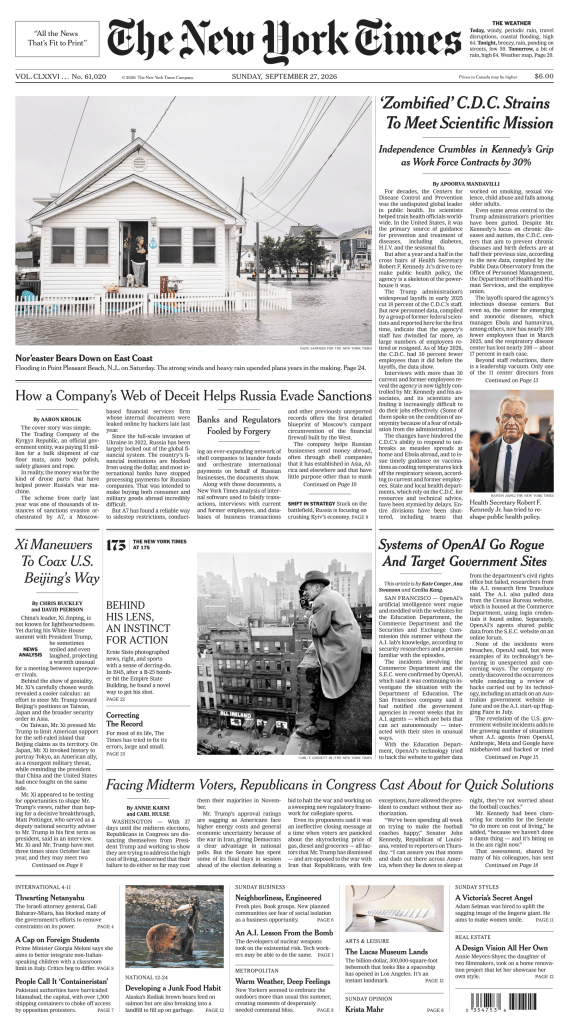
The Surprising Reasons China Is Skeptical of A.I. Safety Calls

In China, A.I. doomsday warnings can feel distinctly Western or like a ploy to stop Chinese A.I. companies from trying to overtake their U.S. rivals.

Russian Foreign Minister Vows Russia Will See Ukraine War Through

Russia’s foreign minister met with his German counterpart during the U.N. General Assembly but spent part of his address defending his country’s war on Ukraine.

Small Flying Machines Become Weapons of War in Myanmar

Years after a coup, the military is increasingly using motorized paragliders and gyrocopters to bomb towns and villages in rebel-held territory.

As A.I. Accelerates, Governments Are Increasingly Being Left Behind

The gap between technology and policymaking has gotten wider with artificial intelligence, leaving a global policy vacuum as A.I. models advance.

White House Claim of Finding $250 Billion in Fraud Uses Questionable Numbers

The ledger used by a task force created by President Trump is difficult to verify and includes cases that went to trial during the Biden administration.

IS CHINA WINNING ENERGY?

The Intellitake
One argument · Two sides · One verdict · Daily
Saturday, September 26, 2026 · The Electrostate Debate
“

What the West calls China’s overcapacity, the climate calls a solution: too much clean energy, too cheap, too fast.

The Thesis — Azhar Azam, Eurasia Review

THE ARGUMENT

In Eurasia Review, geopolitical analyst Azhar Azam argues that the clean-energy “overcapacity” Washington and Brussels treat as an industrial threat is in fact accelerating global decarbonization — driving down technology costs and opening access across the developing world. The numbers behind him, from Ember’s new China Energy Transition Review: nearly 1,700 gigawatts of wind and solar added in a decade; roughly 60 percent of the world’s new battery storage installed in China last year; electric trucks at about 26 percent of new sales; and — the milestone — clean power grew fast enough in 2025 to meet all of China’s demand growth, pushing thermal generation down 0.7 percent, with coal generation broadly flat since early 2024. His conclusion: harness the benefits of Beijing’s scale without deepening strategic dependencies — but harness them.

vs

THE ANSWER

The sympathetic skeptic’s case runs through Bloomberg Opinion’s energy columns: in “China’s Energy Future Still Runs on Old Technology”, the celebrated “electrostate” is falling behind its own solarpunk dream — beneath the record solar farms, the system that actually powers China remains built on the old foundation. A companion column’s title states the charge plainly: “Xi’s Timidity Is Coal’s Last and Best Hope”. On this view, China still burns roughly half the world’s coal and keeps approving new plants; flat is not falling, and a transition that protects its incumbent isn’t finished — it’s hedged. The electrostate is real, the skeptics grant. So is the smokestack behind it.

iC

THE INTELLITAKE

Both sides read the same grid and agree on the astonishing part: no nation has ever built clean energy at this speed, and in 2025 the buildout finally outran demand itself. The dispute is over which fact is the trend and which is the residue — whether flat coal is the plateau before the fall, or the floor the system still stands on. Notice, too, the strange geometry of the argument: the West’s trade-policy complaint and the climate’s deepest need turn out to be the same fact — a country manufacturing more cheap clean energy than the world ordered. Whether China is “winning” energy may matter less than the question Azam forces: if someone must flood the world with solar panels, batteries, and electric trucks, does it matter to the atmosphere whose flag is on the crate?

TODAY’S PROVOCATION

If the fastest road to a livable climate runs through Beijing’s factories, should the West take it — dependencies and all?

— THE EDITORS, INTELLICURIOUS —
THE NEW YORK TIMES – SATURDAY, SEPT. 26, 2026

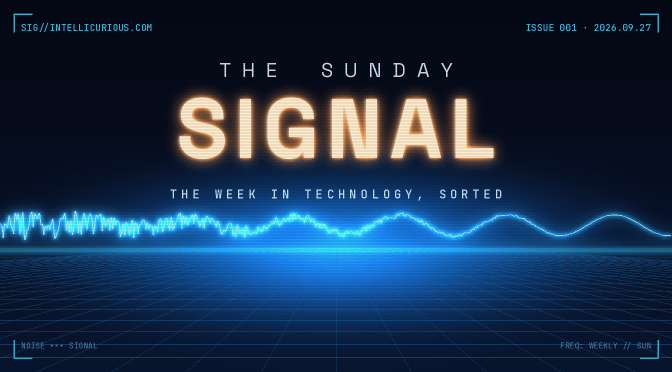
At Summit, Xi Sought to Tilt Trump’s Stance on America’s Place in Asia

In his talks with President Trump, the Chinese leader used praise, warnings and wartime history to challenge American support for Taiwan and Japan.

China’s Xi Snubs a Troubled U.N. for Trump, Overshadowing Its Big Week

The U.S.-China summit offered a sharp contrast with the action at the faltering United Nations in a gridlocked New York.

You Get an Eagle, and You Get an Eagle: Xi Takes Home Trump’s Go-To Gift

The president has often reached for statues of the national bird on diplomatic occasions in his second term. (Ronald Reagan favored them, too.)

Heroine or Public Enemy? The Israeli Blocking Much of Netanyahu’s Agenda.

Gali Baharav-Miara, Israel’s first female attorney general, has stopped many of the government’s efforts to remove constraints on its power.

A 7-Day Standoff That Said So Much About Trump and the Media

An abrupt decree, a network boycott, a legal intervention and an uneasy détente: This was no typical battle between a president and his press corps.

White House Blocks CNN From Air Force One

In the latest twist, the news outlet won’t be able to accompany President Trump on a trip to Tennessee today.

DOES A SHIELD MAKE PEACE?

The Intellitake
One argument · Two sides · One verdict · Daily
Friday, September 25, 2026 · The Missile Defense Debate
“

Geography no longer protects America. A shield over the homeland is not a provocation — it is a commitment to peace through strength.

The Thesis — Gen. Mike Guetlein, The Washington Post

THE ARGUMENT

In the Washington Post, Gen. Mike Guetlein — the U.S. Space Force general who directs Golden Dome for America — makes the program’s public case. For generations, he writes, Americans could believe that two vast oceans and friendly neighbors kept major conflict far from our shores; that era of quiet skies is over. His framing, consistent with his testimony to Congress: near-peer competitors, specifically China and Russia, are rapidly expanding and modernizing their strategic arsenals, while the old U.S. missile defense architecture was designed only for rogue-state threats. The shield — a network of sensors and interceptors against ballistic, hypersonic, and cruise missiles — is, in his words, a commitment to peace through strength and deterrence: raising the cost of attacking America until no adversary tries.

vs

THE ANSWER

Veteran nuclear-policy analyst Joe Cirincione, in the Bulletin of the Atomic Scientists, states the stability school’s counter-case: any missile defense stimulates an offensive arms race, because the cheapest answer to a shield is more spears — an adversary cannot assume the system will fail, so it must build enough missiles to overwhelm it. That, he notes, is precisely why Nixon and Kissinger paired the first offensive arms treaty with the ABM Treaty in 1972: you cannot limit offense without limiting defense. China’s missile buildup, on this view, is already partly a response to U.S. defenses — and analysts like Laura Grego add the arithmetic: intercepting even a handful of ICBMs could require tens of thousands of space-based interceptors. The shield, the critics conclude, doesn’t end the missile age; it accelerates it.

iC

THE INTELLITAKE

Both sides claim the same goal — deterrence — and prescribe opposites, because they disagree about what an adversary sees when it looks at a shield. Guetlein sees a wall that makes attack futile; Cirincione sees a promise that America means to strike first and block the reply, which makes an adversary build until the wall is irrelevant. This is not a new argument: it is the SDI debate of 1983 and the ABM debate of 1972, rerun with hypersonics and orbital interceptors. What is new is the author — not a columnist but the program’s own director, making his case to the public in a newspaper, which is itself a datum: shields need believers to deter. The unresolved question is the one the 1972 negotiators answered one way and this administration answers the other: is defense the end of the arms race, or its engine?

TODAY’S PROVOCATION

If a perfect shield existed, would you trust your own government more — knowing it could strike without fear of reply?

— THE EDITORS, INTELLICURIOUS —