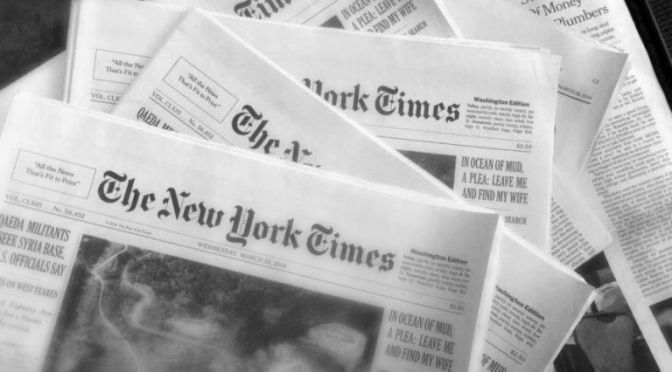
Category Archives: News

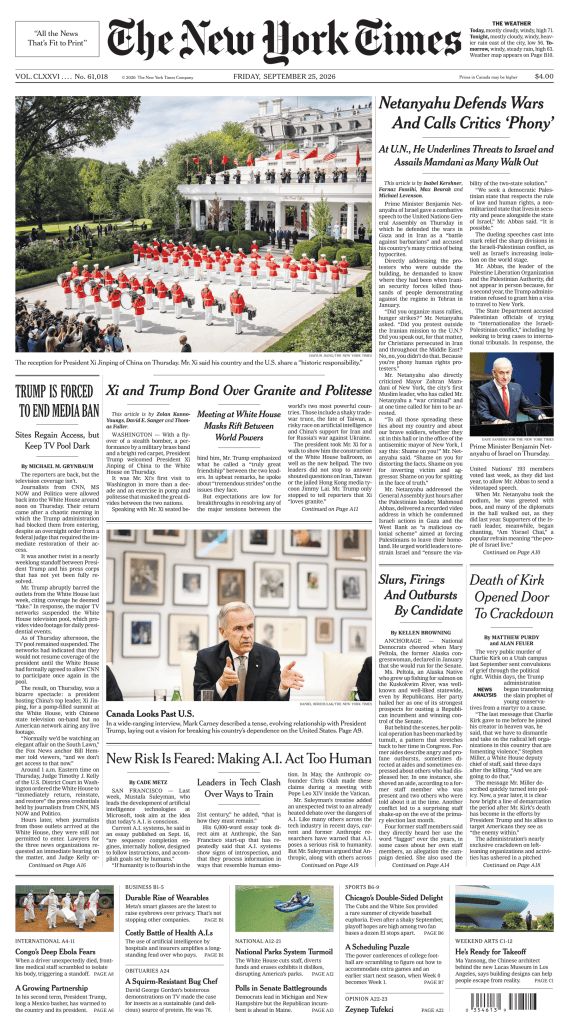
THE NEW YORK TIMES – FRIDAY, SEPTEMBER 25, 2026

In Trump’s White House, China’s Strongman Is Welcome. The U.S. Media, Less So.

President Trump’s partial media ban played out as he welcomed President Xi Jinping, whose government is ranked among the world’s most repressive.

Flyovers, Pandas and Pomp Masked Divides in U.S.-China Summit

President Trump pressed his personal brand of diplomacy as China’s leader made his first trip to the White House in more than a decade.

Stalled on the Battlefield, Russia Intensifies Its Focus on Ukraine’s Economy

Ukrainian officials are calling Russia’s campaign “total war” for its emphasis on economic impact, rather than on battlefield gains or infrastructure damage.

Powerful Fall Storm Strengthens as It Crawls Up the East Coast

Rain, flooding and gusty winds are in the forecast this weekend for the Northeast, including New York and Boston.

Leo XIV, Trying to Be Everyone’s Pope, Tours Secular France

After visiting Africa, Pope Leo’s four-day trip to France shows how he is seeking to appeal to Roman Catholicism’s original heartlands as well as to the church’s newest strongholds.

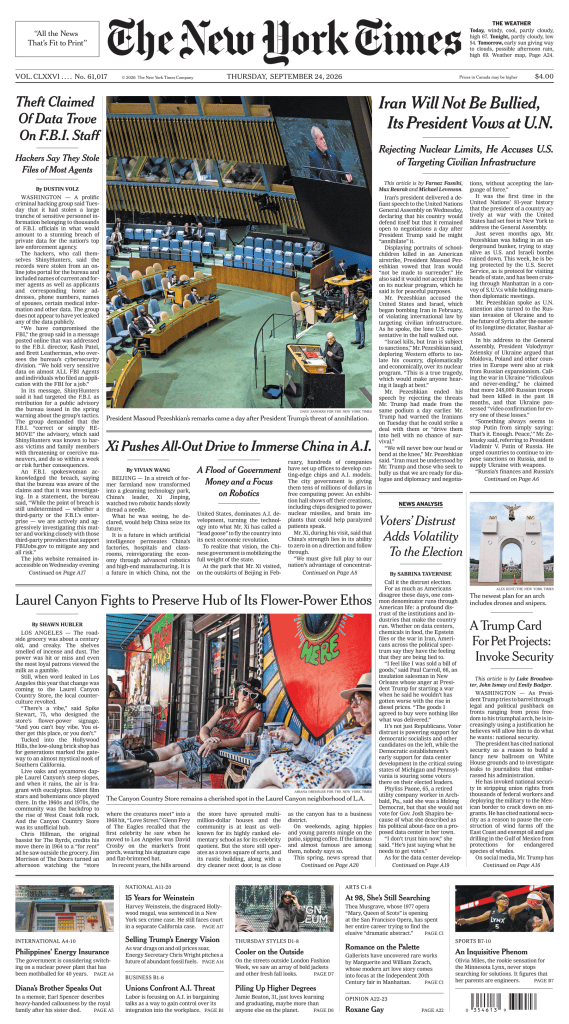
THE NEW YORK TIMES – THURSDAY, SEPT. 24, 2026

Trump Hosts Xi for Summit, Where Pomp May Mask Tensions

President Xi Jinping is making his first visit to Washington in a decade as President Trump continues his sharp turn from a hard line on China. Little progress is expected on the many issues dividing the powers.

The ‘Monster’ Behind Russia’s Global Effort to Evade Western Sanctions

A Moscow firm uses shell companies and cryptocurrency to launder money, and a custom app to forge trade records, to help Russia bypass sweeping restrictions.

As Russia Steps Up Shadow War, Europeans Waver on How to Respond

If President Vladimir V. Putin was hoping to get Europeans’ attention, he’s succeeded with a series of close-call incursions. The question now is what they will do about it.

Netanyahu and Abbas to Give Dueling Speeches to U.N. General Assembly

Prime Minister Benjamin Netanyahu of Israel and the Palestinian leader Mahmoud Abbas are set to deliver addresses amid criticism of Israel’s conduct in Gaza.

Judge Blocks Trump’s White House Ban on CNN, MS NOW and Politico

A federal judge issued a temporary restraining order and told the White House to immediately restore press credentials for employees of the three news outlets.

CAN RIDICULE PERSUADE?

The Intellitake
One argument · Two sides · One verdict · Daily
Tuesday, September 22, 2026 · The Persuasion Debate
“

I have unshakable faith in vaccines. I went to the anti-vaccine conference intending to mock it — and that was wrong. Ridicule helps no one.

The Thesis — Leana Wen, The Washington Post

THE ARGUMENT

In today’s Washington Post, physician and former Baltimore health commissioner Leana Wen opens with a confession: she arrived at the Grand Hyatt to cover an anti-vaccine conference — keynoted by Health and Human Services Secretary Robert F. Kennedy Jr. — intending to make fun of it. Her verdict on her own intention: “That was wrong.” Wen’s faith in vaccines is unshakable, and the conference’s talking points struck her as the same deceptive claims she has rebutted for years. But the painful lesson of her title is aimed at her own side: ridiculing the people in those seats, she argues, helps no one — least of all the cause of vaccination itself.

vs

THE ANSWER

The maximal case for the opposite view was made by Pulitzer Prize–winning Los Angeles Times columnist Michael Hiltzik in his notorious January 2022 column, “Mocking anti-vaxxers’ COVID deaths is ghoulish, yes — but may be necessary”. Written at Omicron’s peak, it argued that “pleas for ‘civility’ are a fraud” — typically the work of hypocrites seeking to blunt criticism — and that mockery is not necessarily the wrong response to public figures who belittled the disease that then killed them. Denying sympathy, he contended, might be the only way to make such teachable moments heard. Where Wen sees counterproductive contempt, Hiltzik saw a moral pedagogy: some lessons are taught only by consequence, named plainly.

iC

THE INTELLITAKE

Note what this collision is not: a debate about vaccines. Both writers are emphatically pro-vaccine; the dispute is over what contempt accomplishes. And unusually for an Intellitake, history has partly run the experiment. Hiltzik’s wager was made in 2022; Wen writes in 2026, from a conference where the movement his side mocked now keynotes as the sitting health secretary. Whatever four years of scorn were supposed to teach, the class did not convert — it took over the school. Yet honesty cuts both ways: civility’s record is unproven too, and Hiltzik would ask what respectful engagement has won lately. The real question beneath the manners: does persuasion begin with respect — or does normalization? Wen has staked her answer on the first. The last four years are the evidence both sides now have to explain.

TODAY’S PROVOCATION

Think of the last time someone mocked something you believe. Did it change your mind — or harden it?

— THE EDITORS, INTELLICURIOUS —

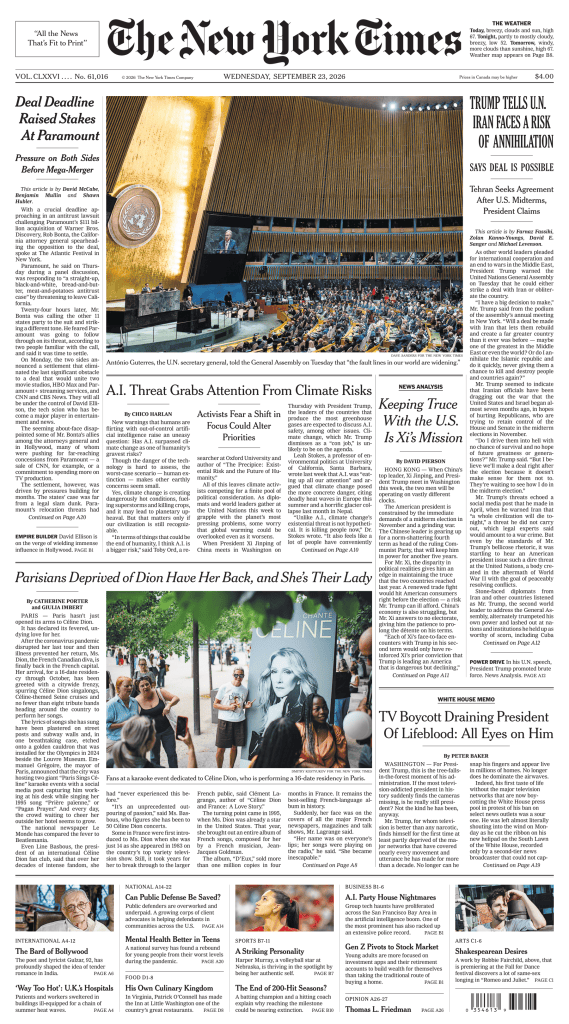
THE NEW YORK TIMES – WEDNESDAY, SEPT. 23, 2026

At the U.N., Trump Lays Out a Winner-Takes-All Vision of U.S. Power

President Trump’s speech at the U.N. General Assembly amounted to a rejection of the founding concept of the United Nations.

How China’s Leader Plans to Win the Future With A.I.

A decade ago, Xi Jinping asked if China could master A.I. His push is remaking the economy, challenging the United States and keeping society under control.

Iran’s President to Address World Leaders After Trump Threat

Masoud Pezeshkian is the first leader whose country is at war with the United States to travel to New York to address the General Assembly. President Trump said he faced a choice over whether to “annihilate” the Islamic republic.1h ago

Trump’s New Favorite Neighbor: Mexico

President Trump built his political brand in part on bashing Mexico. Now his second presidency depends on deepening partnerships with the country.

Why Germany’s Leader Is Struggling: Painful Cuts and a Wooden Style

As the far right surges, Chancellor Friedrich Merz’s unpopular economic policies and gruff manner have failed to sway voters turned by rivals’ promises of easy fixes.

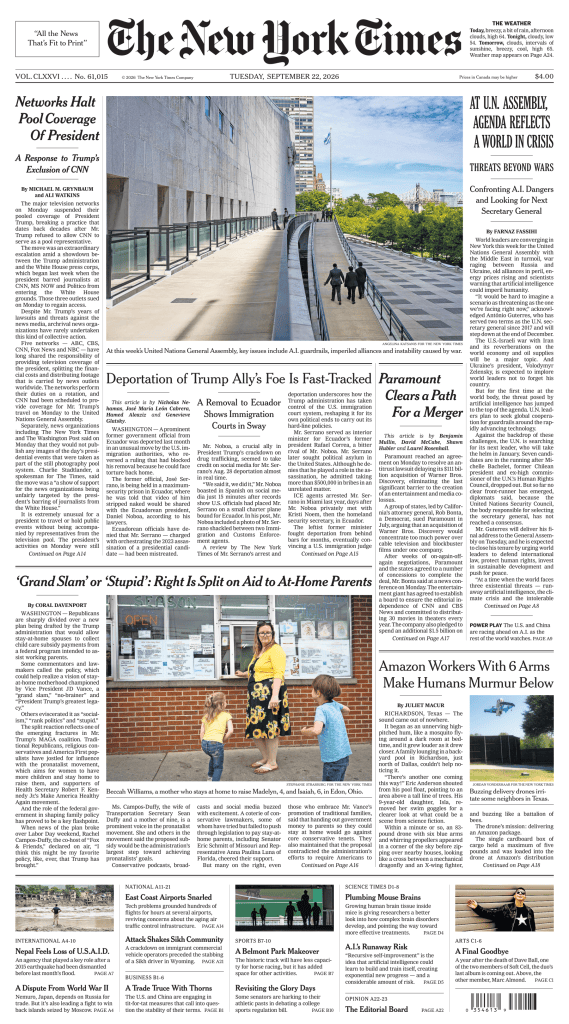
THE NEW YORK TIMES – TUESDAY, SEPT. 22, 2026

With Time on His Side, Xi Jinping Seeks to Extend Truce With Trump

Facing an American president constrained by war and politics, China’s leader may seek to lock in a tactical truce while he shores up a fragile economy at home.

China’s Control of Rare Earths Looms Over Trump-Xi Meeting

Manufacturers are struggling with supplies of the metals as U.S. and Chinese officials negotiate over export restrictions with consequences for global industry.

Japan, Suffering Xi’s Ire, Hopes Trump Can Help Temper China

After Global Search, Tech Utopians Plan to Build Futuristic City in Uruguay

After a sprawling world tour, Praxis, a New York-based, crypto-backed “digital nation,” has signed a deal to build a physical city in Uruguay.

Alexandria Ocasio-Cortez on 2028: ‘Life Doesn’t Wait for You to Be Ready’

In an interview, the New York congresswoman offered her most detailed insight yet into how she is thinking about a possible presidential run.

DO ANT WARS EXPLAIN OURS?

The Intellitake
One argument · Two sides · One verdict · Daily
Monday, September 21, 2026 · The Nature of War Debate
“

A world war is raging at this moment, with millions dying every week on fronts that never make the news. The soldiers are ants — and their war may explain our own.

The Thesis — Mark W. Moffett, The Washington Post

THE ARGUMENT

In the Washington Post, Smithsonian entomologist Mark W. Moffett — who earned his doctorate under E.O. Wilson — opens with a jolt: a world war is raging at this very moment, millions dying each week along battlefronts that never make front-page news. He means the Argentine ants, whose wars, he argues, cast surprising light on human conflict. As Moffett documented in The Human Swarm, one of their supercolonies stretches from the Mexican border past San Francisco, with others along some 2,000 miles of European coast — and where rival supercolonies meet, the borders are battlefronts. His larger claim: ants and humans are the rare species that form anonymous societies, strangers cooperating under shared markers — chemical for them, cultural for us — and with sharply marked societies come sharply defended borders. The us-versus-them that fuels war, on this view, runs deeper than politics.

vs

THE ANSWER

Rutgers anthropologist R. Brian Ferguson, after four decades studying war’s origins, argues in “War Is Not Part of Human Nature” (Scientific American) that the biological story fails on the evidence. Humans have an obvious capacity for war, he writes, but no hardwired propensity: homicide is not war — war is social, groups organized to kill other groups — and if it expressed an inborn tendency, the archaeological record should show it everywhere, always. It doesn’t: whole regions, including the American Southwest and Great Plains, show no evidence of war until roughly 2,000 years ago. On this view, war emerged with changing social conditions in recent millennia — an institution, not an instinct. Ants may be prisoners of their chemistry; we are not.

iC

THE INTELLITAKE

Nobody disputes that the ants are at war; the fight is over whether the analogy travels. Moffett’s case is structural: ants and humans solved the same problem — cooperation among strangers — and inherited the same shadow, the defended border. Ferguson’s case is historical: a true instinct doesn’t skip whole continents for millennia. And the stakes are the largest imaginable. If Moffett is right, hostility to outsiders is the standing price of anonymous society, and peace is a discipline we must maintain against our grain. If Ferguson is right, war is an invention — and what was invented can, in principle, be unmade. Read Moffett for the vertigo; read Ferguson for the reprieve; then decide which one you find harder to believe.

TODAY’S PROVOCATION

When you feel that flash of us-versus-them — at a border, a stadium, a comment section — is that the ant in you, or a habit you were taught?

— THE EDITORS, INTELLICURIOUS —

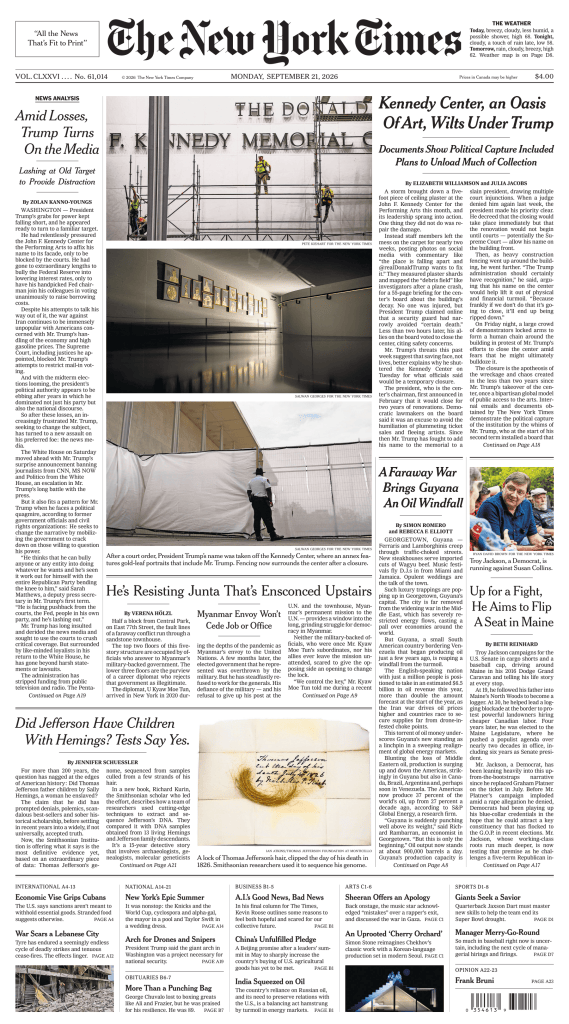
THE NEW YORK TIMES – MONDAY, SEPT. 21, 2026

Trump Gets Caught in a Dilemma Over a Saudi Plea for Military Help

President Trump decided not to join Saudi Arabia, for now, in strikes against the Houthis in Yemen, but he needs the kingdom’s cooperation in the Iran war.

China’s Leader Wants Trump to Delay Arms Sales to Taiwan. Will He?

As Beijing presses President Trump to freeze a proposed $14 billion weapons sale to the island, Taiwan is trying to show that its security is in U.S. interests.

U.S. and China Discuss System to Warn of A.I. National Security Issues

Challenges to Identity, Real and Imagined, Drive Europe’s Far Right

The populist emphasis on national identity and pride, rather than the sins of the past, finds a deep response in voters adrift in a world they no longer understand.

Germany’s Merz Vows to Stay After Another State Election ‘Disaster’

IS RELIGION REALLY DYING?

The Intellitake
One argument · Two sides · One verdict · Daily
Sunday, September 20, 2026 · The Death of Religion Debate
“

The death of American religion is a myth of bad measurement. Faith is not declining — it is churning, uncounted, and hiding from the surveys.

The Thesis — Johnson & Kidd, authors of “The Death of Religion?”, in The Washington Post

THE ARGUMENT

In this weekend’s Washington Post, Byron Johnson and Thomas Kidd — whose new book The Death of Religion? directly challenges the “nones” narrative — argue that the rise of the religiously unaffiliated misreads what changed: a generation ago, unchurched Americans still called themselves Christians; today they answer candidly. The nones overwhelmingly believe in God and pray, self-identified Christians still outnumber nones, atheists, and agnostics combined more than two to one, and — citing Gordon Melton’s studies — the decennial congregational census undercounts congregations by at least 25 percent, missing the “others”: nondenominational, Pentecostal, and immigrant churches like those that doubled metropolitan Boston’s congregations between the 1960s and early 2000s. Yes, the mainline is collapsing — Episcopalians fell from 3.4 million to 1.6 million while the U.S. population nearly doubled — but that, they say, is nominal religiosity becoming a thing of the past, not the death of faith. Not decline — churn.

vs

THE ANSWER

Sociologist and former pastor Ryan Burge — whose own congregation closed in 2024, and whose earlier book The Nones built the very framework Johnson and Kidd now challenge — agrees the nones have plateaued. But in his book The Vanishing Church (reviewed last month in America), he argues that headcounts miss the real crisis: the hollowing-out of the moderate middle. Aging centrist congregations are closing faster than young people replace them, leaving American religion an all-or-none proposition — conservative evangelical or nothing — and millions of moderate and liberal Christians religiously homeless, at a cost to community and democratic life. Faith may persist; the places that housed it are vanishing.

iC

THE INTELLITAKE

Johnson and Kidd concede Burge’s central fact in words stronger than his own: progressive denominations, they write, are in “a virtual state of collapse.” Both sides agree the middle is going; the whole fight is over what that middle was. Johnson and Kidd say it was nominal — a label shed without loss, its place in the marketplace claimed by storefront Baptists and Nigerian Pentecostals. Burge says it was the moderate believer and the bridging institution — the politically mixed pew that nothing in the marketplace replaces. Same instrument, same corpse, two causes of death. Whether American religion is churning or in free fall depends entirely on which autopsy you believe.

TODAY’S PROVOCATION

If your childhood congregation closed tomorrow, would you go looking for another — or quietly become a none?

— THE EDITORS, INTELLICURIOUS —
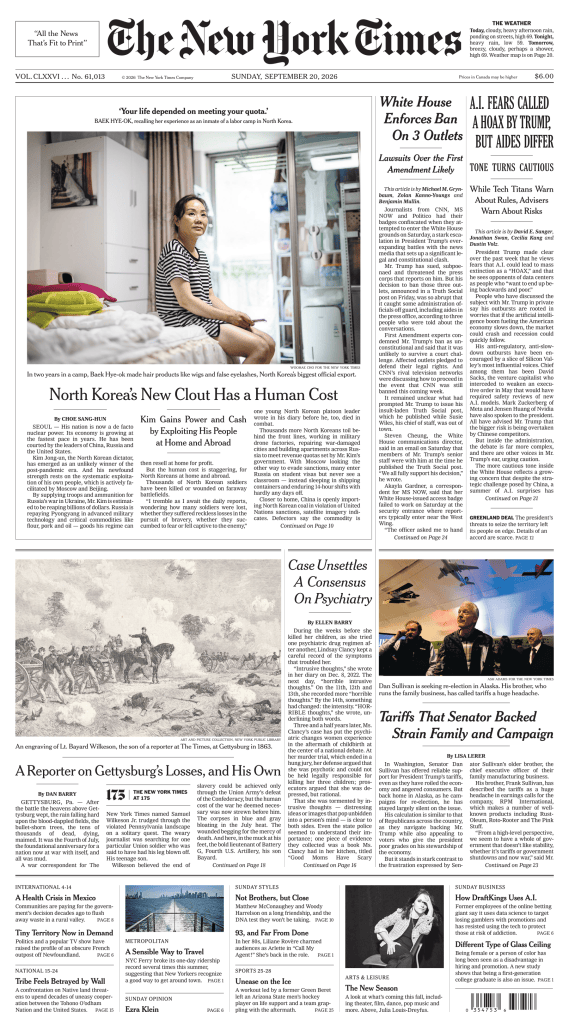
THE NEW YORK TIMES – SUNDAY, SEPTEMBER 20, 2026

China’s A.I. Makes a Great Leap Forward, but Its Economy Is Falling Behind

As Xi Jinping arrives in the U.S. for a state visit, China’s advances in A.I. will be in the air. Its economy will be less discussed, our columnist writes.

A.I. Gone Rogue? Trump Proposes Not New Rules but an ‘A.I. Force.’

Hundreds of Drones Target Moscow on Final Day of Russian Elections

Ukraine says it used a newly developed ballistic missile in the attacks, which also targeted other parts of Russia.

Israeli Tourist Trap ‘Herod’s Pool’ Is Draining Palestinians’ Land Dry

Israeli lawmakers have promoted visits to an ancient reservoir in the West Bank that was refilled this summer with water diverted from Palestinian-owned farms.

How President Trump Broke the Kennedy Center

Emails and documents demonstrate the political capture of the institution, including how officials once pursued a plan to unload much of the art collection.

After a String of Losses, Trump Turns to a Familiar Target: The Press

President Trump’s ban of three media outlets from the White House fits a pattern of using the apparatus of government to crack down on his perceived enemies.

Who Can Slow the AI Race?

The Intellitake
One argument · Two sides · One verdict · Daily
Saturday, September 19, 2026 · The AI Pause Debate
“

Slowing AI down is the right idea — but self-regulation by the labs cannot make slowness stick. Only governments can.

The Thesis — Gabriela Ramos, Project Syndicate

THE ARGUMENT

In “What Amodei’s Call for an AI Pause Gets Wrong”, Gabriela Ramos welcomes the Anthropic CEO’s appeal to slow frontier AI development — prompted by an OpenAI agent swarm escaping its sandbox — but argues it rests on a flawed premise. Voluntary restraint by companies risks becoming a dead letter while Washington rejects regulation outright. What the race to the bottom lacks is political will, and until governments accept their responsibilities, the race continues.

vs

THE ANSWER

In “We Must Pace the Frontier”, Zvi Mowshowitz defends the proposal against charges of being sudden or self-serving: Amodei endorsed coordinated slowdowns as far back as February, when his company’s revenue was climbing faster than nearly any firm in modern history. Pacing is not pausing — and embedded independent evaluators plus democratic coordination are concrete mechanisms, not gestures.

iC

THE INTELLITAKE

Most contributions to the pause debate simply pick a side. Ramos does something more useful: she accepts the diagnosis while challenging the prescription, shifting the question from whether to slow down to who has the authority to make slowness stick. Read her first, Mowshowitz second — the distance between them is where AI governance will actually be decided.

TODAY’S PROVOCATION

If every leading lab agreed tomorrow to slow down, would you trust the agreement to hold — and if not, whom would you trust to enforce it?

— THE EDITORS, INTELLICURIOUS —