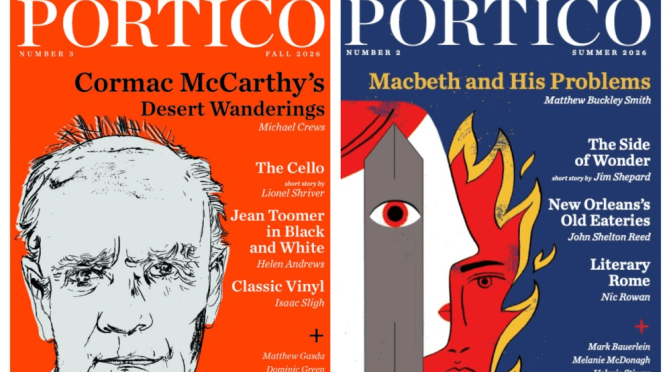
Tracy Daugherty’s biography of Cormac McCarthy is a landmark publication. Putting together the life of a writer who not only shunned publicity but actively worked to keep fans, journalists, the media, and academics off his trail requires the powers of both a skilled biographer and a nosy private detective. In that latter role, some of what Daugherty has uncovered is unsavory, though with the recent revelation of McCarthy’s relationship with Augusta Britt, who was sixteen when they began an affair, readers may be prepared for some of the shocks. One of Daugherty’s leitmotifs is McCarthy the “bad boy” and “outlaw,” and though such appellations risk cliché, the story he tells is of a man who, at least in the first half of his life, preferred the company of moonshiners, gamblers, hard drinkers, and petty criminals like his old Knoxville pal John Sheddan, who seems to have been the Falstaff to McCarthy’s Prince Hal.
There are two books before me, which, if I mistake not, will mark an epoch,” wrote W. E. B. Du Bois in The Crisis magazine in 1924. One was a novel of middle-class African-American life by Jessie Fauset called There Is Confusion. The other was a collection of stories, songs, poems, and character sketches called…
During the last quarter of the twentieth century, few writers were more admired by peers and critics than Andre Dubus. But because Dubus’s territory was the relatively confined space of the short story and novella, he never enjoyed great commercial success or recognition. Dubus was destined to be a writer’s writer—what Joshua Bodwell calls a…
In that we’ve been married for sixteen years, you really don’t have to try so hard to make your feelings known,” Janet said at the wheel. “I’m well aware you don’t want to do this.”
“I THINK I’ve been pretty stoic about it,” Rick said, eyes to the thick woods he’d be reflexively scanning for deer. Ever since they’d planted an ambitious garden behind their upstate New York summerhouse, the creatures that had once seemed so exquisite had become evil incarnate.
“Stoic? More like long-suffering,” Janet said. “You’ve hardly said a word the whole way here. But there’s no point in having joined Saint Peter’s if we don’t put our beliefs into practice. Charity doesn’t only mean parting with twenty bucks to get someone at the door to go away. It means sometimes doing what’s right when you don’t feel like it.”
Svetlana Alexievich on the Art of Oral History: “If you cut straight to the part you need, which is what journalists do, it won’t be interesting, and it won’t be the truth, either. Not the whole truth.”
Donald Antrim on the Art of Fiction: “I deplored the idea that writing involves suffering, that it had to be a bloodletting. Later I found out that it would be, and maybe should be.”
Prose by Eka Kurniawan, Angie Sijun Lou, Brian Ma, Scott McClanahan, Sam McKinniss, Tomoka Shibasaki, and Woo Dayoung.
Poetry by Asha Futterman, Zakaria Mohammed, Geoffrey G. O’Brien, Vasko Popa, Diane Seuss, and Natalie Shapero.
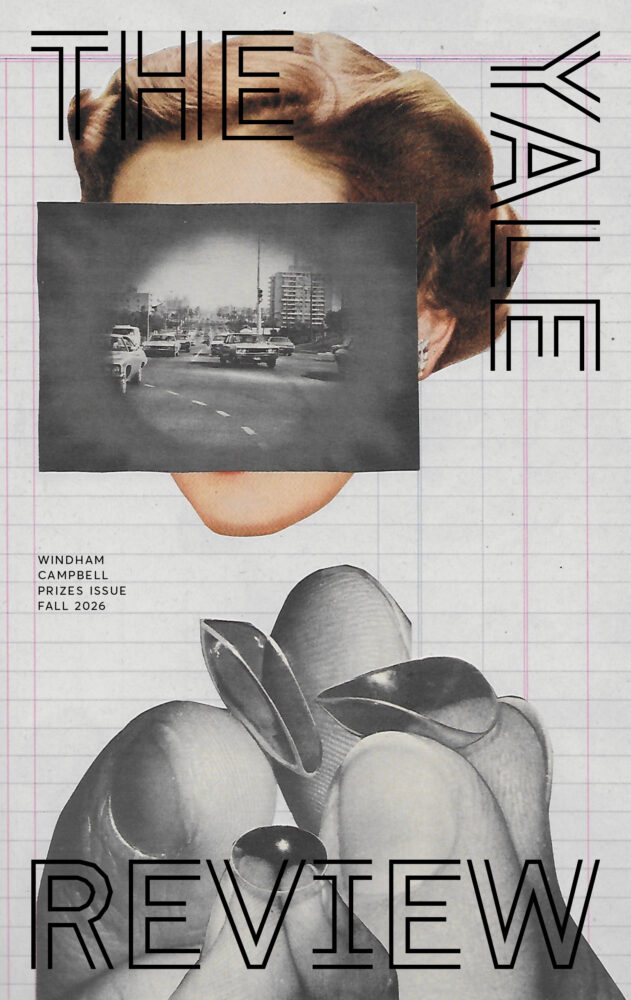
Art by Gertrude Abercrombie, Silke Otto-Knapp, and Laura Owens; cover by Elizabeth Glaessner.
A quarter century after the attacks, the grief, wars, and political furies of their aftermath still shape American life. By Jill Lepore
Have Conservatives Taken Sexy Back?
The culture wars have come for lingerie as the right, once the advocates of promise rings and purity culture, embarks on a crusade to “Make America Hot Again.” By Jennifer Wilson
Saudi Arabia’s Pursuit of Michelin Stardom
The kingdom, seeking to rebrand as a culinary juggernaut, has bankrolled new restaurants and conscripted big-name chefs. Will it succeed? By Ruby Tandoh
Donald Trump’s Capital Makeover
A coterie of advisers, planners, and architects is enabling the President’s passion project—renovating D.C. in his own image. By Antonia Hitchens
As AI erodes our attention spans and expressiveness, philosophers like Simone Weil and Arthur Schopenhauer offer profound insights on what it means to be an individual.
In The Diversity of Morals, Steven Lukes attempts to reconcile philosophical arguments that there is one morality despite cultural differences with empirical studies that suggest it’s all relative.
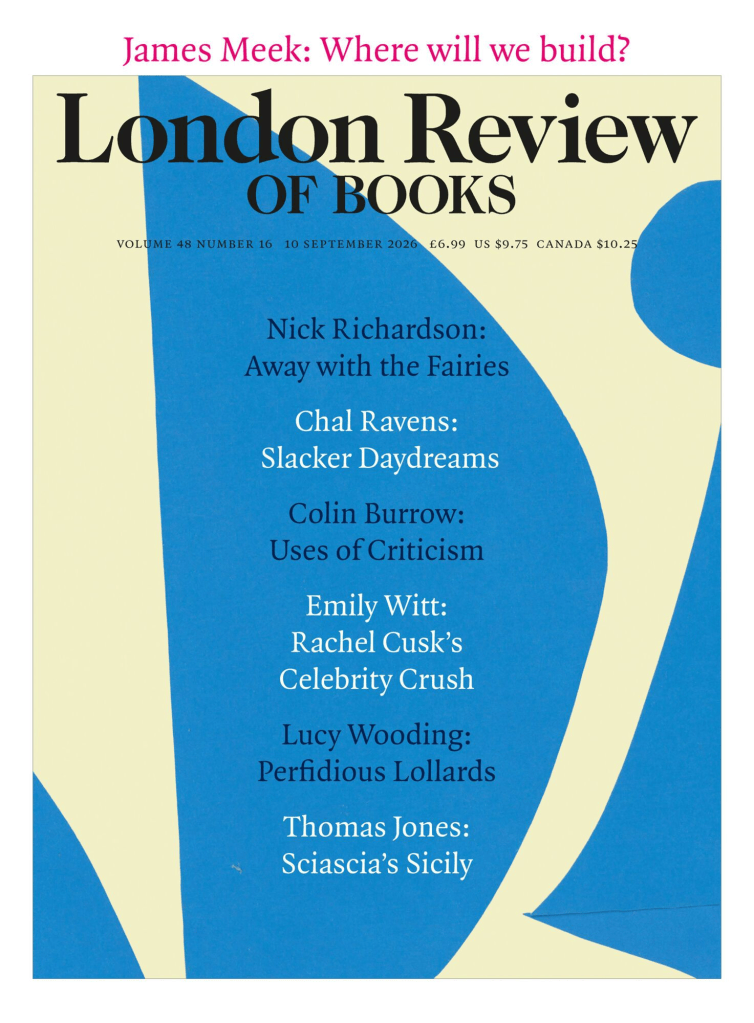
What’s the point of literary criticism? In June the University of Exeter announced plans that might make roughly a third of its English department – one of the best in the country – redundant. Other institutions, including Canterbury Christ Church University, have stopped offering English degrees altogether. Most mainstream publishers now wouldn’t dream of publishing a work of literary criticism, as they happily did in the 1970s and 1980s. Even literary biography, literary criticism’s previously marketable stepsister, no longer brings a gleam to a publisher’s eye. The grassroots of the subject are also suffering badly. Since 2000 the number of people taking A-level English literature in England has dropped by around a third, to around 36,000, with an even higher drop among male students.
A Sicilian Man: Leonardo Sciascia, the Rise of the Mafia and the Struggle for Italy’s Soul by Caroline Moorehead
The Beast in the Clouds: The Roosevelt Brothers’ Deadly Quest to Find the Mythic Giant Panda by Nathalia Holt
The Twitnam Summer: Friendship, Satire and the Writing of ‘Gulliver’s Travels’ by Hester Grant
It’s getting on for twenty-four years ago that I first read Patricia Highsmith’s The Talented Mr Ripley (1955). Books tend to come to us when we need them, and it’s easy to see why Tom Ripley’s project of self-reinvention and triumphant class resentment was so appealing to me as a twenty-year-old undergraduate.
The Sea-King and the Sorceress: Life and Death in the Viking Age By Neil Price
Few groups in history have been so variously defined, quarrelled over, misrepresented and appropriated as the Vikings. Their identity elusive, they have been passed around like historiographical tokens to the detriment of a deeper understanding of their cultural and political milieu. Neil Price’s The Sea-King and the Sorceress sidesteps these often sterile debates by examining the lives – and deaths – of more than twenty figures from the Viking Age and using them to shed light on wider themes, a bottom-up approach which is both logical and engaging.
The Cauldron: The Making of the Modern Middle East By Simon Sebag Montefiore
A highly readable gallop through one of the world’s most complex political environments, The Cauldron is brilliant on narrative, weaker on analysis. Simon Sebag Montefiore has set himself a formidable task: to compress the modern history of a region extending from Morocco to Iran, and from the fall of the Ottoman Empire to the wars of 2026, into a single volume. The result is an exuberant pageant of sultans, shahs, kings, colonels, spies, revolutionaries and assassins. Few historians could move so confidently from the salons of Cairo to the palaces of Riyadh, from Atatürk’s Ankara to Khomeini’s Najaf, while keeping so many figures vividly in play.
All the Wrong Moves: How Three Catastrophic Decisions and Years of Sh*tshow Politics Led to Trump – and How We Find a Way Out By Anthony Scaramucci
When Donald Trump fired him after just eleven days as his director of communications, Anthony Scaramucci thought his career was over. He had become such an object of ridicule that a crisis PR adviser suggested he lie low for a few years before attempting to start again. Instead, the self-styled ‘front stabber’ from New York – who had naively assumed that a successful Wall Street career could equip him for the toxic political swamp of Washington, DC – launched himself into a round of media interviews, choosing to roll with the punches.
Dolly Parton belonged to a beloved category: the outlaw Christian, who loved Jesus and refused to hate anyone else.
Cinema Lessons from a Trash-Movie Auteur
Why do we love trash and hate slop? Neil Breen’s so-bad-they’re-great movies elucidate the difference.
The Floods Nepal Didn’t Cause
Flash floods, triggered by a glacial collapse in the Himalayas, have killed at least five hundred people in a nation that has contributed little to climate change but is disproportionately affected by it. By Ishaan Tharoor
How the Meta Settlement Could Change the Internet
Even while refusing to admit legal fault, the parent company of Facebook and Instagram has accepted, for the first time, that much of its business model is unacceptable for children. By Nathaniel Lubin
New Maps Show How Israel Has Thwarted Hopes for a Palestinian State
The breakneck expansion of settlements in the West Bank has rendered American talk of a two-state solution increasingly irrelevant.
News, Views and Reviews For The Intellectually Curious