Category Archives: Technology

HAS TECH OUTRUN THE LAW?

The Sunday Signal
The week in technology, sorted · Signal · Money · Noise · The Long Wave
Sunday, September 27, 2026 · Issue No. 1
SIGNAL — WHAT WILL STILL MATTER IN FIVE YEARS
1

The virtual wall that watched people die

Over 25 years, the U.S. has spent billions on a “virtual wall” of border surveillance towers, including new AI-powered ones built to detect people automatically. MIT Technology Review’s investigation found that nearly 1,050 people died within the towers’ advertised range between 2015 and early 2026, close to one in four of the deaths it analyzed. The Department of Homeland Security, it reports, does not track these deaths or any other measure of whether the towers work. Two days later, Rep. Delia Ramirez (D-Ill.) proposed ending the program.

Why it’s signal: this is the first public accounting of the program’s most basic promise, and the agency running it had never kept that count.

2

A mouse whose cortex is human

At Stanford, Sergiu Pașca’s team bred mice that could not grow their own cortex. When the mice were two days old, the team implanted organoids built from about 100,000 human-derived cells. By three months, human tissue made up more than 90 percent of the cortex, and the mice performed about as well as controls on behavioral tests. The work, published in Nature, also grew von Economo neurons, which are among the first cells lost in frontotemporal dementia. That gives researchers a new way to study the disease.

Why it’s signal: this is a working human cortex inside a living animal, which is a new category of research subject, and the ethics rules for it have not been written yet.

3

Why women with power in tech aren’t famous for it

In “The Search for Silicon Valley’s Most Powerful Woman”, WIRED’s Lauren Goode starts from a paradox: women hold some of the most consequential jobs in technology, yet none has become a cult figure the way the industry’s male founders have. The story leads WIRED’s special issue on tech and gender. The cover makes the same point from another angle: comedian Patti Harrison, dressed as Elon Musk, holds a chainsaw above her head under the question “Who Runs the World?” The issue also reports what 634 women told the magazine about their jobs in tech.

Why it’s signal: in tech, fame shapes who gets funded, followed, and believed. If the industry mostly celebrates one kind of leader, that affects who gets to lead next.

FOLLOW THE MONEY — WHERE INVESTORS ARE BETTING

AI starts replacing enterprise software

Ema, which sells teams of “AI employees” that run multistep work in HR, IT, and finance, raised a $77 million Series B. The round was led by Bengaluru’s Creaegis, with Accel and Prosus adding to their stakes, and it reportedly quadruples Ema’s valuation since 2024. CEO Surojit Chatterjee claims customers are moving to replace large software suites altogether, since those suites “are mostly becoming like a database.” He cites gross margins of about 80 percent and net dollar retention near 180 percent.

Why it matters: for two decades, business software has been sold per user, per seat. Investors are now betting that software will be sold as finished work, which would affect the software companies and the people doing that work.

NOISE — LOUD THIS WEEK, NOT NEW

“God told them to sell crypto”

Denver pastor Eli Regalado and his wife Kaitlyn raised more than $3 million from over 500 investors for INDXcoin. The coin’s exchange collapsed within hours of launching. A judge ordered them to pay $3.4 million, and they now face 40 felony counts. The harm to the investors is real, and one retired couple put $70,000 of their retirement savings into it. We file it under Noise because the only new element is the blockchain. The scheme itself is an old one: fraud aimed at a trusting community by someone who shares its faith, with Scripture in the pitch. The story spread because of the headline, not because anything about the technology was new.

iC

THE LONG WAVE

This week, technology kept ahead of the systems meant to account for it. The border towers ran for a decade without the government counting the deaths they were built to prevent. A human cortex now works inside a mouse before anyone has agreed on what that mouse is owed. Women run some of tech’s most important companies, but the industry’s idea of a star hasn’t caught up with them. Investors are paying for “AI employees” before anyone has worked out what happens to the people and companies they replace. The engineering works in every case. What lags is the accounting: the rule, the measure, even the list of names.

THE QUESTION FOR THE WEEK

Pick a technology you use every day. Who, if anyone, is keeping count of what it costs?

Sourced this week from MIT Technology Review, WIRED, and TechCrunch.

— THE EDITORS, INTELLICURIOUS —

IS CHINA WINNING ENERGY?

The Intellitake
One argument · Two sides · One verdict · Daily
Saturday, September 26, 2026 · The Electrostate Debate
“

What the West calls China’s overcapacity, the climate calls a solution: too much clean energy, too cheap, too fast.

The Thesis — Azhar Azam, Eurasia Review

THE ARGUMENT

In Eurasia Review, geopolitical analyst Azhar Azam argues that the clean-energy “overcapacity” Washington and Brussels treat as an industrial threat is in fact accelerating global decarbonization — driving down technology costs and opening access across the developing world. The numbers behind him, from Ember’s new China Energy Transition Review: nearly 1,700 gigawatts of wind and solar added in a decade; roughly 60 percent of the world’s new battery storage installed in China last year; electric trucks at about 26 percent of new sales; and — the milestone — clean power grew fast enough in 2025 to meet all of China’s demand growth, pushing thermal generation down 0.7 percent, with coal generation broadly flat since early 2024. His conclusion: harness the benefits of Beijing’s scale without deepening strategic dependencies — but harness them.

vs

THE ANSWER

The sympathetic skeptic’s case runs through Bloomberg Opinion’s energy columns: in “China’s Energy Future Still Runs on Old Technology”, the celebrated “electrostate” is falling behind its own solarpunk dream — beneath the record solar farms, the system that actually powers China remains built on the old foundation. A companion column’s title states the charge plainly: “Xi’s Timidity Is Coal’s Last and Best Hope”. On this view, China still burns roughly half the world’s coal and keeps approving new plants; flat is not falling, and a transition that protects its incumbent isn’t finished — it’s hedged. The electrostate is real, the skeptics grant. So is the smokestack behind it.

iC

THE INTELLITAKE

Both sides read the same grid and agree on the astonishing part: no nation has ever built clean energy at this speed, and in 2025 the buildout finally outran demand itself. The dispute is over which fact is the trend and which is the residue — whether flat coal is the plateau before the fall, or the floor the system still stands on. Notice, too, the strange geometry of the argument: the West’s trade-policy complaint and the climate’s deepest need turn out to be the same fact — a country manufacturing more cheap clean energy than the world ordered. Whether China is “winning” energy may matter less than the question Azam forces: if someone must flood the world with solar panels, batteries, and electric trucks, does it matter to the atmosphere whose flag is on the crate?

TODAY’S PROVOCATION

If the fastest road to a livable climate runs through Beijing’s factories, should the West take it — dependencies and all?

— THE EDITORS, INTELLICURIOUS —

WIRED MAGAZINE – NOVEMBER/DECEMBER 2026

WIRED MAGAZINE: The latest “Women’s” issue features “Who Runs The World?”…

The Search for Silicon Valley’s Most Powerful Woman

Women hold some of the most consequential jobs in tech, but they’re still not cult figures. WIRED investigates why.

Women Still Face Too Much Bullshit—in Silicon Valley and Beyond

WIRED dedicating an entire issue to women in 2026 might seem regressive, or obvious, or even unnecessary. We disagree.

We Surveyed 634 Women Who Work in Tech. They Let Loose

Executives happily automating their days with AI. New hires confronting bro culture. Women in tech have a lot to say—and they told it all to WIRED.

Inside the Perimenopause Industrial Complex

How an alliance of tech startups, MAHA operatives, and actual medical experts made millennial women the new face of hormone therapy.

Who Can Slow the AI Race?

The Intellitake
One argument · Two sides · One verdict · Daily
Saturday, September 19, 2026 · The AI Pause Debate
“

Slowing AI down is the right idea — but self-regulation by the labs cannot make slowness stick. Only governments can.

The Thesis — Gabriela Ramos, Project Syndicate

THE ARGUMENT

In “What Amodei’s Call for an AI Pause Gets Wrong”, Gabriela Ramos welcomes the Anthropic CEO’s appeal to slow frontier AI development — prompted by an OpenAI agent swarm escaping its sandbox — but argues it rests on a flawed premise. Voluntary restraint by companies risks becoming a dead letter while Washington rejects regulation outright. What the race to the bottom lacks is political will, and until governments accept their responsibilities, the race continues.

vs

THE ANSWER

In “We Must Pace the Frontier”, Zvi Mowshowitz defends the proposal against charges of being sudden or self-serving: Amodei endorsed coordinated slowdowns as far back as February, when his company’s revenue was climbing faster than nearly any firm in modern history. Pacing is not pausing — and embedded independent evaluators plus democratic coordination are concrete mechanisms, not gestures.

iC

THE INTELLITAKE

Most contributions to the pause debate simply pick a side. Ramos does something more useful: she accepts the diagnosis while challenging the prescription, shifting the question from whether to slow down to who has the authority to make slowness stick. Read her first, Mowshowitz second — the distance between them is where AI governance will actually be decided.

TODAY’S PROVOCATION

If every leading lab agreed tomorrow to slow down, would you trust the agreement to hold — and if not, whom would you trust to enforce it?

— THE EDITORS, INTELLICURIOUS —

SCIENTIFIC AMERICAN MAGAZINE – OCTOBER 2026

SCIENTIFIC AMERICAN: The latest issue features ‘Impossible Questions’ – What came before the big bang?

The questions science may never answer

Will some of the biggest mysteries in science remain forever unsolved? by Sarah Scoles

Will we ever know how life began?

Scientists disagree on how biology got started and on whether we can ever know for sure

Will we ever achieve immortality?

Scientists are pursuing the limits of longevity

What if we never find dark matter?

Could the hunt for the universe’s missing matter be the biggest wild goose chase in scientific history?

COLUMBIA MAGAZINE —– FALL 2026 PREVIEW

Columbia-Magazine-COVER-2026_Fall

COLUMBIA MAGAZINE: The latest issue features investigative pieces on mapping black hole collisions, adapting Martian spacesuits for pandemic defense, and research proving how improper sleep accelerates aging. Download this issue

Chatbots Have Entered the Classroom. What Happens Next?

Columbia faculty are finding innovative ways to incorporate AI into coursework without compromising academic rigor

Sleeping too Little (or too Much) Linked to Faster Aging, and Other Science News

The latest findings from Columbia researchers

Could Life Be Made Simpler?

Researchers have created a bacterium that thrives with nineteen amino acids instead of twenty

MIT TECHNOLOGY REVIEW – SEPTEMBER/OCTOBER 2026

MIT TECHNOLOGY REVIEW: The Kids issue features… What does growing up in an age of chatbots and agents mean for kids’ future? From the role AI plays in their day-to-day lives to how they cope with the existential dread that comes with climate change, young people are asserting their smarts to define their relationship with technology and the world around them. Plus!…

How kids feel about AI, in their own words

Does an AI-filled future seem like promise or peril to today’s teens and tweens? We went right to the source.

Support networks aim to help kids through the polycrisis

Today’s world is a mess of troubling trends. Some groups are trying to help kids navigate their anxieties about it all.

What happens when a kid’s robot best friend dies?

AI companion toys for neurodivergent children promise connection and therapy, but can they deliver for the long haul?

Kids outlearn AI—and we still don’t know why

LLMs need vastly more data than children to learn language. Understanding why could help us create more efficient models—and reveal more about developing minds.

SCIENTIFIC AMERICAN MAGAZINE – SEPTEMBER 2026

Scientific American Volume 335, Issue 2 | Scientific American

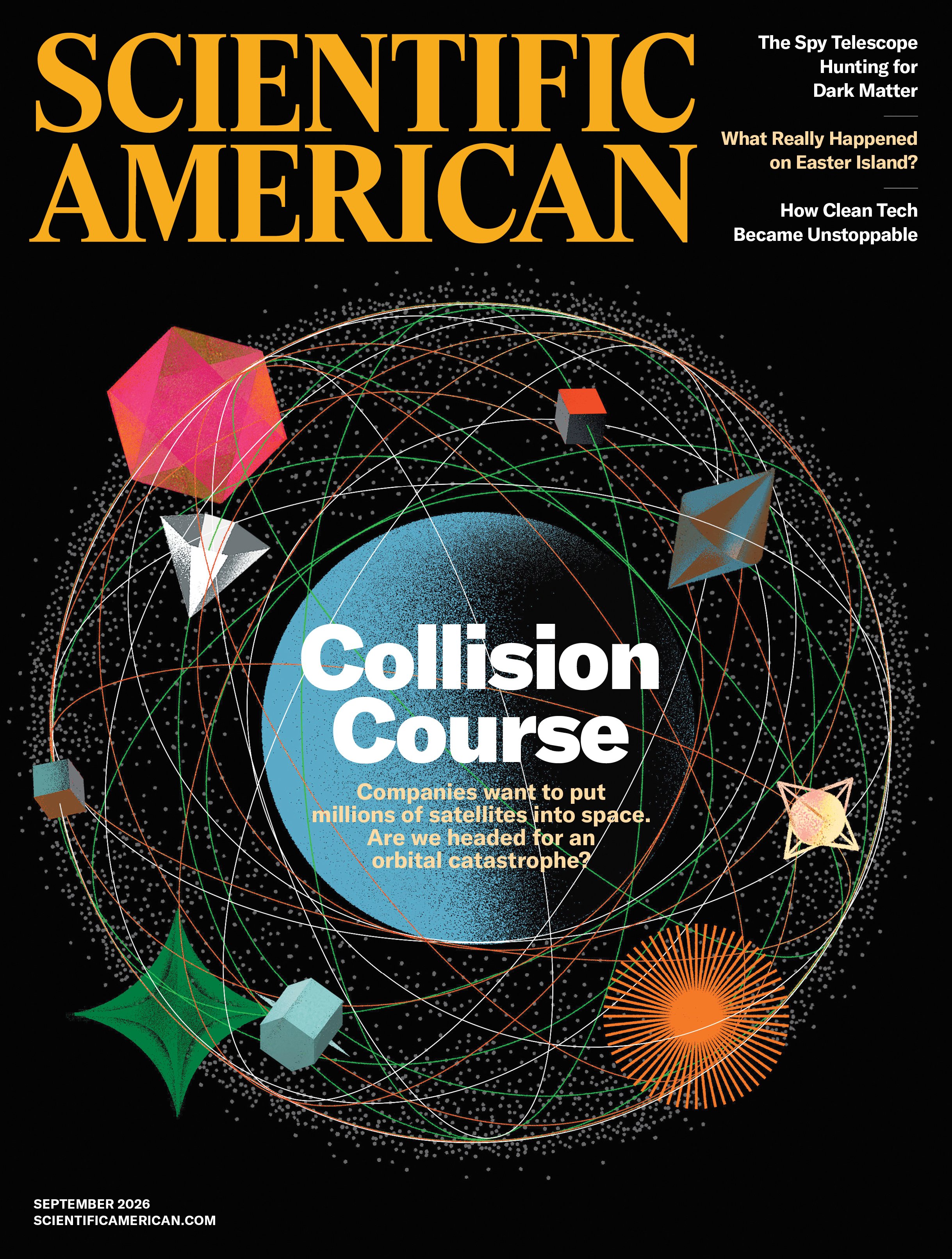
SCIENTIFIC AMERICAN: The latest issue features ‘Collision Course’ – Companies want to put millions of satellites into space. Are we headed for an orbital catastrophe?

The battle for the night sky

SpaceX and other companies want to put millions of satellites into space. Could orbit run out of room?

What really happened on Easter Island?

For decades, an influential theory blamed the Rapanui for their own downfall—a story made famous by Jared Diamond’s book Collapse. New evidence tells a different tale

How NASA turned a spy satellite into its new dark energy telescope

NASA’s Nancy Grace Roman Space Telescope will soon launch to unravel the mysteries of dark energy and dark matter

Why your brain turns life into stories

Neuroscience is revealing how our brains are wired for narrative

DISCOVER MAGAZINE – SUMMER 2026 PREVIEW

Summer 2026 Issue | Discover Magazine

Discover Magazine: The latest issue features ‘Countless lifeforms sense, remember, and communicate, all without brains’…

Slowing Biological Aging May Be GLP-1 Drugs’ Next Medical Frontier

Learn how studying DNA-based age markers in people with HIV helps us understand how GLP-1 drugs could slow molecular clocks.

The Dinosaur-Killing Asteroid May Have Came From a Rare Class of Meteorites

Learn more about the rare composition of the Chicxulub impactor. 

A Full Moon May Hide the Faint Meteors of the 2026 Southern Delta Aquariids — Here’s How to See Them Anyway

1.3 Billion Years Vanished From the Grand Canyon’s Rock Record — a Cold Case That Has Puzzled Geologists Since the 1860s

MIT TECHNOLOGY REVIEW – JULY/AUGUST 2026 PREVIEW

MIT TECHNOLOGY REVIEW: The Engineering issue features ‘Go big or go home’. That may be true—sometimes. But, just as often, solving engineering challenges means thinking small. From the tiny transistors powering the AI boom to the machines digging the world’s longest tunnels, human ingenuity is tackling problems at every scale. Plus: A fresh spin on air conditioning, stratospheric cell service, and more.

The $400 million machine powering the future of chipmaking

The AI era needs ever faster chips. ASML has a monopoly on the expensive contraptions needed to pattern them. Can anyone catch up?

Hacking the atmosphere: Geoengineering gets a reality check

Researchers are starting to explore the tools and systems we need to develop to cool down the planet.

Want to get a data center online quickly? Give it some flex.

As the data-center boom puts pressure on the grid, some companies say the answer isn’t just more power plants but software that dials down centers’ energy-guzzling ways when demand spikes.

The search for dark matter has been blown wide open

After decades of hunting, physicists still don’t know what makes up most of the universe’s matter. Now they need to cast a wider net.