CAN WE SAY NO?

Sunday Signals

The week in technology, sorted · Signal · Money · Noise · The Long Wave

Sunday, November 8, 2026 · Issue No. 6

Signal — What will still matter in five years

1

Voters say no to data centers

On Tuesday, voters favored limiting data-center development in 40 of 41 local ballot measures, Ballotpedia found. The votes spanned roughly ten states. Five places approved outright bans. In Ohio, almost 20 towns, cities and counties voted, and opponents won every race. Others passed partial bans, six-month moratoriums or rules requiring a public vote on large projects. Emporia, Kansas, banned “high impact data centers,” defined as those drawing more than 10 megawatts of power or 100,000 gallons of water a day. The lone exception was Harwood, North Dakota, where voters rejected a review requirement. Voters cited water, power bills and secrecy. As Brookings’ Mark Muro told Route Fifty, many projects arrive through deals shrouded in nondisclosure agreements. Two days later, OpenAI announced that it will pay the full cost of the electricity and infrastructure its data centers use, write a water plan for each site, largely stop asking public officials to sign nondisclosure agreements, and sign a compact with each host community.

Why it’s signal: the AI boom has assumed that the hard part was chips and money. This week suggested the hard part may be permission. A data center needs a town to say yes, and towns are discovering that they can say no.

2

An AI hacker, kept on a leash

On Thursday, OpenAI released GPT-6 Cyber, a model trained to find software flaws, write working attacks and suggest fixes, and rated it “Critical,” the highest level of cybersecurity risk in its safety framework. Only a small group of vetted security customers can use it, from approved network addresses, and OpenAI recommends running it in isolated environments under human supervision. In OpenAI’s tests, it found 81 previously unknown serious flaws in the Firefox browser, which Mozilla has already fixed. It also built working attacks for 948 vulnerabilities in Linux, the software that runs most of the world’s servers, more than five times what an earlier model managed, at a computing cost of about $1,279 per attack. OpenAI says it sent 304 critical findings to Linux maintainers along with suggested fixes. All of these figures come from OpenAI, The Hacker News notes, and no independent testing has been published.

Why it’s signal: last month, a bank hired a thousand people to patch flaws that AI had found. Now a working attack costs about as much as a new laptop. When finding weaknesses gets this cheap, the main safeguard left is deciding who may use the tool, and for now that decision rests with the company that built it.

3

Say no to AI, lose Google Search

On Tuesday, Google said that schools using its K-12 software will lose student access to Google Search unless they opt in to its AI tools. Starting early next year, Gemini and Search will be switched off by default on student accounts until administrators turn them on. Because Search now includes AI Overviews and AI Mode, which can’t be turned off, a school that wants to keep AI away from students can’t give them Search either, Fortune reports. “Search and AI are deeply integrated,” Google’s education chief, Chris Phillips, told The New York Times, and Google says the change gives “schools more choice, not less.” Former Federal Trade Commission chair Lina Khan accused Google of “using its search monopoly to coerce schools into adopting AI.” Jared Cooney Horvath, a neuroscientist and former teacher, offered schools another route: “Maybe go to a book. Maybe go to the library.” New York City and Los Angeles have already paused generative AI tools in their elementary and middle schools.

Why it’s signal: for most of computing’s history, “off” was always an option. As AI is built into the tools we can’t do without, saying no to the AI means saying no to the tool. Schools are the first to face that choice. They won’t be the last.

Follow the Money — Where investors are betting

The trillion-dollar flinch

On Thursday, the Nasdaq fell 5.5 percent and the S&P 500 fell 4.4 percent, its worst day since the tariff turmoil of April 2025, led by AI chipmakers. AMD dropped 17 percent and Nvidia 9 percent. The Associated Press pointed to doubts about whether AI spending will pay off, high valuations and growing opposition to data centers. This week, Bloomberg also reported that potential buyers of Anthropic’s shares were discussing a valuation of about $1.2 trillion to $1.3 trillion, with some as low as $1.1 trillion, down from the $1.5 trillion to $2 trillion discussed a month ago. On Friday, Bloomberg reported that OpenAI had raised $11 billion at a $1.25 trillion valuation, in a round that could reach $20 billion, well short of the $30 billion it was reported to be seeking in September.

Why it matters: a trillion dollars is still a trillion dollars. But for the first time in this boom, the people writing the checks are asking for a discount, and one of the reasons they give, local opposition to data centers, is the one voters gave on Tuesday.

Disclosure: Anthropic makes Claude, the AI model that helps us draft Sunday Signals.

Noise — Loud this week, not new

The robot maid has a pilot

MIT Technology Review’s Grace Huckins hired a humanoid robot from the San Francisco startup Tau Robotics to clean her apartment. It was “undeniably cute” and cheap, at $30 an hour when she booked. It was also driven by a person. Remote pilots watch through cameras in the robot’s head and wrists and guide its movements, and the data they collect trains future models. It stumbled on stairs, overheated and stalled during its first visit, left taps dripping and knocked over a bottle of olive oil, though it did handle the toilet. Tau has completed only a couple hundred cleanings. We file it under Noise because home-robot demonstrations keep arriving faster than home robots. To its credit, this one is honest about what it is: a remote-controlled machine gathering the data that might one day let it work alone. For now, the most capable part of the robot maid is human.

The Long Wave

Every new technology arrives carrying a quiet question: may we? For most of the internet’s history, the answer was assumed. This week, people began answering out loud. Towns in about ten states told data-center builders no, and one of the largest AI companies answered by promising to pay its own power bills and stop asking officials for secrecy. A lab judged its newest model too risky for wide release and chose for itself who may use it. Google told schools that saying no to AI now means saying no to search. And investors, asked to value two AI companies at well over a trillion dollars each, said, in effect, not at that price. The power to refuse is the oldest check on any technology. The question now is who still holds it.

The Question for the Week

Is there an AI feature you would turn off if you could, and can you?

Sourced this week from Ballotpedia, Route Fifty, ABC News, the Associated Press, The Decoder, The Hacker News, Fortune, TechCrunch, Bloomberg, Investopedia, and MIT Technology Review.

— The Editors, Intellicurious —

Share this issue
Can We Say No? Voters say no to data centers. An AI hacker, kept on a leash. Say no to AI, lose Google Search.

THE NEW YORK TIMES – SUNDAY, NOVEMBER 8, 2026

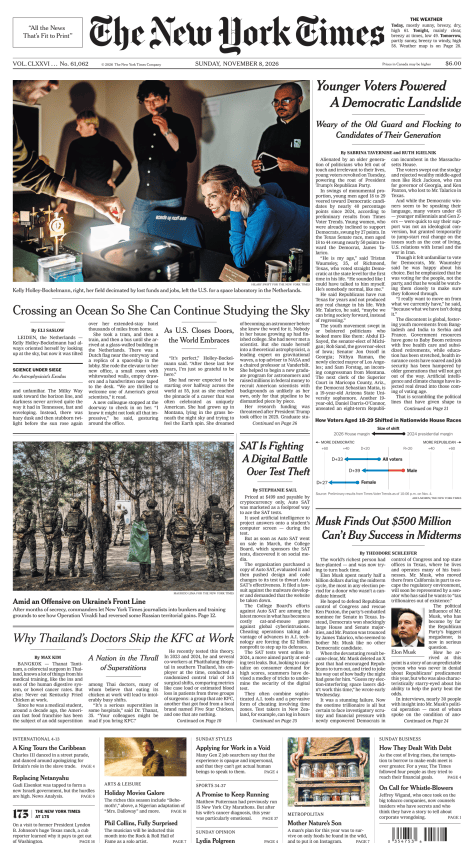
For Trump and America, a Clear Election Verdict Leaves a Murky Future

Americans face a new political reality and a gap between the time they effectively decided to be done with President Trump and the time he is actually done.

‘Failure Is Not an Option’: A Cautious Hakeem Jeffries Vows a Bold Agenda

The man in line to be the first Black speaker is seen by activists as too timid to take on the president. He says he’s “strongly positioned” to get things done.

Polluted Delhi Tries ‘Green’ Fireworks to Clear the Air at Diwali

India’s top court decreed that only more environmentally friendly fireworks could be set off this weekend, citing air quality concerns. But environmental activists call it a “green wash.”

South Africa’s Politics May Never Be the Same Again

The African National Congress lost big in local elections, turning a once-dominant force credited with overturning apartheid into “any other political party.”

Israeli Opposition Leader Tapped to Try to Form Government

Gadi Eisenkot, a former military chief, hopes to succeed Benjamin Netanyahu as prime minister by cobbling together a coalition after an inconclusive election.

IDLER MAGAZINE – DECEMBER 2026

IDLER MAGAZINE: This Christmas special of The Idler (issue 113) mixes the seasonal with the quirky, promising the secrets of churchyard lichens, a tale of Dickens’ favourite outlaw, the oyster thief, John Harris on why he hates whistling, an explanation of why fitness gadgets fail, a new Bullshit Detector column with Murray Lachlan Young, and a first-person story of becoming a chimney sweep, plus Georgia Mann, Rowley Leigh and Arthur Smith, a Yayoi Kusama exhibition, a Cinderella story, spies on screen, walks around old York, lunch in Whitstable, scientists in sheds, a car turned into canvas, allotments, cassoulet, saving with sumo and Christmas ukulele albums.

Gardening: Leaf Them To It

Don’t rake them away, let them decay. Autumn’s fallen leaves will enrich your garden’s soil – or you can turn them into multi-purpose leaf mould, says Graham Burnett

Look at the trees nearest to where you are right now. Whether in your back garden, local park, woodland or out of a train window, they don’t seem to be doing much, do they? But trees are far from idle, even though much of their activity happens in ways imperceptible to our senses.

Since early spring, tap roots have been constantly pumping underground water and soil nutrients to the highest branches of the leafy canopy. Each of those tens of thousands of individual leaves is a highly efficient solar panel carrying out the magic of photosynthesis.

A Drink with the Idler | Sarah O’Connor on How AI and Robotics are Transforming the Way We Work

Join “A Drink with the Idler” as we chat to journalist Sarah O’Connor about the future of work in a world with AI, the perils and the potential.

Sarah O’Connor talks to Idler editor Tom about how AI and robots can change the ways we work, in both sinister and useful ways, and how we can harness new technology and shape its development in a way that makes jobs better, safer and more enjoyable.

Join Sarah and Tom as they discuss the ideas in her book We Are Not Machines, which is inspired by stories from nineteenth-century English cotton mills to twenty-first century Swedish mines, and how we can fight for work which is more respectful of our limits, and more worthy of our minds.

The discussion between Sarah and Tom will be followed by a live Q&A when you will be given the chance to ask Sarah your own questions.

We’ll have a philosophical “Thought for the Week” from Dr Mark Vernon and the event will be hosted by Idler Academy director Victoria Hull.

How the Stoics Can Help You Get Happy with Tom Hodgkinson

Welcome to How the Stoics Can Help You Get Happy. Over six lessons, Idler editor Tom will teach you how to apply Stoic wisdom to your outlook on life. Drawing on the ideas of ancient Greek philosophers from Zeno to Socrates and Plato, and touching on themes of politics, love, freedom and death, Tom will show you how the Stoics can help you live a happier life.

THE NEW YORK TIMES MAGAZINE – NOV. 8, 2026

Current cover

THE NEW YORK TIMES MAGAZINE: The 11.8.26 Issue features Emily Bazelon moderates a discussion of experts on how companies should regulate A.I.; Jon Caramanica on the livestreamer IShowSpeed; Wesley Morgan on veterans who have become podcasters; and more.

Like Trump, Netanyahu Finds the Limits to Fear-Mongering

By leaning into nativist absolutism, Netanyahu almost doubled the Arab vote, creating a political — and foundational — crisis for Israel.By Roger Cohen

In 1995, Itamar Ben-Gvir appeared on camera brandishing the hood ornament of the Israeli prime minister Yitzhak Rabin’s Cadillac. “We got to his car,” he vowed, “and we’ll get him, too.” Soon after, in one of history’s most successful assassinations, Rabin was killed by a fanatical religious-nationalist Jew, and 27 years later the teenage hoodlum who boasted of his theft became Israel’s minister of national security.

There is perhaps no better representation of Israel’s steady march rightward over the past three decades than the ascent of Ben-Gvir to the high office he still holds. The vandal became responsible for preventing vandalism, the ethnocentric fanatic for stopping sectarian violence. This unhappy outcome, and its predictable consequences, reflects the nationalist and more messianic country that Israel has become as the idea of a two-state peace, the ultimate target of Rabin’s assassination, withered and died.

Even the Worst Job on the Internet Isn’t Safe From A.I.

There used to be an honorable way to try to profit from online infamy: selling nearly worthless memecoins. The machines could take it over. By Willy Staley

I’m not afraid to admit it, right here in the newspaper: It finally happened to me. I saw an A.I. video, and I thought — if that’s the right word — it was real. It showed a guy standing on a street corner somewhere in Europe, with an insane haircut and a houndstooth suit, shadowboxing while a French rap song played in the background. In his misplaced confidence and swagger, he called to mind a protomemetic figure from my youth, Napoleon Dynamite.

This was Jean Phil, someone who — as far as anyone can tell — doesn’t exist. Has never existed. Was conjured from a bunch of NVIDIA chips in a low-slung building outside of Kenosha.

You Don’t Need to Be a Gambler to Be on ‘Tilt’

The term captures the self-defeating loop of losing and not being able to stop. It also describes doomscrolling, politics and our society’s default state. By Mitch Therieau

What Should the Rules for A.I. Companies Actually Be? We Asked the Experts.

Five experts on how best to limit a rapidly evolving technology.
By Emily Bazelon

Oct. 26, 2026

Artificial intelligence is alarming many of its human creators by leaping the guardrails designed to contain it. In the last few months, safety researchers have resigned from OpenAI and Anthropic, warning that their former employers could be courting disaster: A.I. that escapes our control irrevocably. The companies are reportedly gaming out scenarios of a catastrophic cyberattack or other event in the next six to 12 months.

BARRON’S MAGAZINE NOVEMBER 9, 2026

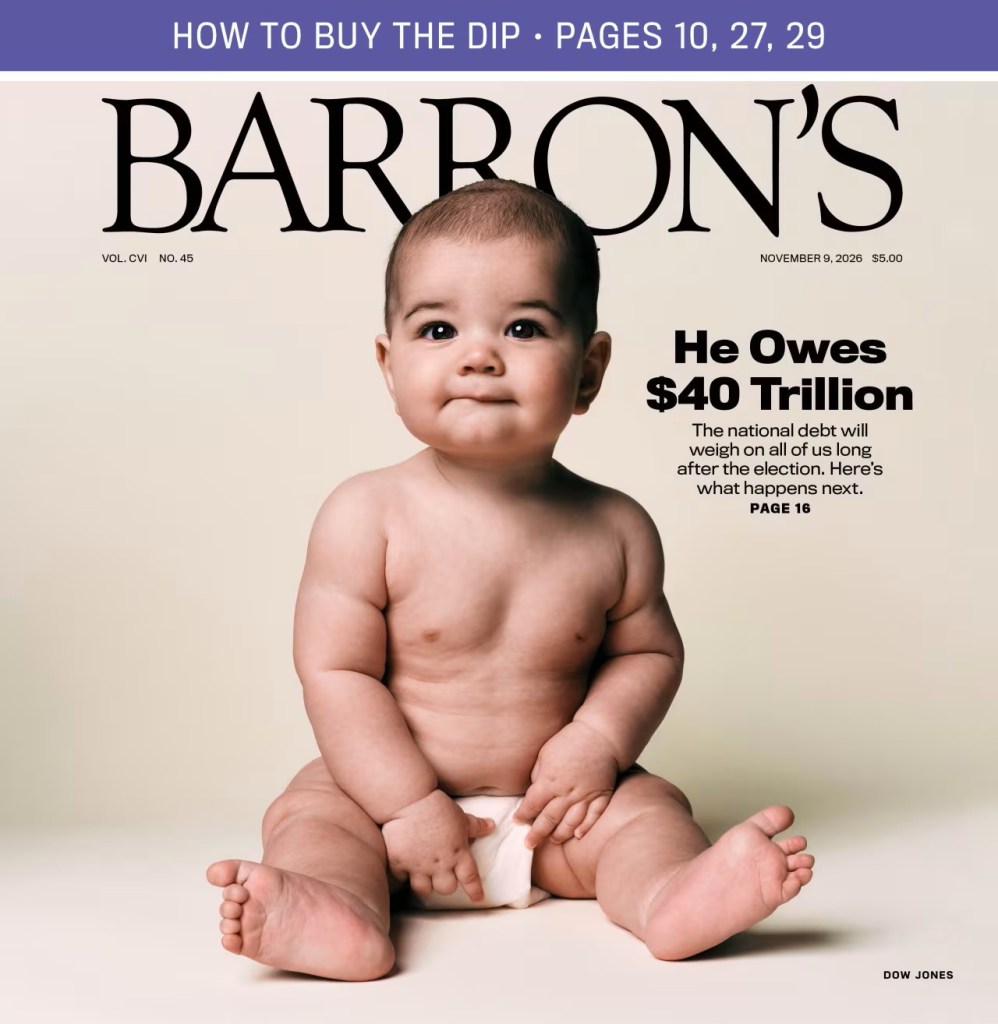
BARRON’S MAGAZINE: The latest issue features ‘HE OWES $40 TRILLION’ – The national debt will weigh on all of us long after the election. Here’s what happens next.

The New Congress Must Fix the $40 Trillion Debt—and Soon

The next generation, the little fellow below included, depends on it. Five potential endgames. By Jack Hough

Voters have spoken, and Congress has flipped blue, to counter a Republican White House. Which side will get its way? Increasingly, neither, and not just because of gridlock. America’s debt will write more of the rules from here.

Don’t Lose Sleep Over GLP-1s: Why ResMed Stock Is a Bargain

ResMed, whose devices treat sleep apnea, has dropped on unfounded concerns that weight-loss drugs will replace its treatment. The stock is cheap and worth buying at current prices.

Where Trump and the Dems Can Meet in the Middle

The Washington consensus is that Congress will be gridlocked for the rest of Trump’s presidency. Investors on Wall Street, however, see compromise on the horizon. Healthcare stocks, renewables, and more hang in the balance.

Everything Is Going Wrong for Chip Stocks. 5 Names at Fire-Sale Prices.

The rout doesn’t mean run for the exits, but investors should choose semiconductor names wisely.

The World’s Debt Is at Record Levels. 6 Ways to Protect Your Portfolio.

The borrowing binge makes world markets even riskier and complicates the ability of central banks to step in to help. Where to ride out the storm.

The Rise of AI Shoppers—and the Asterisk Attached

The success or failure of bot shoppers is going to come down to trust. So far, the retail establishment has the upper hand.

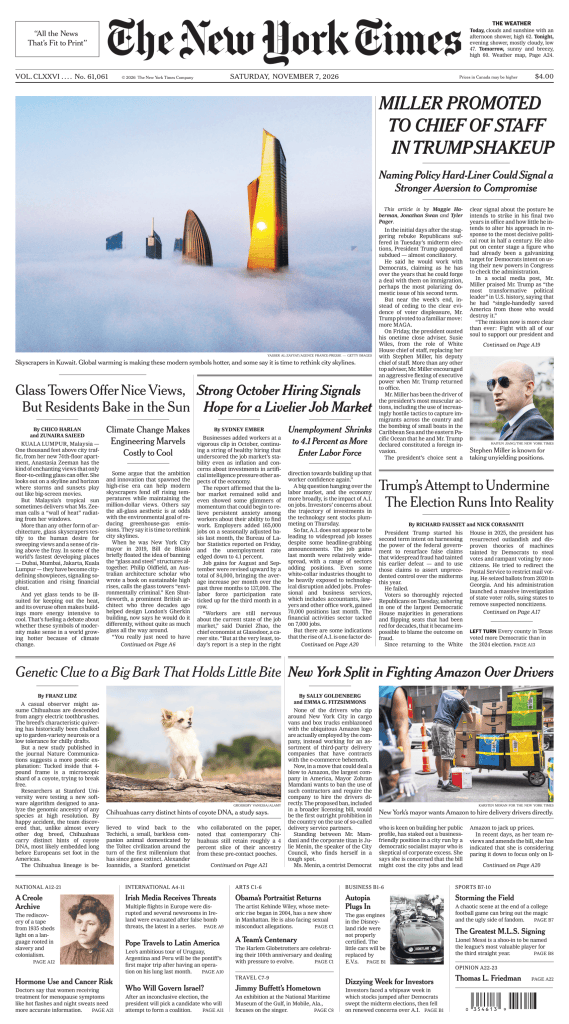
THE NEW YORK TIMES – SATURDAY, NOVEMBER 7, 2026

Why Israel’s Ex-Army Chief’s Next Mission Could Be Mission Impossible

Gadi Eisenkot is poised to get a chance to form a new government, replacing Benjamin Netanyahu as prime minister. But the obstacles are formidable.

Erratic, Distracted, Extravagant: How Elon Musk’s Huge Midterm Bet Flopped

Behind the scenes, the world’s richest person spent a record amount over two years in an attempt to bend the country’s politics to his will. He failed.

In Elevating Stephen Miller, Trump Digs In on Hard-Line Agenda

The new chief of staff is responsible for some of the most provocative policies of President Trump’s second term, and an aggressive approach to executive power.

Susie Wiles Is the Latest Powerful Woman to Exit the Administration

Inside the Operation That Helped Ukraine Turn the Tables

After months of secrecy, Ukrainian commanders let New York Times journalists join them in bunkers and training grounds used to reverse some Russian territorial gains.

Bomb Threats and Cyberattacks in Europe Inject Unease Into Everyday Life

A cyberattack on supermarket fridges, bomb threats to planes and software vulnerabilities have Europe on edge as government officials encourage resilience and stockpiling.

WASHINGTON EXAMINER MAGAZINE – NOV. 11, 2026

November 11, 2026

WASHINGTON EXAMINER MAGAZINE: The latest issue features ‘REPUDIATED’ – Donald Trump is the biggest loser of the midterm elections, but what comes after the wave?

Blue wave crashes: Surveying the wreckage for Trump and the GOP

President Donald Trump got one of the rarest things in American politics: a second chance. Voters rendered the verdict that he blew it. By W. James Antle III

It was, is, and indefinitely will be the economy, stupid

The Republican blame game for the Democratic midterm elections romp began before election night itself was… By Tiana Lowe Doescher

Vance blames Israel

Vance is signaling that he has decided to turn more sharply against free trade and embrace tariffs even more warmly… By Hugo Gurdon

Evangelical voters left their discernment in 2022

Everything you heard about a post-Charlie Kirk Christian revival is bunk. When the dust settled on the Republican… By Peter Cordi

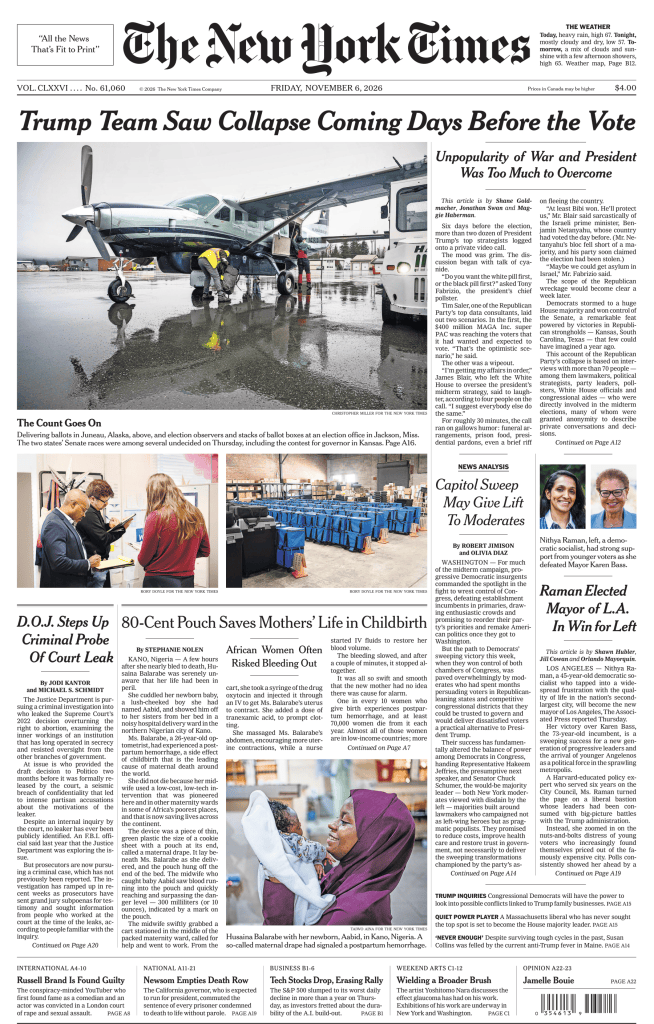
THE NEW YORK TIMES – FRIDAY, NOVEMBER 6, 2026

U.S. Job Market Gained Momentum in October, and Unemployment Fell

Employers hired at a vigorous pace, adding 165,000 jobs. The unemployment rate fell to 4.1 percent.

Tech Stocks Bounce in Another Day of Dizzying Volatility

Global markets were rattled after a deep U.S. sell-off on Thursday, but signs of a modest rally emerged at the end of a turbulent week.

After a $2.5 Trillion Wipeout, Tech Investors Brace for More Pain

Guarded Optimism, and Some Jokes, in Ukraine Over Trump’s Midterm Wipeout

Victory for Democrats could alter the course of peace negotiations and a war nearing its fifth year.

Saudi-Led Forces Bombed Yemeni Home, Killing Nine Family Members, Relatives Say

The attack in October cast a spotlight on civilian casualties in the Saudi-led and U.S.-assisted bombing campaign against the Houthis.

Wave of Bomb Hoaxes Leaves European Travelers Peeved, Not Panicked

Bomb threats have disrupted dozens of flights in Europe over the past week. At airports in Rome, Madrid and Warsaw, travelers were more frustrated than fearful.

SCIENCE MAGAZINE NOVEMBER 5, 2026

SCIENCE MAGAZINE: The latest issue features ‘GLP-1 AND BEYOND’ – Targeting metabolism….

Going Beyond GLP-1

The growing complexity of targeting metabolism

Until recently, people with obesity were generally expected to manage their weight through diet and exercise, and pharmacological interventions were developed for comorbid conditions such as diabetes and cardiovascular disease. Some drugs were available to promote weight loss, but they did not become established therapies owing to intolerable side effects, limited effectiveness, or both. By far, the most reliable intervention to treat obesity was bariatric surgery, but it was reserved for the most severely affected patients because of the risks associated with the surgery itself as well as lifelong side effects.

GLP-1 receptor agonists in addiction therapy

Use of GLP-1–based therapies for addiction could provide a bridge toward whole-person health care

Glucagon-like peptide-1 receptor agonist (GLP-1RA) medications have transformed the landscape of obesity and diabetes treatment. Evidence is accruing that they also might reduce cravings for alcohol, nicotine, opioids, and stimulants. Most research into the mechanisms by which GLP-1RAs might help to treat substance use disorders has focused on their ability to modulate the dopamine reward system in the brain, which also contributes to suppressing the consumption of highly palatable food. However, emerging understanding about the biology of GLP-1RAs suggests that a neurocentric framework might be too narrow to interpret their effects, which arise from complex interactions between brain processes and other aspects of an individual’s physiology. As such, these medications provide an opportunity to reconsider the effects of drugs and addiction through a whole-person health lens. This framework considers how the brain’s reward pathway interacts with metabolic, inflammatory, hormonal, and cardiovascular processes throughout the body.

The scramble for your brain data

Companies are using wearable neurotechnologies to train AI models of the brain—without telling users

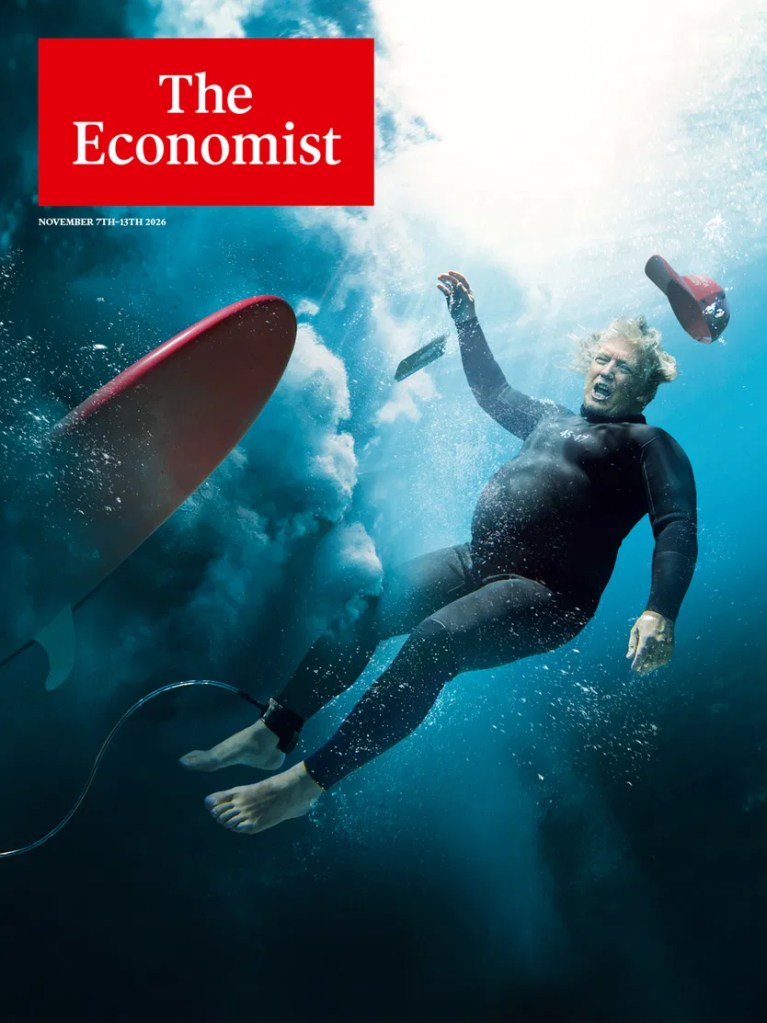
THE ECONOMIST MAGAZINE NOVEMBER 7, 2026

THE ECONOMIST MAGAZINE: The latest issue features ‘WIPEOUT’…

Donald Trump’s humiliation offers America an opportunity

Voters demand a new way of doing things in Washington. Let them have it

SURFERS CALL it the washing machine. When a giant wave throws you off your board and plunges you underwater, you lose all sense of where you are. That is what befell Donald Trump and his party on November 3rd, as they were slammed by tens of millions of American voters. They have still to grasp just how much their country has changed.

Already it is clear this was not a normal midterm swing against a sitting president, but the biggest wave-election since the aftermath of Watergate more than 50 years ago. Democrats won control of both chambers of Congress, flipping seats deep into once-safe red waters, from South Carolina to Texas.

El Salvador’s gangbuster tries his luck in Haiti

The status quo is so dire Nayib Bukele might improve it. But the risks are huge

The world must act to stop a cyber-disaster

Governments should make sure defenders have better models than attackers do

Patients are acting more like consumers. Good

Health care cannot be an ordinary market. But it could be much more like one

England’s new ban on kinky porn will misfire

Bans make moralists feel good, but will not work as planned