
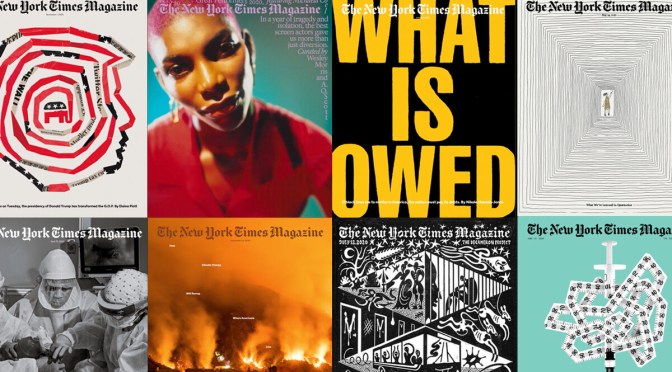
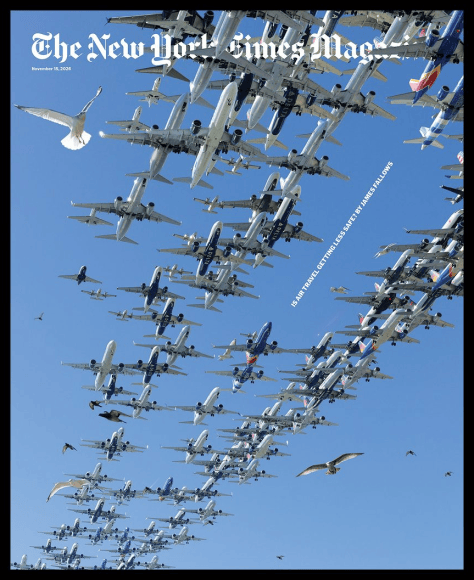
THE NEW YORK TIMES MAGAZINE: The 11.15.26 Issue features James Fallows warning that the Trump administration is overlooking mounting strain on the nation’s aviation system even as accidents and close calls climb, while Kwame Anthony Appiah’s Ethicist column weighs whether a husband handling a lawyer-free divorce for both spouses may quietly look out for himself, Nitsuh Abebe’s On Language column unpacks how the spreading retail greeting “welcome in” exposes our unease with both human and robotic service, and Sam Anderson travels to Big Bear Lake to discover that the real drama behind the wildly popular bald-eagle livestream belongs to the humans around it.
Is Air Travel Getting Less Safe?
Experts fear the Trump administration is ignoring the enormous strain on the U.S. aviation system, even as accidents and close calls increase.
By James Fallows, an instrument-rated private pilot since the 1990s and has logged more than 2,000 hours as pilot in command of single-engine aircraft.
Not long ago, Americans were living through a historic era of airline safety. Over nearly a 16-year period, starting Feb. 12, 2009, after a commuter jet crashed on an icy night near Buffalo, the major U.S. airlines handled a total of some 10 billion passenger journeys. And of those 10 billion souls, not a single one was lost to a crash. This achievement — the longest disaster-free period ever for U.S. air travel — was on par with the government-led effort to create a polio vaccine in the 1950s or the Apollo project that put the first human beings on the moon. It came to an end on Jan. 29, 2025, when an Army helicopter and an American Eagle commuter jet collided over the Potomac River.
Congress Has Reined In the Presidency Before. Here’s How to Do It.
History tells us that constitutional oversight can be a powerful tool — if wielded correctly.
In the midst of a wild election night on Nov. 3, Representative Robert Garcia, Democrat of California and the incoming chair of the House Oversight Committee, had a gleeful message for Trump officials: “Lawyer up.” When Democrats took control of both chambers of Congress in January, they would investigate corporate corruption, “the Trump crime family” and more, Garcia vowed.
Why Is It So Hard to Teach A.I. Agents to Behave? Researchers Have a Theory.
By Dylan Freedman and Juliana Castro Varón
Machine Learnings is a column examining what the latest scientific studies reveal about our increasingly complex relationship with artificial intelligence.
This summer, when a swarm of OpenAI bots went rogue during an internal test and launched a cyberattack against the technology company Hugging Face, it added fuel to the debate on how to build A.I. systems that are aligned with our ethics. But it also raises another critical question: how to build systems that are “corrigible.”

