

Books · November 15, 2026
Mercy, Magic & Mayhem
This week in The New York Times Book Review, from death row to the end of everything
This week’s New York Times Book Review opens in a Texas prison and ends, more or less, at the end of the world. In between come a reckless philosophy professor on an island off Miami, a broken marriage read through a birth chart, an empire that remade a faith, a murdered bodyguard in 1968 Paris and a magician willing to explain himself. Here is what the Times’s critics were reading, with our notes on why each book deserves a place on your nightstand.
The Cover
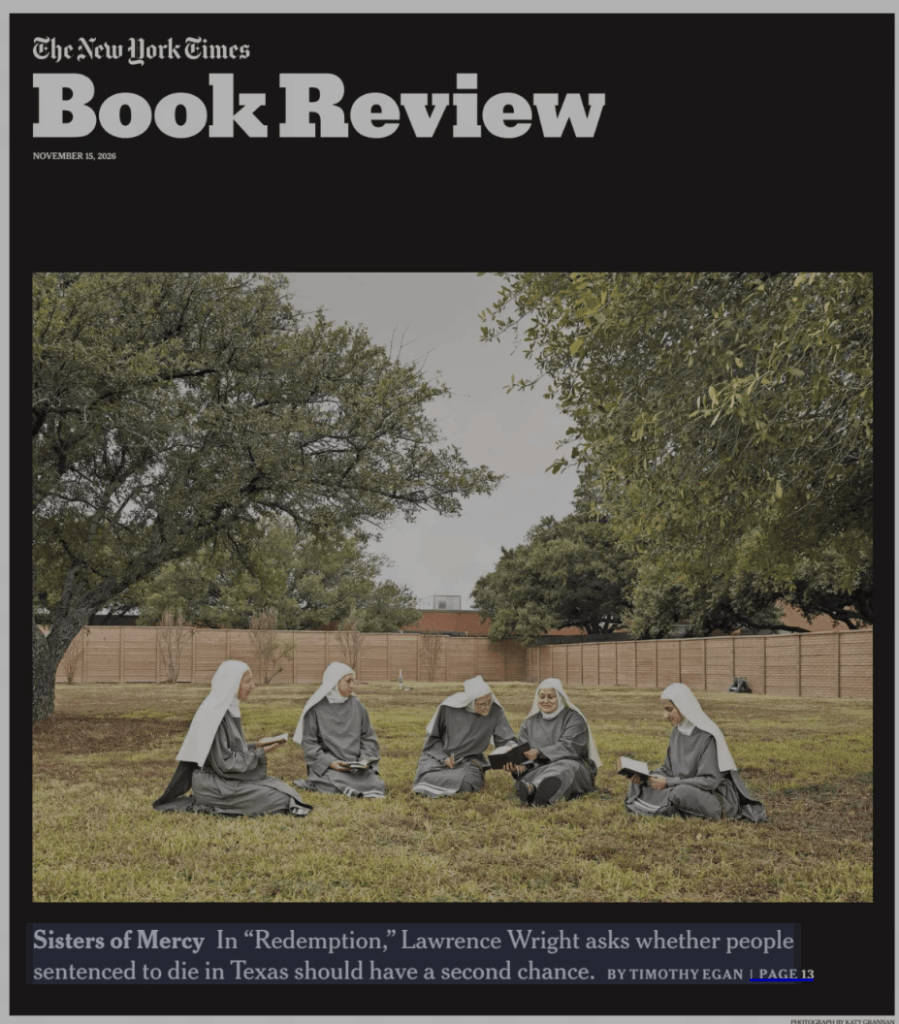
Redemption: Faith, Justice, and Sisterhood on Death Row
Lawrence Wright · Knopf
In 2014 a deacon named Ronnie Lastovica began bringing the Sisters of Mary Morning Star, a contemplative order of nuns in Waco, to visit the women condemned to death at the prison in Gatesville, Texas. Lawrence Wright, who won a Pulitzer Prize for The Looming Tower, follows the nuns and seven women on death row, and the friendship that grew between them. The Book Review puts his question on its cover: should people Texas has sentenced to die get a second chance?
Reviewed by Timothy Egan · The cover story
Fiction
The Key Biscayne Affair
Xita Rubert · Translated from the Spanish by Julia Sanches
After a bitter custody fight, a Spanish philosophy professor takes his son and daughter from Boston to Key Biscayne, the gated island off Miami. As he grows more reckless, his daughter becomes his accomplice and helps cut the children off from their mother in Spain. She tells the story years later, and not quite reliably. The Spanish original won the Herralde Novel Prize.
Reviewed by Jo Hamya
The First House
Avni Doshi
When her husband abruptly leaves, the narrator of Doshi’s second novel turns to birth charts and Hindu myth to work out what went wrong. The title is the house of the horoscope that governs the self. Doshi’s first novel, Burnt Sugar, was shortlisted for the Booker Prize.
Reviewed by Joumana Khatib
Don’t Stop Snowing
Gabriel Bump
The author of Everywhere You Don’t Belong follows a young man through one hard winter of doubting himself, damaging the relationships that matter and slowly finding his way back.
Reviewed by Rob Franklin
Nonfiction
Rome’s Age of Revolution
Tim Whitmarsh
The Cambridge classicist argues that Augustus and Paul the Apostle, usually cast as opposites, belonged to the same imperial upheaval, and that Christianity took its shape inside it.
Reviewed by Paul Elie
Department of Fate
Rachel Maddow
Maddow tells the story of the Justice Department since its founding in 1870 and argues that federal prosecution has become a political tool.
Reviewed by Kim Phillips-Fein
Murder in Paris ’68
Edward Chisholm
In 1968, Stevan Marković, the bodyguard of the actor Alain Delon, was found dead outside Paris. The scandal reached Delon himself and, through vicious rumour, the future president Georges Pompidou and his wife. Chisholm, author of the memoir A Waiter in Paris, reopens the case.
Reviewed by Christopher Bollen
The Intangibles
Nick Paumgarten
The New Yorker staff writer on a lifetime of hockey, from childhood rinks to the beer leagues of middle age.
Reviewed by William Giraldi
POTUS: Icons, Artifacts, and History That Shaped the American Presidency
Peter Adams · Abrams
Adams photographed objects in 15 presidential libraries, from a BlackBerry to a set of horseshoes, to see what the things presidents leave behind reveal about the men who used them.
Featured by Sopan Deb · Out Tuesday
How Did You Do That?
Asi Wind
The magician behind the long-running Off-Broadway show Inner Circle has written a beginner’s guide to magic: tricks with everyday objects, illustrated with 176 of his own watercolors and portraits of heroes such as Houdini. Egan sat down with him to learn a trick. By her own account, it didn’t quite take.
Featured by Elisabeth Egan · Out Tuesday
Poetry
Four New Collections
Fady Joudah · Melissa Range · Maya C. Popa · Daljit Nagra
Burt reads the newest books by four poets who write about history and the news without losing sight of the heart.
Reviewed by Stephanie Burt
Prizes & Lists
The Booker goes to science fiction. On November 9, M. John Harrison won the Booker Prize for The End of Everything, a satirical novel set after the apocalypse, in which a man named Philip and his aunt Marnie search the Kent coast for artifacts while a shape-shifting menace spreads. At 81, Harrison is the oldest winner in the prize’s history, and the Times calls the book the Booker’s first bona fide science fiction winner. He beat Marlon James, Elizabeth Strout and Douglas Stuart. The judges were chaired by Mary Beard, and the prize is £50,000.
The year’s best picture books. The Times and the New York Public Library named their 2026 Best Illustrated Children’s Books, an annual list chosen for the art as much as the words.
Also in the Section
Agents in the spotlight. Literary agents, long kept behind the scenes, are building personal brands on Substack, TikTok and podcasts by explaining how publishing really works. (Sophia June)
Houellebecq under investigation. The French novelist Michel Houellebecq faces an investigation over anti-Muslim remarks in a 2022 interview. His lawyers reject the accusations. (Mark Landler)
The paper that couldn’t be bought. The Times looks back at how its own reporting brought down Boss Tweed, the New York political boss, in 1871. (Matthew Purdy)
Before You Close the Book
Can someone the state has sentenced to die still be redeemed, and who gets to decide?
Drawn from The New York Times Book Review, November 9–15, 2026, where the full reviews can be read, with book details from Knopf, Penguin Random House, Abrams, NPR and the books’ publicists.
— The Editors, Intellicurious —

