Tag Archives: Trump

THE ATLANTIC MAGAZINE – NOVEMBER 2026 PREVIEW

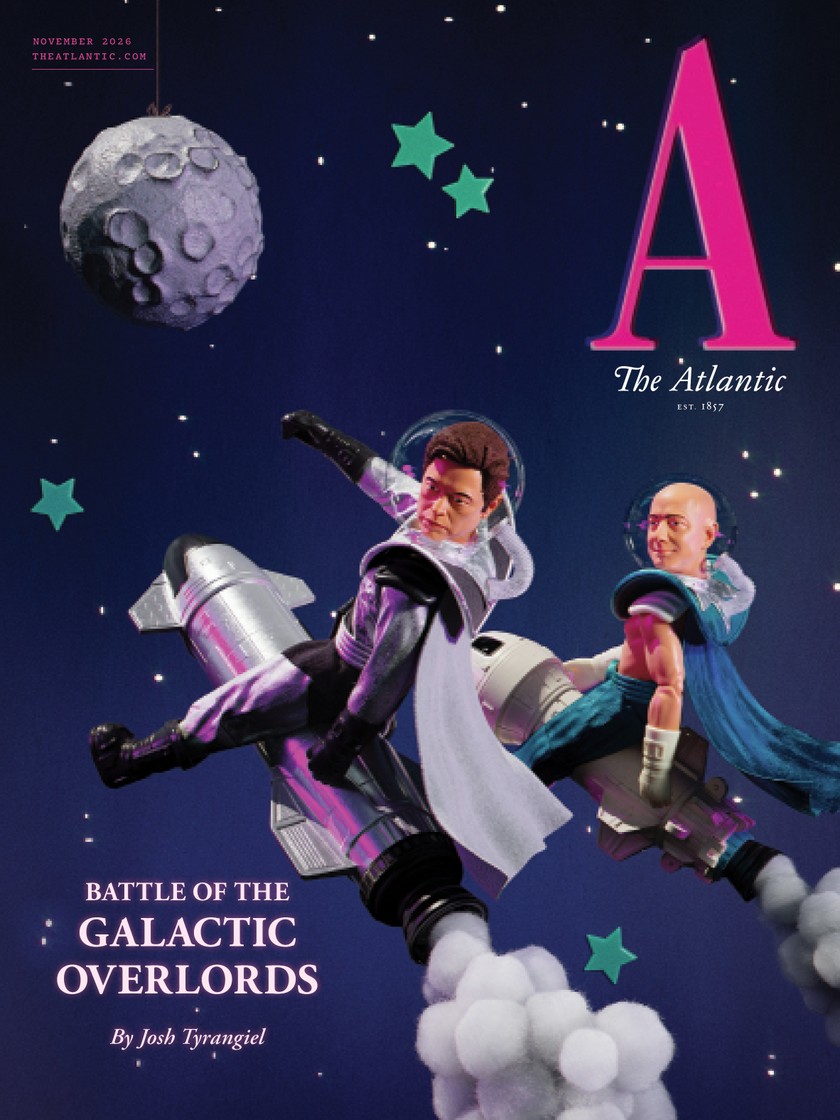
cover of the November 2026 Atlantic

THE ATLANTIC MAGAZINE: The latest issue features “BATTLE OF THE GALACTIC OVERLORDS’….

Choose Your Overlord

Musk vs. Bezos

By Josh Tyrangiel

The Adriatic has been crossed by Odysseus and Caesar, by Venetian fleets and Napoleon’s navy, by countless men bent on dominating the world. It has seen its share of courage and folly. But one day in June 2025, off the island of Cres, it witnessed something genuinely new: a man worth $240 billion standing waist-deep in bubbles on the deck of a $500 million yacht, wearing a white bucket hat.

The Great Data-Center Rebellion

Could a new populist movement help save American democracy?

By George Packer

Clinton, Iowa, is topographically flat and economically declining. The sawmills that made the city rich in the late 19th century have been repurposed as a museum. One of the Victorian mansions long since abandoned by the old lumber barons is open for tours, but tourists are scarce. Clinton has shrunk to about 24,000 people, and the town center, along the Mississippi River, feels nearly empty. On the west side, miles of deep-green corn and soy fields are crisscrossed with transmission wires and zoned for heavy industrial use. The city’s economic activity includes corn processing, pet-food production, and methamphetamines. With available land and a dire need for investment, Clinton seems like the perfect place for a gigantic data center.

The Baltic States Prepare for War

Lithuania, Latvia, and Estonia are readying themselves to fend off a Russian attack—with the help of the United States, or without it.

By Isaac Stanley-Becker

ne evening this summer, in the village of Bezdonys, in eastern Lithuania, I watched as a platoon of riflemen arrived at a train station occupied by enemy forces. Some of the Lithuanians let out a burst of gunfire from across the tracks, pinning the adversary in place as the rest of the unit advanced on the station. As the firefight intensified, wounded riflemen were evacuated to makeshift medical tents. An enemy soldier lay slumped against the station’s yellow clapboard siding.

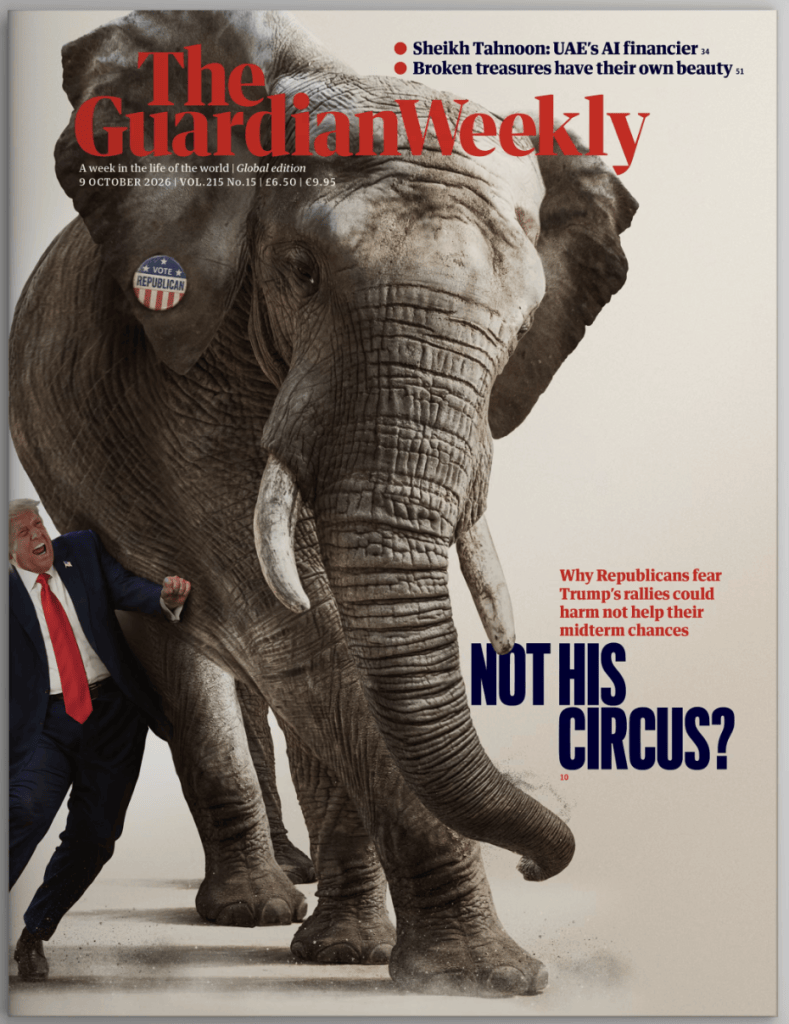
THE GUARDIAN WEEKLY – OCTOBER 9, 2026

THE GUARDIAN WEEKLY: The latest issue features ‘NOT HIS CIRCUS?’ – Why Republicans fear Trump’s rallies could harm not help their midterm chances….

With fewer than 30 days until the US midterm elections, Donald Trump seems determined to still be centre stage despite poll fears that after 3 November he may end up a lame-duck president as a Democratic blue wave sweeps the country. Our Washington bureau chief, David Smith, has been watching how the president is playing to Republican voters at the start of a blitz of cross-country rallies. It’s, at best, a mixed picture.

As David reports, Trump’s self-belief and message to voters to “pretend” his name is on the ballot reveal a man out of touch with ordinary Americans’ worries about the cost of living and whose promises that the war with Iran will soon be over ring ever more hollow. And then there are the candidates, more of whom are shying away from their earlier allegiances to a president whose approval ratings continue to slide.

Spotlight | An education crisis in France
As school and university protests intensify, Paris correspondent Angelique Chrisafis finds out why students feel the government is ignoring their complaints about the state of education

Spotlight | Green division and diversion
Peter Walker reports on the English and Welsh Green party’s annual conference in which a motion equating Zionism with racism was passed, and analyses how this reveals weaknesses in the way the party is run

Feature | The big business of porn
Why not analyse the porn industry just like any journalist would the oil business? That was the premise behind Patricia Nilsson’s new book. An approach that, as Amelia Gentleman finds out, yields new insights into how pornography’s imperatives have seeped into all our online lives

Opinion | Putin won’t bomb Ukraine into submission
Kyiv may now be under almost constant attack but, says Rajan Menon, history shows that bombing doesn’t crush morale

Culture | There’s beauty in bits and pieces
A novel exhibition in Florence puts broken sculptures on display and, as Philip Oltermann discovers, reveals their profound allure

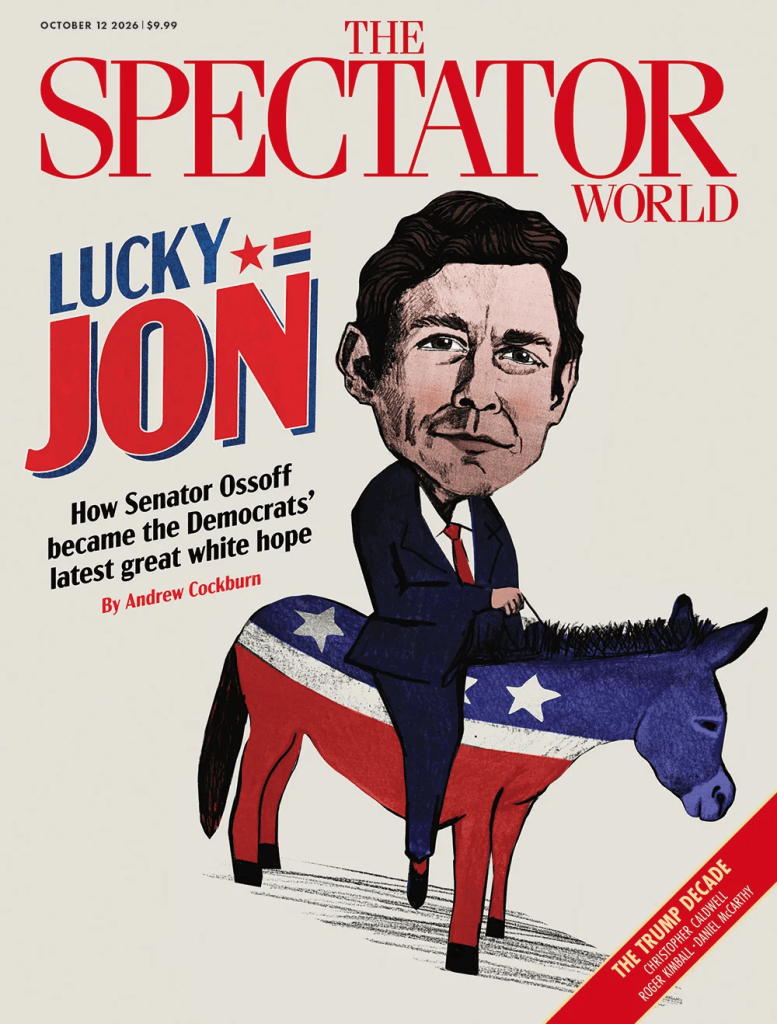
THE SPECTATOR WORLD MAGAZINE – OCT. 12, 2026

THE SPECTATOR WORLD: The latest issue features ‘Lucky Jon’ – How Senator Ossoff became the Democrats’ latest great white hope.

Will Jon Ossoff’s luck last long enough for a run at the presidency?

Once upon a time, the export crop of Martha’s Vineyard and Nantucket was whale oil. Nowadays it is money, harpooned by visiting campaigns from deep-pocketed donors at anchor in their summer seaside retreats. In the peak season of July and August, the islands’ social rhythms are dictated by money-harvesting events, wrangled by local hosts jostling for the social éclat that comes from securing a high-profile honoree. By late August this year, the territory had already been worked over by a series of hopeful visitors with hands outstretched, such as the rising Texas Senate hopeful James Talarico, Hakeem Jeffries in eager pursuit of the House Speakership that is almost in his grasp, Maryland Governor Wes Moore and others questing the donor dollar.

How Trump can confront the new age of terror

The world has become strangely numb to terror. Sometimes an atrocity will be sufficiently horrifying – the murder of Charlie Kirk, say – to cause mass shock and anguish. Yet now reports of car rammings or knife rampages or foiled Islamist plots feel almost routine. We have become inured to ideological violence. In the quarter-century since 9/11, the specter of terrorism has almost become a fact of modern life. Last year, America was one of the few western countries to see a rise in terrorism, with 13 recorded attacks and 28 deaths. Today even the most appalling acts generate only a brief sense of widespread outrage. And then the news cycle moves on. No mass killing has come close to the scale of the Twin Towers attacks.

America must shore up its missile-building capabilities

America’s war with Iran is in its eighth month and stuck. On September 26, Donald Trump confirmed that he had rejected Tehran’s offer to reopen the Strait of Hormuz in return for lifting the American naval blockade and easing sanctions. He has reportedly told his staff that renewed bombing is likely after the midterm elections on November 3. He is reluctant to

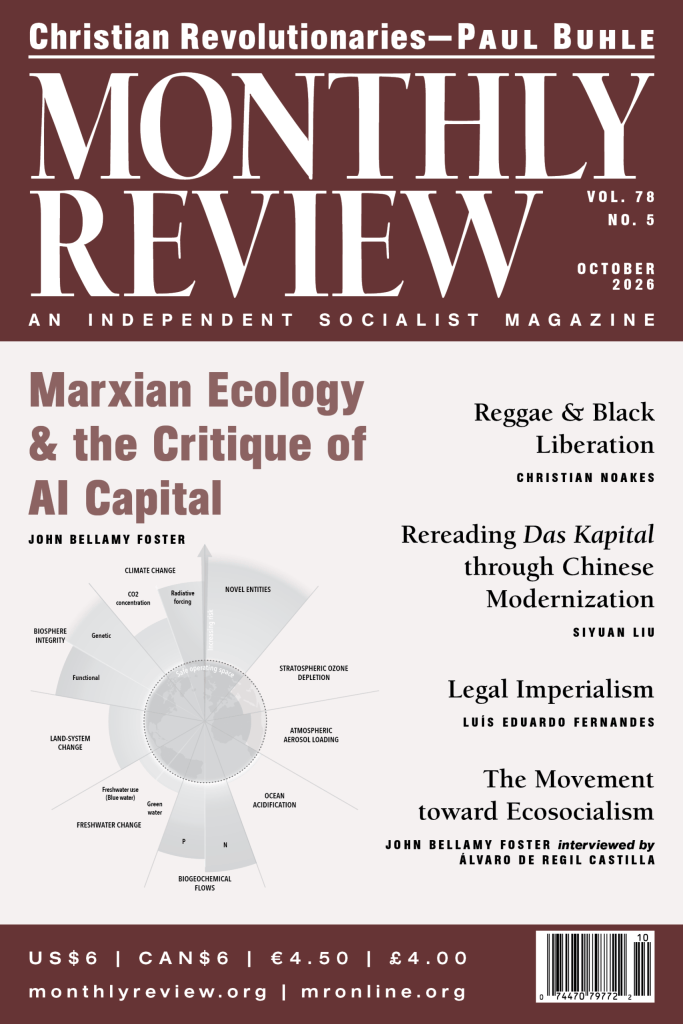
MONTHLY REVIEW MAGAZINE – OCTOBER 2026 PREVIEW

MONTHLY REVIEW MAGAZINE: The latest issue features ‘Marxian Ecology & the Critique of AI Capital’….

Marxian Ecology and the Critique of AI Capital

by John Bellamy Foster

What is the rise of AI capital, and what does it mean for contemporary work, culture, and the ecological state of our planet? John Bellamy Foster dispels the myth of a “hyperorganized AI capitalism.” As Foster writes: “We are not entering a stable new age…but rather a new, capitalist-engendered global disorder in which humanity, according to climate science, is headed ever more rapidly toward a planetary ‘point of no return.'” The only way out—the only way, that is, to ensure the survival of humanity—is a radical shift away from the catastrophically destructive regime of capital accumulation and toward sustainable human development through socialism.

Radical Jewish Tradition

by Paul Buhle

Paul Buhle reviews The Radical Jewish Tradition by Donny Glickstein and Janey Stone. The book, Buhle writes, is a window onto “the antinomies of nineteenth-century Jewish life”—including the growing movement against Zionism and for socialism among Eastern European Jews. This authors, Buhle notes, also tells the story of Jewish communists in Britain, the United States, and beyond, taking into account the wide sweep of Jewish left activity globally, situating the present struggles against genocide in Palestine squarely within the legacy of radical Jews everywhere.

Legal Imperialism: International Law and Dependency in Late Imperialism

by Luís Eduardo Fernandes

Today’s resurgence in U.S. imperialist interventions abroad and the concomitant so-called crisis of the “rules-based order” can be explained, Luís Eduardo Fernandes argues, through the category of “legal imperialism, which refers to how the international juridical form is internalized within societies and in the context of dependency, colonialism, unequal exchange, and monopoly capital. “International law and imperialism,” Fernandes writes, “do not stand as opposing poles. They are part of the same unity.… Violence is constitutive of the juridical form.”

THE GUARDIAN WEEKLY – OCTOBER 2, 2026

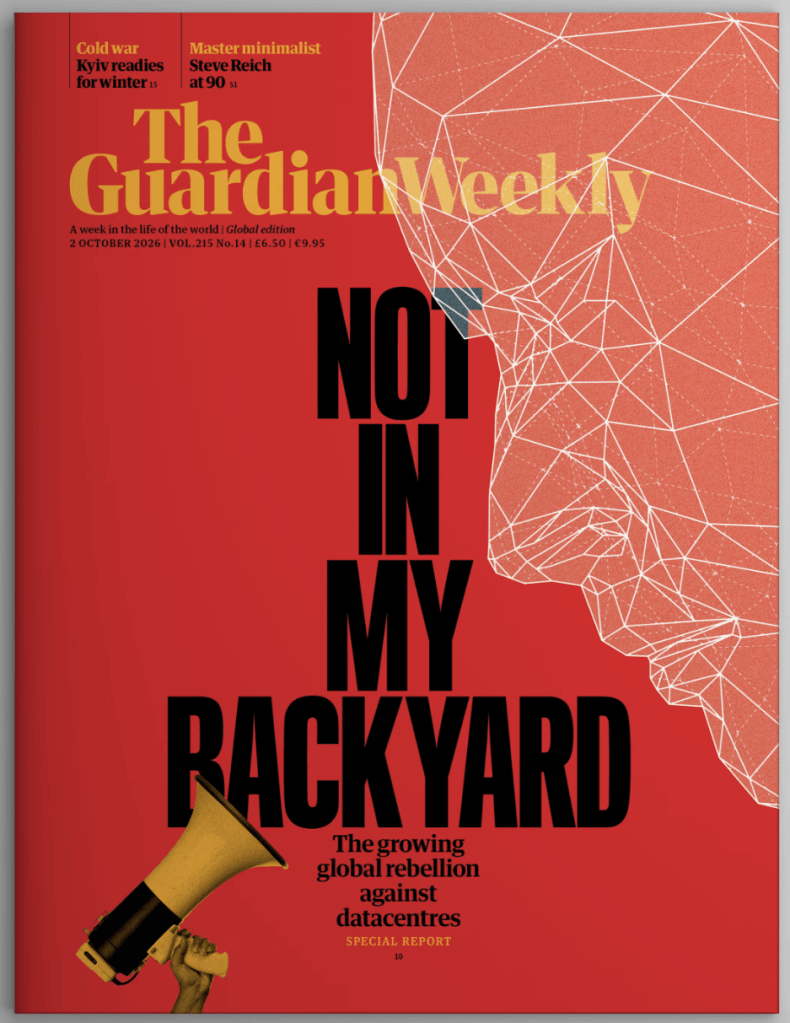
THE GUARDIAN WEEKLY: The latest issue features ‘NOT IN MY BACKYARD’ – The growing global rebellion against datacenters.

As the alarm bells sound ever louder about the potentially existential threat of breakneck AI development, people far removed from Silicon Valley debates about the future of the artificial intelligence revolution are voicing other more immediately tangible worries about the building of the vast datacentres that power these entities.

For this week’s cover story, economics and political writer Eduardo Porter, analyses why communities are pushing back against AI and the future that the big tech plutocrats want to create. These fears, based around environmental concerns over resource use and rapid societal change, are, he argues, far more complex than luddite attitudes or nimbyism.

It’s a position exemplified by reporting from two rural communities in India and the UK where vast datacentres are already under construction or being planned. As Hannah Ellis-Petersen and Aakash Hassan find out, the villagers of Tarluvada, in Andhra Pradesh, feel that government promises of a “golden age” that a hyperscale Google datacentre would bring them have been broken. Meanwhile, Sandra Laville meets protesters in Great Torrington, Devon, who sense that they are being kept in the dark about plans for an AI campus, one of Europe’s largest, in a Unesco-designated nature reserve.

Spotlight | Kyiv’s cold front is approaching
Charlotte Higgins reports on how residents are preparing for winter, stocking up on food and determination, as Russia increases its attacks on energy infrastructure

Environment | What Nepal has taught Argentina
What can the Patagonian town of El Chaltén at the foot of the Torre glacier do to avoid an event similar to the disaster in Nepal? María de los Ángeles Orfila finds out

Feature | Andy Burnham: a man with a plan
As the first Labour conference with Andy Burnham as prime minister takes place, Hettie O’Brien finds out just how radical his policies could be

Opinion | Macron’s brave swansong
In his final speech to the UN, Emmanuel Macron told the world how to stand up to Trump, says Steve Bloomfield

Culture | A minimalist at 90
As he prepares to celebrate a milestone birthday, Steve Reich tells Flora Willson how he developed his musical ideas and why he wants others to take up the baton of performing his works

CLAREMONT REVIEW OF BOOKS – FALL 2026

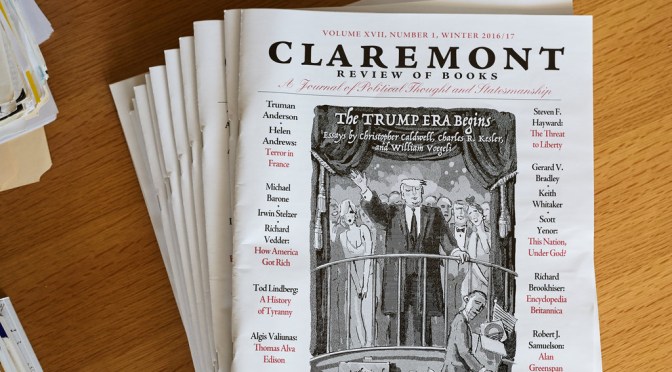
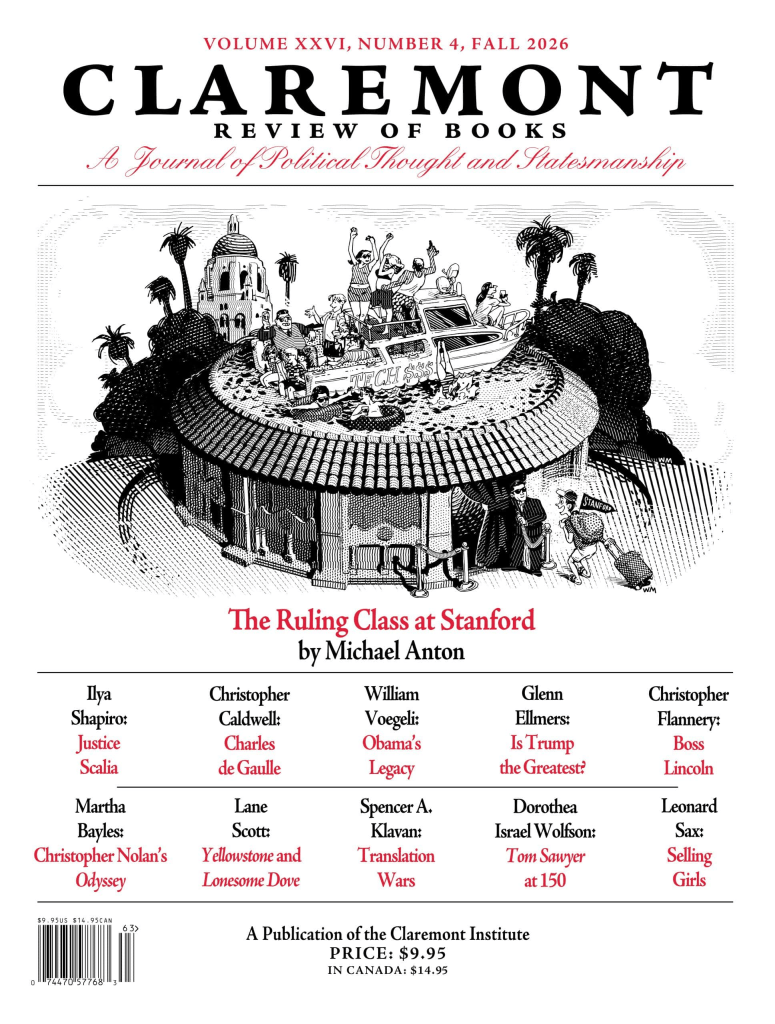
Claremont Review of Books: The latest issue features ‘The Ruling Class At Stanford’….

Tune In, Drop Out, Start Up

by Michael Anton

Because I’m going to be quite critical of Theo Baker’s How to Rule the World, it feels only right to start with three pieces of sincere praise: the book held my attention all the way to the end, I learned things from it, and I read it twice. These are not reactions I expect most new books to generate, let alone one written by someone not yet of legal drinking age. Hence on this basis alone, I would have to concede that Rule (borrowing Baker’s shorthand for a “secret” Stanford class, about which more below) is a real achievement.

The Married Vine

by Sam Schneider

The first marriage in Tuscan history was not between a man and a woman but between a vine and a tree. Before the Etruscans cleared these hills, they were dense with oakwood, through which wild grape vines climbed naturally toward the canopy, wedded to the forest in which they grew. The Etruscans formalized that marriage. Vines were trained up living maples, elms, and poplars. Grapes were cut from ladders or with long sickles. Later Italians called it the vite maritata—the married vine.

Blowing Off The Odyssey

by Martha Bayles

After watching Christopher Nolan’s The Odyssey in a sold-out IMAX theater, my husband and I were heading for the exit when we were attacked by smiling employees brandishing free rolled-up posters. Raising our shields, we broke through their phalanx, leaped aboard our vessel moored in the parking lot, and sailed homeward with only a few posters glancing off the moonroof.

THE GUARDIAN WEEKLY – SEPTEMBER 25, 2026

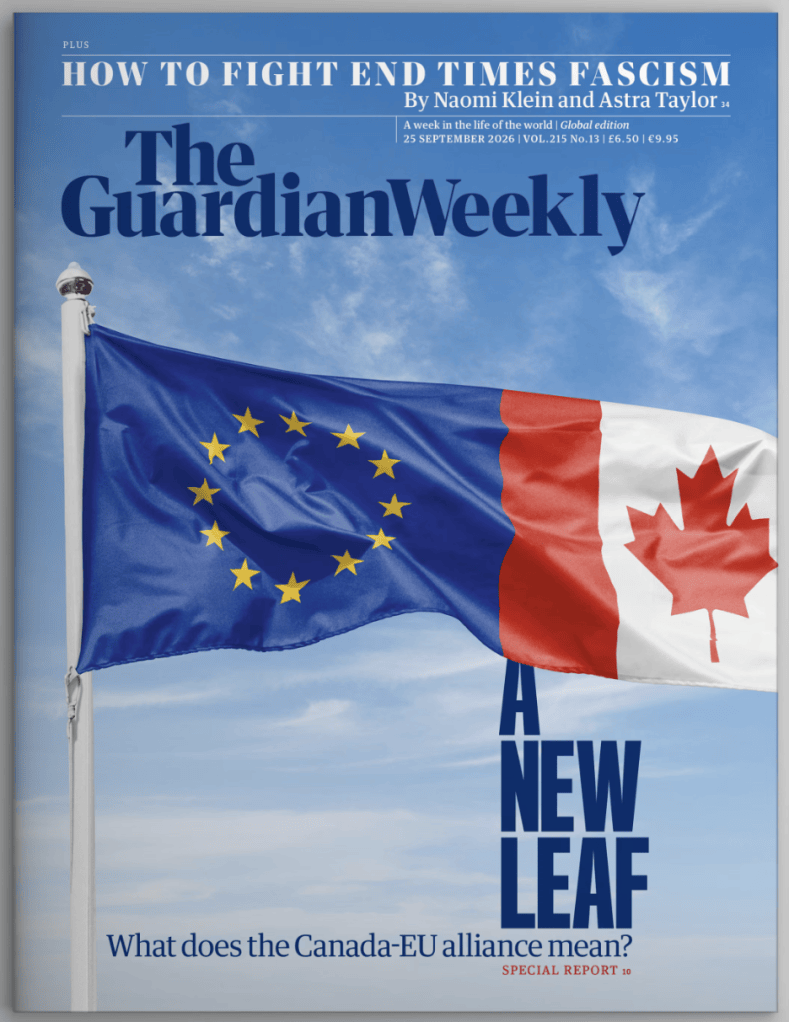
THE GUARDIAN WEEKLY: The latest issue features ‘A NEW LEAF’ – What does the Canada-EU alliance mean?

The European Commission president, Ursula von der Leyen, last week extended an unprecedented offer to Canada, inviting it to become the EU’s first “associate member”.

For our big story this week, Brussels correspondent Jennifer Rankin explores what the proposed alliance might mean. While there is a lot of common ground for the two parties, she writes, their agreement raises many questions and is clouded in uncertainty.

Meanwhile, senior correspondent Lisa O’Carroll examines the possible implications for the UK – asking whether it offers a blueprint for Britain, or a reminder it is out in the cold.

Then, former White House speechwriter Ted Widmer says Canadian prime minister Mark Carney’s remarks before the European parliament set out what a new west might look like, without its most powerful member – the US.

Spotlight | Yemeni families’ flight
Fierce fighting has forced people to abandon their homes, leaving everything behind to seek shelter in refugee camps. Nasser Al-Sakkaf reports from Taiz

Science | ‘A map is never neutral’
The cartographers who took on centuries of western bias with the new Equal Earth projection speak to Oliver Holmes, Ana Lucía González Paz and Pablo Gutiérrez about their alternative to the 16th-century Mercator display

Feature | How to fight end times fascism
An unholy alliance is working toward an apocalyptic future from which only a chosen few will emerge unscathed. It’s becoming clear how we stop them, say Naomi Klein and Astra Taylor

Opinion | This Israeli election could be the country’s last
Spend time on the ground and you see how high the stakes are for next month’s contest – for Israelis and Palestinians alike, writes Jonathan Freedland

Culture | Present and correct
Author Jonathan Franzen talks to Sophie McBain about a new TV adaptation of his bestseller The Corrections, the future of reading and why creating new work is “horrible”

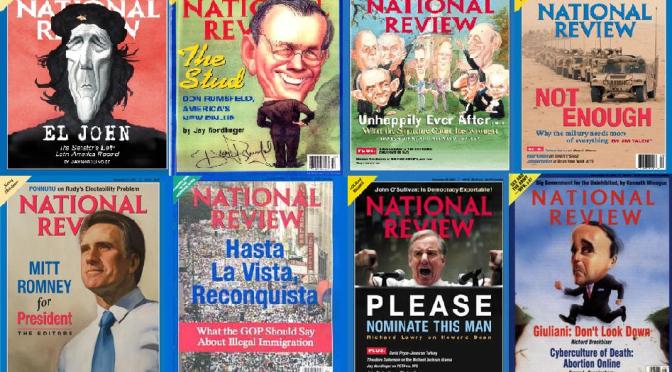
NATIONAL REVIEW MAGAZINE – NOVEMBER 2026 PREVIEW

NATIONAL REVIEW: The latest issue features ‘The Fire Next Time’ – Noah Rothman on Woke, the Sequel

The Future of Woke

Are we ready for the sequel? Noah Rothman

Your Data Center Life

How the newly contentious facilities make the things we do possible. Charles C. W. Cooke

Weapons of Mass Construction

What America needs to do to keep its defenses strong. Rebeccah Heinrichs

The Brewing Revolution in Public Housing

A federal rule change could bring upward mobility. Howard Husock

THE GUARDIAN WEEKLY – SEPTEMBER 18, 2026

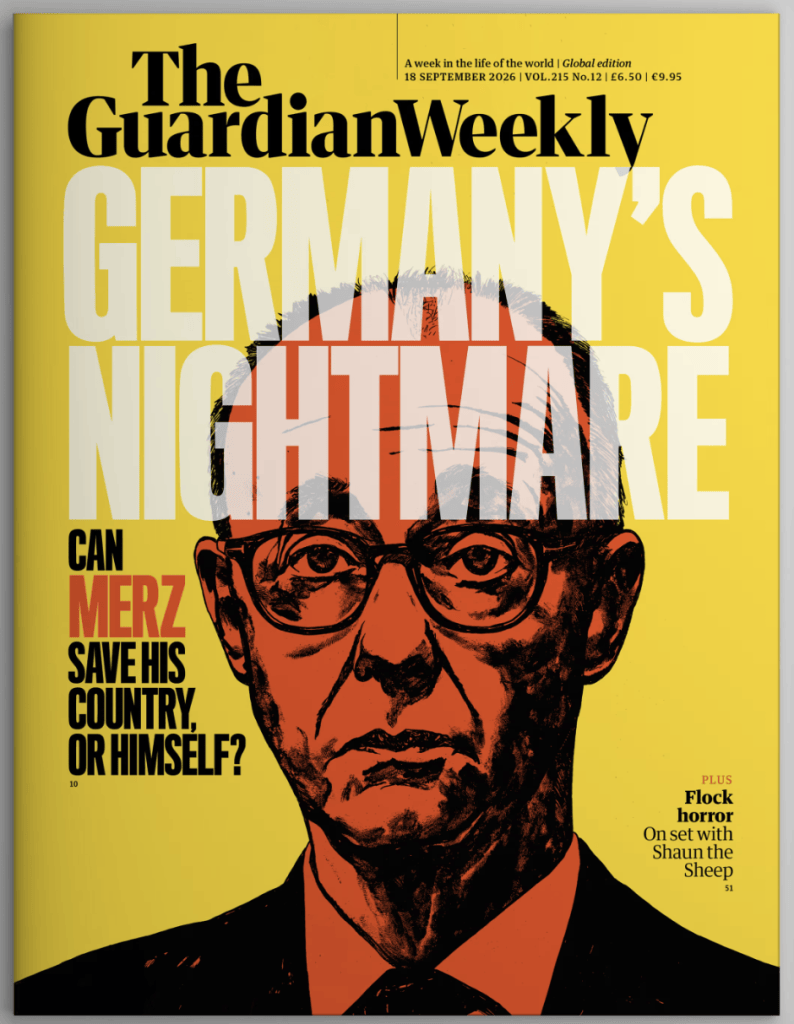
THE GUARDIAN WEEKLY: The latest issue features ‘Germany’s Nightmare’ – Can Merz Save His Country Or Himself?

Friedrich Merz is a man with few choices and little popular support as he faces the end of Germany’s postwar settlement and the collapse of all the checks and balances to maintain democratic norms after the second world war and reunification. While Alternative für Deutschland’s success in state elections in Saxony-Anhalt saw the party win 44% of the vote, they are three seats short of a governing majority and, so far, no other party has said they are prepared to work with them, which means that for the moment, at least, the threat of Germany’s first rightwing extremist state government since the Nazi period has not yet come to pass.

As Berlin correspondent Deborah Cole explains, Merz is seen as the wrong man to present and sell a political counterpoint to the AfD’s populist policies. Seen as lacking in empathy and political dexterity, his demeanour is in sharp contrast to Ulrich Siegmund, the AfD’s lead candidate in Saxony-Anhalt. But as Deborah’s Berlin colleague, Kate Connolly, reports, some of Siegmund’s prospective new MPs have questionable backgrounds, including criminal records, Stasi pasts and connections to far-right networks.

Spotlight | Stop, slow down and swerve the apocalypse
Can the world heave a collective sigh of relief after fellow tech bosses heeded a proposal by Anthropic CEO Dario Amodei’s to put the brakes on AI’s headlong rush to over take human intelligence? Nick Robins-Early weighs up our chances

Science | Can I borrow your coyote?
Guardian US reporter Lois Beckett visits a one-of-a-kind California lending library where you can check out taxidermied animals and fossilised dinosaur bones.

Feature | Slime is not as simple as it seems
Scientists are battling to determine whether supposedly simple organisms demonstrate a form of intelligence. If they do, what does it mean for our understanding of brain power, asks Samanth Subramanian

Opinion | Ethics make a return to UK foreign policy
The evidence is Ed Miliband’s bold decision to label settler violence in the West Bank as “ethnic cleansing” and institute a boycott, argues Steve Bloomfield

Culture | Shear fun
Catherine Shoard is rounded up for a trip down to Mossy Bottom farm to get a behind-the-scenes preview of the latest Shaun the Sheep film

THE ATLANTIC MAGAZINE – OCTOBER 2026 PREVIEW

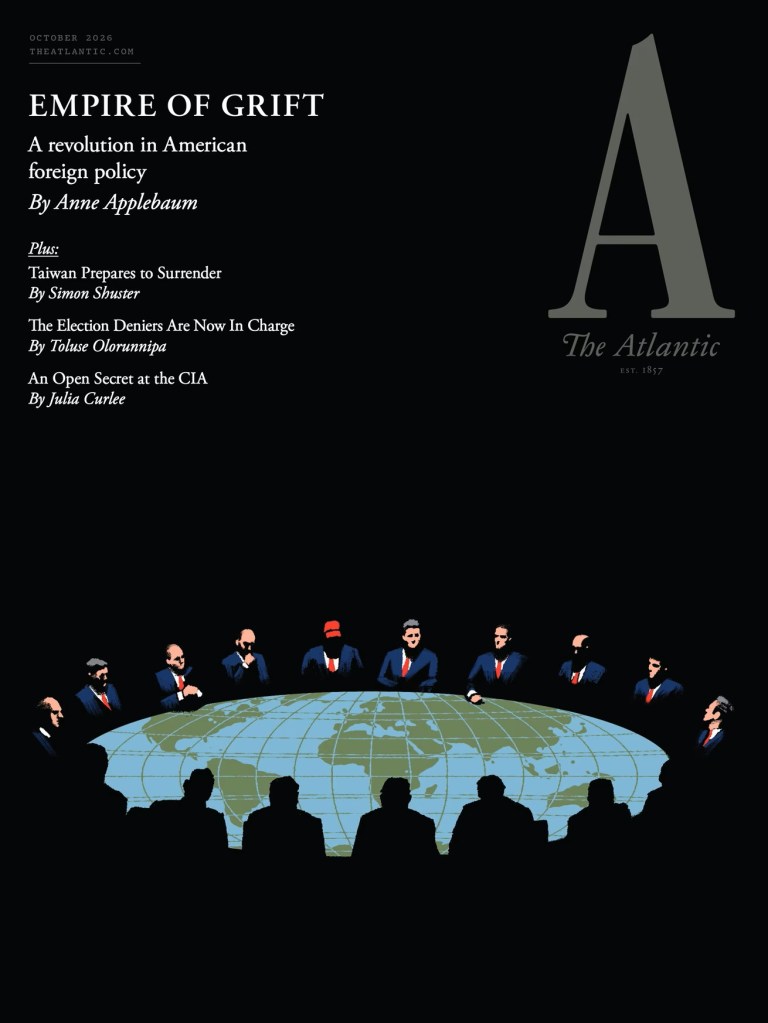
THE ATLANTIC MAGAZINE: The latest issue features “EMPIRE OF GRIFT” – Anne Applebaum examines how hardened ideologues and opportunistic profiteers are bending American diplomacy to advance an antidemocratic agenda—and their own financial interests. For our cover, the illustrator Ben Hickey created an ominous image of figures in shadow arrayed around a map of the world, evoking the war-room scenes from Stanley Kubrick’s 1964 film, Dr. Strangelove or: How I Learned to Stop Worrying and Love the Bomb.

MAGA Is Making the World Safe for Corruption

Far-right ideologues have transformed American foreign policy into a tool of private gain and antidemocratic reaction. By Anne Applebaum

What Trump’s Bizarre Posts Are Teaching Us About AI

The president’s recent Truth Social barrage of fake images reflects the dangers—for all of us—of virtual self-aggrandizement. By Gal Beckerman

A Diagnosis for Social Conflict That Gets Lost Along the Way

A new book suggests that arguing isn’t about winning but seems preoccupied with it anyway. By Lily Meyer