The optimists cite robust earnings growth; the pessimists see a bubble in danger of bursting. Plus, the pros’ forecasts for interest rates, international markets, the midterm elections, and more.
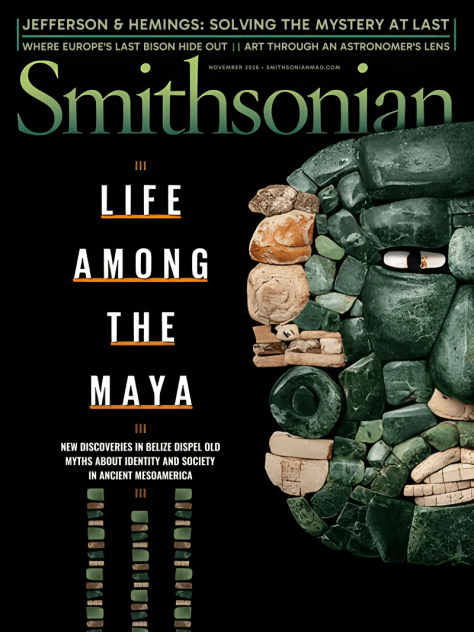
In the rainforest of Belize, archaeologists are uncovering neighborhoods, local markets and urban farms that shed new light on daily life in the ancient world By Ellen Ruppel Shell | Photographs by Neil Ever Osborne
A lock of hair, advances in genetic science and the Smithsonian’s 15-year quest to conclusively resolve an enduring question: Did Thomas Jefferson father Sally Hemings’ children? Dr. Richard Kurin, Ambassador at Large, Smithsonian Institution. Author, History by a Hair Portraits by Joshua Rashaad McFadden
Astronomers, astrophysicists and art historians are on a luminous quest to unlock the real-world secrets of classic paintings and literature By Michael Ray Taylor
After centuries of setbacks, the European bison faces a new challenge: surviving in a primeval forest that isn’t its true home By Marta Zaraska | Photographs by Kasia Strek
With Sudan still in the midst of conflict and the largest humanitarian and displacement crisis in the world, this magazine shows the complexity of the crisis and the political dynamics behind the headlines. In collaboration with independent Sudanese media platform Ayin Network, the Big Story explores the impact of the war on civilians, from the interruption of education to how displacement is changing the face of the country. We hear from revolutionaries turned fighters, and activists in exile who can’t escape the war, even outside Sudan’s borders. How does the revolutionary dream continue and what does it mean for the goal of civilian rule?
Also in this edition, a report from Syria on attacks against the Alawite minority, a long read exploring how Palestine became a focus of international anti-colonial solidarity, and is the AI apocalypse really on its way?
TAKE BACK THE LAND
The land beneath our feet is what sustains us – from it we can produce food, construct shelter and build livelihoods. But, it’s also a cultural marker and a source of identity. Its control has been a long-favoured tool of colonizers, wealth hoarders and polluters, while its fiercest protectors – often Indigenous peoples – are criminalized, violated and dispossessed. This edition hears from struggles to take back the land in Brazil, Bangladesh, Kenya and North America. We also launch our new series ‘Decolonize how?’ which will explore what people are doing to dismantle the impacts – and current realities – of British-linked colonialism.
As Israel’s assault on Gaza grew worse and worse, Joe Biden and his advisers acted as though they had no option but to offer their unconditional support. Why couldn’t they see the destruction they were enabling? By Ben Rhodes
Mary K. Simkhovitch, the founder of Greenwich House, believed in the radical idea that housing should be made as livable for the working class as it was for the middle class. By Vivian Gornick
A forensic study of a rape survivor from 1473 Dijon reveals a legal process surprisingly accepting of imperfect victims and contradictory testimony. By Erin Maglaque
‘To win the Senate, the Democrats need to hold on to the one Michigan seat (out of two) that is up for grabs, and have chosen a new candidate, Abdul El-Sayed, a moderate leftist in European terms, a “communist loser who hates Jews and Israel” according to Trump, “very, very evil”, per J.D. Vance.’ By James Meek
‘The superego – and its precursor, conscience – refers to the part of us that has no curiosity about ourselves. It’s the saboteur of curiosity about ourselves. And that part of us, like a narrow-minded fascist, has only one project: to destroy our pleasures in being alive by trying to kill our curiosity (or by making us frightened of our curiosity, which amounts to the same thing).’ By Adam Phillips
‘Israel’s automated targeting system allows for the responsibility for “industrialised annihilation” to be shared between coders, operators, legal officers who pre-set the level of collateral damage, officers who approve the strike, officers who choose the bomb and the pilots or drone operators who launch it. “I am just a small screw in the system,” one of the interviewees says, quoting Eichmann’s defence during his trial in Jerusalem. The system that begins with a phone number being put into a computer system ends with an entire family crushed under the rubble.’
The socialist cash that collected capitalist trash by David I. Backer
Today, the crossroads of socialism and barbarism meet in cities across America. In New York, Seattle, and Chicago, organizers have seized local and state authority, empowering mayors Zohran Mamdani, Katie Wilson, and Brandon Johnson—and a nonnegligible number of other politicians—to pursue the left project municipally. These local victories, won in the years since 2020, have kicked off a positive feedback loop and inspired yet more socialists to run for office in our time. The candidates tell us they want to collectivize the relations of production. Can they?
Last winter, the Mexican Army killed its main foe. Nemesio Oseguera Cervantes was spending a Sunday in Tapalpa, a tourist town just south of Guadalajara, the capital of Jalisco. Maybe Oseguera, a cartel leader who rose to international infamy over the past two decades, was there to visit the sixteenth-century chapel that’s nestled behind the main square, or maybe he wanted to admire the town’s snake-decorated fountains. In all likelihood, he was confident that authorities in that part of the country would ignore him spending time in the state that gave its name to his organization, Cártel de Jalisco Nueva Generación.
On reality television, all tenants are squatters by Michael Friedrich
A bouncer-looking guy with a steel-wool goatee lies his way into a woman’s Washington State home, posing as an inspector. He moves from room to drywall-covered room, testing smoke alarms. The home’s occupant, a quiet, middle-aged woman named Sally Barton Jeffries, offers the guy a glass of water. Her place looks cozy enough, furnished with an orange sectional, a checkered rug, and a table in the eat-in kitchen. She mentions that she has lived there for nine months.
Before we saw a single parakeet, we heard them: a disembodied static that grew louder as we approached Hither Green Cemetery in southeast London. It was an early evening in late June, and we had come to witness an invasion. By the time my friend and I reached the cemetery’s western edge, the clamor was all-encompassing. We hopped the fence and picked our way across the gravestones. Above us now were the birds themselves, their kryptonite-green plumage, scab-red beaks, pearly black collars, and trailing tail feathers unmistakable: Psittacula krameri, the ring-necked parakeet.
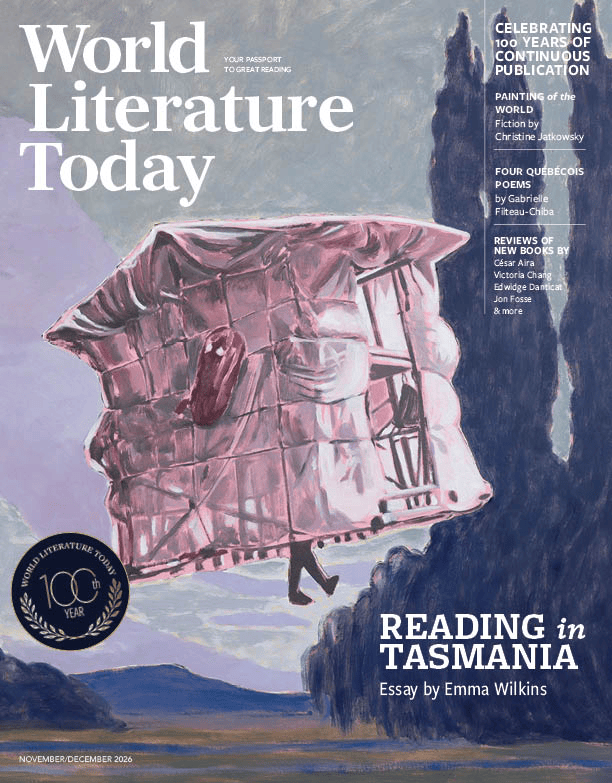
WORLD LITERATURE TODAY: The latest issue features ‘Reading in Tasmania’. The 100th year of continuous publicationgifts readers all their favorite genres—a profusion of essays, poetry, book reviews, creative nonfiction, fiction, interviews, a booklist for Trans Awareness Month, a postcard from Colombia, and more. Emma Wilkins’s essay on Tasmanian literature provides the cover feature, and translated work from China, Egypt, Mexico, Quebec, and Russia enlivens the issue. Reviews of new books by Solvej Balle, Emmanuel Carrère, Victoria Chang, Edwidge Danticat, Jon Fosse, and dozens more round out the year with essential reading-list titles.
Do the Fondation Beyeler’s new buildings by Peter Zumthor fit in with the rest of the site designed by Renzo Piano? Perhaps they aren’t trying to
What blockbuster auctions tell us about the value of art
The October auctions are always a test of the health of the art market, but there’s more than one way to read the results
Could members’ clubs bring new collectors into the art market?
From the November 2026 issue of Apollo. About a decade ago I found myself in a private room at the Arts Club on Dover Street in Mayfair explaining the reasons for my selection of that year’s international exhibitions, biennnials and art fairs to a table of wealthy diners. The expensively, if discreetly, dressed group – […]
The French restaurant that really does turn food into art
Guy Savoy is the first chef ever to be elected to the Académie des Beaux-Arts in France. A meal at his restaurant in Paris proves why he deserves this unprecedented honour
Since taking up his post in Paris, Kushner has become known for lobbing provocations onto France’s domestic scene at sensitive moments. As he put it, “Nobody has the courage to say what I say.” By Lauren Collins
Donald Trump has tried to purge voter rolls nationwide. Deidre Henderson, the Republican lieutenant governor of Utah, is among the chief election officers standing in his way. By Barton Gellman