Tag Archives: History

LITERARY REVIEW MAGAZINE – MAY 2026 PREVIEW

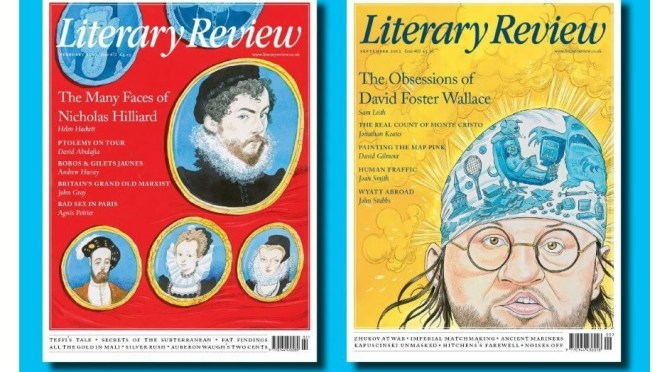
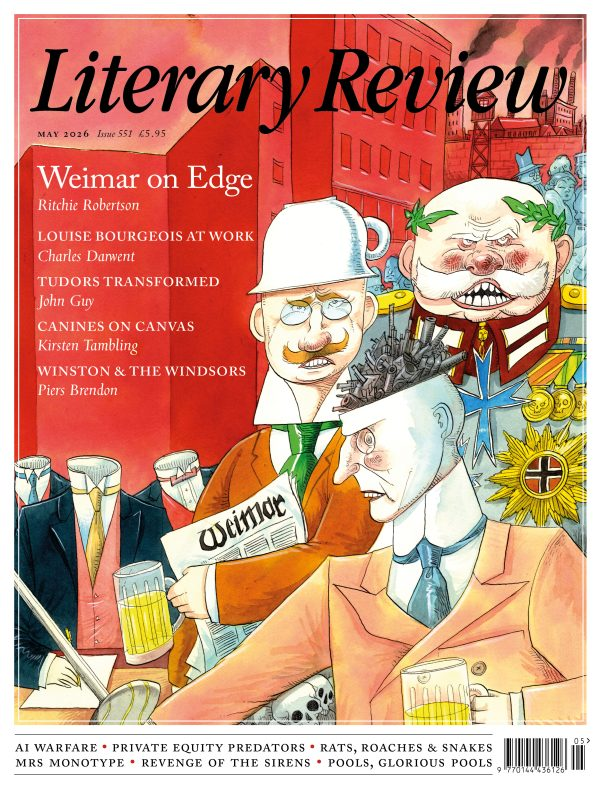
LITERARY REVIEW : The latest issue features Ritchie Robertson on Weimar * Charles Darwent on Louise Bourgeois * John Guy on the Tudors * Kirsten Tambling on dogs in art * Piers Brendon on Churchill and the crown * Saul David on AI warfare * Simon Nixon on private equity predators * Nigel Andrew on outsider animals * Zoe Guttenplan on Beatrice Warde * Maren Meinhardt on women and music * Lucy Lethbridge on swimming * Diane Purkiss on being published * Anthony Pagden on the West * Michael Reid on Lula * Anthony Teasdale on Tory leaders * Anna Reid on Vera Gedroits * Wendy Holden on Elizabeth II * Harriet Rix on trees * Emma Smith on Shakespeare’s identity * Jane Yager on Herta Müller * Sheena Joughin on Siri Hustvedt *  Adam Kucharski on evidence * Keith Miller on Douglas Stuart * Natalie Perman on Jem Calder *  and much, much more…

Weimar Germany: Death of a Democracy By Victor Sebestyen

Weimar: Life on the Edge of Catastrophe By Katja Hoyer

The small town of Weimar is overladen with historical associations. Goethe spent more than fifty years there as an employee and friend of Duke (later Grand Duke) Karl August. After the last grand duke abdicated in November 1918, the National Assembly met in Weimar to draw up a new republican constitution for Germany. Other symbolically charged venues considered were Nuremberg (home of Dürer) and Bayreuth (because of Wagner), but it was Weimar that gave its name to the period of German history from … 


Knife-Woman: The Life of Louise Bourgeois By Marie-Laure Bernadac (Translated from French by Lauren Elkin)

Having been named for her father, Louis, a mere dealer in antique tapestries, seemed insufficiently romantic to Louise Bourgeois, who was born on Christmas Day in 1911. She preferred the idea that her namesake was Louise Michel, ‘the red virgin of Montmartre’, an anarchist heroine of the Paris Commune. It wasn’t true, of course, but … 

This Little World: A New History of Tudor and Stuart England By Nandini Das

A phrase like ‘fortress England’ seems to echo down the centuries, and turns up again in This Little World, Nandini Das’s new study of identity and belonging, cross-border migration, assimilation and estrangement in the period between 1500 and the restoration of Charles II. Das seeks to unmask the period’s most fundamental assumptions about English … read more
THE GUARDIAN WEEKLY —- MAY 1, 2026 PREVIEW

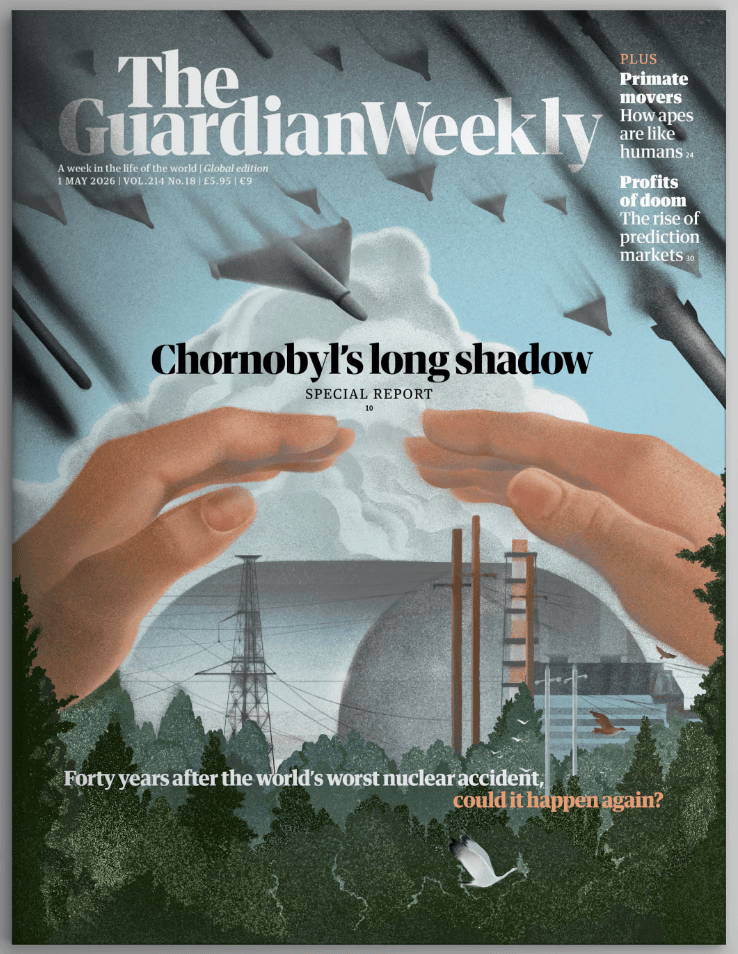
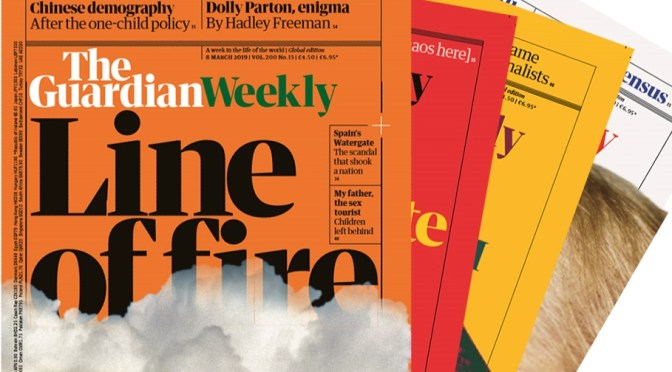
THE GUARDIAN WEEKLY: The latest issue features ‘Chornobyl’s Long Shadow’ – Forty years after the world’s worst nuclear accident, could it happen again?

In March 2022, soon after the full-scale Russian invasion of Ukraine began, Kyiv-based illustrator Masha Foya produced what I think is one of the Guardian Weekly’s most powerful covers on the war, concerning the devastation of Mariupol. So it’s a pleasure to feature Masha’s work again for the current edition, this time marking 40 years since the Chornobyl nuclear disaster.

“Since childhood, the story of Chornobyl has always made me feel a strange dissonance – such a tragedy occurring on a beautiful spring day in April,” explains Masha on the thought process behind her design, in which seasonal greens fade away into ominous skies.

It also reflects present-day anxieties. For a special report, Pjotr Sauer visits the site of the world’s worst nuclear accident and sees up close how the giant containment structure around the failed reactor is in urgent need of costly repairs after a Russian drone strike, as fears grow of a possible new catastrophe.

Five essential reads in this week’s edition

Environment | Why apes are more like us than we ever thought
Imagination, reason and ability to recognise faces from the past are not the sole preserve of humans, studies show. Gloria Dickie reports

Finance | The wagering of war
Once largely siloed to sporting events, betting has now spread to include contracts on news events where insider information could pay handsomely. With over $1bn in perfectly timed bets on the Iran war having recently been seen, Lauren Aratani explores what exactly is going on

Feature | The big game hunters who believe they can save Africa’s wildlife
One way to pay for wildlife conservation is to allow the rich to bag a few animals for high prices. But critics see this approach as an exercise in neocolonialism. Cal Flyn went in pursuit of answers

Opinion | Starmer’s listless government shows zombie politics is the new norm
Distracted, listless and unambitious – the British PM’s true form has finally emerged. But whatever comes next must end this ruinous cycle for the country, argues Nesrine Malik

Culture | Iron Maiden on 50 years of heavy metal madness
As a career-spanning documentary hits cinemas, the legendary rock band revisit their path from pubs to stadiums over half a century of headbanging hits. Harry Sword buckles up

TIMES LITERARY SUPPLEMENT – MAY 1, 2026 PREVIEW

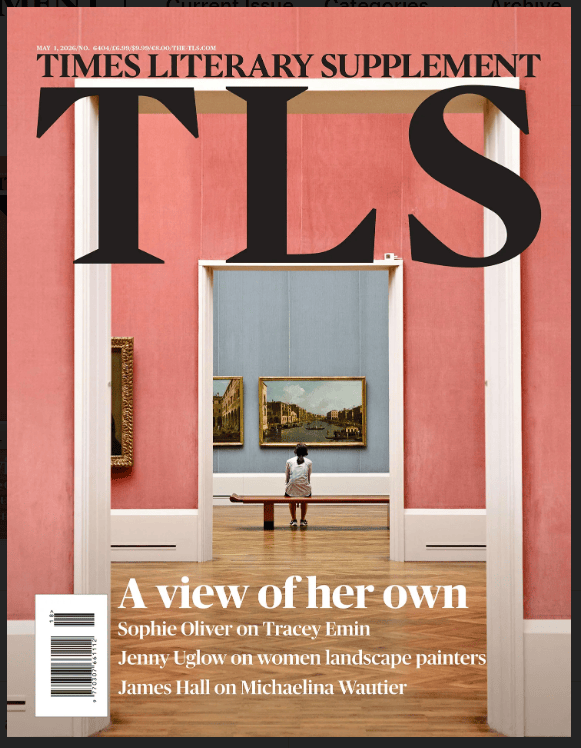
TIMES LITERARY SUPPLEMENT: The latest issue features ‘A View of Her Own’….

Out of nothing

Tracey Emin’s self-fashioning By Sophie Oliver

Amateurs in name only

Women landscape painters reconsidered By Jenny Uglow

Bomb culture

Mankind has escaped nuclear war, for now By P. D. Smith

So close to the United States

Mexico’s challenge to received historical ideas By Benjamin T. Smith

Greedy for light        

The bittersweet contentment of old age By Rory Waterman

LONDON REVIEW OF BOOKS – MAY 7, 2026 PREVIEW

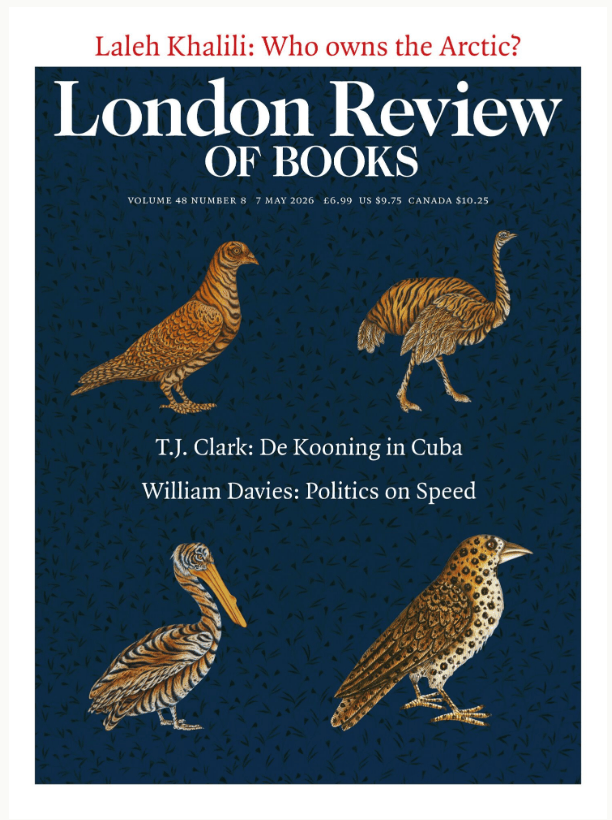
LONDON REVIEW OF BOOKS: The latest issue features ‘Who Owns The Arctic?’ by Laleh Khalili; De Kooning in Cuba by T.J. Clark; Politics on Speed by William Davies…

Who owns the Arctic?

Laleh Khalili

From the 16th century onwards, as European powers feverishly colonised the world, the possibility of a Northern Sea Route connecting the Atlantic to the Pacific, from Scandinavia to the Bering Strait, tantalised the Dutch and the British as an alternative to the southern routes to Asia and the Americas, which were dominated by Portugal and Spain. But the route only became a reality in the Soviet era, after investments in scientific, economic, industrial and military infrastructure in Siberia. 

Politics on Speed

William Davies

This is what distinguishes hyperpolitics from the mass democracy of the mid-20th century. Symbolic political gestures are now commonplace, but paid membership of organisations and parties has plummeted. The left has failed to find a replacement for trade unions as a basis for collective action in civil society. Political movements are easy to join, and just as easy to leave. 

De Kooning in Cuba

T.J. Clark

De Kooning’s Suburb in Havana is a counter-revolutionary painting. Well, of course. It is counter-revolutionary because it is counter everything, versus everything, lost in suburbia. It wants to show us how hard it had to work to get precisely nowhere. Why nowhere was where it wished to get to is a question it leaves to the viewer. 

Orbán’s Fall

Jan-Werner Müller

Can there be poetic justice in politics? Perhaps once in a lifetime. In 1989, a young Viktor Orbán bravely told the crowds in Budapest’s Heroes’ Square that it was time for the Russians to go home, just as protesters had demanded in 1956; almost four decades later, he was heckled on the campaign trail with the same words.

APOLLO MAGAZINE ———- MAY 2026 PREVIEW

Apollo issue: May 2026

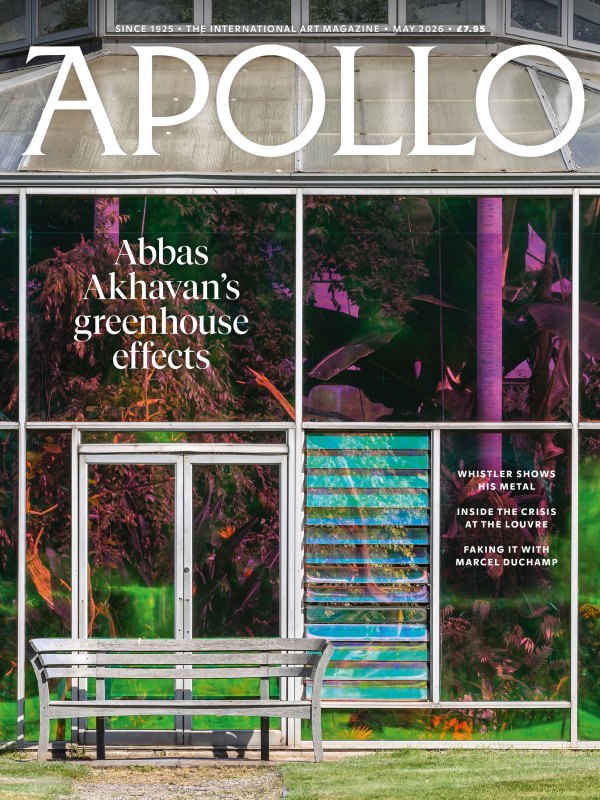
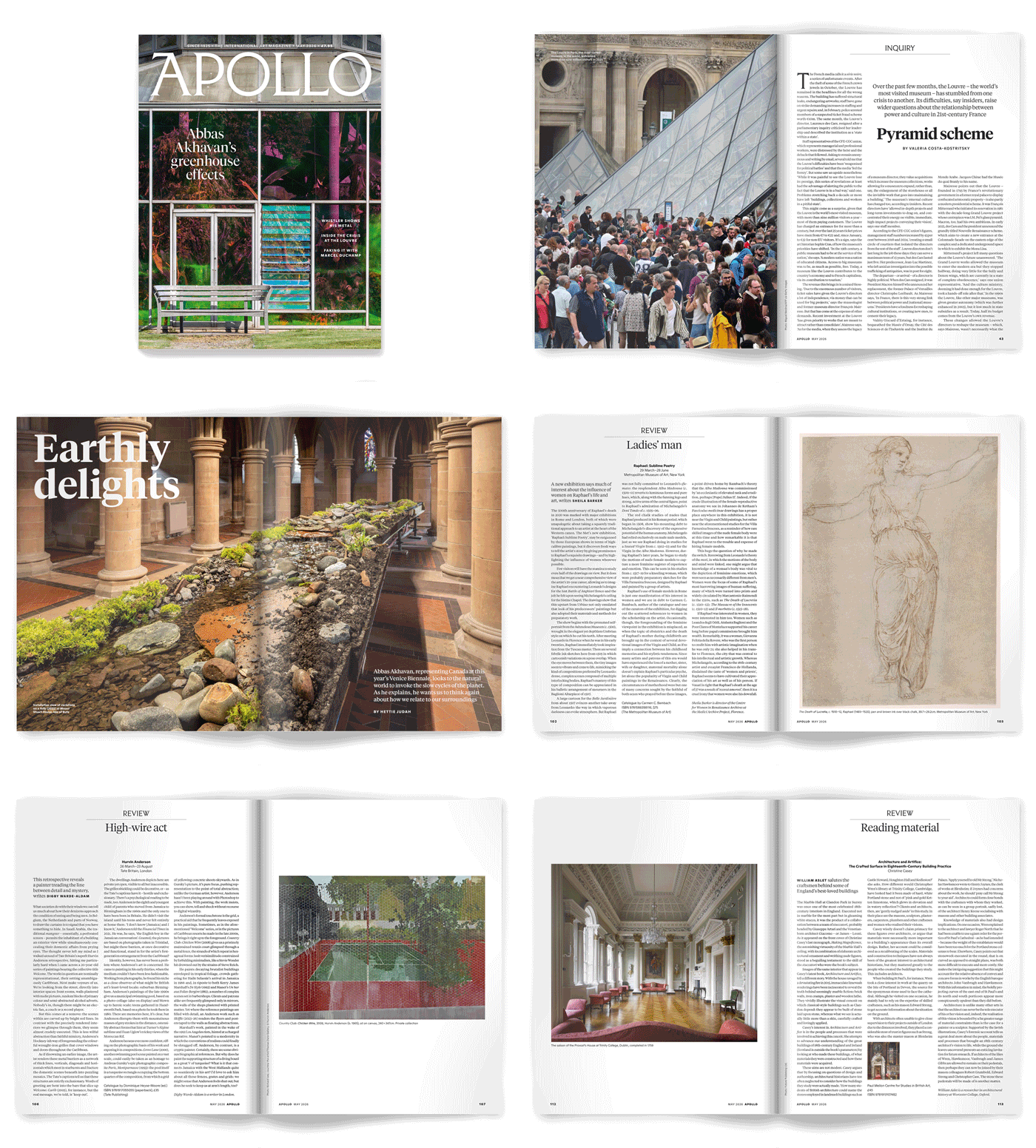
APOLLO MAGAZINE: The latest issue features Inside the crisis at the Louvre | how Marcel Duchamp invented modern art | an interview with Abbas Akhavan | Whistler shows his metal

FEATURES | Valeria Costa-Kostritsky explores the crisis at the Louvre; Hettie Judah talks to Abbas Akhavan before the artist represents Canada at the Venice Biennale; Ana María Bresciani of the Munchmuseet on Edvard Munch and the chocolate factory; Nicole Rudick on how Marcel Duchamp has been misunderstood; and Tara Contractor takes a closer look at Whistler’s love of metallic surfaces

REVIEWS | Sheila Barker on Raphael’s interest in women – and their interest in him; Zachary Ginsberg takes the temperature of contemporary American art at the Whitney Biennial; Digby Warde-Aldam admires Hurvin Anderson’s tricky balancing acts; Robert Hanks on the role of man’s best friend in art history; and William Aslet on the craftsmen behind some of Britain and Ireland’s best buildings

MARKET | Jane Morris on the status of online auctions; Emma Crichton-Miller on the mid-century French designers who married form, function and fun; in New York fair previews: Fatema Ahmed picks highlights from TEFAF; and Arjun Sajip looks ahead to Frieze

PLUS | Charles Darwent salutes the subtleties of Jasper Johns; Samuel Reilly on the threat to one of Glasgow’s most unusual attractions; Will Wiles applauds the witty architectural cartoons of Alan Dunn; Ivan Day on extravagant banquets in the Georgian era; Christina Makris visits the vineyard of Château La Coste; Helena Attlee is fired up by a depiction of Mount Etna; and Edward Behrens on a sale that shines new light on Gerhard Richter

THE ATLANTIC MAGAZINE – MAY 2026 PREVIEW

May 2026 Issue - The Atlantic

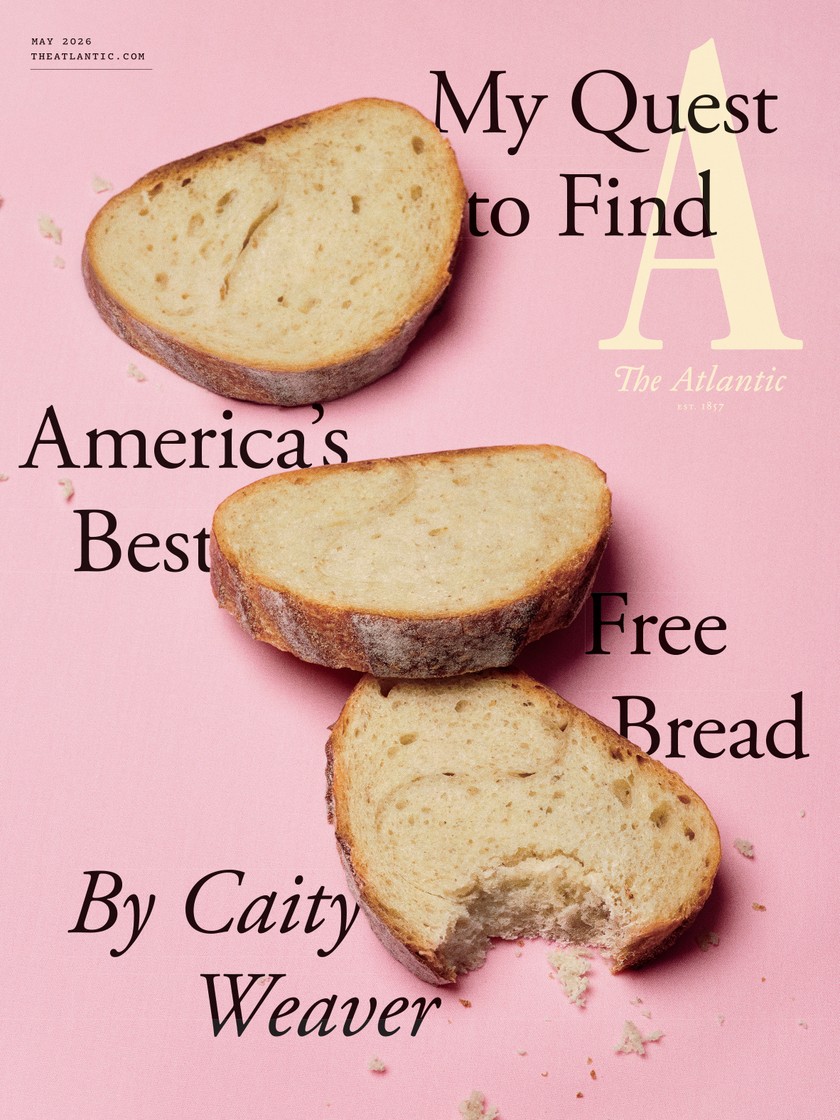
THE ATLANTIC MAGAZINE: The latest issue features America’s best free bread, the cartel Olympics, a billionaire’s private retreat, and why reactionaries are taking over the world. Plus the U.S. gerontocracy, masterpieces of the New Deal, John Mark Comer, Black comedy, the eighth deadly sin, and more.

I Found It: The Best Free Restaurant Bread in America

Thirteen thousand miles. Infinite contenders. One beautiful loaf. Caity Weaver

The Incredible Story of the Cartel Olympics

A Mexican athlete said he was kidnapped and forced to compete for his life in a tournament of gangs. But was he actually playing a different game? McKay Coppins

Someday in Tehran

The heartbreak of hoping for a democratic Iran Laura Secor

History Is Running Backwards

Why reactionaries are taking over the world David Brooks

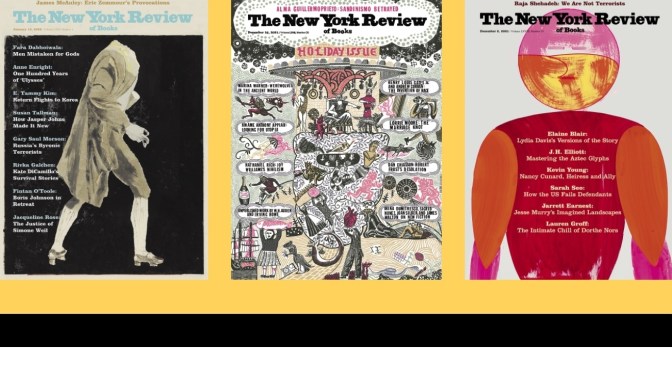
THE NEW YORK REVIEW OF BOOKS – MAY 14, 2026

THE NEW YORK REVIEW OF BOOKS: The latest issue features Jed Perl on the Whitney Biennial, Fintan O’Toole on the president’s precarious sanity, Nicole Rudick on June Leaf’s unique vision, Clare Bucknell on know-it-alls, Julian Bell on Joseph Wright of Derby, Dennis Lim on low-resolution cinema, Elaine Blair on the Guerrilla Girls, Mark O’Connell on a death in London, Martin Filler on David Adjaye’s demons, Nick Laird on the complete Seamus Heaney, Rosa Lyster on the evaporating salt lakes, Susan Tallman on Manet and Morisot, poems by Paul Muldoon and Fiona Sze-Lorrain, and much more.

‘The Right Amount of Crazy’

In Trump’s strategy of feigning madness to get what he wants, there is no longer any border between pretense and actual irrationality. By Fintan O’Toole

Charlatans & Bores

The profile of the pedant has changed surprisingly across time periods and cultures, but what’s constant is that nobody wants to be called one.

On Pedantry: A Cultural History of the Know-It-All by Arnoud S.Q. Visser

‘The Music of What Happens’

Seamus Heaney’s complete poems, following on editions of his letters, prose, and translations, confirm the extent of his achievement.

The Poems of Seamus Heaney edited by Rosie Lavan and Bernard O’Donoghue, with Matthew Hollis

Manet and Morisot: Game On

An important exhibition showcases a painterly repartee that altered the trajectory of the two artists’ work and, by extension, modern art itself.

Manet and Morisot – an exhibition at the Legion of Honor, San Francisco, October 11, 2025–March 1, 2026, and the Cleveland Museum of Art, March 29–July 5, 2026

HISTORY TODAY MAGAZINE – MAY 2026 PREVIEW

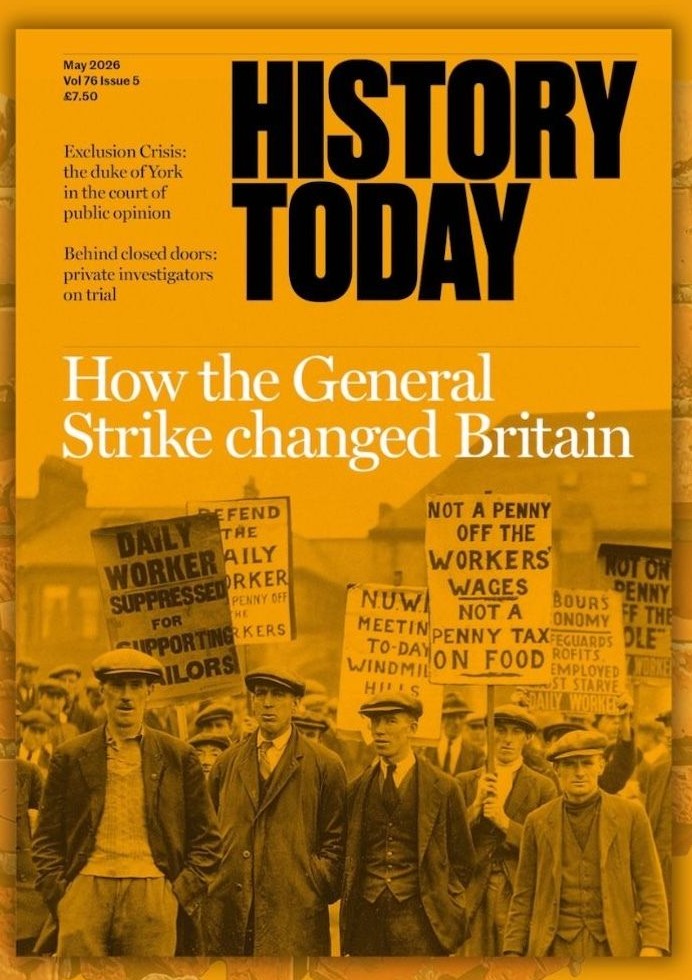
HISTORY TODAY MAGAZINE: The latest issue features ‘How The General Strike Changed Britain’….

How the General Strike Changed Britain

The General Strike of May 1926 was quickly defeated, but it would rupture and recast the landscape of British politics. For some, the strikers’ failure was an opportunity.

Why Did Britain Abolish the Slave Trade?

The Slavery Abolition Act was passed by Parliament in 1833. What was really behind Britain’s moment of moral enlightenment?

Exclusion Crisis: Challenging James II’s Right to Rule

The Exclusion Crisis of the late 17th century posed a question of national importance: should the Catholic duke of York be allowed to succeed to the throne? And should he be subject to the same law as everyone else?

‘Weimar’ by Katja Hoyer review

Weimar: Life on the Edge of Catastrophe by Katja Hoyer explores the city – and citizens – at the heart of Germany’s ill-fated republic, and the Reich that replaced it.

THE GUARDIAN WEEKLY – APRIL 24, 2026 PREVIEW

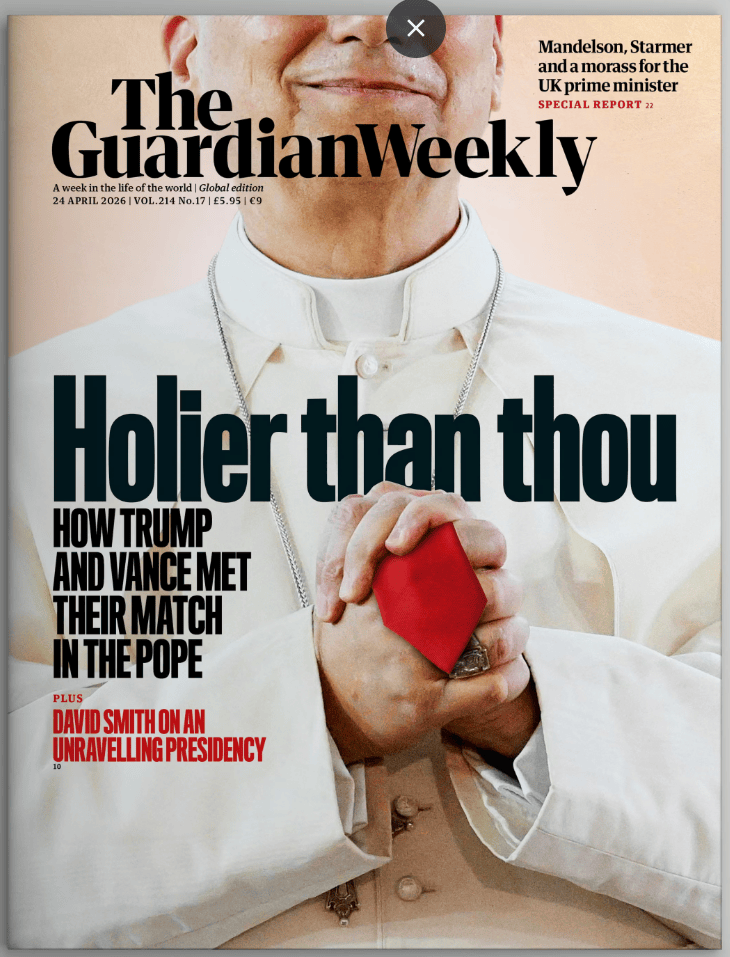
THE GUARDIAN WEEKLY: The latest issue features ‘Holier than thou’ – How Trump and Vance met their match in the Pope…

The Trump administration’s efforts to validate their incoherent war on Iran with some sort of Christian moral authority have led to a few, shall we say, interesting moments recently.

After bizarrely berating Pope Leo XIV as “WEAK on Crime, and terrible for Foreign Policy”, Donald Trump posted (and later deleted) a meme of himself as a Christ-like figure healing the sick. The self-styled “secretary of war” Pete Hegseth then confused what he evidently thought was a biblical passage with a bastardised version of a speech from the Quentin Tarantino movie Pulp Fiction.

Perhaps most damagingly of all, the vice-president, JD Vance, took Leo’s carefully considered thoughts on the concept of the “just war” as an opportunity to lecture the pope on theology.

Spotlight | Starmer and the scandal of Mandelson’s vetting
The British prime minister came under huge pressure to resign this week over what he knew about Peter Mandelson’s appointment as UK ambassador to the US, even though he had failed Foreign Office security vetting. Pippa CrerarJessica ElgotPaul Lewis and Kiran Stacey spearhead our coverage

Science | The magic of mushrooms
Fungi play a key role in ecosystems and storing carbon, so African scientists are championing the preservation of “funga” as much as flora and fauna, writes Whitney Bauck

Feature | When older relatives lurch to the far right
It starts with a “back in my day” nostalgic meme – then suddenly your elders are sharing AI-generated “boomerslop” and repeating conspiracy theories … Simon Usborne speaks to families dealing with rightwing political rifts

Opinion | Our governments are woefully underprepared for the AI revolution
Every wave of new tech has come with a doomsday scenario. But governments just aren’t planning a human response on the scale required, warns Larry Elliott

Culture | How the female gaze caught the attention of film, TV and fiction
From passionate romantasy novels to premium television dramas, culture is bringing the agency, desires and interior lives of women to the fore. It’s proving good for business, but is this a permanent revolution, asks Deborah Linton

THE GUARDIAN WEEKLY – APRIL 17, 2026 PREVIEW

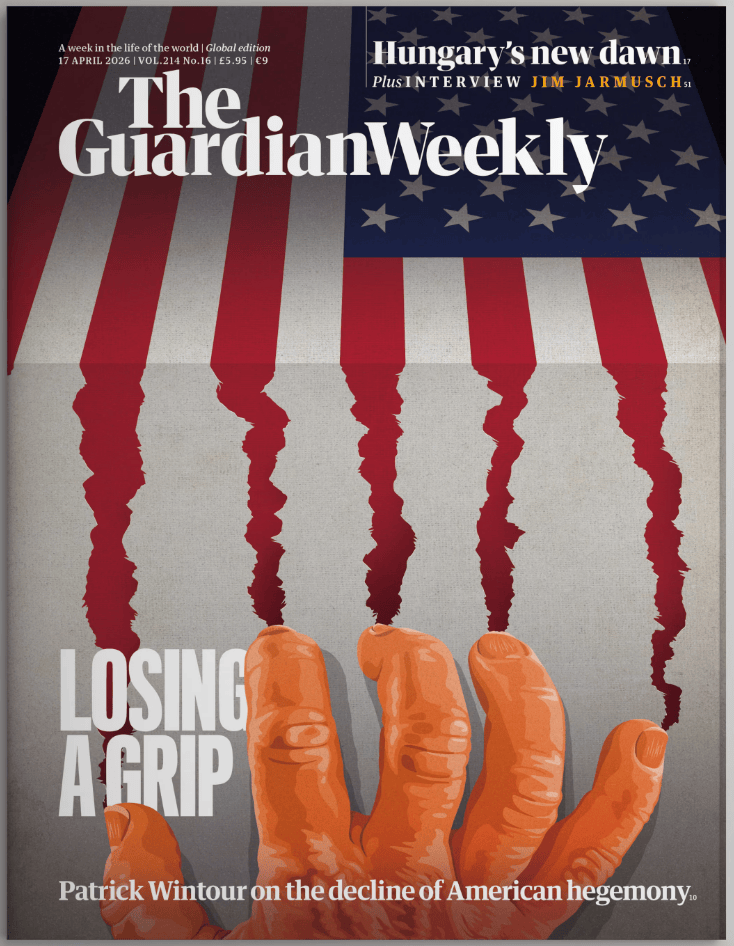
THE GUARDIAN WEEKLY: The latest issue features ‘Losing A Grip’ – Patrick Wintour on the decline of American hegemony…

At the end of 2025, Patrick Wintour wrote a compelling essay for Guardian Weekly in which he described an interregnum in global history, where the rules-based order had been eroded and great powers once again jostled for control and influence.

This week’s edition sees Patrick return to a key aspect of that theme, the deteriorating global standing of the United States after a period of high-stakes brinkmanship with Iran. Donald Trump’s aborted threat that Iranian civilisation would “die … never to be brought back” unless it ceded to his demands exposed the limits of his apocalyptic foreign policy. It also pointed to the wider decline of American influence in a world where the US appears untrustworthy and strategically isolated.

Spotlight | Hungary’s new dawn
After 16 years, Viktor Orbán’s populist grip on the country’s politics is over. But will his successor Péter Magyar be much different? Ashifa Kassam and Flora Garamvolgyi report amid jubilant scenes in Budapest

Science | The man who was bitten by snakes 200 times – on purpose
Tim Friede put his “ass on the line” to help stop snakebite deaths – whose numbers appear to be rising amid the climate crisis. Oliver Milman met him

Feature | The brutal reality of life as a foreign student in the UK
Universities in Britain rely on overseas applicants paying full fees, which has given rise to some unscrupulous recruiters and left many hopefuls and their families deep in debt. Samira Shackle investigates

Opinion | Netanyahu-ism has achieved nothing for Israelis
It is the voting public in Israel that will settle their PM’s fate later this year. But, argues Jonathan Freedland, all they have heard are promises of “total victory” that prove to be hollow

Culture | Jim Jarmusch, the darling of indie cinema
The 73-year-old has been at the cutting edge of US independent movies since the 1980s. As Father Mother Sister Brother opens in the UK, he tells Amy Raphael about grief, greed and “doing crazy shit” with Steve Coogan