Tag Archives: Fiction

THE GUARDIAN WEEKLY —- MAY 29, 2026 PREVIEW

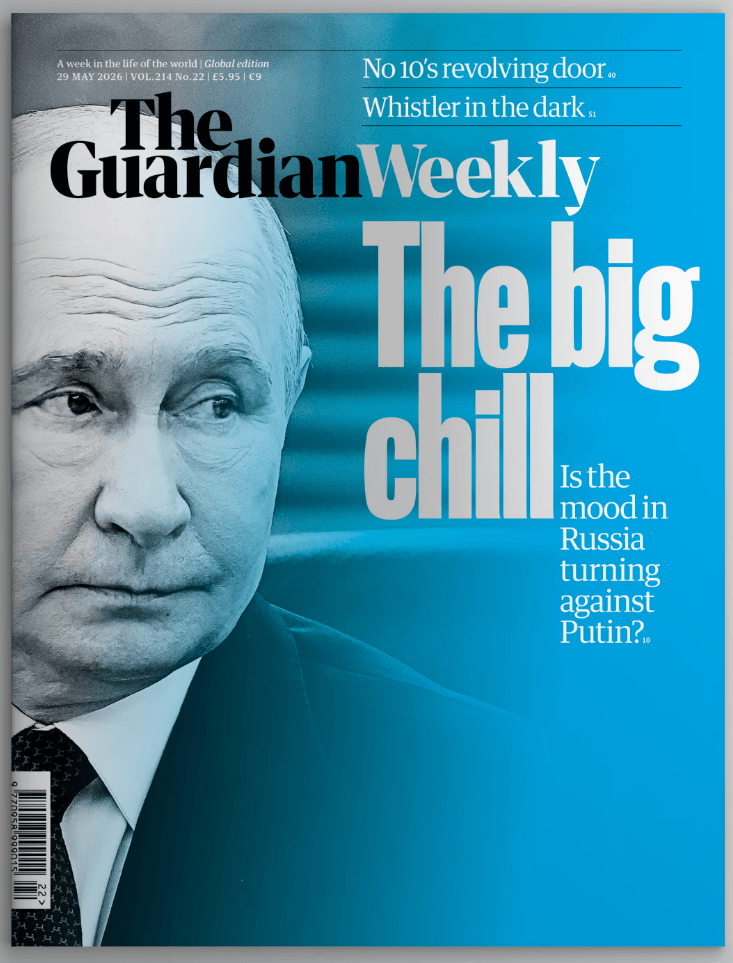
THE GUARDIAN WEEKLY: The latest issue features ‘The Big Chill’ – Is the mood in Russia turning against Putin?’

Like the majority of western news organisations, the Guardian has had no correspondent or reporter in Moscow since the invasion of Ukraine. But the Kremlin’s efforts to shut down outside media coverage has not stopped us from taking the political temperature of Russia. Indeed, as Pjotr Sauer and Shaun Walker report, attempts to close off the country have lost Vladimir Putin support among both the elites and ordinary citizens.

Talking to contacts made from many years working inside Russia, Pjotr and Shaun detail a shifting mood as the invasion drags on into its fourth summer with the economic and personal costs being increasingly felt at home. As one insider explains, “there is profound disappointment in Putin”, accompanied by “a growing sense that some kind of catastrophe is looming”.

The narrative of a bunkered ruler surrounded by underlings too scared to tell them the truth historically leads to putsch or revolution but our analysis shows that at present, though the winds may be chilling at home, Putin is far from being frozen out of power.

Spotlight | Ebola: ‘Out of control’
A new strain of virus, aid cuts and conflict in parts of the Democratic Republic of the Congo have hampered efforts to halt the spread of the virus, report Prosper Heri Ngorora in Goma and Carlos Mureithi

Science | Here be monsters
An exhibition, Jurassic Oceans, at London’s Natural History Museum, showcases the fearsome creatures that once lurked below the surface – and offers a stark warning about the impact of warming waters on marine ecosystems today. Matthew Pearce dives in

Feature | When the lights went out in Berlin
Earlier this year power was cut to a swathe of the German capital. A shadowy organisation, Volcano Group, claimed responsibility. But in the absence of any leads, theories of eco-terrorism, Russian meddling and far-right activity have flourished, discovers Ben Knight

Opinion | Victory doesn’t happen overnight
Arsenal’s careful planning to regain the Premier League title is a lesson in long-term thinking that the Labour party, and Arsenal fan Keir Starmer, should pay attention to, argues Jonathan Freedland

Culture | Back to black with Whistler
What does restoring Arrangement in Grey and Black No 1, or Whistler’s Mother, teach you about the artist who heralded a century of great American artists and about the craft of painting colour? Sarah Walden uncovers it all
THE GUARDIAN WEEKLY —- MAY 22, 2026 PREVIEW

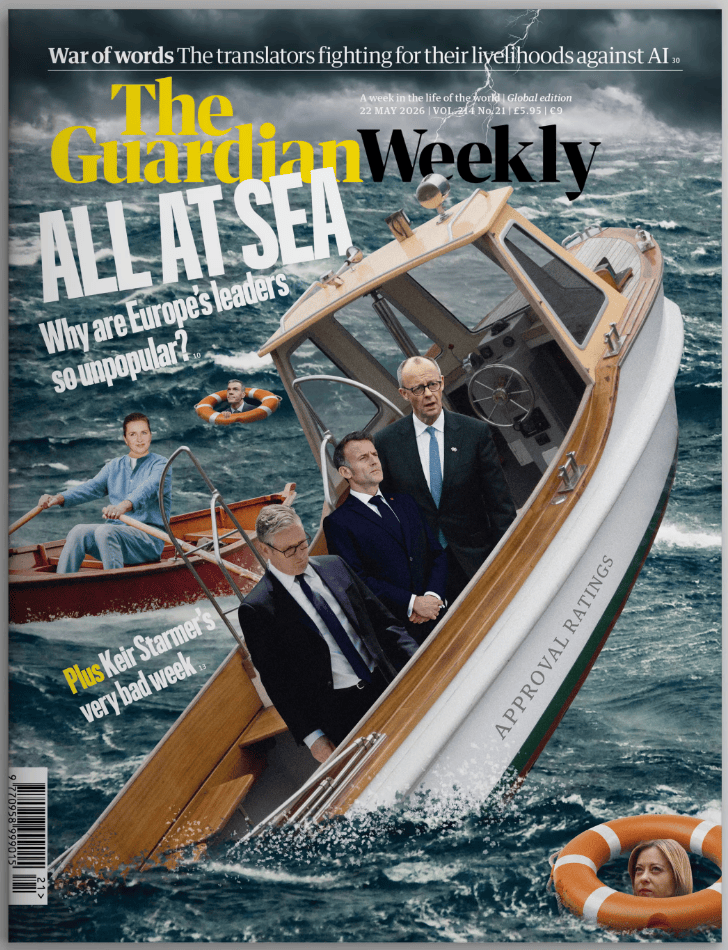
THE GUARDIAN WEEKLY: The latest issue features ‘All At Sea’ – Why are Europe’s leaders so unpopular…

After a week like Keir Starmer just had, what could one possibly do to cheer up the beleaguered UK prime minister? (Aside from his beloved Arsenal winning the Premier League title, that is.)

Perhaps remind him he’s not Friedrich Merz or Emmanuel Macron. Starmer may not be flavour of the month with UK voters or his own Labour MPs right now, but both the German and French leaders have barrel-scraping approval ratings that make the British PM look popular in comparison.

Even among the less-disliked European leaders, Giorgia Meloni of Italy and Pedro Sánchez of Spain are only marginally more liked than Donald Trump is in the US – and neither of them have started a war in Iran.

What’s behind this widespread disaffection for Europe’s leaders? Are they a generationally bad crop of politicians or have they been dealt an impossible hand of social and economic circumstances – or is it a mixture of both?

For our cover story this week, Daniel Boffey asks what Europe’s embattled leaders can do to reverse that sinking feeling. Then, from our UK political team, Pippa Crerar and Peter Walker look back on a week when Starmer was left looking increasingly like an interim PM.

Spotlight | Xi rolled out the red carpet for Trump, but that was all
There was no swift end to the Iran war, uncertainty over Taiwan and only vague outlines of commercial deals – but the US president at least got to bask in the company of his Chinese counterpart, reports David Smith

Technology | Despite rise of AI, is there still hope for Europe’s translators?
A booming tech sector has disrupted translation jobs in publishing – but they could be needed for a while longer yet, writes Philip Oltermann

Feature | The sinister spread of France’s killer seaweed
After a series of deaths on the beaches of Brittany, one bereaved family set out to prove the foul-smelling bloom was to blame. Marta Zaraska investigates

Opinion | Normalising Reform UK’s ideas turns neighbour against neighbour
“Concern” about immigration has now morphed into policing how ethnic minorities exist in our communities, argues Nesrine Malik

Culture | How Backrooms upended the horror movie
It started off just as a creepy picture on the internet. Now it’s the year’s freakiest film. Steve Rose meets its auteur, Kane Parsons, and stars Chiwetel Ejiofor and Renate Reinsve


What else we’ve been reading

 The Guardian’s new list of the 100 best novels of all time provoked extensive discussion in my household. How many have you read? I won’t embarrass myself by divulging my own total, except to admit there is considerable catching up to be done. Graham Snowdon, editor

 Politidex is a Pokémon-like mobile phone game where players can build their own political party by “catching” local councillors and MPs. Having started life as an April Fools’ Day joke, the game’s mission is now to humanise both politics and politicians, says its creator in this interesting piece. Bowie Qiu, Marketing manager

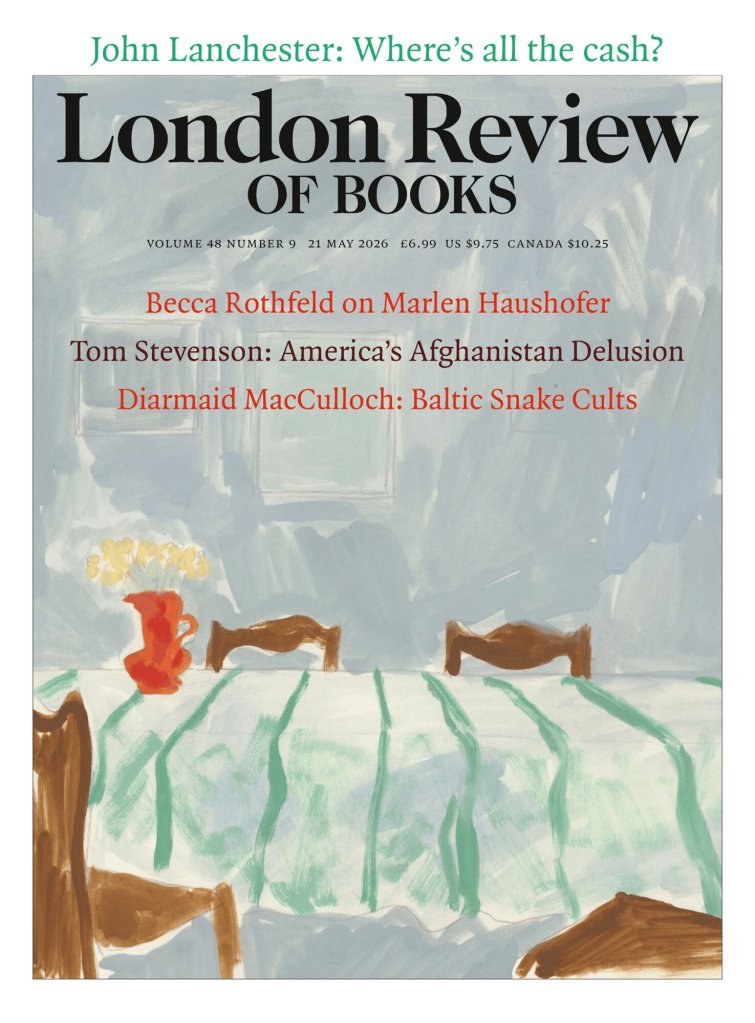
LONDON REVIEW OF BOOKS – MAY 21, 2026 PREVIEW

LONDON REVIEW OF BOOKS: The latest issue features…

Lead Essays & Politics

  • “America’s Afghanistan Delusion” by Tom Stevenson: Stevenson examines the legacy of the War on Terror, arguing that the 2021 withdrawal from Kabul was viewed by the Western establishment as a “mistake” or “cautionary tale” rather than the “crime” he suggests it was. He traces the expansion of American power through “black sites” and military advisers across the globe.
  • “Short Cuts: Labour’s Failure” by James Butler: Butler analyzes the results of the English local elections (held on May 7). He criticizes Keir Starmer’s leadership style as “all injunction and no argument” and explores why national revulsion toward the Labour Party overshadowed local government issues.
  • “Where’s All the Cash?” by John Lanchester: A characteristically lucid investigation into modern economics, focusing on the circulation of physical currency and the shifting nature of wealth in a digital-first economy.

Literature & History

  • “On Marlen Haushofer” by Becca Rothfeld: A deep dive into the work of the Austrian writer, specifically her 1963 masterpiece The Wall. Rothfeld explores Haushofer’s recurring themes of entrapment and isolation, noting the paradoxical “joy” found in her most barricaded characters.
  • “Baltic Snake Cults” by Diarmaid MacCulloch: The eminent historian reviews the long survival of paganism and “serpent worship” in the Baltic regions, challenging the standard narrative of a monolithic Christian Europe during the Middle Ages.
  • “Should We Punish?” by Thomas Nagel: The philosopher engages with the ethics of the penal system, weighing the traditional justifications for punishment against contemporary moral and legal theories.

Other Features

“The Clearance of Aoineadh Mòr, 1824” by Tarn MacArthur: A historical account of the Highland Clearances, specifically focusing on the displacement of communities in Scotland.

At the Movies: Michael Wood provides his regular column of film criticism, likely focusing on current European or art-house releases.

Poetry & Correspondence: The issue also contains poems and a robust letters section, which in this period has been heavily occupied by debates over the Arctic (following Laleh Khalili’s piece in the previous issue) and the fallout of the UK local elections.

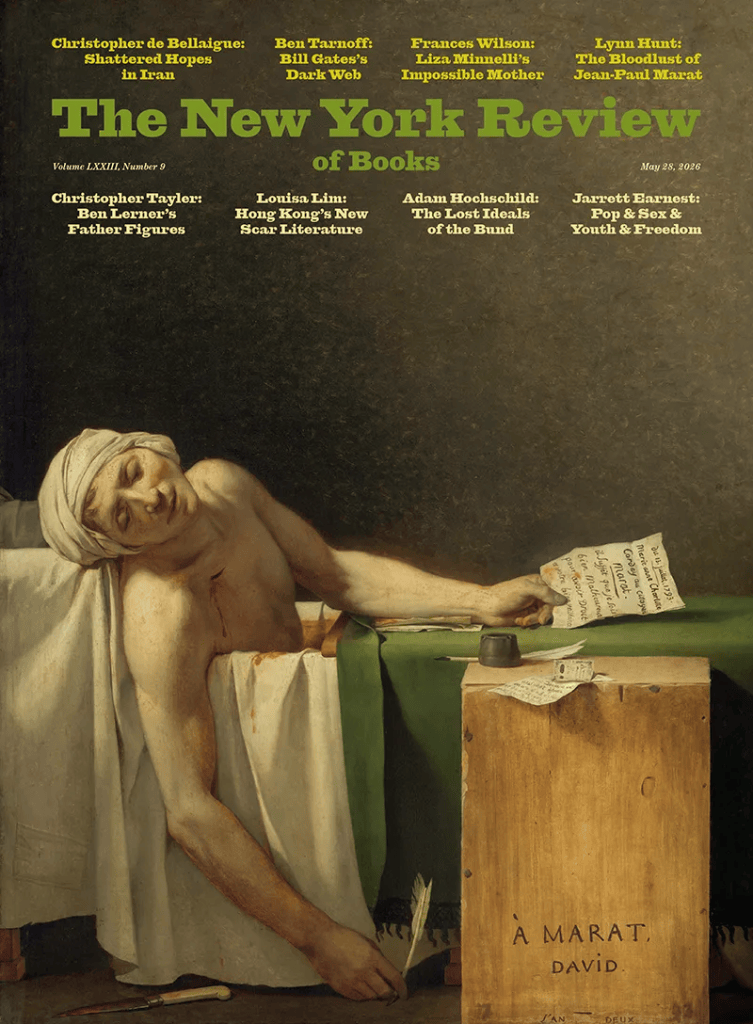
THE NEW YORK REVIEW OF BOOKS – MAY 28, 2026

THE NEW YORK REVIEW OF BOOKS: The latest issue features Ben Tarnoff on Silicon Valley’s paterfamilias, Christopher de Bellaigue on Iran’s political future, Frances Wilson on Liza (with a “Z”), Christopher Tayler on Ben Lerner, Lynn Hunt on Marat’s afterlife, Charlie Lee on John Gregory Dunne’s descent into Vegas, Adam Hochschild on the dream of the Bundists, Nina Siegal on the real-life Hoosier Indiana Jones, Louisa Lim on contemporary Hong Kong literature, poems by Dan Chiasson and Emily Berry, and much more.

Whither the Nerd-Bully?

Bill Gates was the monopolistic father figure who Silicon Valley’s young founders rebelled against—and, in so rebelling, became.

Billionaire, Nerd, Savior, King: Bill Gates and His Quest to Shape Our World by Anupreeta Das

Source Code: My Beginnings by Bill Gates

Iran’s New Winter

The US-Israeli war against Iran, far from encouraging a popular uprising, has strengthened the regime’s grip and set back the cause of Iranian freedom indefinitely.

Don’t Call It Entertainment

In Everthing Is Now, J. Hoberman chronicles a radical avant-garde’s attempts to jostle New York City out of its postwar complacency and moral retrenchment.

Everything Is Now: The 1960s New York Avant-Garde—Primal Happenings, Underground Movies, Radical Pop by J. Hoberman

The Sage of Washington

Walter Lippmann was the most influential political commentator of his generation, but behind his preternatural confidence was a far more complicated and unsettled character.

Walter Lippmann: An Intellectual Biography by Tom Arnold-Forster

THE GUARDIAN WEEKLY —- MAY 8, 2026 PREVIEW

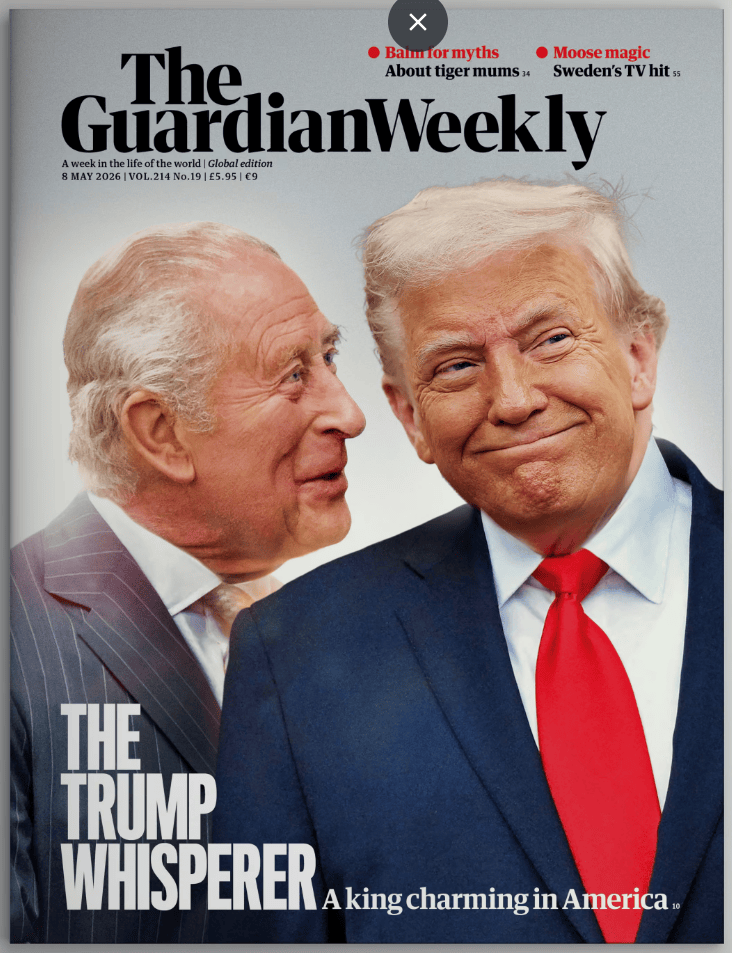
THE GUARDIAN WEEKLY: The latest issue features ‘The Trump Whisperer’ – A king charming in America….

It’s fair to say that the Guardian Weekly does not cover many royal visits, but King Charles III’s US state visit was the most consequential of his reign so far. The king’s ostensible purpose was to celebrate America’s 250 years of independence but last week’s trip was freighted with other agendas, most important of which was to flatter his host, Donald Trump. Washington bureau chief David Smith’s cover story shows how “like a rapier wrapped in ermine, Charles managed to tame Trump while rebuking Trumpism”.
Both David and our veteran foreign affairs commentator Simon Tisdall unpick the skill with which Charles spoke truth to this capricious and egotistical president and gave both sides of the heavily divided Congress much to praise. It was a performance of high diplomacy at a time of huge tension in the transatlantic relationship and beyond.

But the charm didn’t wash in New York where, as Adam Gabbatt’s sketch shows, the shadow of Jeffrey Epstein and Andrew Mountbatten-Windsor, Charles’s disgraced brother, lurked while the mayor, Zohran Mamdani, brought up the spectre of colonialism in the shape of the Koh-i-noor diamond, snatched under disputed circumstances.

Spotlight | A small town in Germany
Landstuhl, the heart of the largest American military community outside the US, considers its future after Donald Trump’s decision to withdraw 5,000 troops, reports Deborah Cole

Environment | A gift of wings
Patrick Barkham takes off for a flight of wonder with The Lost Words duo, who have reunited for a new book on endangered birds

Feature | A balm for tiger mother myths
Rebecca Liu explores why a certain image of the tiger mum – strict, cold and demanding – is ubiquitous in popular culture

Opinion | Antiracists need to stand up for us all
Another attack on the UK’s Jewish population demands a clear show of solidarity from those who march to protect minorities, argues Jonathan Freedland

Culture | Moose magic on the loose
How do cameras capture Sweden’s seasonal TV hit, the Great Moose Migration? Malcolm Jack travels to an uninhabited island in the Ångerman river to ask the show’s makers

LITERARY REVIEW MAGAZINE – MAY 2026 PREVIEW

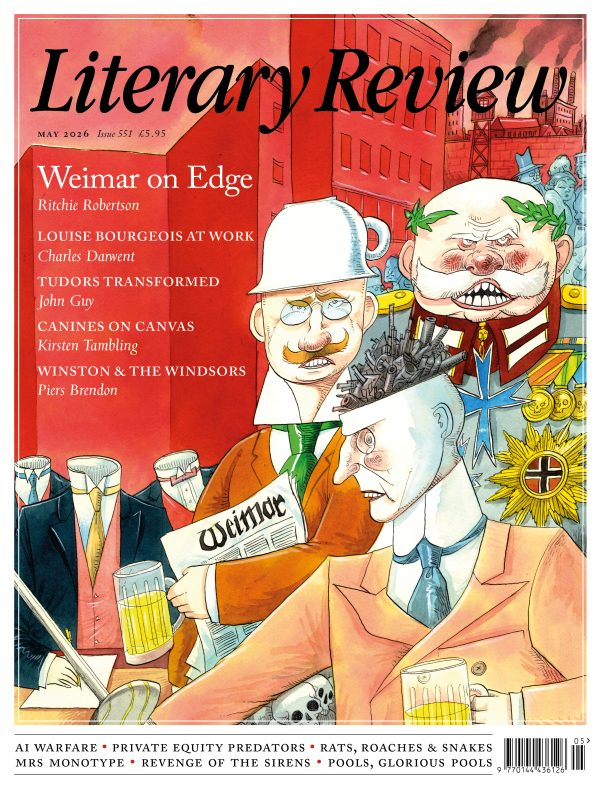
LITERARY REVIEW : The latest issue features Ritchie Robertson on Weimar * Charles Darwent on Louise Bourgeois * John Guy on the Tudors * Kirsten Tambling on dogs in art * Piers Brendon on Churchill and the crown * Saul David on AI warfare * Simon Nixon on private equity predators * Nigel Andrew on outsider animals * Zoe Guttenplan on Beatrice Warde * Maren Meinhardt on women and music * Lucy Lethbridge on swimming * Diane Purkiss on being published * Anthony Pagden on the West * Michael Reid on Lula * Anthony Teasdale on Tory leaders * Anna Reid on Vera Gedroits * Wendy Holden on Elizabeth II * Harriet Rix on trees * Emma Smith on Shakespeare’s identity * Jane Yager on Herta Müller * Sheena Joughin on Siri Hustvedt *  Adam Kucharski on evidence * Keith Miller on Douglas Stuart * Natalie Perman on Jem Calder *  and much, much more…

Weimar Germany: Death of a Democracy By Victor Sebestyen

Weimar: Life on the Edge of Catastrophe By Katja Hoyer

The small town of Weimar is overladen with historical associations. Goethe spent more than fifty years there as an employee and friend of Duke (later Grand Duke) Karl August. After the last grand duke abdicated in November 1918, the National Assembly met in Weimar to draw up a new republican constitution for Germany. Other symbolically charged venues considered were Nuremberg (home of Dürer) and Bayreuth (because of Wagner), but it was Weimar that gave its name to the period of German history from … 


Knife-Woman: The Life of Louise Bourgeois By Marie-Laure Bernadac (Translated from French by Lauren Elkin)

Having been named for her father, Louis, a mere dealer in antique tapestries, seemed insufficiently romantic to Louise Bourgeois, who was born on Christmas Day in 1911. She preferred the idea that her namesake was Louise Michel, ‘the red virgin of Montmartre’, an anarchist heroine of the Paris Commune. It wasn’t true, of course, but … 

This Little World: A New History of Tudor and Stuart England By Nandini Das

A phrase like ‘fortress England’ seems to echo down the centuries, and turns up again in This Little World, Nandini Das’s new study of identity and belonging, cross-border migration, assimilation and estrangement in the period between 1500 and the restoration of Charles II. Das seeks to unmask the period’s most fundamental assumptions about English … read more

THE GUARDIAN WEEKLY —- MAY 1, 2026 PREVIEW

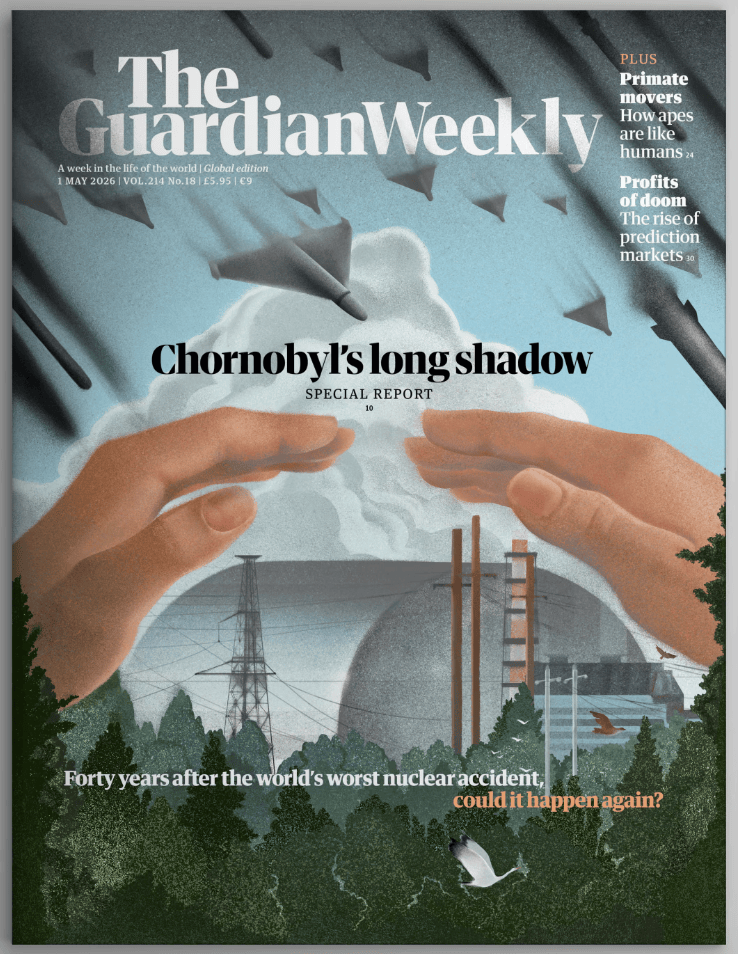
THE GUARDIAN WEEKLY: The latest issue features ‘Chornobyl’s Long Shadow’ – Forty years after the world’s worst nuclear accident, could it happen again?

In March 2022, soon after the full-scale Russian invasion of Ukraine began, Kyiv-based illustrator Masha Foya produced what I think is one of the Guardian Weekly’s most powerful covers on the war, concerning the devastation of Mariupol. So it’s a pleasure to feature Masha’s work again for the current edition, this time marking 40 years since the Chornobyl nuclear disaster.

“Since childhood, the story of Chornobyl has always made me feel a strange dissonance – such a tragedy occurring on a beautiful spring day in April,” explains Masha on the thought process behind her design, in which seasonal greens fade away into ominous skies.

It also reflects present-day anxieties. For a special report, Pjotr Sauer visits the site of the world’s worst nuclear accident and sees up close how the giant containment structure around the failed reactor is in urgent need of costly repairs after a Russian drone strike, as fears grow of a possible new catastrophe.

Five essential reads in this week’s edition

Environment | Why apes are more like us than we ever thought
Imagination, reason and ability to recognise faces from the past are not the sole preserve of humans, studies show. Gloria Dickie reports

Finance | The wagering of war
Once largely siloed to sporting events, betting has now spread to include contracts on news events where insider information could pay handsomely. With over $1bn in perfectly timed bets on the Iran war having recently been seen, Lauren Aratani explores what exactly is going on

Feature | The big game hunters who believe they can save Africa’s wildlife
One way to pay for wildlife conservation is to allow the rich to bag a few animals for high prices. But critics see this approach as an exercise in neocolonialism. Cal Flyn went in pursuit of answers

Opinion | Starmer’s listless government shows zombie politics is the new norm
Distracted, listless and unambitious – the British PM’s true form has finally emerged. But whatever comes next must end this ruinous cycle for the country, argues Nesrine Malik

Culture | Iron Maiden on 50 years of heavy metal madness
As a career-spanning documentary hits cinemas, the legendary rock band revisit their path from pubs to stadiums over half a century of headbanging hits. Harry Sword buckles up

Zyzzyva Magazine —– Spring 2026 Preview

ZYZZYVA Magazine: The latest issue features…

Nonfiction

“Saguaro in the Sea” by Sophia Acuña: on surfing and indigeneity in Southern California, told through collage.

“Care Directive” by Sarah Matsui: a daughter’s attempt to keep her aging father in Hawaii from all sorts of calamity, but having to monitor him from the mainland.

“Triptych: A Biographer’s Sketchbook” by Carolyn Burke: “The Baroness was lively, curious, and still blond at eighty-five. She received me in a flurry of franglais, the mingling of two languages in which we would converse, and put us at ease with pink champagne, her favorite.”

Fiction

“Decoys” by Will Boast: goofing around working at the town supermarket, burning through the days till it all comes to head.

“Lilac Mud” by Anita Felicelli: A Bay Area artist in Amsterdam is approached one night by a man claiming to be a former student, leading to a crisis of identity and purpose.

“Grote geplumaceerde” by Emily Nemens: “Afterward, staring hard at her phone, which was her radio, which was the bearer of bad news, she wondered what mattered at all.”

Poetry

Kevin Cantwell, Geraldine Jorge, Jonathon Keats, Caroline Kessler, and Noelani Piters.

In Conversation

Lydia Kiesling talks to acclaimed author Karen Russell about Russell’s latest novel, The Antidote, and about Russell’s “fascination with foundational myths, the things we choose to know, and the things we choose to ignore or forget.”

Art

Ian Everard

THE NEW YORK REVIEW OF BOOKS – MAY 14, 2026

THE NEW YORK REVIEW OF BOOKS: The latest issue features Jed Perl on the Whitney Biennial, Fintan O’Toole on the president’s precarious sanity, Nicole Rudick on June Leaf’s unique vision, Clare Bucknell on know-it-alls, Julian Bell on Joseph Wright of Derby, Dennis Lim on low-resolution cinema, Elaine Blair on the Guerrilla Girls, Mark O’Connell on a death in London, Martin Filler on David Adjaye’s demons, Nick Laird on the complete Seamus Heaney, Rosa Lyster on the evaporating salt lakes, Susan Tallman on Manet and Morisot, poems by Paul Muldoon and Fiona Sze-Lorrain, and much more.

‘The Right Amount of Crazy’

In Trump’s strategy of feigning madness to get what he wants, there is no longer any border between pretense and actual irrationality. By Fintan O’Toole

Charlatans & Bores

The profile of the pedant has changed surprisingly across time periods and cultures, but what’s constant is that nobody wants to be called one.

On Pedantry: A Cultural History of the Know-It-All by Arnoud S.Q. Visser

‘The Music of What Happens’

Seamus Heaney’s complete poems, following on editions of his letters, prose, and translations, confirm the extent of his achievement.

The Poems of Seamus Heaney edited by Rosie Lavan and Bernard O’Donoghue, with Matthew Hollis

Manet and Morisot: Game On

An important exhibition showcases a painterly repartee that altered the trajectory of the two artists’ work and, by extension, modern art itself.

Manet and Morisot – an exhibition at the Legion of Honor, San Francisco, October 11, 2025–March 1, 2026, and the Cleveland Museum of Art, March 29–July 5, 2026

THE GUARDIAN WEEKLY – APRIL 24, 2026 PREVIEW

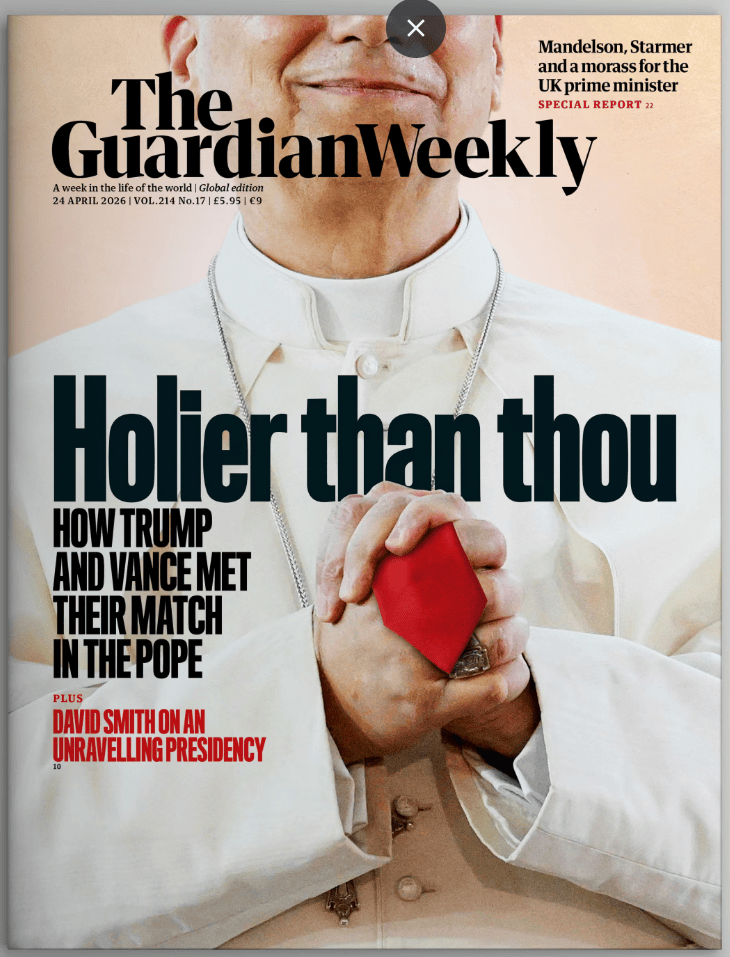
THE GUARDIAN WEEKLY: The latest issue features ‘Holier than thou’ – How Trump and Vance met their match in the Pope…

The Trump administration’s efforts to validate their incoherent war on Iran with some sort of Christian moral authority have led to a few, shall we say, interesting moments recently.

After bizarrely berating Pope Leo XIV as “WEAK on Crime, and terrible for Foreign Policy”, Donald Trump posted (and later deleted) a meme of himself as a Christ-like figure healing the sick. The self-styled “secretary of war” Pete Hegseth then confused what he evidently thought was a biblical passage with a bastardised version of a speech from the Quentin Tarantino movie Pulp Fiction.

Perhaps most damagingly of all, the vice-president, JD Vance, took Leo’s carefully considered thoughts on the concept of the “just war” as an opportunity to lecture the pope on theology.

Spotlight | Starmer and the scandal of Mandelson’s vetting
The British prime minister came under huge pressure to resign this week over what he knew about Peter Mandelson’s appointment as UK ambassador to the US, even though he had failed Foreign Office security vetting. Pippa Crerar, Jessica Elgot, Paul Lewis and Kiran Stacey spearhead our coverage

Science | The magic of mushrooms
Fungi play a key role in ecosystems and storing carbon, so African scientists are championing the preservation of “funga” as much as flora and fauna, writes Whitney Bauck

Feature | When older relatives lurch to the far right
It starts with a “back in my day” nostalgic meme – then suddenly your elders are sharing AI-generated “boomerslop” and repeating conspiracy theories … Simon Usborne speaks to families dealing with rightwing political rifts

Opinion | Our governments are woefully underprepared for the AI revolution
Every wave of new tech has come with a doomsday scenario. But governments just aren’t planning a human response on the scale required, warns Larry Elliott

Culture | How the female gaze caught the attention of film, TV and fiction
From passionate romantasy novels to premium television dramas, culture is bringing the agency, desires and interior lives of women to the fore. It’s proving good for business, but is this a permanent revolution, asks Deborah Linton