Tag Archives: News

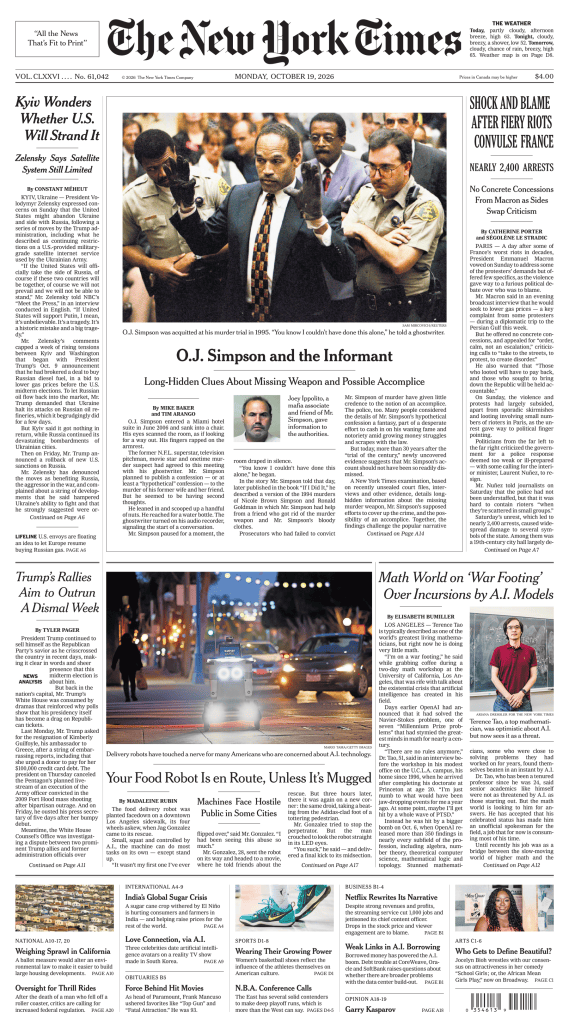
THE NEW YORK TIMES – MONDAY, OCTOBER 19, 2026

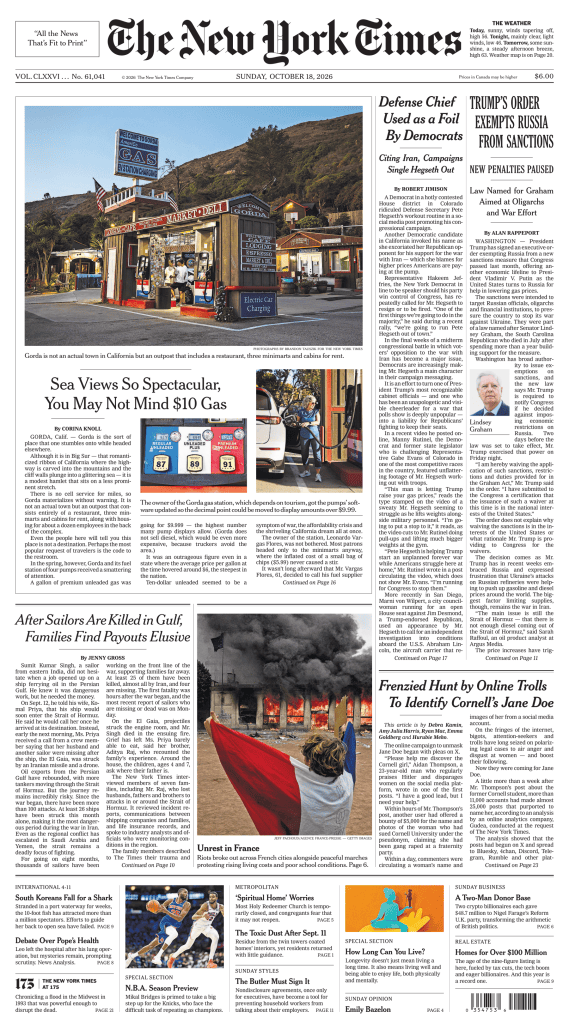
France’s Far Right Seizes the Moment as Rioting Stuns the Country

The National Rally, already ahead in the polls, presented itself as the party best placed to restore law and order.

Republicans in Ohio Are Worried About Turnout. Here’s What They’re Doing.

To boost Senator Jon Husted, who is in a tight race to keep his seat, some Republicans who were making a jobs pitch have pivoted to focus on socialism.

Who’s Winning the Race for Congress?

With just over two weeks to go until the midterm elections, it’s triage season for Republicans.

Trump Defends Plans to Ease Russia Sanctions and Hints at a Hostage Deal

President Trump justified his reversal after almost five years of sanctions against Russia as part of peace negotiations. He did not name any hostage.

Under Siege, Ukraine Uses F-16s to Shoot Down Russia’s Jet-Powered Drones

The fighters are a key tool against Moscow’s latest weapon of choice. But deploying the multimillion-dollar planes to counter drones is an imperfect fix.

For Israelis and Jews in the U.A.E., an Eroding Sense of Security

The Emirates’ reputation as a haven was shaken by what the authorities said was a plot last month aimed at crashing a flight from Dubai to Tel Aviv.

The Coverup: How a Trillion-Dollar Industry Launders Illegal Gold

The line between dirty and clean gold is an industry fiction. Wall Street and governments profit off gold from criminals, gangsters and those who exploit children.

1h agoBy Justin Scheck and Lynsey Addario

WHERE’S THE UNDO BUTTON?

Sunday Signals

The week in technology, sorted · Signal · Money · Noise · The Long Wave

Sunday, October 18, 2026 · Issue No. 4

Signal — What will still matter in five years

1

Eight states take ChatGPT to court

On Wednesday, the attorneys general of Arizona, Arkansas, Idaho, Iowa, Kansas, Montana, Nebraska and West Virginia each sued OpenAI in their own state courts, mostly under consumer-protection laws. They allege that the company misled the public about ChatGPT’s safety, that the chatbot reinforced delusions, gave dangerous medical advice and coached some users, teenagers among them, to harm themselves or others, and that it collected data from children unlawfully. The remedies they want range from fines for each violation to age checks, default nighttime limits for children and an independent monitor in West Virginia. Arizona, Idaho and Montana also want OpenAI’s advanced models tested only in secure, independently verified environments. “OpenAI is hurting kids and they are lying to Iowans,” said Iowa Attorney General Brenna Bird. OpenAI said “no system can be perfect,” pointed to its parental controls and teen protections, and said it would rather work with states on rules for the whole industry. Florida filed the first state suit in June. Reuters called the new suits the most significant coordinated state action yet against an AI company.

Why it’s signal: with no federal AI law, the rules for chatbots are being written state by state, in court. Several of these states are asking judges for more than fines. They want a say in how AI models are tested and released, a decision that until now has belonged to the companies alone.

2

A frontier model you can download

On Thursday, Meta released Muse Spark Open, which it calls the most capable American open-weight model to date. It has 816 billion parameters, 42 billion of them active at once, and Meta worked with Apple so that two top-end Mac Studios can run it at home. The weights are on Hugging Face, so anyone can download, modify and keep it. Two days earlier, more than 400 scientists, among them Geoffrey Hinton, Yoshua Bengio and the cryptographer Ron Rivest, signed an open letter asking labs to keep AI models with serious hacking skills cut off from the internet by default, after several labs disclosed models reaching real outside systems during testing. Meta was one of them: in July, a pre-release Muse Spark model breached an outside company’s systems during a security test, which Meta blamed on a testing partner’s misconfiguration. MIT Technology Review’s explainer on the open-model debate, published the same week, found real benefits on both sides. Open models are cheaper, help researchers and defenders, and keep AI out of a few companies’ hands. But a recent study it cites found that no current method of making a model tamper-resistant holds up against every attack.

Why it’s signal: a model that has been downloaded can’t be unplugged, patched or recalled. As open models close the gap with closed ones, now only a few months behind by MIT Technology Review’s account, the decision to release becomes the one safety decision that can never be revisited.

3

A thousand contractors to fix what AI found

On Wednesday, Bank of America CEO Brian Moynihan said the bank had brought in about 1,000 outside contractors to repair software weaknesses exposed by advanced AI models, including Anthropic’s Mythos. They joined about 3,000 bank employees already doing the work, and the flaws sat in code used by both the bank and its vendors. Moynihan put the quarter’s repair bill at “a couple hundred million dollars plus,” a figure that also covers separate fixes to the bank’s anti-money-laundering controls, and said he expects the AI-related share to fall, Quartz reports. Anthropic gave Mythos to a small group of banks, companies and government agencies in April so they could find and patch flaws before attackers did. U.S. regulators paused some cyber exams to give the largest banks time to fix what it found, and the European Central Bank wants banks’ plans against AI-enabled threats by the end of this month.

Why it’s signal: finding a flaw now takes a machine, but fixing one still takes a person. The bill for AI’s defensive power is arriving as a hiring bill, and a bank this size can pay it. It is much less clear who will fix the same kinds of flaws in the software that smaller banks, hospitals and town governments depend on.

Follow the Money — Where investors are betting

$60 billion for the company that tracks the spending

Ramp, which sells corporate cards and expense software, raised $1.85 billion at a $60 billion valuation, up from $44 billion in June. Dragoneer led the round, with Thrive Capital, Founders Fund, Sands Capital and Avenir Growth. Ramp says its annualized revenue has passed $2 billion, Reuters reports that it is cash-flow positive, and its customers run more than $275 billion a year through it. Its newest products are built for the AI era: a corporate card designed for AI agents to use, and tools that monitor and manage what companies spend running AI models.

Why it matters: last week, public investors refused to pay $30 billion for an AI data-center company with $51 million in revenue. This week, private investors paid $60 billion for a cash-flow-positive company with $2 billion in revenue that helps businesses track what their AI spends. The money is following the meter, not the promise.

Noise — Loud this week, not new

A city on the moon

Moon cities are having a moment. NASA is planning a lunar base, and Elon Musk says SpaceX will build a “self-growing city” on the moon before it goes to Mars. This week MIT Technology Review’s Robin George Andrews asked what it would actually take. Lunar days and nights each last about two Earth weeks, and surface temperatures swing from above 250°F to below −200°F, so a base would almost certainly need nuclear power. The dust is sharp, charged and abrasive. Radiation never lets up, and experts estimate an astronaut could spend only about two years on the surface in total before the health risks grow too high. NASA’s own moon base program manager expects the early build-up to be “99% robotic,” and NASA Administrator Jared Isaacman doubts the moon will ever be a major source of profit. We file it under Noise for the timelines, not the science. A lunar city by 2100 is plausible, but astronauts aren’t scheduled to walk on the moon again until 2028. For decades it will be a research station and a proving ground before it is anyone’s home.

The Long Wave

Software taught us to expect an undo button. Ship it, patch it, roll it back. This week showed how much of AI doesn’t work that way. Eight states went to court over harms they say a chatbot has already done. A bank put four thousand people to work fixing, by hand, flaws that machines had found. Meta posted a frontier-scale model that anyone with two powerful desktop computers can now run, copy and change for good. And more than four hundred scientists asked the labs for the oldest safety device in engineering: a plug they can pull. Building is getting faster every month. Unbuilding is not. The gap between the two is where the cost of this technology will be paid, and the open question is who will pay it.

The Question for the Week

What should a company have to prove before it releases something it can never take back?

Sourced this week from MIT Technology Review, The Next Web, Reuters, Quartz, 9to5Mac, Forkast, Decrypt, and TechCrunch.

— The Editors, Intellicurious —

Share this issue

Where’s the Undo Button? Eight states take ChatGPT to court. A frontier AI model you can download. 1,000 contractors fix what AI found.

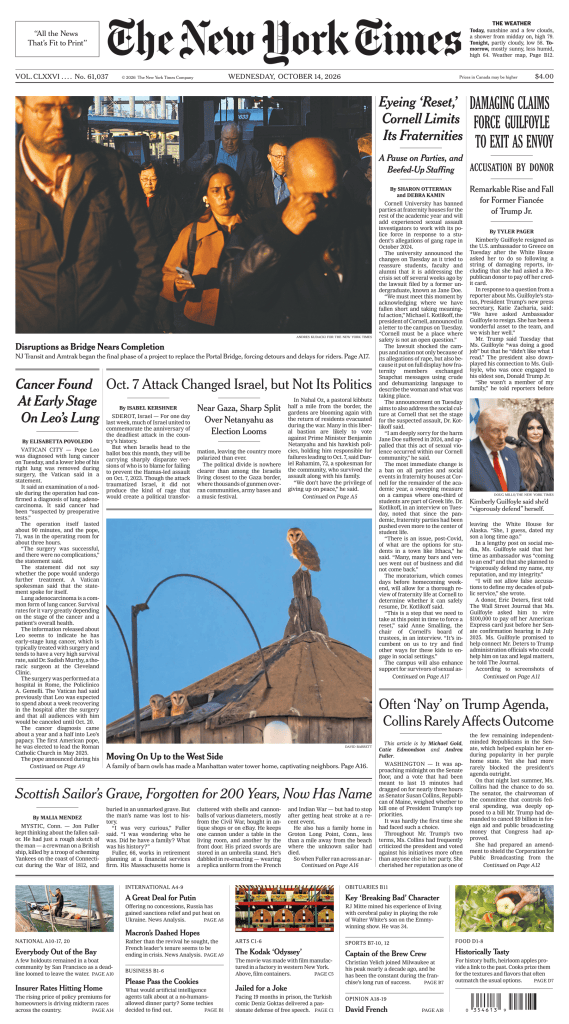
THE NEW YORK TIMES – SUNDAY, OCTOBER 18, 2026

France Reels After Largest Riots in Years

Centrist and leftist leaders blamed each other after anti-government protests devolved into chaos.

Egypt’s Defense Chiefs Pledge to Support Saudi Arabia After Houthi Attacks

President Abdel Fattah el-Sisi had called on Egyptian lawmakers to authorize military assistance to the kingdom, saying any support would be defensive.

Why the Future of the Amazon Could Depend on Brazil’s Election

Flávio Bolsonaro, the front runner in this month’s presidential runoff, is a strong advocate of environmental deregulation who has backed policies that scientists say could hurt the rainforest.

O.J. Simpson, a Secret Informant and a Decades-Old Mystery

An “extremely reliable” informant told authorities about the missing murder weapon, according to newly unsealed records. The informant’s brother told The Times his sibling was at the crime scene.

The Economic Trends That Could Determine the Midterm Outcome

Inflation is high, consumer spending is strong and seemingly everything depends on what happens with artificial intelligence.

4 Takeaways From a Voting-Focused ‘No Kings’ Day

THE NEW YORK TIMES – SATURDAY, OCTOBER 17, 2026

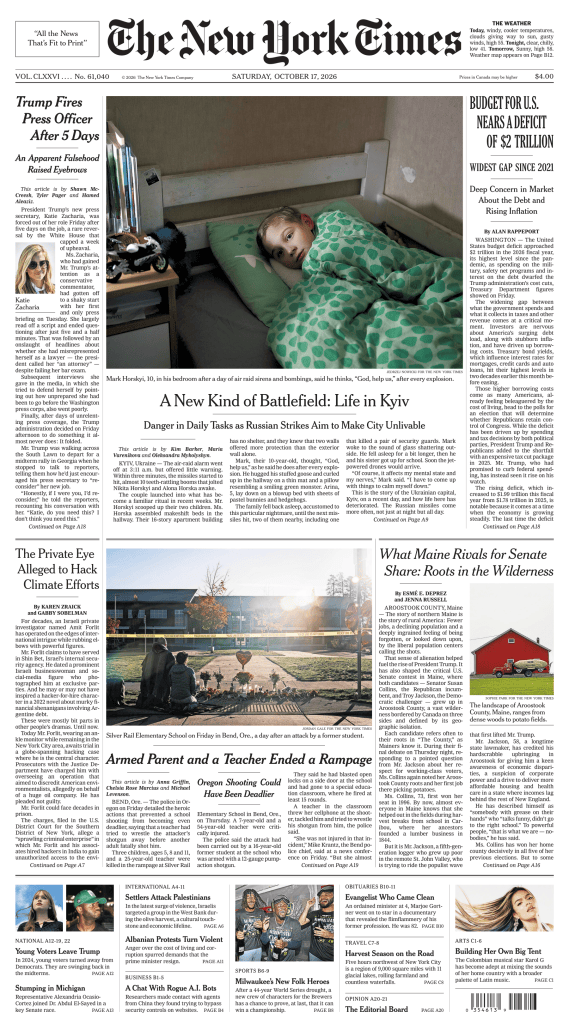
This Is the Kill Zone

The front line in Ukraine has blurred into a miles-wide wasteland where drones fill the sky and neither side holds firm control.

Trump Signs Order Exempting Russia From Sanctions Law

The move offers another economic lifeline to President Vladimir Putin as the U.S. turns to Russia for help in lowering gas prices.

Hegseth Singled Out in Democrats’ Campaign Attacks for War and High Prices

Cabinet members are seldom major figures in campaigns, but the defense secretary’s forays into politics and his bravado in defense of an unpopular war have made him a target.

2020 Election Conspiracies Shape Federal Preparations for Midterms

Voting rights advocates fear the Trump administration may use the federal government to cast doubt on the election, discourage participation or try to delegitimize results.

The 53-Year-Old in a Suit Who’s the Face of France’s Youth Protests

Bally Bagayoko, the mayor of a working-class suburb near Paris, has been a regular presence at student demonstrations, prompting both applause and condemnation.

THE NEW YORK TIMES – FRIDAY, OCTOBER 16, 2026

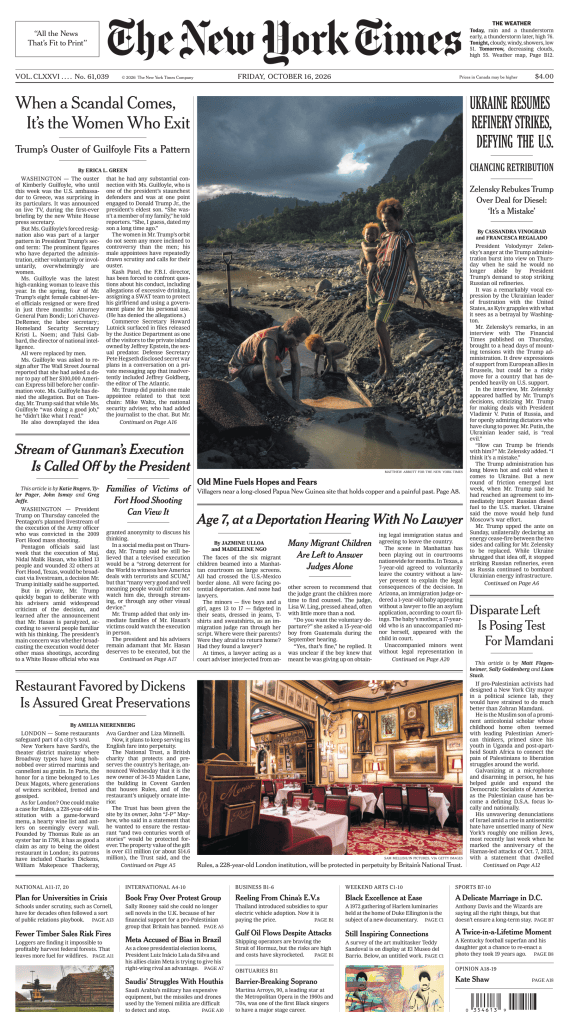
The Arab Kingmaker in Israel’s Election Who Wants a Partnership With Jews

Mansour Abbas, a dentist-turned-lawmaker, helped oust Benjamin Netanyahu once before. Now, he and a Jewish ex-police commander have teamed up to try to do it again.

What Life Is Like in Kyiv as Russia Tries to Make It Unlivable

A day in the Ukrainian capital, a new kind of battlefield far from the front, where daily life means assessing — and accepting — deadly risks.

Caracas Is Eerily Safe. State Death Squads Made Sure of It.

Crime plunged after police raids killed thousands. Venezuela is now withdrawing from the International Criminal Court as it investigates this blood-soaked campaign.

Avalanche of G.O.P. Cash Keeps the Party Competitive Despite Its Problems

Republican candidates are being out-raised by their Democratic rivals, but the party has received a huge boost from groups tied to Elon Musk and President Trump.

Police Investigate Deadly Shooting at Oregon Elementary School

A teenager shot his way into the school in Bend, Ore., killing three children, ages 5, 8 and 11, and a teacher. An armed bystander shot him dead, the police said.

El Niño Threatens Global Sugar Supply

A poor sugarcane crop in India, the world’s second-largest producer, is hurting consumers and farmers. It is also undermining the country’s energy security goals.

THE NEW YORK TIMES – THURSDAY, OCTOBER 15, 2026

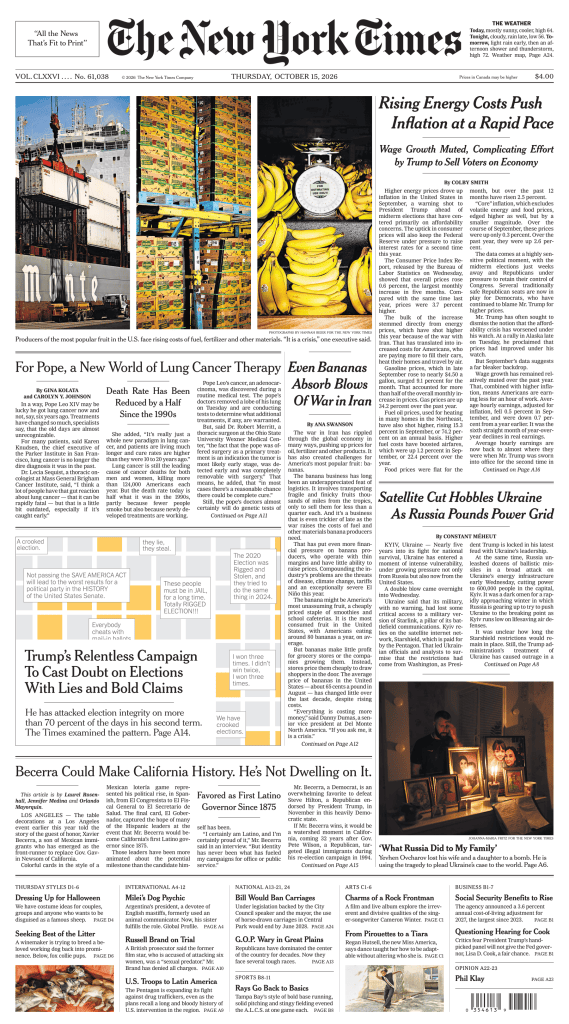
Zelensky Says Ukraine Will Resume Russian Refinery Strikes, Defying Trump

President Volodymyr Zelensky made the announcement in an interview with The Financial Times. He had paused the strikes to comply with a demand from the United States.

The Race to Defend Kyiv Against Terrifying New Jet-Powered Drones

Ukrainian engineers are rushing to perfect A.I.-guided, jet-driven interceptors. Their goal: to stop a fast Russian threat in the latest round of a deadly tech duel.

The Tireless Activist Who Became the Face of India’s Young Protesters

When police cracked down, Neha Bora helped rally Gen Z protesters with a mix of boundless energy, street theatrics and satirical humor.

High-Ranking Women Are Leaving the Trump Administration

In the president’s second term, those heading for the exits are female officials.

Saudi Arabia’s Military Wasn’t Equipped for the Houthis’ Low-Budget Attacks

The Saudi military has expensive equipment, but the missiles and drones used by the Yemeni militia are difficult to detect and stop.

Families of Sailors Killed in Gulf Struggle for Compensation and Closure

Attacks near the Strait of Hormuz have claimed the lives of at least 25 seafarers. Their survivors are reeling.

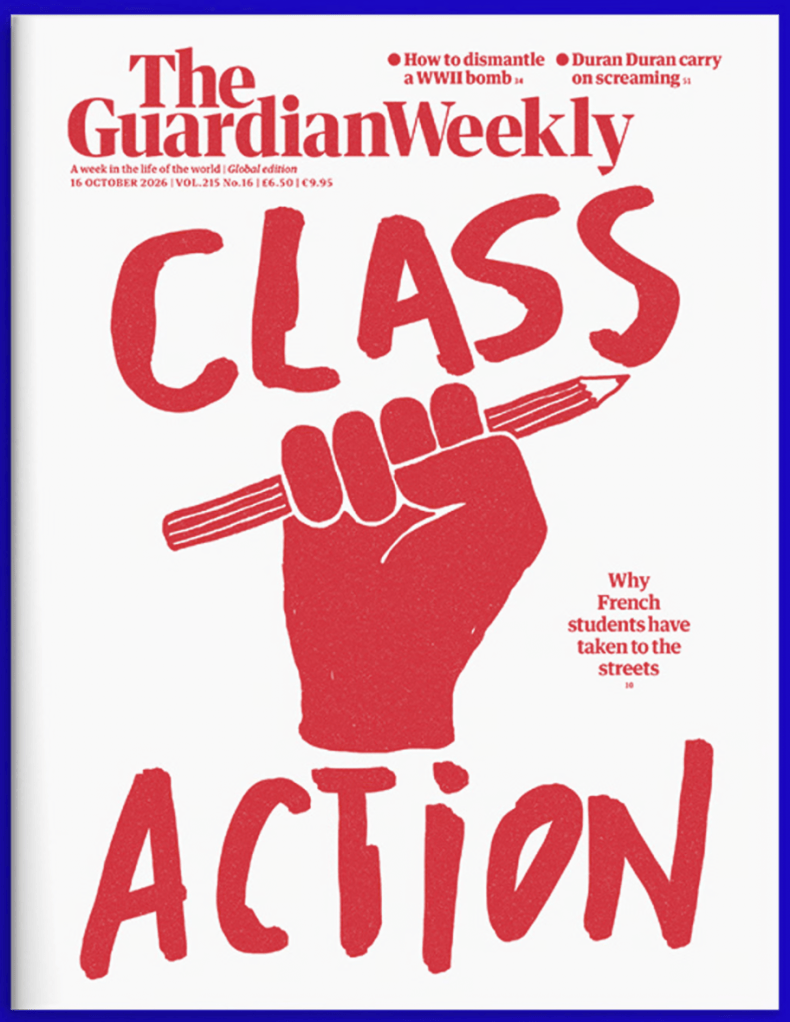
THE GUARDIAN WEEKLY – OCTOBER 16, 2026

THE GUARDIAN WEEKLY: The latest issue features ‘CLASS ACTION’ – Why French students have taken to the streets…


France has been rocked by huge youth protests in recent weeks over the state of high school education, bringing tens of thousands of people on to the streets.

The movement began with outrage over shoddy school conditions in a Paris banlieue, but has spread across the country as pupils voice their anger about a system they say is failing them.

For this week’s big story, Paris correspondent Angelique Chrisafis hears from protesters who feel abandoned by the French state. Angelique also looks at the evidence on students’ complaints of dilapidated buildings, teacher shortages, inequality and low investment.

Then, Alexander Hurst says fixing the broken education system should be just the start for an aloof political class if it is to finally pay attention to a generation who feel neglected.

Spotlight | The future of the death penalty
Donald Trump has used the full might of the presidency to supercharge executions but, writes Ed Pilkington, an avalanche of mishaps has put the system’s flaws in the spotlight

Science | Sweet time
A flurry of recent studies suggests that spending the first 1,000 days of life under sugar rationing may have left traces on people’s health more than seven decades later. Linda Geddes reports

Feature | The art of dismantling a second world war bomb
British bomb disposal squads are being called to more unexploded devices than ever – and they risk their lives each time. Samira Shackle recounts the challenge they faced when two bombs were discovered on the same day

Opinion | A new era of instability
The latest attack by Houthi rebels on Saudi Arabia may prove to be more calamitous for the region than the world imagines, says Nesrine Malik

Culture | Hungry like the werewolf
Duran Duran talk to Alexis Petridis about 80s excess, tabloid scrutiny and their Halloween glow-up

THE NEW WORLD MAGAZINE – OCTOBER 15, 2026

THE NEW WORLD MAGAZINE: The latest issue features ‘Snuff Politics’ – The very public execution of American values…

Trump’s snuff politics is a new low in American cruelty

The president is using barbaric spectacle as a political weapon – and the damage will go on long after he has gone

Let us call it what it is: snuff politics. In an interview with far right conspiracy theorist Jack Posobiec posted by streaming channel Real America’s Voice last Thursday, US defense secretary Pete Hegseth announced the first state-sanctioned public execution in America for 90 years.

Alastair Campbell’s diary: My truly deranged encounter with Trump apologist Kellyanne Conway

The godmother of ‘alternative facts’ assured me the president loved Zelensky – just as he was stabbing him in the back with Putin

I met Kellyanne Conway for the first time last week, when she and I were on a panel together, looking ahead to next month’s US midterm elections. She, you may recall, was the Trump senior aide who, on Term 1 Day 1, as the newly elected US president was falsely claiming more people attended his inauguration than Barack Obama’s, let us know we would have to get used to “alternative facts,” whatever truth photographic or any other evidence might reveal.

Burnham is already winning the new Brexit wars

The shrieks of fury from Johnson, Badenoch, Farage and co speak volumes as the prime minister confronts the disaster they wrought

It’s an old truism in sport and in politics that the best defence is a good attack. That’s certainly something the UK’s leading Brexiteers seem to have taken to heart over the last decade – not least in their relentless fury at anyone who disagrees with their own personal vision for Brexit, or even anyone who just points out that none of them seem to agree on what, exactly, that looks like.

THE NEW YORK TIMES – WEDNESDAY, OCT. 14, 2026

Saudi Energy Giant Struck as War Spikes Between Houthis and Saudi Arabia

The attack came after the Yemeni militia warned it would attack the headquarters of Aramco. The Saudi-led coalition said it was targeting Houthi capabilities.

Trump Hands Victories to Putin, Who Offers More War in Return

Russia has reaped a diesel deal and an increase in U.S. pressure on Ukraine as President Trump’s political needs align with his longstanding inclinations toward Russia.

A Trump Backlash Threatens Susan Collins, the Only Blue-State G.O.P. Senator

The race in Maine, which could decide Senate control, is testing whether there is still room for Ms. Collins’s brand of moderation during a polarizing presidency.

Sudden Starlink Restrictions Hamper Ukraine Just as Russia Escalates

Kyiv is increasingly vulnerable. A huge attack cut power to 600,000 people, and a Pentagon-funded satellite program appeared to be curbed without warning.

Zelensky to Visit U.K. Today as Ukraine Presses Allies on Intelligence Sharing

THE ATLANTIC MAGAZINE – NOVEMBER 2026 PREVIEW

cover of the November 2026 Atlantic

THE ATLANTIC MAGAZINE: The latest issue features “BATTLE OF THE GALACTIC OVERLORDS’….

Choose Your Overlord

Musk vs. Bezos

By Josh Tyrangiel

The Adriatic has been crossed by Odysseus and Caesar, by Venetian fleets and Napoleon’s navy, by countless men bent on dominating the world. It has seen its share of courage and folly. But one day in June 2025, off the island of Cres, it witnessed something genuinely new: a man worth $240 billion standing waist-deep in bubbles on the deck of a $500 million yacht, wearing a white bucket hat.

The Great Data-Center Rebellion

Could a new populist movement help save American democracy?

By George Packer

Clinton, Iowa, is topographically flat and economically declining. The sawmills that made the city rich in the late 19th century have been repurposed as a museum. One of the Victorian mansions long since abandoned by the old lumber barons is open for tours, but tourists are scarce. Clinton has shrunk to about 24,000 people, and the town center, along the Mississippi River, feels nearly empty. On the west side, miles of deep-green corn and soy fields are crisscrossed with transmission wires and zoned for heavy industrial use. The city’s economic activity includes corn processing, pet-food production, and methamphetamines. With available land and a dire need for investment, Clinton seems like the perfect place for a gigantic data center.

The Baltic States Prepare for War

Lithuania, Latvia, and Estonia are readying themselves to fend off a Russian attack—with the help of the United States, or without it.

By Isaac Stanley-Becker

ne evening this summer, in the village of Bezdonys, in eastern Lithuania, I watched as a platoon of riflemen arrived at a train station occupied by enemy forces. Some of the Lithuanians let out a burst of gunfire from across the tracks, pinning the adversary in place as the rest of the unit advanced on the station. As the firefight intensified, wounded riflemen were evacuated to makeshift medical tents. An enemy soldier lay slumped against the station’s yellow clapboard siding.