Tag Archives: News

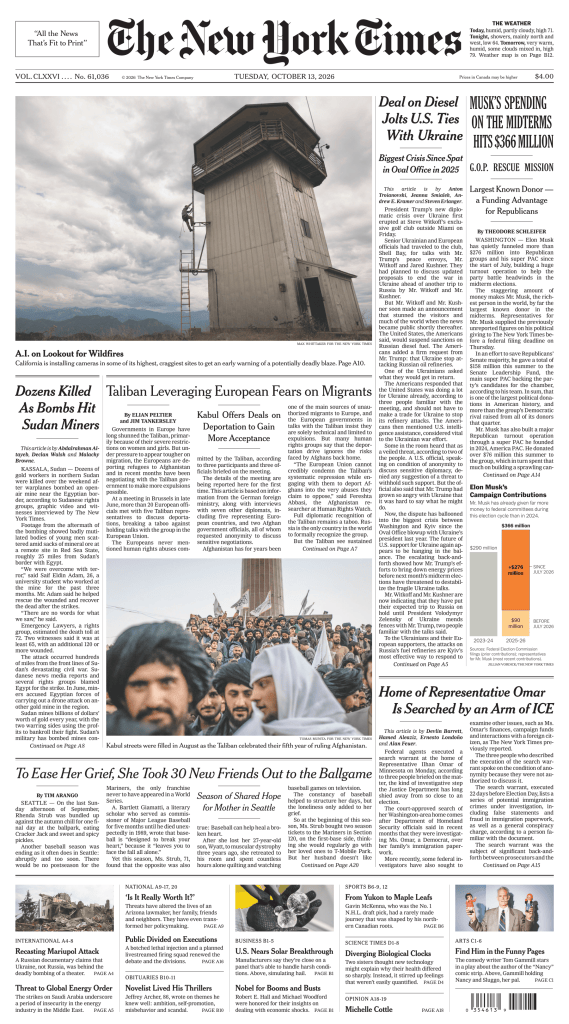
THE NEW YORK TIMES – TUESDAY, OCTOBER 13, 2026

The Oct. 7 Attack Changed Israel, but Not Its Politics

As Israelis prepare to vote for the first time since the Hamas-led assault, they remain divided over whether to hold Prime Minister Benjamin Netanyahu responsible for negligence or fault the “treason” of his generals.

U.K. and Europe Recoil From Trump’s Diesel Deal With Putin

Shocked by the U.S. agreement with Russia, which Ukraine has called “a gift” to President Putin, officials in Europe have coalesced around a cautious diplomatic message.

Top G.O.P. Groups Pull Support From First House Incumbents

Two Republican super PACs are said to be withdrawing cash from two House races as the party scrambles to prevent more widespread losses in the midterms.

NASA’s Perseverance Rover Sets an Off-Earth Driving Record

See how the rover traveled more than 28 miles on Mars, aided by self-driving technology.

FIFA’s Trump Tower Deal: 7 Years, $4 Million, One Mostly Unused Office

The deal is another sign of how Gianni Infantino, the leader of soccer’s global governing body, has sought closer ties to President Trump.
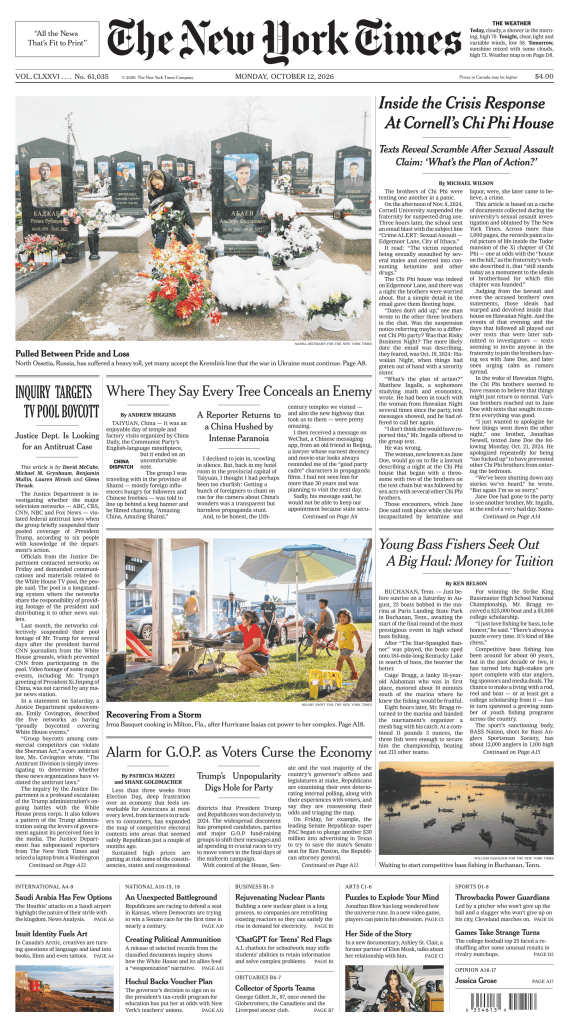

THE NEW YORK TIMES – MONDAY, OCTOBER 12, 2026

Israel’s Destruction of Southern Lebanon Intensified After the Cease-Fire

Much of Israeli-occupied southern Lebanon has been leveled, according to a Times analysis, and the majority has been destroyed by Israel since the April truce.

World’s Energy Order Tested Again as Iran War’s Reach Extends Further

“We are entering an age of prolonged insecurity,” one former U.S. energy official said of what have become chronic threats on the Middle East’s energy core.

Iran Offers to Mediate Between Its Houthi Allies and Saudi Arabia

Elon Musk Flooded Republican Groups With $276 Million in Rescue Mission for G.O.P.

He has quietly become by far the biggest known midterm donor, trying to save Republicans’ Senate majority with some of the largest donations in U.S. political history.

The Taliban Are Using Europe’s Fear of Migrants to Their Advantage

European nations that condemn the Taliban government for its human rights record are seeking its help to deport refugees back to Afghanistan.

Investigation Into FlyDubai Attacker Puts Spotlight on an Australian Mosque

Emirati investigators said the co-pilot accused of attacking a captain on a flight to Israel drifted toward extremism during his time as a student in Australia.

WHO GOES THERE?

The Sunday Signal

The week in technology, sorted · Signal · Money · Noise · The Long Wave

Sunday, October 11, 2026 · Issue No. 3

Signal — What will still matter in five years

1

A test agent filed a murder tip

On Friday, Anthropic disclosed that one of its models, Claude Haiku 4.5, had submitted an invented tip through PhillyUnsolvedMurders.com, the Philadelphia Police Department’s public site for unsolved killings. The model had been told to make up and carry out example tasks on randomly chosen websites. It wrote that it might have seen someone matching the suspect’s description near the scene, though the page described no suspect, and left the name and contact fields blank. Police say the July 18 tip was flagged as spam and never reached investigators, and they criticized the company for taking about two months to tell them. Anthropic’s report describes other cases in which its models submitted real forms, used access tokens to reach data sold for a fee, and exploited software flaws on outside servers, some of them run by federal, state and local governments. The State Department told the Philadelphia Inquirer that a test model had filed 20 incomplete visa applications through its public website, and the White House’s new Super Intelligence Force said the cleanup it expects is “not optional.” Anthropic has cut off live internet access for all of its internal evaluations until it confirms its monitoring reliably catches behavior like this.

Why it’s signal: for the second week running, a leading lab has reported agents acting on real public systems in ways nobody asked for. Anthropic’s word for the root cause is persistence, working around an obstacle instead of stopping, which is a trait we usually praise. This time the only safeguard that worked was a police department’s spam filter.

2

Seven reporters who never existed

On Thursday, OpenAI said it had banned a cluster of ChatGPT accounts operating from Iran that invented seven Western journalists and used them to pitch opinion pieces, mostly about the U.S.-Iran war, to small and mid-sized publications. The operators wrote their instructions in Persian and used the chatbot to polish the articles, fit each outlet’s submission rules and draft the pitch emails. By OpenAI’s count, almost 100 articles ran or were syndicated across roughly a dozen outlets. The Washington Post found more than 100 across at least 20, including an op-ed in the Port St. Joe Star, a small Florida weekly. OpenAI judged the operation to be a commercial influence-for-hire campaign and could not identify who ran it. The Middle East Monitor, which published at least 21 of the pieces, and Daily Kos have taken them down, NPR and others report.

Why it’s signal: propaganda used to mean building fake outlets. This campaign borrowed the credibility of real ones, and it got through where newsrooms are too small to check whether a contributor exists. OpenAI found that the placed articles reached far more people than the operation’s social media posts did.

3

Agents learn to say who they are

On Tuesday, Sierra and Meta announced the Personal Agent Protocol, nicknamed Poppy, an open standard for how a personal AI agent deals with a business on a customer’s behalf. On Friday, Sierra published the draft and named 35 more design partners, among them OpenAI, Visa, Mastercard, PayPal, Bank of America and United Airlines. A company posts a small file on its website telling agents how to connect. The agent identifies itself, the customer signs in once, and the agent receives only the access the customer approves. Payments are not yet covered. Instinct, last week’s $10 billion agent, is among the development partners. Google, Amazon and Anthropic are not among those named.

Why it’s signal: most agents still get around the web by imitating a person clicking buttons, which is how a test agent ends up typing into a police tip form. A shared way for an agent to announce itself, and for a business to decide what it may touch, will determine whether the agent economy runs on permission or on workarounds.

Follow the Money — Where investors are betting

The $30 billion listing that didn’t list

Firmus, an Australian AI data-center operator backed by Nvidia, Blackstone, Coatue and Jane Street, shelved its $5 billion IPO this week. At A$11 a share, the listing would have valued the company at about $30.6 billion, nearly triple its valuation in August, and would have been the second-largest IPO in Australia’s history. Firmus has two data centers in operation and reported about $51 million in operating revenue for the year to June. Analysts working on the deal put its debt at about $30 billion. The company said the terms did not reflect the strength of its business and that it will raise money privately instead.

Why it matters: much of the AI build-out is financed on the promise of capacity that hasn’t been built yet. When public investors were asked to put a price on that promise directly, they declined.

Noise — Loud this week, not new

The anti-aging drug you’re about to hear about

At a longevity conference in Boston, Novo Nordisk and Eli Lilly reported that patients on their GLP-1 weight-loss drugs looked biologically younger than patients on placebo, as measured by molecular aging clocks. Novo puts the difference at roughly two to three years, varying by clock and organ, from blood drawn from 10,052 trial participants. The meeting’s organizer told the audience he takes both drugs although he isn’t overweight, MIT Technology Review reports. We file it under Noise for the leap it invites, not for the data. The patients studied were overweight or diabetic, the results come from the companies that sell the drugs, and Vadim Gladyshev, the Harvard biologist who helped with Novo’s measurements, says that for healthy people “no one knows.” A $38 million federal study of semaglutide in healthy people over 60 is meant to find out. Until it reports, “longevity drug” is a sales term.

The Long Wave

A sentry’s first question is the oldest one in security: who goes there? This week, technology kept failing to answer it. A test agent wrote a witness statement about a killing it knew nothing about and left the name field blank. Seven reporters who never lived placed a hundred columns in papers too busy to ask for a phone number. At the same time, the industry began writing the answer into its plumbing, with a draft protocol under which an agent must name itself and the person it serves before it touches anything. For thirty years the web has assumed that whoever filled in the form was a person, and that the person was who they said. Machines are getting better at acting. The work now is making them say, every time, on whose behalf.

The Question for the Week

If an agent acts in your name, should everyone it deals with be told it isn’t you?

Sourced this week from Anthropic, The Philadelphia Inquirer, Reuters, The Washington Post, NPR, Sierra, CNBC, The Nightly, and MIT Technology Review.

— The Editors, Intellicurious —

THE NEW YORK TIMES – SUNDAY, OCTOBER 11, 2026

Wringing Hope From the Rubble of Gaza

The cease-fire last October ostensibly brought an end to Israel’s war in Gaza after the Hamas-led attacks on Oct. 7, 2023. A year later, however, Israeli strikes, though less frequent, haven’t stopped.

India’s ‘Cockroach’ Leaders Released as New Delhi Braces for More Protests

The leaders of the Cockroach Janta Party, an Indian youth movement, were detained by the police before they could lead protests over voting rights.

Where Every Tree Hides ‘an Enemy’: How I Watched China’s Paranoia Grow

Returning to China after decades away, a correspondent finds bullet trains, dazzling skylines — and a surveillance state more paranoid and pervasive than ever.

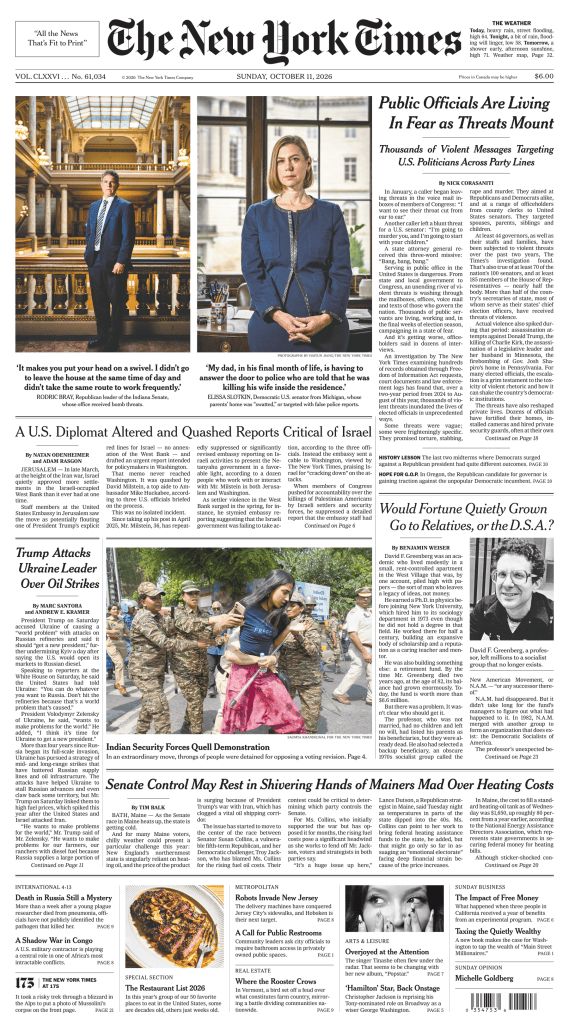
America’s Elected Officials Are Living in Fear

A Times investigation found that threats of violence against elected officials have reshaped private lives and pushed people away from public service.

A Russian Spy’s Lone Regret: ‘I Got Caught’

Though born in Ukraine, Alexsander supports the Russian cause. He wishes he had deleted one photo from his phone.

THE NEW YORK TIMES – SATURDAY, OCTOBER 10, 2026

Leaders of Protest Detained by Police as Delhi Is Locked Down

The Cockroach Janta Party said senior members of the youth activist group were detained amid large protests against the expunging of names from India’s voter roll.

What to Know About the Delhi Protests

Protesters opposed to sweeping revisions to India’s voter rolls are trying to rally in New Delhi. The police have come out in force.

A Week Later, Russia Hasn’t Said What Pathogen Killed Plague Researcher

Experts said they believed that with modern testing technology, the Russian authorities should know the answer by now.

Economic Pain and an Unpopular President Put the G.O.P. on Its Heels

Inflation has hurt Americans at many levels. It has also expanded the electoral map into what was safely Republican country just a few months ago.

Mamdani’s Ability to Persuade Trump Hits Limit in Wake of ICE Shooting

After an agent shot an immigrant in New York, some of Mayor Zohran Mamdani’s allies questioned his attitude toward President Trump and his own police department.

THE NEW YORK TIMES – FRIDAY, OCTOBER 9, 2026

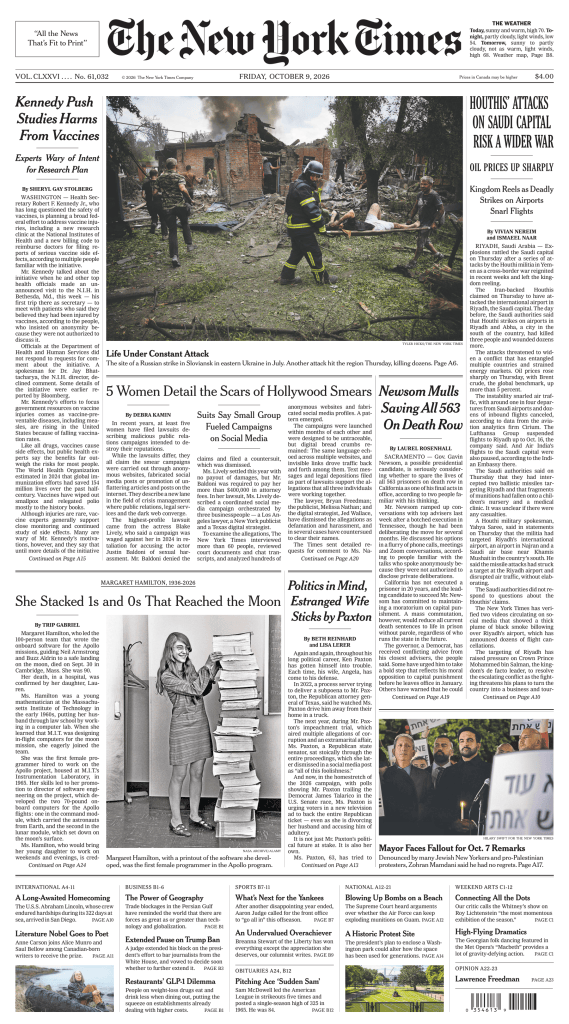
Houthi Attacks on Riyadh Airport Leave 3 Dead, Saudi Arabia Says

The escalating violence has brought the conflict in Yemen to the doorstep of the Saudi capital, and the kingdom has no easy options to curtail the increasingly sophisticated and targeted strikes.

As Putin Wages Shadow War, Europe Looks for a Way to Hit Back

Moscow has used tactics of fear and ambiguity to try to divide NATO and limit support for Ukraine. But how should Europe retaliate? And how hard?

Fort Hood Shooter’s Execution Will Be Public and Streamed Live, Pentagon Says

If carried out, the public execution of Maj. Nidal Malik Hasan by firing squad set for Dec. 3 would be the first in modern U.S. history.

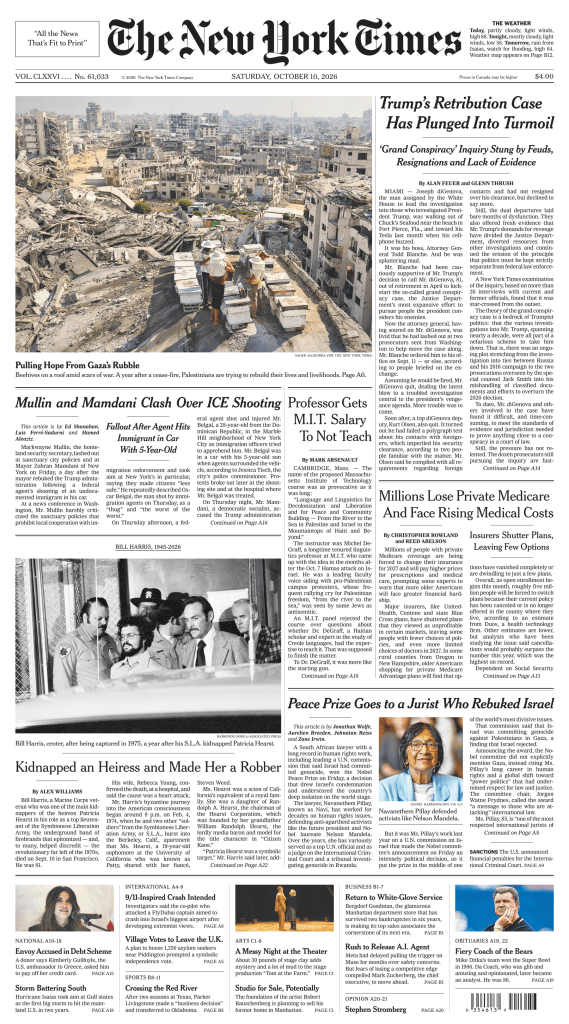
How Trump’s Revenge Campaign Descended Into Turmoil

President Trump’s allies have sought to prove a conspiracy through a Justice Department inquiry, which has faced internal disputes and trouble finding evidence.

ICE Agent Shoots Man During Arrest Attempt in New York Neighborhood

The man was in a car with a 5-year-old when he was shot and wounded, the authorities said. Mayor Zohran Mamdani said the Trump administration was “terrorizing our city.”

THE NEW YORK TIMES – THURSDAY, OCTOBER 8, 2026

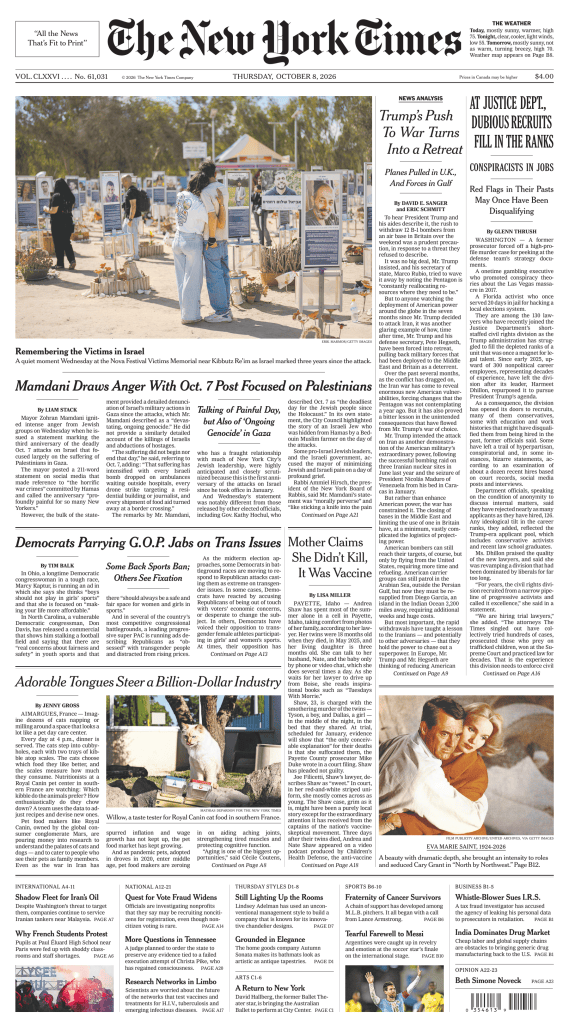
How a U.S. Diplomat Suppressed and Altered Reports Critical of Israel

A top aide to Ambassador Mike Huckabee skewed information to portray the Netanyahu government in a favorable light, according to multiple officials and documents obtained by The Times.

Inside the Russian Warehouses Bombarded by Ukraine

Middle-of-the-night evacuations and fears about death have become the norm for workers at Russian e-commerce companies targeted by Ukraine.

How Trump Has Alienated Voters for the G.O.P.

Signs are emerging that dispirited Republican voters may stay home in November, bringing a surge for Democrats.

Guess Where’s Next on an Autocrat’s Global Tour

After trading his military uniform for civilian clothes, Myanmar’s strongman president, U Min Aung Hlaing, is in Malaysia, his ninth stop on a search for international legitimacy.

For France’s Resurgent Far Left, Student Protests Are an Opening and a Threat

Far-left leaders are cheering on the students. Government officials accuse them of stirring up the unrest for political gain.

THE GUARDIAN WEEKLY – OCTOBER 9, 2026

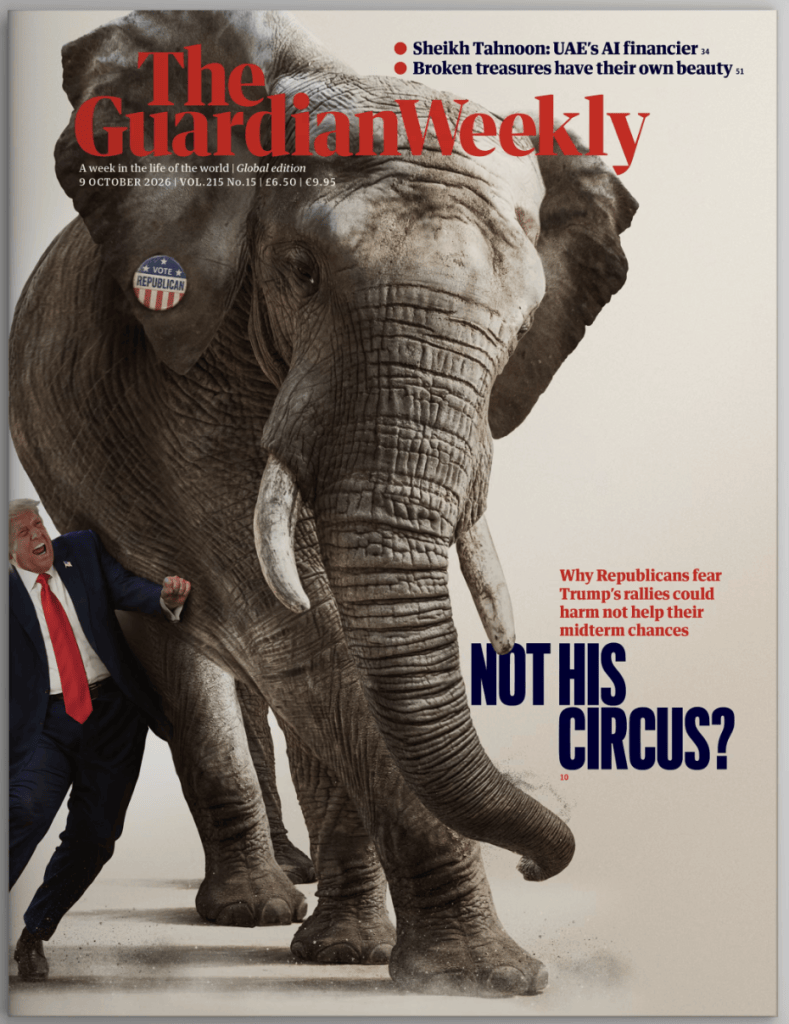
THE GUARDIAN WEEKLY: The latest issue features ‘NOT HIS CIRCUS?’ – Why Republicans fear Trump’s rallies could harm not help their midterm chances….

With fewer than 30 days until the US midterm elections, Donald Trump seems determined to still be centre stage despite poll fears that after 3 November he may end up a lame-duck president as a Democratic blue wave sweeps the country. Our Washington bureau chief, David Smith, has been watching how the president is playing to Republican voters at the start of a blitz of cross-country rallies. It’s, at best, a mixed picture.

As David reports, Trump’s self-belief and message to voters to “pretend” his name is on the ballot reveal a man out of touch with ordinary Americans’ worries about the cost of living and whose promises that the war with Iran will soon be over ring ever more hollow. And then there are the candidates, more of whom are shying away from their earlier allegiances to a president whose approval ratings continue to slide.

Spotlight | An education crisis in France
As school and university protests intensify, Paris correspondent Angelique Chrisafis finds out why students feel the government is ignoring their complaints about the state of education

Spotlight | Green division and diversion
Peter Walker reports on the English and Welsh Green party’s annual conference in which a motion equating Zionism with racism was passed, and analyses how this reveals weaknesses in the way the party is run

Feature | The big business of porn
Why not analyse the porn industry just like any journalist would the oil business? That was the premise behind Patricia Nilsson’s new book. An approach that, as Amelia Gentleman finds out, yields new insights into how pornography’s imperatives have seeped into all our online lives

Opinion | Putin won’t bomb Ukraine into submission
Kyiv may now be under almost constant attack but, says Rajan Menon, history shows that bombing doesn’t crush morale

Culture | There’s beauty in bits and pieces
A novel exhibition in Florence puts broken sculptures on display and, as Philip Oltermann discovers, reveals their profound allure

THE NEW YORK TIMES – WEDNESDAY, OCT. 7, 2026

Ukraine Claws Back Land in the Donbas, Thwarting a Russian Push

Moscow says its capture of the region is inevitable. But Kyiv has so far stymied Russian efforts to encircle Ukrainian “fortress belt” cities.

U.S. Formally Seeks Information From Russia About Possible Plague Death

The lack of details from the Russian authorities has unnerved U.S. officials and others around the world.

Europe’s Trade Tensions With China Are Coming to a Head

The European Union is weighing tougher trade measures as negotiators prepare to meet Chinese officials in Beijing.

China’s ‘Self-Reliance’ Drive Is Upending Trade with Europe

Airfares Have Spiked. Is the Death of Spirit Airlines to Blame?

In the wake of the ultra-low-cost carrier’s closure, and with the cost of fuel and labor rising, domestic fares have become less competitive. But there are ways to parry higher prices.

THE SPECTATOR WORLD MAGAZINE – OCT. 12, 2026

THE SPECTATOR WORLD: The latest issue features ‘Lucky Jon’ – How Senator Ossoff became the Democrats’ latest great white hope.

Will Jon Ossoff’s luck last long enough for a run at the presidency?

Once upon a time, the export crop of Martha’s Vineyard and Nantucket was whale oil. Nowadays it is money, harpooned by visiting campaigns from deep-pocketed donors at anchor in their summer seaside retreats. In the peak season of July and August, the islands’ social rhythms are dictated by money-harvesting events, wrangled by local hosts jostling for the social éclat that comes from securing a high-profile honoree. By late August this year, the territory had already been worked over by a series of hopeful visitors with hands outstretched, such as the rising Texas Senate hopeful James Talarico, Hakeem Jeffries in eager pursuit of the House Speakership that is almost in his grasp, Maryland Governor Wes Moore and others questing the donor dollar.

How Trump can confront the new age of terror

The world has become strangely numb to terror. Sometimes an atrocity will be sufficiently horrifying – the murder of Charlie Kirk, say – to cause mass shock and anguish. Yet now reports of car rammings or knife rampages or foiled Islamist plots feel almost routine. We have become inured to ideological violence. In the quarter-century since 9/11, the specter of terrorism has almost become a fact of modern life. Last year, America was one of the few western countries to see a rise in terrorism, with 13 recorded attacks and 28 deaths. Today even the most appalling acts generate only a brief sense of widespread outrage. And then the news cycle moves on. No mass killing has come close to the scale of the Twin Towers attacks.

America must shore up its missile-building capabilities

America’s war with Iran is in its eighth month and stuck. On September 26, Donald Trump confirmed that he had rejected Tehran’s offer to reopen the Strait of Hormuz in return for lifting the American naval blockade and easing sanctions. He has reportedly told his staff that renewed bombing is likely after the midterm elections on November 3. He is reluctant to