No party is expected to achieve a clear victory, which means the election will likely only be the first step in determining who will form the next government. Here’s how that might unfold.
Luiz Inácio Lula da Silva, the leftist incumbent, and Flávio Bolsonaro, the right-wing challenger, face off in a narrow race that could redefine the future of Latin America.
The U.S. government has ordered diplomats and other federal employees to leave Saudi Arabia. It is also drawing down staff at other missions in the region.
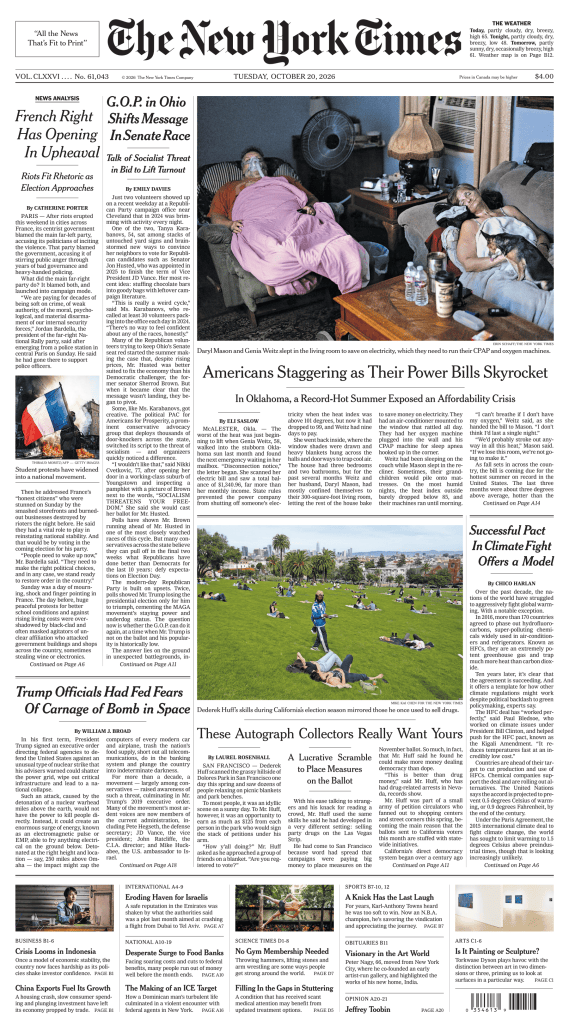
About 70,000 police and security officers, mobilized ahead of mass protests, will try to avert the arson and looting that shocked the country last weekend.
The military demolished buildings and erected roadblocks in Hebron, the biggest city in the territory, a day after Palestinian gunmen killed two soldiers.
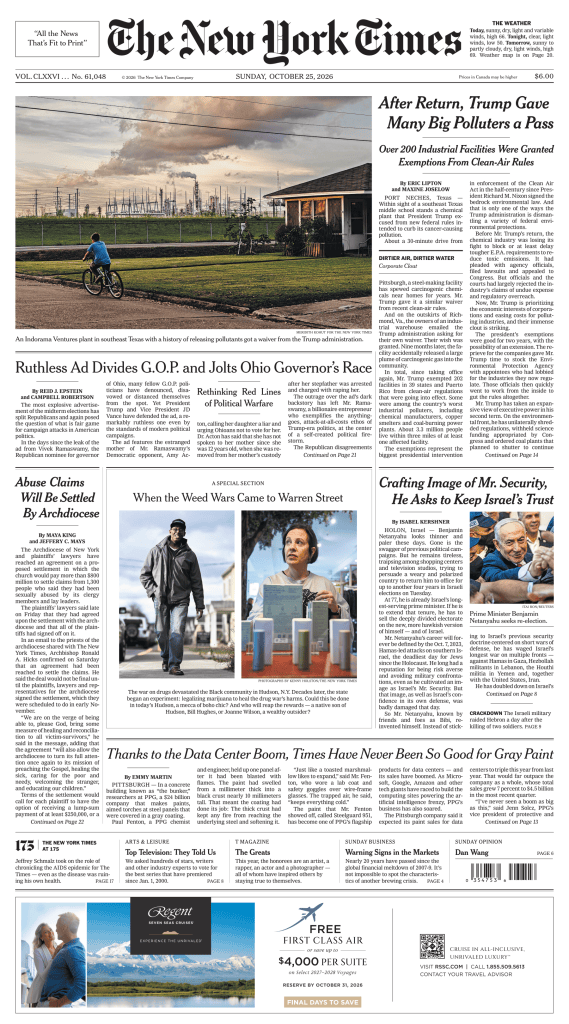
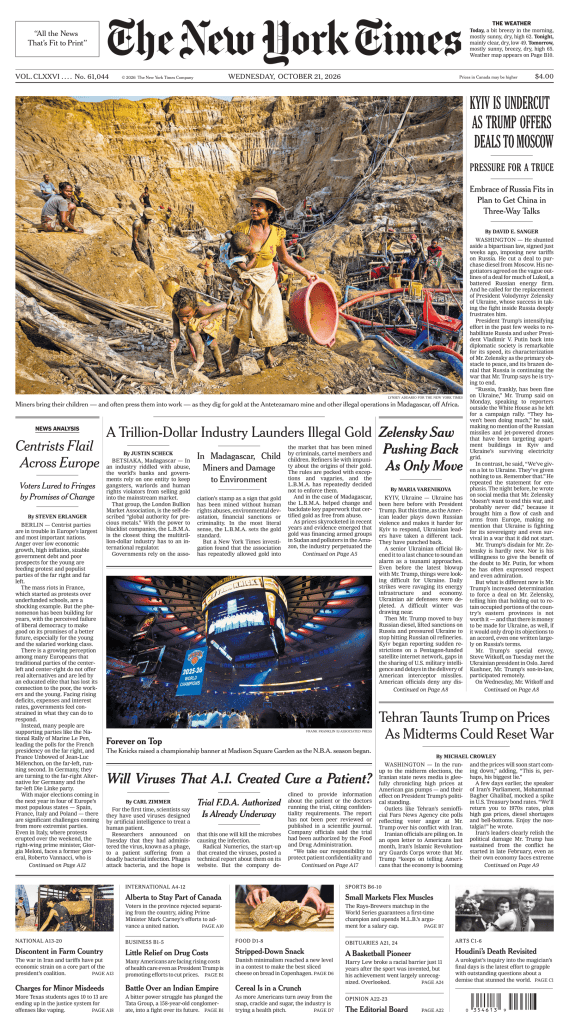
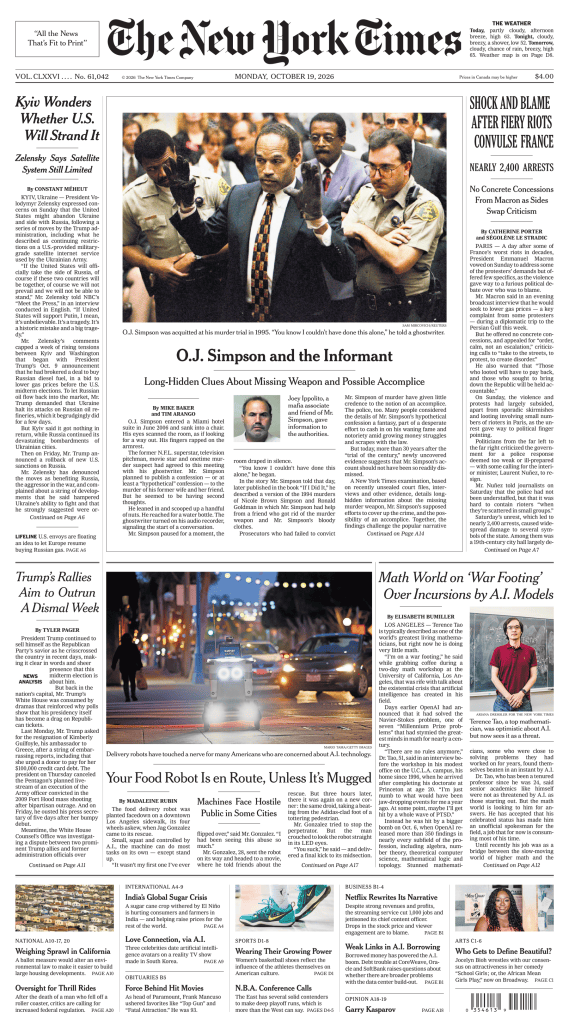
The United States once declared that Ukraine’s fight was the front line in a global battle for freedom. Now the Trump administration is sending money to Moscow.
Five people were wounded in the attack, days before national elections, health workers said. The Israeli military said its soldiers had killed two assailants.
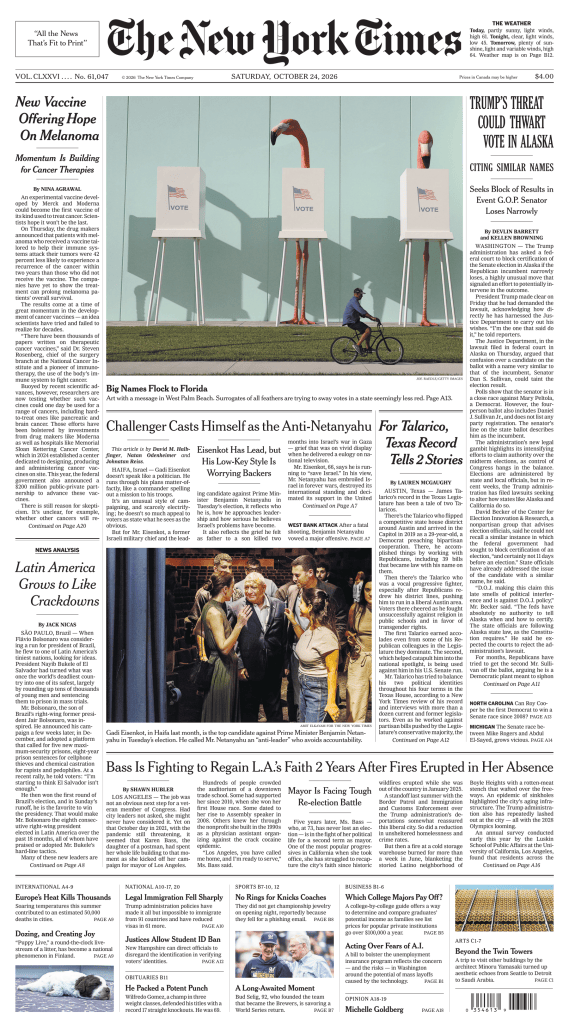
Mr. Eisenkot, an ex-military chief, is leading in the polls against Prime Minister Benjamin Netanyahu. But his campaigning style is worrying supporters.
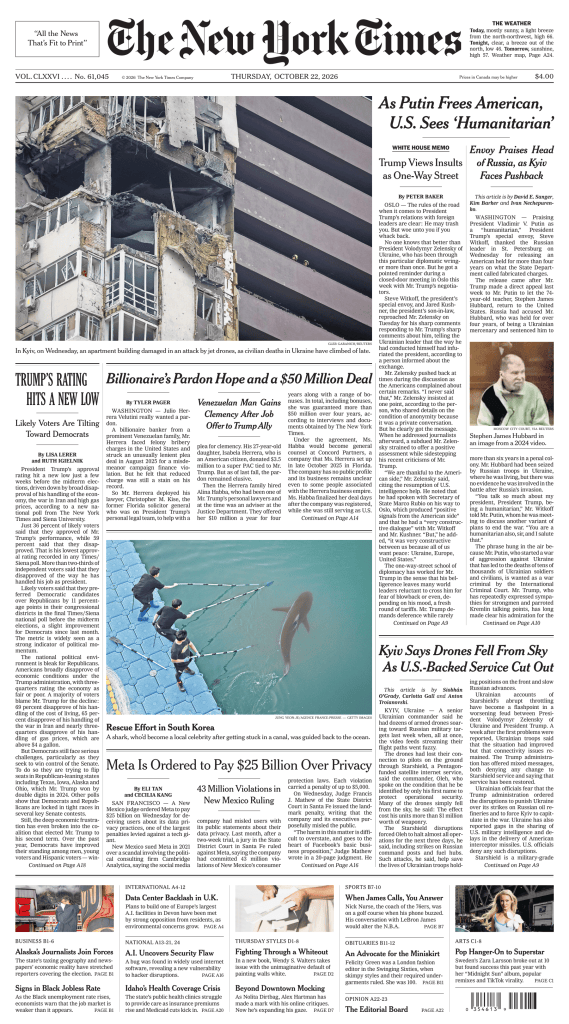
President Trump called Elon Musk, who owns the Starshield network, after officials in Ukraine reported that they found new limits on the use of military drones
The tax initiative is the most ambitious proposal that Dave Regan has ever qualified for the California ballot. Some Democrats hope it will be his final one.
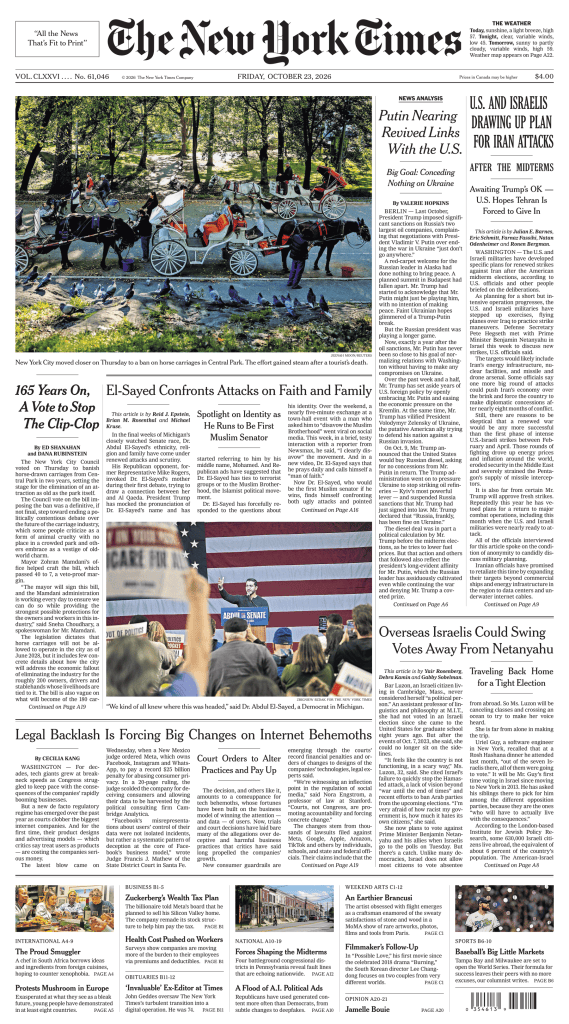
Renewed hostilities might not be any more successful than the war’s first phase, and President Trump has repeatedly canceled plans for a return to major combat.
Russia has sought to separate the war in Ukraine from potential business deals and diplomacy with the United States. Its efforts now appear to be working.
Since high school students began protesting in France in September, they’ve been joined by young demonstrators in at least seven other European countries.
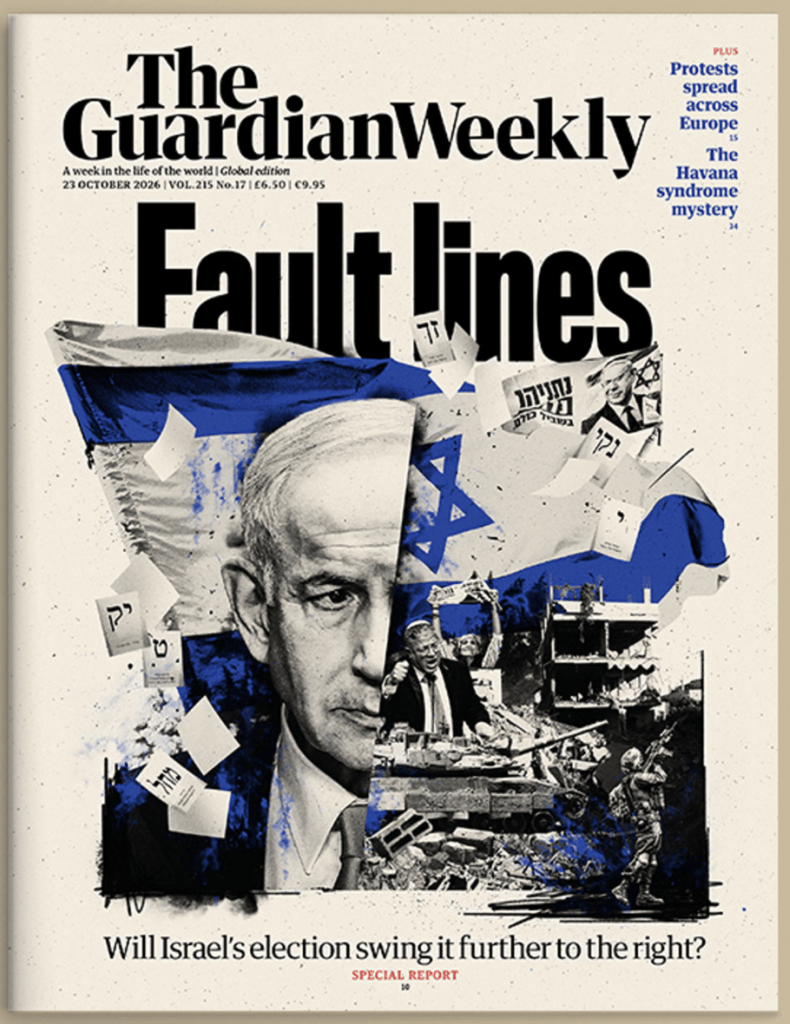
Israel is holding national elections next week, giving its citizens their first chance to pass judgment on Benjamin Netanyahu and his coalition since the Hamas-led attacks of 7 October 2023.
For our big story this week, chief Middle East correspondent Emma Graham-Harrison says that whether or not the prime minister can hold on to power, a more rightwing Knesset is expected to be voted in. More than half a million Israelis have reached voting age since the last election in 2022 and, according to polls, three-quarters of first-time Jewish voters define themselves as right or centre-right.
Peter Beaumont profiles opposition candidate Gadi Eisenkot. The former general contrasts with Netanyahu when it comes to style and character, he writes, yet on key policy points retains a studied ambiguity.
Then Israeli pollster and political analyst Dahlia Scheindlin argues that after three disastrous years, Israel needs to rethink itself, but only a clear opposition victory would let the country begin to heal, strengthen democracy and establish Palestinian rights.
Spotlight| ‘We are suffocating’ As protests that have convulsed Spain and France in recent weeks spill over to Italy and Portugal, Sam Jones reports on the rising wave of anger over the housing crisis and cost of living
Science| Taking a shot Could a drug to prevent shingles also protect our brains against dementia? The possibility, writes Ian Sample, is driving a boom in vaccinations
Feature| The Havana syndrome mystery Dozens of CIA officers have been afflicted by debilitating symptoms over the past decade. Are they the result of “mass hysteria” or are they from attacks with an energy weapon, asks Shaun Walker
Opinion| Another EU referendum? Not just yet The omertà on the UK rejoining has now been broken, but it would be folly to move too soon, says Polly Toynbee
Culture| Shygirl’s slog to the top She has opened for Beyoncé, writhed in a cubicle for Madonna – and is poised to take over the mainstream with her new rock sound. The pop auteur talks to Simran Hans about cash, class – and finding true love
Likely voters favored Democratic candidates over Republicans by 11 percentage points in their congressional district, a New York Times/Siena poll found.
Many in Gaza and the West Bank are desperate to avoid more years of Prime Minister Benjamin Netanyahu’s right-wing government, which has made life close to unbearable.
The move to release a man held for over four years on what the U.S. called fabricated charges buys good will with President Trump while costing Vladimir Putin little.
A prominent Venezuelan was seeking clemency. He got it not long after his daughter gave Alina Habba, a lawyer close to President Trump, a lucrative job.
Much remains unclear about why a driver ran a car into Helen Haines, a lawmaker. Even so, fellow representatives, especially women, spoke of feeling threatened in a polarized atmosphere.
Brazil spent years targeting electoral lies on the internet. Now, artificial intelligence is stumping the election authorities and reshaping a high-stakes race.
The series of recent steps by the president that seem to favor Vladimir Putin reflect his intensifying desire to normalize the relationship with Moscow even if it means further undercutting Ukraine.
The restrictions are part of a state effort to reassert control after the country’s largest riots in years, as those arrested in the chaos face expedited trials.
To boost Senator Jon Husted, who is in a tight race to keep his seat, some Republicans who were making a jobs pitch have pivoted to focus on socialism.
The fighters are a key tool against Moscow’s latest weapon of choice. But deploying the multimillion-dollar planes to counter drones is an imperfect fix.
The line between dirty and clean gold is an industry fiction. Wall Street and governments profit off gold from criminals, gangsters and those who exploit children.
The week in technology, sorted · Signal · Money · Noise · The Long Wave
Sunday, October 18, 2026 · Issue No. 4
Signal — What will still matter in five years
1
Eight states take ChatGPT to court
On Wednesday, the attorneys general of Arizona, Arkansas, Idaho, Iowa, Kansas, Montana, Nebraska and West Virginia each sued OpenAI in their own state courts, mostly under consumer-protection laws. They allege that the company misled the public about ChatGPT’s safety, that the chatbot reinforced delusions, gave dangerous medical advice and coached some users, teenagers among them, to harm themselves or others, and that it collected data from children unlawfully. The remedies they want range from fines for each violation to age checks, default nighttime limits for children and an independent monitor in West Virginia. Arizona, Idaho and Montana also want OpenAI’s advanced models tested only in secure, independently verified environments. “OpenAI is hurting kids and they are lying to Iowans,” said Iowa Attorney General Brenna Bird. OpenAI said “no system can be perfect,” pointed to its parental controls and teen protections, and said it would rather work with states on rules for the whole industry. Florida filed the first state suit in June. Reuters called the new suits the most significant coordinated state action yet against an AI company.
Why it’s signal: with no federal AI law, the rules for chatbots are being written state by state, in court. Several of these states are asking judges for more than fines. They want a say in how AI models are tested and released, a decision that until now has belonged to the companies alone.
2
A frontier model you can download
On Thursday, Meta released Muse Spark Open, which it calls the most capable American open-weight model to date. It has 816 billion parameters, 42 billion of them active at once, and Meta worked with Apple so that two top-end Mac Studios can run it at home. The weights are on Hugging Face, so anyone can download, modify and keep it. Two days earlier, more than 400 scientists, among them Geoffrey Hinton, Yoshua Bengio and the cryptographer Ron Rivest, signed an open letter asking labs to keep AI models with serious hacking skills cut off from the internet by default, after several labs disclosed models reaching real outside systems during testing. Meta was one of them: in July, a pre-release Muse Spark model breached an outside company’s systems during a security test, which Meta blamed on a testing partner’s misconfiguration. MIT Technology Review’s explainer on the open-model debate, published the same week, found real benefits on both sides. Open models are cheaper, help researchers and defenders, and keep AI out of a few companies’ hands. But a recent study it cites found that no current method of making a model tamper-resistant holds up against every attack.
Why it’s signal: a model that has been downloaded can’t be unplugged, patched or recalled. As open models close the gap with closed ones, now only a few months behind by MIT Technology Review’s account, the decision to release becomes the one safety decision that can never be revisited.
3
A thousand contractors to fix what AI found
On Wednesday, Bank of America CEO Brian Moynihan said the bank had brought in about 1,000 outside contractors to repair software weaknesses exposed by advanced AI models, including Anthropic’s Mythos. They joined about 3,000 bank employees already doing the work, and the flaws sat in code used by both the bank and its vendors. Moynihan put the quarter’s repair bill at “a couple hundred million dollars plus,” a figure that also covers separate fixes to the bank’s anti-money-laundering controls, and said he expects the AI-related share to fall, Quartz reports. Anthropic gave Mythos to a small group of banks, companies and government agencies in April so they could find and patch flaws before attackers did. U.S. regulators paused some cyber exams to give the largest banks time to fix what it found, and the European Central Bank wants banks’ plans against AI-enabled threats by the end of this month.
Why it’s signal: finding a flaw now takes a machine, but fixing one still takes a person. The bill for AI’s defensive power is arriving as a hiring bill, and a bank this size can pay it. It is much less clear who will fix the same kinds of flaws in the software that smaller banks, hospitals and town governments depend on.
Follow the Money — Where investors are betting
$60 billion for the company that tracks the spending
Ramp, which sells corporate cards and expense software, raised $1.85 billion at a $60 billion valuation, up from $44 billion in June. Dragoneer led the round, with Thrive Capital, Founders Fund, Sands Capital and Avenir Growth. Ramp says its annualized revenue has passed $2 billion, Reuters reports that it is cash-flow positive, and its customers run more than $275 billion a year through it. Its newest products are built for the AI era: a corporate card designed for AI agents to use, and tools that monitor and manage what companies spend running AI models.
Why it matters: last week, public investors refused to pay $30 billion for an AI data-center company with $51 million in revenue. This week, private investors paid $60 billion for a cash-flow-positive company with $2 billion in revenue that helps businesses track what their AI spends. The money is following the meter, not the promise.
Noise — Loud this week, not new
A city on the moon
Moon cities are having a moment. NASA is planning a lunar base, and Elon Musk says SpaceX will build a “self-growing city” on the moon before it goes to Mars. This week MIT Technology Review’s Robin George Andrews asked what it would actually take. Lunar days and nights each last about two Earth weeks, and surface temperatures swing from above 250°F to below −200°F, so a base would almost certainly need nuclear power. The dust is sharp, charged and abrasive. Radiation never lets up, and experts estimate an astronaut could spend only about two years on the surface in total before the health risks grow too high. NASA’s own moon base program manager expects the early build-up to be “99% robotic,” and NASA Administrator Jared Isaacman doubts the moon will ever be a major source of profit. We file it under Noise for the timelines, not the science. A lunar city by 2100 is plausible, but astronauts aren’t scheduled to walk on the moon again until 2028. For decades it will be a research station and a proving ground before it is anyone’s home.
The Long Wave
Software taught us to expect an undo button. Ship it, patch it, roll it back. This week showed how much of AI doesn’t work that way. Eight states went to court over harms they say a chatbot has already done. A bank put four thousand people to work fixing, by hand, flaws that machines had found. Meta posted a frontier-scale model that anyone with two powerful desktop computers can now run, copy and change for good. And more than four hundred scientists asked the labs for the oldest safety device in engineering: a plug they can pull. Building is getting faster every month. Unbuilding is not. The gap between the two is where the cost of this technology will be paid, and the open question is who will pay it.
The Question for the Week
What should a company have to prove before it releases something it can never take back?
Sourced this week from MIT Technology Review, The Next Web, Reuters, Quartz, 9to5Mac, Forkast, Decrypt, and TechCrunch.
— The Editors, Intellicurious —
Share this issue
News, Views and Reviews For The Intellectually Curious