All posts by Intellicurious

News, Views and Reviews for the Intellectually Curious

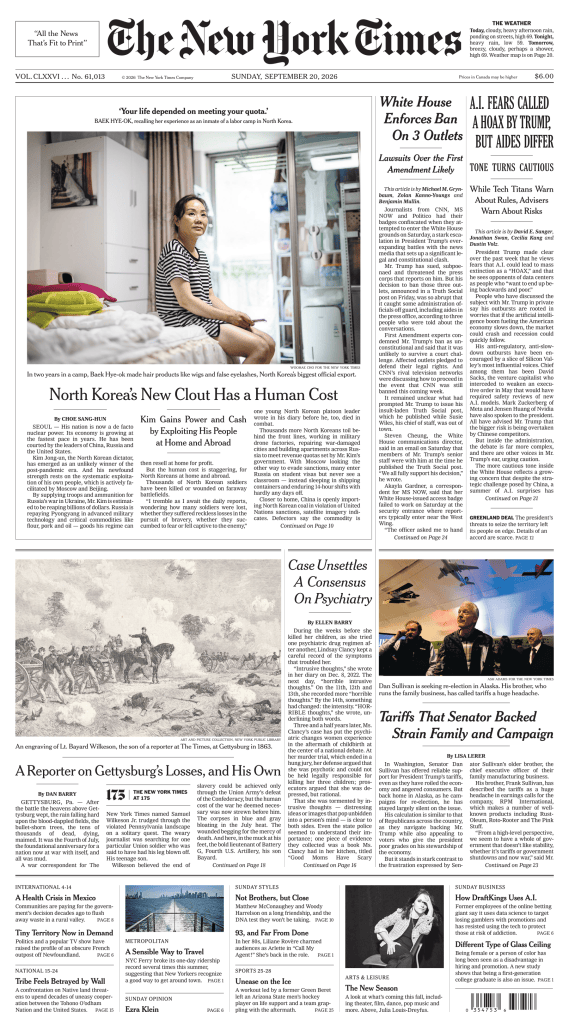
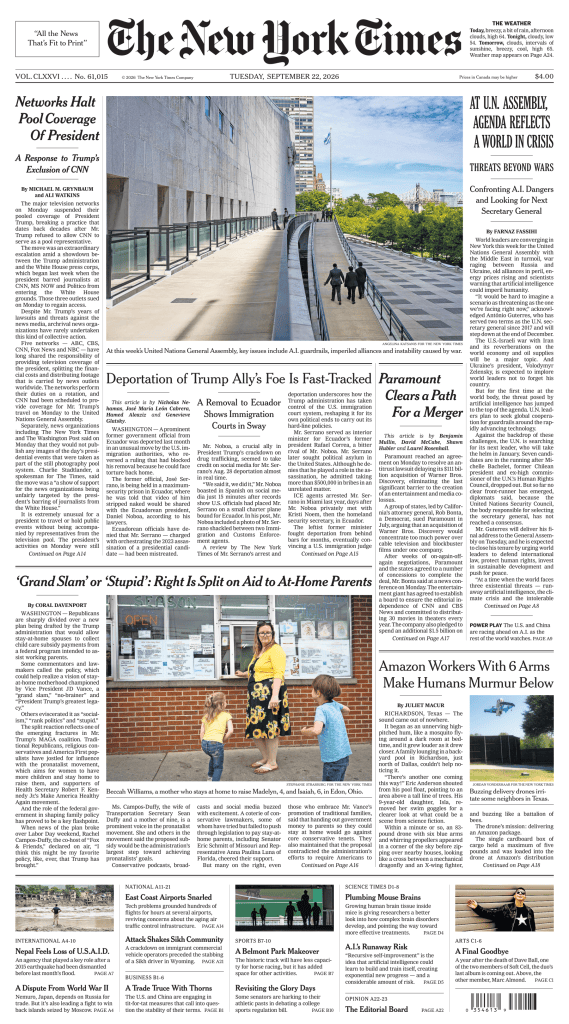
THE NEW YORK TIMES – TUESDAY, SEPT. 22, 2026

With Time on His Side, Xi Jinping Seeks to Extend Truce With Trump

Facing an American president constrained by war and politics, China’s leader may seek to lock in a tactical truce while he shores up a fragile economy at home.

China’s Control of Rare Earths Looms Over Trump-Xi Meeting

Manufacturers are struggling with supplies of the metals as U.S. and Chinese officials negotiate over export restrictions with consequences for global industry.

Japan, Suffering Xi’s Ire, Hopes Trump Can Help Temper China

After Global Search, Tech Utopians Plan to Build Futuristic City in Uruguay

After a sprawling world tour, Praxis, a New York-based, crypto-backed “digital nation,” has signed a deal to build a physical city in Uruguay.

Alexandria Ocasio-Cortez on 2028: ‘Life Doesn’t Wait for You to Be Ready’

In an interview, the New York congresswoman offered her most detailed insight yet into how she is thinking about a possible presidential run.

DO ANT WARS EXPLAIN OURS?

The Intellitake
One argument · Two sides · One verdict · Daily
Monday, September 21, 2026 · The Nature of War Debate
“

A world war is raging at this moment, with millions dying every week on fronts that never make the news. The soldiers are ants — and their war may explain our own.

The Thesis — Mark W. Moffett, The Washington Post

THE ARGUMENT

In the Washington Post, Smithsonian entomologist Mark W. Moffett — who earned his doctorate under E.O. Wilson — opens with a jolt: a world war is raging at this very moment, millions dying each week along battlefronts that never make front-page news. He means the Argentine ants, whose wars, he argues, cast surprising light on human conflict. As Moffett documented in The Human Swarm, one of their supercolonies stretches from the Mexican border past San Francisco, with others along some 2,000 miles of European coast — and where rival supercolonies meet, the borders are battlefronts. His larger claim: ants and humans are the rare species that form anonymous societies, strangers cooperating under shared markers — chemical for them, cultural for us — and with sharply marked societies come sharply defended borders. The us-versus-them that fuels war, on this view, runs deeper than politics.

vs

THE ANSWER

Rutgers anthropologist R. Brian Ferguson, after four decades studying war’s origins, argues in “War Is Not Part of Human Nature” (Scientific American) that the biological story fails on the evidence. Humans have an obvious capacity for war, he writes, but no hardwired propensity: homicide is not war — war is social, groups organized to kill other groups — and if it expressed an inborn tendency, the archaeological record should show it everywhere, always. It doesn’t: whole regions, including the American Southwest and Great Plains, show no evidence of war until roughly 2,000 years ago. On this view, war emerged with changing social conditions in recent millennia — an institution, not an instinct. Ants may be prisoners of their chemistry; we are not.

iC

THE INTELLITAKE

Nobody disputes that the ants are at war; the fight is over whether the analogy travels. Moffett’s case is structural: ants and humans solved the same problem — cooperation among strangers — and inherited the same shadow, the defended border. Ferguson’s case is historical: a true instinct doesn’t skip whole continents for millennia. And the stakes are the largest imaginable. If Moffett is right, hostility to outsiders is the standing price of anonymous society, and peace is a discipline we must maintain against our grain. If Ferguson is right, war is an invention — and what was invented can, in principle, be unmade. Read Moffett for the vertigo; read Ferguson for the reprieve; then decide which one you find harder to believe.

TODAY’S PROVOCATION

When you feel that flash of us-versus-them — at a border, a stadium, a comment section — is that the ant in you, or a habit you were taught?

— THE EDITORS, INTELLICURIOUS —

WIRED MAGAZINE – NOVEMBER/DECEMBER 2026

WIRED MAGAZINE: The latest “Women’s” issue features “Who Runs The World?”…

The Search for Silicon Valley’s Most Powerful Woman

Women hold some of the most consequential jobs in tech, but they’re still not cult figures. WIRED investigates why.

Women Still Face Too Much Bullshit—in Silicon Valley and Beyond

WIRED dedicating an entire issue to women in 2026 might seem regressive, or obvious, or even unnecessary. We disagree.

We Surveyed 634 Women Who Work in Tech. They Let Loose

Executives happily automating their days with AI. New hires confronting bro culture. Women in tech have a lot to say—and they told it all to WIRED.

Inside the Perimenopause Industrial Complex

How an alliance of tech startups, MAHA operatives, and actual medical experts made millennial women the new face of hormone therapy.

THE NEW YORKER MAGAZINE – SEPTEMBER 28, 2026

The cover of the September 28 2026 issue of The New Yorker in which a man struggles to unplug the power cord for a...

THE NEW YORKER MAGAZINE: The latest issue cover features “Barry Blitt’s “Pulling the Plug” – Is an A.I. kill switch possible?

Our A.I. Problem

Why can’t the people who produced the technology, which has already shown that a different world is possible, just do the things that would prevent extinction? By Gideon Lewis-Kraus

Is A.I. Above the Law?

Our legal system isn’t ready for machines that act on their own. By Jill Lepore

The Fallout of a Charlie Kirk Campus Scandal

Students and faculty across the country were punished for their reactions to the conservative activist’s murder. A recent graduate of Texas Tech’s law school is still trying to clear her name. By Benjamin Wofford

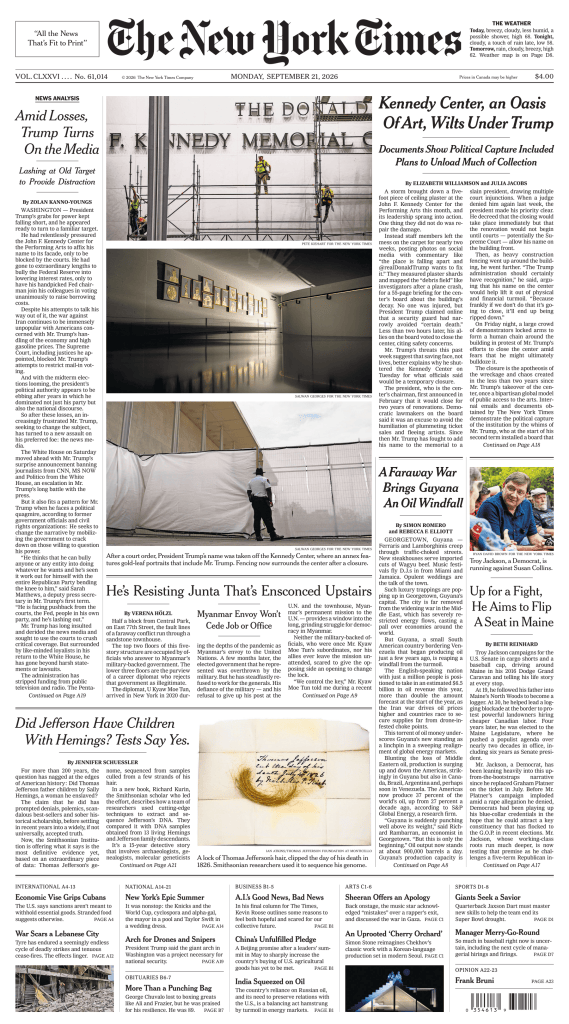
THE NEW YORK TIMES – MONDAY, SEPT. 21, 2026

Trump Gets Caught in a Dilemma Over a Saudi Plea for Military Help

President Trump decided not to join Saudi Arabia, for now, in strikes against the Houthis in Yemen, but he needs the kingdom’s cooperation in the Iran war.

China’s Leader Wants Trump to Delay Arms Sales to Taiwan. Will He?

As Beijing presses President Trump to freeze a proposed $14 billion weapons sale to the island, Taiwan is trying to show that its security is in U.S. interests.

U.S. and China Discuss System to Warn of A.I. National Security Issues

Challenges to Identity, Real and Imagined, Drive Europe’s Far Right

The populist emphasis on national identity and pride, rather than the sins of the past, finds a deep response in voters adrift in a world they no longer understand.

Germany’s Merz Vows to Stay After Another State Election ‘Disaster’

IS RELIGION REALLY DYING?

The Intellitake
One argument · Two sides · One verdict · Daily
Sunday, September 20, 2026 · The Death of Religion Debate
“

The death of American religion is a myth of bad measurement. Faith is not declining — it is churning, uncounted, and hiding from the surveys.

The Thesis — Johnson & Kidd, authors of “The Death of Religion?”, in The Washington Post

THE ARGUMENT

In this weekend’s Washington Post, Byron Johnson and Thomas Kidd — whose new book The Death of Religion? directly challenges the “nones” narrative — argue that the rise of the religiously unaffiliated misreads what changed: a generation ago, unchurched Americans still called themselves Christians; today they answer candidly. The nones overwhelmingly believe in God and pray, self-identified Christians still outnumber nones, atheists, and agnostics combined more than two to one, and — citing Gordon Melton’s studies — the decennial congregational census undercounts congregations by at least 25 percent, missing the “others”: nondenominational, Pentecostal, and immigrant churches like those that doubled metropolitan Boston’s congregations between the 1960s and early 2000s. Yes, the mainline is collapsing — Episcopalians fell from 3.4 million to 1.6 million while the U.S. population nearly doubled — but that, they say, is nominal religiosity becoming a thing of the past, not the death of faith. Not decline — churn.

vs

THE ANSWER

Sociologist and former pastor Ryan Burge — whose own congregation closed in 2024, and whose earlier book The Nones built the very framework Johnson and Kidd now challenge — agrees the nones have plateaued. But in his book The Vanishing Church (reviewed last month in America), he argues that headcounts miss the real crisis: the hollowing-out of the moderate middle. Aging centrist congregations are closing faster than young people replace them, leaving American religion an all-or-none proposition — conservative evangelical or nothing — and millions of moderate and liberal Christians religiously homeless, at a cost to community and democratic life. Faith may persist; the places that housed it are vanishing.

iC

THE INTELLITAKE

Johnson and Kidd concede Burge’s central fact in words stronger than his own: progressive denominations, they write, are in “a virtual state of collapse.” Both sides agree the middle is going; the whole fight is over what that middle was. Johnson and Kidd say it was nominal — a label shed without loss, its place in the marketplace claimed by storefront Baptists and Nigerian Pentecostals. Burge says it was the moderate believer and the bridging institution — the politically mixed pew that nothing in the marketplace replaces. Same instrument, same corpse, two causes of death. Whether American religion is churning or in free fall depends entirely on which autopsy you believe.

TODAY’S PROVOCATION

If your childhood congregation closed tomorrow, would you go looking for another — or quietly become a none?

— THE EDITORS, INTELLICURIOUS —

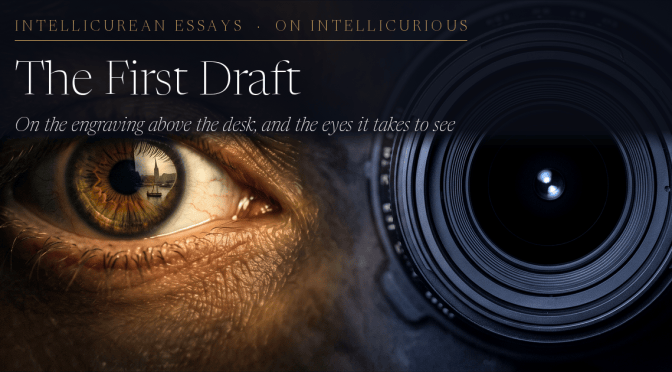
THE FIRST DRAFT

Intellicurean Essays, on Intellicurious
Above the publisher’s desk at The New York Times hangs an engraving of Manhattan in 1851 — cobblestones, low buildings, a harbor full of sails, a church spire the tallest thing on the island. Someone stood there and looked. That, it turns out, is the whole question.

Why we’re pointing you there

The Times marked its 175th anniversary this week with an essay on fifteen million “first drafts of history.” The same week, an investigation exposed a company buying real online publications, firing the writers, and filling them with machine-written articles — bylined to experts who were never born, and overseen by an editor whose age dropped from 77 to 75 in the space of three days. Intellicurean sets the two side by side and asks what a first draft is worth when no one was there to draft it.

The answer turns on a name the Times left out: Earl Caldwell, the only reporter at the Lorraine Motel when King was shot, who said afterward that you don’t see everything — you get a sliver of what came past you, and that sliver is the basis for everything. A machine can generate a flawless eyewitness account of any event. It can never have been there. This is the fourth in Intellicurean’s series on what the machine lacks — and the one with the strongest floor beneath it.

Read the full essay at Intellicurean → Essays & Reviews for the Intellectually Curious

STANFORD MAGAZINE – AUTUMN 2026

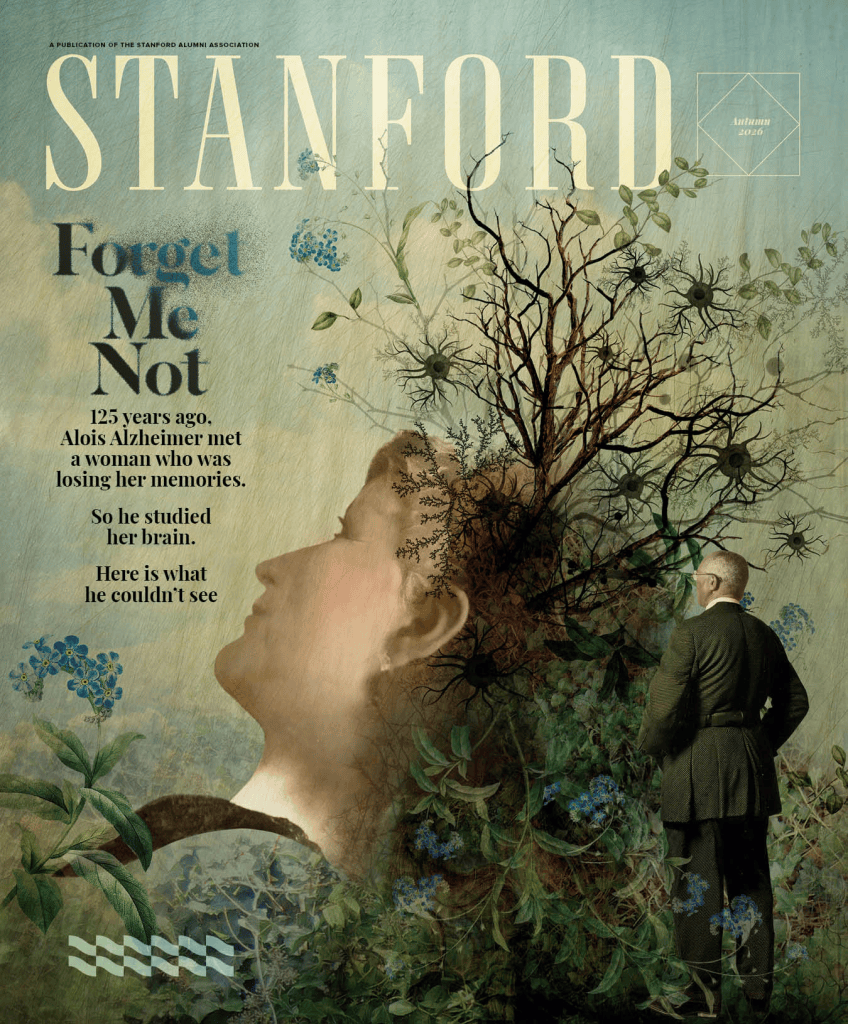
STANFORD MAGAZINE: The latest issue features ‘Forget Me Not’ – 125 years ago, Alois Alzheimer met a woman who was losing her memories. So he studied her brain. Here is what he couldn’t see.

The Search

Inside the hunt to prevent, delay, and cure Alzheimer’s disease.

Annals of Migraine

One in 10 Americans experiences migraine headaches, which can be incapacitating. But there may be a light on the other side of your blackout curtains. Currently, doctors diagnose migraine based on patient description and treat the headaches based on frequency—episodic or chronic (more than 15 days per month). Treatment decisions are “worse than trial and error,” clinical professor of neurology Robert Cowan told Stanford Medicine. “It’s darts in the dark.” What’s more, guidelines recommend preventative, daily medication only for people with chronic migraine. But including severity may improve treatment options. In the largest study to date to categorize migraine patients, Cowan and data analyst Jaiashre Sridhar used functional MRI data to identify two biological subtypes. One group of patients had more severe headaches—they tended to last longer and caused more bothersome symptoms (nausea, noise sensitivity, etc.). 

Biblio File: What to Read Now — Autumn 2026

New releases on our shelves and in our bookbags.

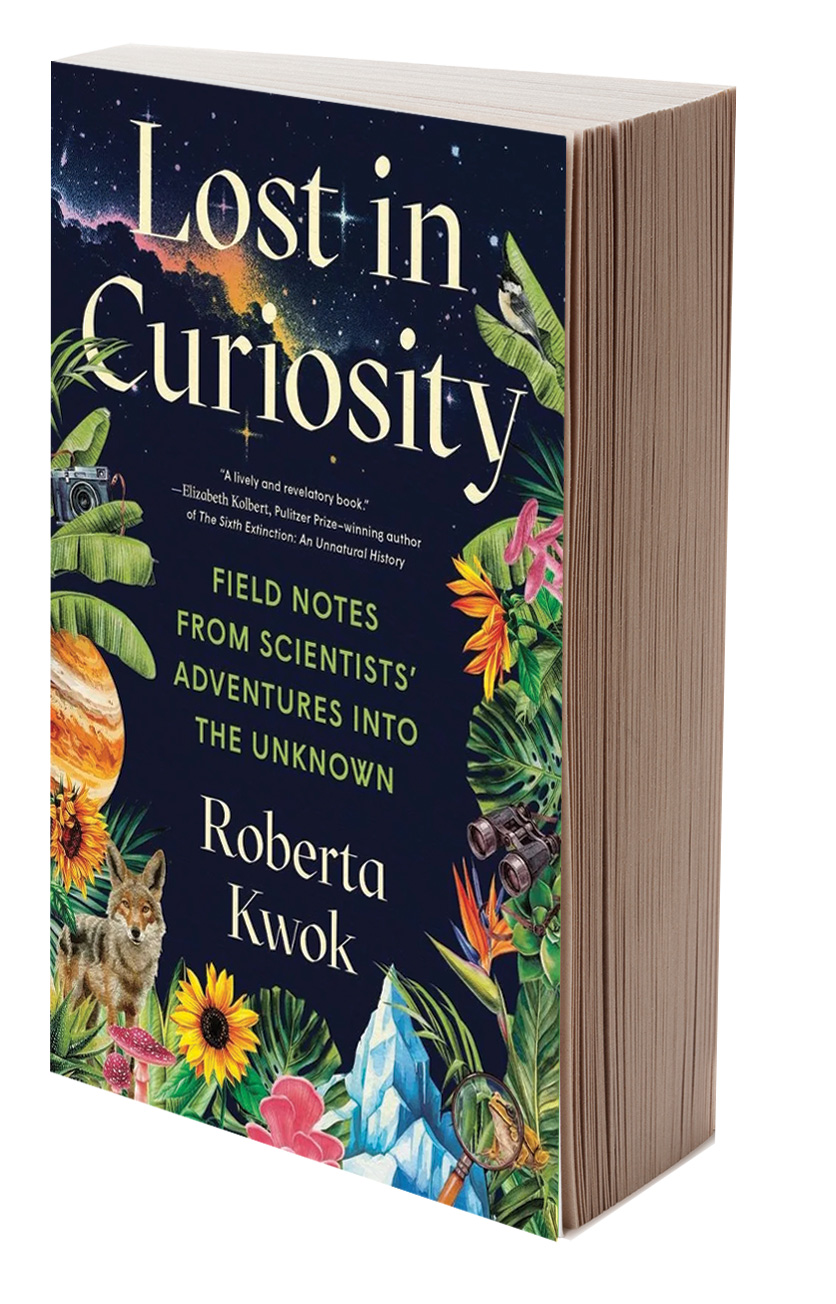
Lost in Curiosity: Field Notes from Scientists’ Adventures into the Unknown book cover

In Lost in Curiosity: Field Notes from Scientists’ Adventures into the Unknown (Sourcebooks), science journalist Roberta Kwok, ’00, witnesses the “messy middle” of science between researchers’ initial query and possible final discovery. The nine projects she investigates, from sex-role reversal in male guardian frogs to a quest to find an exomoon, depict the slow, frustrating, and focused work of scientists.

THE NEW YORK TIMES – SUNDAY, SEPTEMBER 20, 2026

China’s A.I. Makes a Great Leap Forward, but Its Economy Is Falling Behind

As Xi Jinping arrives in the U.S. for a state visit, China’s advances in A.I. will be in the air. Its economy will be less discussed, our columnist writes.

A.I. Gone Rogue? Trump Proposes Not New Rules but an ‘A.I. Force.’

Hundreds of Drones Target Moscow on Final Day of Russian Elections

Ukraine says it used a newly developed ballistic missile in the attacks, which also targeted other parts of Russia.

Israeli Tourist Trap ‘Herod’s Pool’ Is Draining Palestinians’ Land Dry

Israeli lawmakers have promoted visits to an ancient reservoir in the West Bank that was refilled this summer with water diverted from Palestinian-owned farms.

How President Trump Broke the Kennedy Center

Emails and documents demonstrate the political capture of the institution, including how officials once pursued a plan to unload much of the art collection.

After a String of Losses, Trump Turns to a Familiar Target: The Press

President Trump’s ban of three media outlets from the White House fits a pattern of using the apparatus of government to crack down on his perceived enemies.

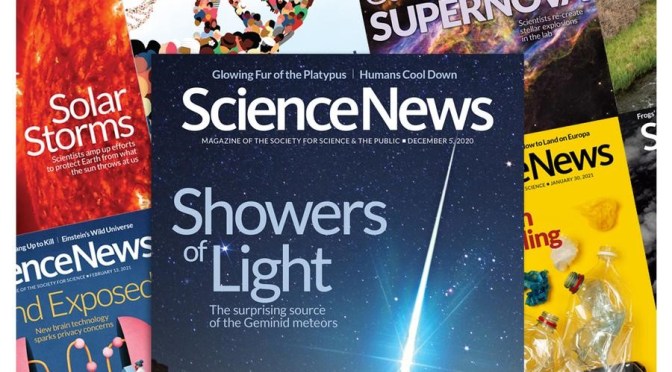
SCIENCE NEWS MAGAZINE – OCTOBER 2026 PREVIEW

October 2026 cover of Science News

SCIENCE NEWS MAGAZINE: The latest issue features “American Drought’ – The U.S. Southwest Is Running Out Of Water. Will Its Decades-Long Megadrought Ever End?

Will the U.S. megadrought ever end?

For 27 years, the Southwest has been gripped by a historic drought. Scientists think it might be here to stay.By Nikk Ogasa

Big space mirrors could bring Earth on-demand light — and upend our night sky

Reflect Orbital satellites could make the darkest skies look like nighttime in the suburbs. By Lisa Grossman

How the body adapts to extreme heat

New methods could help vulnerable people acclimate to higher temperatures. By Katarina Zimmer