If the coming election does result in a blue wave, Trump will be faced with the fact of his diminishment. The rest of us will be faced with the wreckage. By David Remnick
The F.B.I. director’s hockey team, the Dons, faced their rivals in a beer league. With rogue slap shots and hovering security agents, Patel was in the zone—or, at least, next to it. By Richie McGinniss
My Education on the Border of the Syrian War
In the last Turkish town on the road to Aleppo, jihadis and spies mixed with reporters trying to prove themselves. By Ben Taub
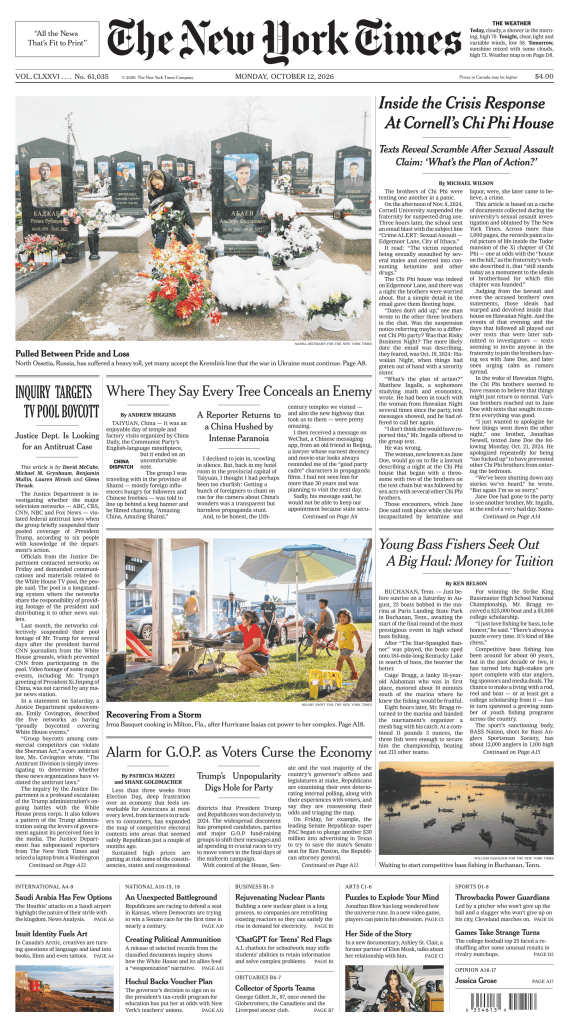
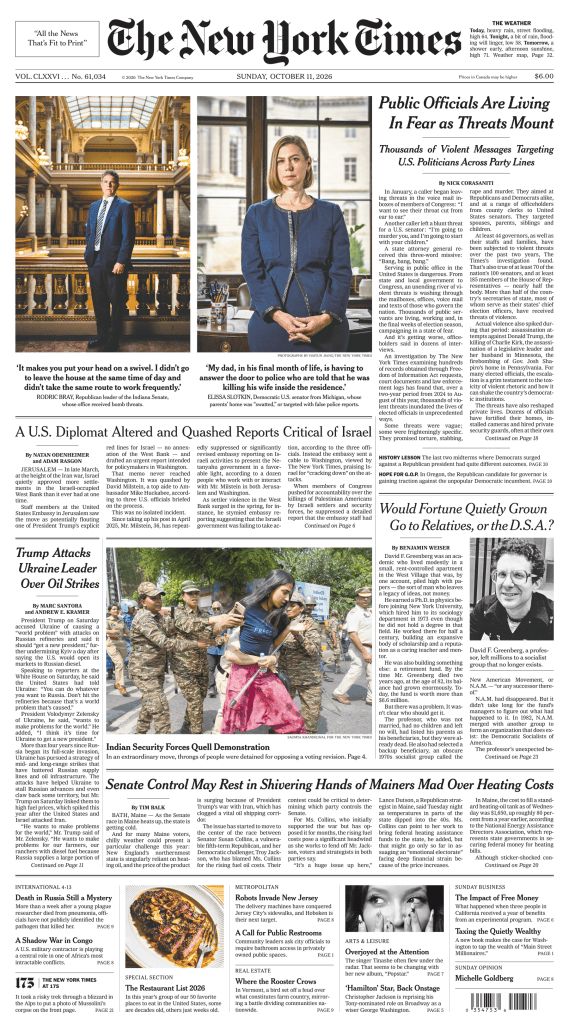
Much of Israeli-occupied southern Lebanon has been leveled, according to a Times analysis, and the majority has been destroyed by Israel since the April truce.
“We are entering an age of prolonged insecurity,” one former U.S. energy official said of what have become chronic threats on the Middle East’s energy core.
He has quietly become by far the biggest known midterm donor, trying to save Republicans’ Senate majority with some of the largest donations in U.S. political history.
Emirati investigators said the co-pilot accused of attacking a captain on a flight to Israel drifted toward extremism during his time as a student in Australia.
Scholar, author, and activist Tony Platt reviews the new narrative history by Miriam Pawel, “California Dreams: The Making and Remaking of the University of California.” Pawel’s narrow focus on five high-achieving alumni, argues Platt, elides both radical traditions and unethical…
Palestinian national poet Mahmoud Darwish’s “Mawwal” confronts immeasurable grief with unbending steadfastness: “the stabs of daggers I prefer / to being ruled by the vile.”
I lost a beautiful dream, I lost the scent of the lilies, and my night was long, upon the fences of gardens… But I never lost my way! The palm of my hand is now accustomed to the wounds of hope. Shake my hand hard and a river of songs will flow forth. Mother of my colt and sword: Mother mine, here’s a ditty of love! Mother mine, a ditty! The stabs of daggers I prefer, to being ruled by the vile.
Andrew Holter interviewed Tom Overton, author of a new biography, “John Berger: From Life,” out from Verso Books. In this fascinating discussion, Overton discusses his friendship with Berger, the biography’s literary approach, Berger on Palestine, and future plans for scholarship…
The cease-fire last October ostensibly brought an end to Israel’s war in Gaza after the Hamas-led attacks on Oct. 7, 2023. A year later, however, Israeli strikes, though less frequent, haven’t stopped.
Returning to China after decades away, a correspondent finds bullet trains, dazzling skylines — and a surveillance state more paranoid and pervasive than ever.
The NHS’s growing use of non-doctors risks creating a two-tier health service, argues Jatinder Hayre
After Aneurin Bevan created the National Health Service in 1948, the principle of universality became firmly embedded in the popular consciousness: illness would no longer divide the British people according to wealth, and the quality of care received in sickness would not depend upon the depth of one’s pockets. Bevan articulated another principle which receives rather less attention today: that the state might finance medicine, but it should not command medical judgement. Doctors needed sufficient professional independence to practise according to the needs of their patients rather than the administrative or financial convenience of the state. Both principles are now being tested – and in some cases, rewritten.
Across the NHS, work historically undertaken by doctors has increasingly been transferred to physician associates (PAs), advanced clinical practitioners (ACPs) and an expanding constellation of other roles. I use “Noctor” as an umbrella term for the phenomenon whereby non-doctors cease to complement doctors and begin to serve as a substitute for them.
The language surrounding this transformation is revealingly anaesthetic: “skill mix”, “workforce transformation”, “new models of care”. These phrases make a profound political choice sound like an administrative rearrangement. Beneath them sits a simple idea: medicine can be dismantled into tasks, those tasks redistributed amongst more rapidly trained practitioners, and the whole reconstructed without meaningful loss.
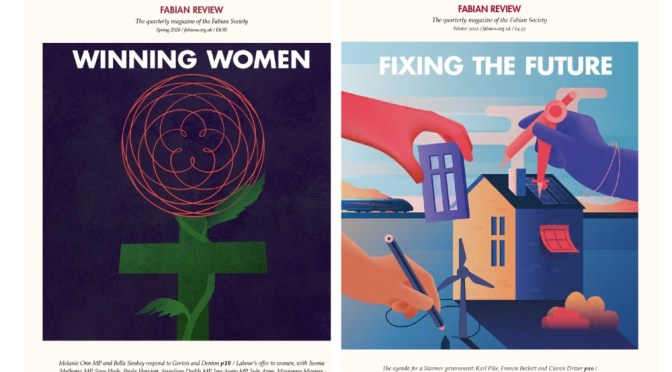
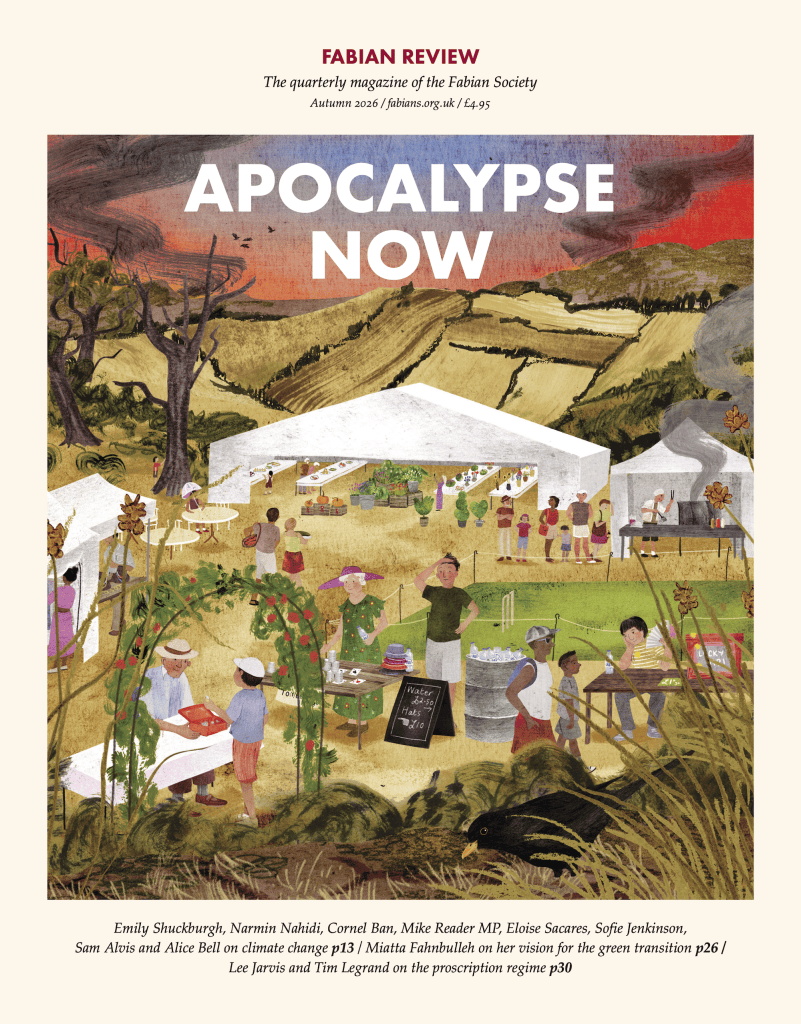
Miatta Fahnbulleh is right about everything. Will it matter? She talks to Iggy Wood about her plan for a green transition that benefits all
In the not-so-distant past, consensus around the need to tackle climate change at least superficially encompassed the entirety of British society. It was the historic party of capital – the Conservatives – who enshrined net zero in law, eliminated coal from Britain’s energy mix, and committed to ending the sale of petrol and diesel cars. Some of the most important progress was made under Boris Johnson, who, while not on the right of the party per se, was a Brexit-supporting populist.
Unglamorous electricity grid reforms could be the key to winning on the doorstep
Even Andy Burnham was surprised to get a standing ovation for taking VAT off electricity bills. His plans to address the plight of the industrialist seeking a grid connection did not meet with the same enthusiasm during his first Labour conference speech as prime minister. Yet faster grid access matters far more for bringing down Britain’s high energy costs.
On 29th September, the government announced GB Grid, a new entity under the government’s publicly-owned energy company, GB Energy. Seeded with £4bn of reallocated funding, GB Grid will be able to finance and build grid infrastructure and plans to compete with incumbent providers. Alongside GB Grid, the government announced it would expand self-build connections and accelerate competitive tendering for transmission projects, effectively increasing competitive pressure on networks. This is a refreshing approach to bringing down energy costs, combining a bold public ownership experiment with unglamorous but necessary competition reforms.
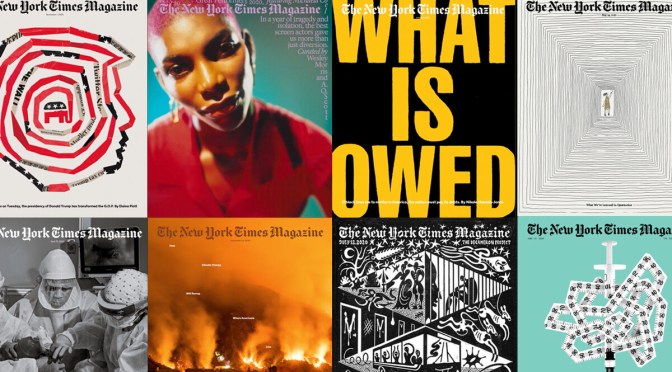
THE NEW YORK TIMES MAGAZINE: The 10.11.26 Issue features Daniel Kolitz on the rise of microdramas; Janet Reitman on a group of Texans accused of being Antifa terrorists; Marcela Valdes on the author Min Jin Lee; and more.
The Cockroach Janta Party said senior members of the youth activist group were detained amid large protests against the expunging of names from India’s voter roll.
After an agent shot an immigrant in New York, some of Mayor Zohran Mamdani’s allies questioned his attitude toward President Trump and his own police department.
The escalating violence has brought the conflict in Yemen to the doorstep of the Saudi capital, and the kingdom has no easy options to curtail the increasingly sophisticated and targeted strikes.
President Trump’s allies have sought to prove a conspiracy through a Justice Department inquiry, which has faced internal disputes and trouble finding evidence.
The man was in a car with a 5-year-old when he was shot and wounded, the authorities said. Mayor Zohran Mamdani said the Trump administration was “terrorizing our city.”
A top aide to Ambassador Mike Huckabee skewed information to portray the Netanyahu government in a favorable light, according to multiple officials and documents obtained by The Times.
After trading his military uniform for civilian clothes, Myanmar’s strongman president, U Min Aung Hlaing, is in Malaysia, his ninth stop on a search for international legitimacy.