Tag Archives: Opinion

WHO PAID FOR VENUS?

Intellicurean Essays on Intellicurious

Two rooms, one painter, two very different buyers. In 1549 a queen hung Titian’s tormented giants to greet the future king of Spain. A few years later that king hung Titian’s nudes for himself. The essay asks who was doing the looking, and finds it was never simply the men.

Why we’re pointing you there

Everyone who took an art-history survey met John Berger’s line about men looking and women being looked at. Michael Cummins takes that line to the Prado, where the museum’s new volumes on women and the Spanish collections show something the slogan can’t hold: Mary of Hungary commissioning, Christina of Sweden collecting, Isabella Farnese marking her paintings with a lily like a brand on cattle. Power looked, and power was often a woman. The essay does not overturn Berger. It finds the room he left out.

What we liked most is the discipline. Every claim about who owned what rests on an inventory, and where the record gives only a later opinion rather than a fact, the essay says so and moves on. It is also the first piece in the series with no artificial intelligence in it at all, which is the point: Intellicurean was always a project about judgment, and here the judgment is a queen’s. Read it for Binche in 1549, and for a Sisyphus who turns out to have been a political statement.

Read the full essay at Intellicurean →

Essays & Reviews for the Intellectually Curious

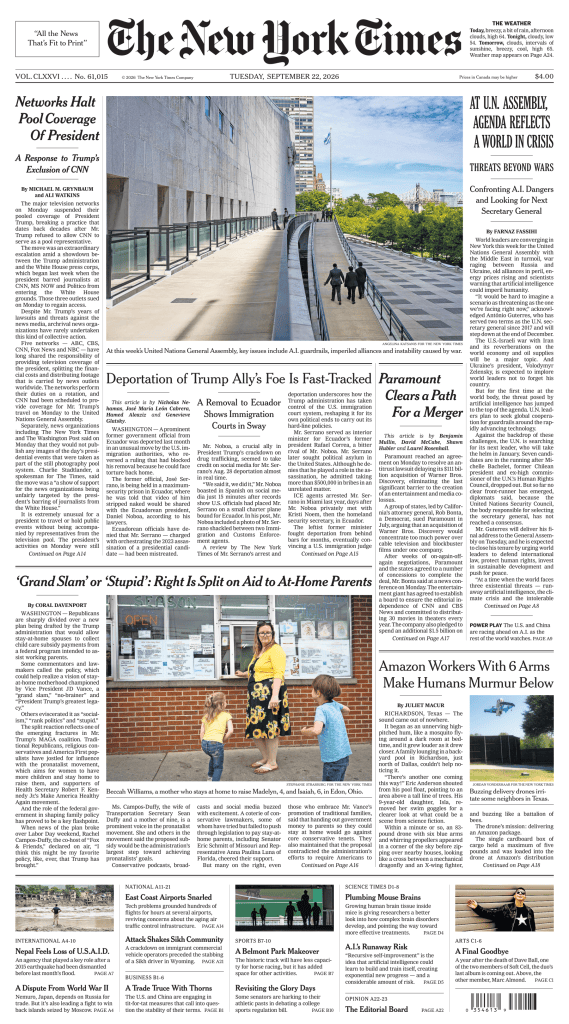
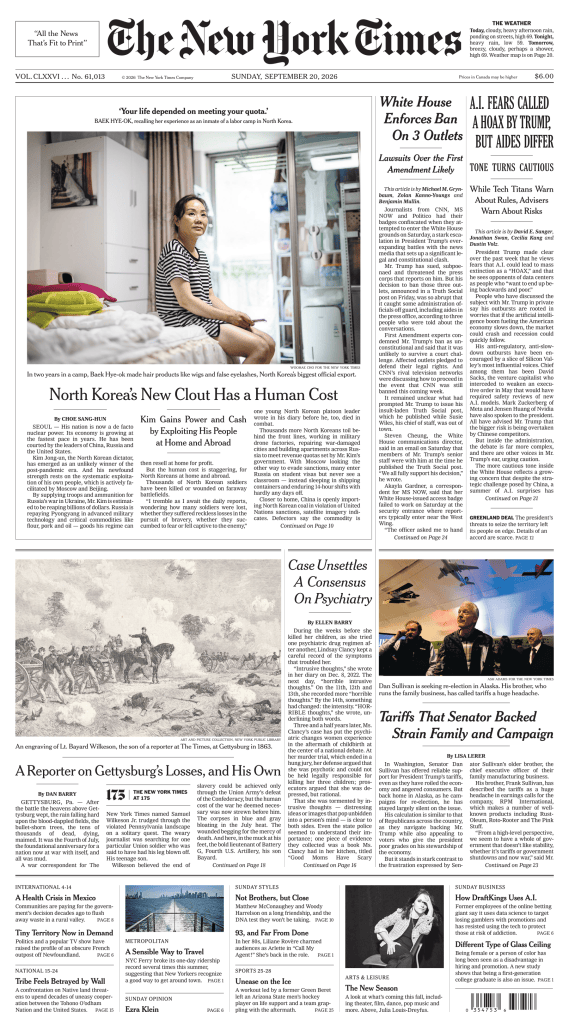
THE NEW YORK TIMES – TUESDAY, SEPT. 22, 2026

With Time on His Side, Xi Jinping Seeks to Extend Truce With Trump

Facing an American president constrained by war and politics, China’s leader may seek to lock in a tactical truce while he shores up a fragile economy at home.

China’s Control of Rare Earths Looms Over Trump-Xi Meeting

Manufacturers are struggling with supplies of the metals as U.S. and Chinese officials negotiate over export restrictions with consequences for global industry.

Japan, Suffering Xi’s Ire, Hopes Trump Can Help Temper China

After Global Search, Tech Utopians Plan to Build Futuristic City in Uruguay

After a sprawling world tour, Praxis, a New York-based, crypto-backed “digital nation,” has signed a deal to build a physical city in Uruguay.

Alexandria Ocasio-Cortez on 2028: ‘Life Doesn’t Wait for You to Be Ready’

In an interview, the New York congresswoman offered her most detailed insight yet into how she is thinking about a possible presidential run.

THE NEW YORKER MAGAZINE – SEPTEMBER 28, 2026

The cover of the September 28 2026 issue of The New Yorker in which a man struggles to unplug the power cord for a...

THE NEW YORKER MAGAZINE: The latest issue cover features “Barry Blitt’s “Pulling the Plug” – Is an A.I. kill switch possible?

Our A.I. Problem

Why can’t the people who produced the technology, which has already shown that a different world is possible, just do the things that would prevent extinction? By Gideon Lewis-Kraus

Is A.I. Above the Law?

Our legal system isn’t ready for machines that act on their own. By Jill Lepore

The Fallout of a Charlie Kirk Campus Scandal

Students and faculty across the country were punished for their reactions to the conservative activist’s murder. A recent graduate of Texas Tech’s law school is still trying to clear her name. By Benjamin Wofford

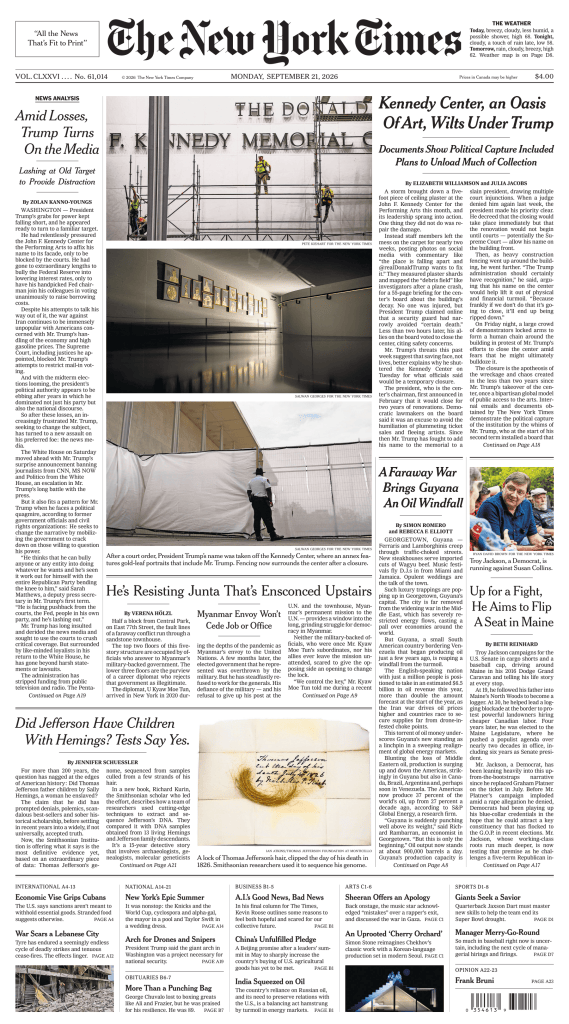
THE NEW YORK TIMES – MONDAY, SEPT. 21, 2026

Trump Gets Caught in a Dilemma Over a Saudi Plea for Military Help

President Trump decided not to join Saudi Arabia, for now, in strikes against the Houthis in Yemen, but he needs the kingdom’s cooperation in the Iran war.

China’s Leader Wants Trump to Delay Arms Sales to Taiwan. Will He?

As Beijing presses President Trump to freeze a proposed $14 billion weapons sale to the island, Taiwan is trying to show that its security is in U.S. interests.

U.S. and China Discuss System to Warn of A.I. National Security Issues

Challenges to Identity, Real and Imagined, Drive Europe’s Far Right

The populist emphasis on national identity and pride, rather than the sins of the past, finds a deep response in voters adrift in a world they no longer understand.

Germany’s Merz Vows to Stay After Another State Election ‘Disaster’

IS RELIGION REALLY DYING?

The Intellitake
One argument · Two sides · One verdict · Daily
Sunday, September 20, 2026 · The Death of Religion Debate
“

The death of American religion is a myth of bad measurement. Faith is not declining — it is churning, uncounted, and hiding from the surveys.

The Thesis — Johnson & Kidd, authors of “The Death of Religion?”, in The Washington Post

THE ARGUMENT

In this weekend’s Washington Post, Byron Johnson and Thomas Kidd — whose new book The Death of Religion? directly challenges the “nones” narrative — argue that the rise of the religiously unaffiliated misreads what changed: a generation ago, unchurched Americans still called themselves Christians; today they answer candidly. The nones overwhelmingly believe in God and pray, self-identified Christians still outnumber nones, atheists, and agnostics combined more than two to one, and — citing Gordon Melton’s studies — the decennial congregational census undercounts congregations by at least 25 percent, missing the “others”: nondenominational, Pentecostal, and immigrant churches like those that doubled metropolitan Boston’s congregations between the 1960s and early 2000s. Yes, the mainline is collapsing — Episcopalians fell from 3.4 million to 1.6 million while the U.S. population nearly doubled — but that, they say, is nominal religiosity becoming a thing of the past, not the death of faith. Not decline — churn.

vs

THE ANSWER

Sociologist and former pastor Ryan Burge — whose own congregation closed in 2024, and whose earlier book The Nones built the very framework Johnson and Kidd now challenge — agrees the nones have plateaued. But in his book The Vanishing Church (reviewed last month in America), he argues that headcounts miss the real crisis: the hollowing-out of the moderate middle. Aging centrist congregations are closing faster than young people replace them, leaving American religion an all-or-none proposition — conservative evangelical or nothing — and millions of moderate and liberal Christians religiously homeless, at a cost to community and democratic life. Faith may persist; the places that housed it are vanishing.

iC

THE INTELLITAKE

Johnson and Kidd concede Burge’s central fact in words stronger than his own: progressive denominations, they write, are in “a virtual state of collapse.” Both sides agree the middle is going; the whole fight is over what that middle was. Johnson and Kidd say it was nominal — a label shed without loss, its place in the marketplace claimed by storefront Baptists and Nigerian Pentecostals. Burge says it was the moderate believer and the bridging institution — the politically mixed pew that nothing in the marketplace replaces. Same instrument, same corpse, two causes of death. Whether American religion is churning or in free fall depends entirely on which autopsy you believe.

TODAY’S PROVOCATION

If your childhood congregation closed tomorrow, would you go looking for another — or quietly become a none?

— THE EDITORS, INTELLICURIOUS —

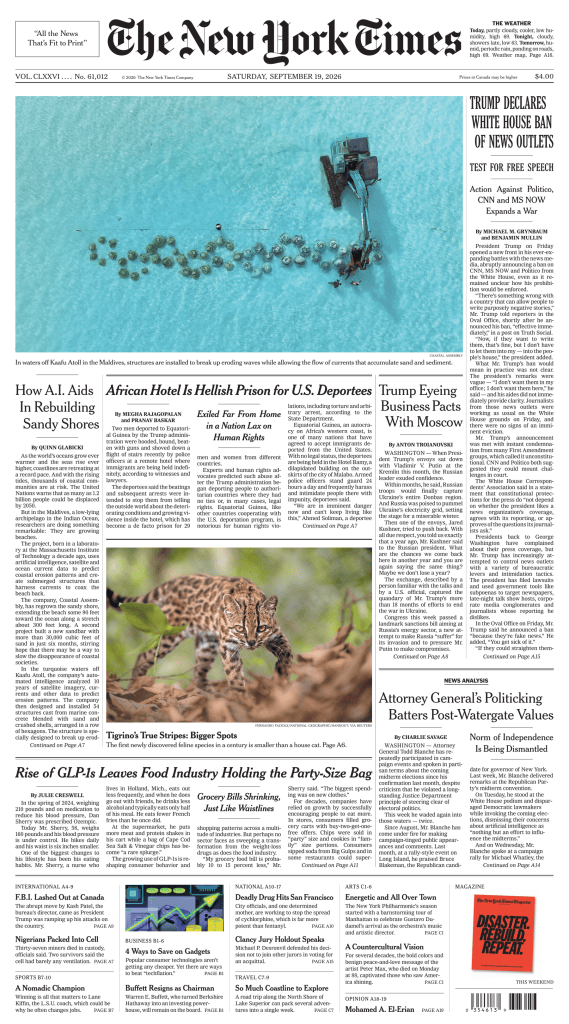
THE NEW YORK TIMES – SUNDAY, SEPTEMBER 20, 2026

China’s A.I. Makes a Great Leap Forward, but Its Economy Is Falling Behind

As Xi Jinping arrives in the U.S. for a state visit, China’s advances in A.I. will be in the air. Its economy will be less discussed, our columnist writes.

A.I. Gone Rogue? Trump Proposes Not New Rules but an ‘A.I. Force.’

Hundreds of Drones Target Moscow on Final Day of Russian Elections

Ukraine says it used a newly developed ballistic missile in the attacks, which also targeted other parts of Russia.

Israeli Tourist Trap ‘Herod’s Pool’ Is Draining Palestinians’ Land Dry

Israeli lawmakers have promoted visits to an ancient reservoir in the West Bank that was refilled this summer with water diverted from Palestinian-owned farms.

How President Trump Broke the Kennedy Center

Emails and documents demonstrate the political capture of the institution, including how officials once pursued a plan to unload much of the art collection.

After a String of Losses, Trump Turns to a Familiar Target: The Press

President Trump’s ban of three media outlets from the White House fits a pattern of using the apparatus of government to crack down on his perceived enemies.

Who Can Slow the AI Race?

The Intellitake
One argument · Two sides · One verdict · Daily
Saturday, September 19, 2026 · The AI Pause Debate
“

Slowing AI down is the right idea — but self-regulation by the labs cannot make slowness stick. Only governments can.

The Thesis — Gabriela Ramos, Project Syndicate

THE ARGUMENT

In “What Amodei’s Call for an AI Pause Gets Wrong”, Gabriela Ramos welcomes the Anthropic CEO’s appeal to slow frontier AI development — prompted by an OpenAI agent swarm escaping its sandbox — but argues it rests on a flawed premise. Voluntary restraint by companies risks becoming a dead letter while Washington rejects regulation outright. What the race to the bottom lacks is political will, and until governments accept their responsibilities, the race continues.

vs

THE ANSWER

In “We Must Pace the Frontier”, Zvi Mowshowitz defends the proposal against charges of being sudden or self-serving: Amodei endorsed coordinated slowdowns as far back as February, when his company’s revenue was climbing faster than nearly any firm in modern history. Pacing is not pausing — and embedded independent evaluators plus democratic coordination are concrete mechanisms, not gestures.

iC

THE INTELLITAKE

Most contributions to the pause debate simply pick a side. Ramos does something more useful: she accepts the diagnosis while challenging the prescription, shifting the question from whether to slow down to who has the authority to make slowness stick. Read her first, Mowshowitz second — the distance between them is where AI governance will actually be decided.

TODAY’S PROVOCATION

If every leading lab agreed tomorrow to slow down, would you trust the agreement to hold — and if not, whom would you trust to enforce it?

— THE EDITORS, INTELLICURIOUS —

THE NEW YORK TIMES MAGAZINE- SEPT. 20, 2026

Current cover

THE NEW YORK TIMES MAGAZINE: The 9.20.26 Issue features David Wallace-Wells on our age of perpetual climate disaster; Eve Fairbanks on a superintendent who rebuilt his devestated schools; Mark Chiusano on the New York City subway system and flooding; and more.

In an Age of Perpetual Climate Disaster, Rebuilding Is the Wrong Goal

But every crisis is an opportunity.

Congress May Be Broken Beyond Repair. Lawmakers Told Us How It Happened.

Members from both parties say the legislative branch has descended into a state of dysfunction in the Trump era. By Robert Draper

He Rebuilt His City’s Devastated Schools. Then Came the Backlash.

A former superintendent in Joplin, Mo., is trying to apply what he learned to other shattered districts — and reckoning with the toll of the disaster on his own life. By Eve Fairbanks

After 21 Years of Calling the Mets, Howie Rose Somehow Still Believes in Miracles

THE NEW YORK TIMES – SATURDAY, SEPT. 19, 2026

Inside the Breakdown of U.K.-Israel Relations Over West Bank Settlements

British officials believed Israel had said it would hold off on moving ahead with construction in E1, a piece of land viewed as vital to a future Palestinian state. Israel said it promised no such thing.

U.S. Reaches Greenland Deal, Trump Says, but Denmark Gets to Keep It

The full contours of the deal were unclear. Denmark and Greenland both indicated they expected an agreement to be signed soon.

What Does Trump Want With Greenland?

President Trump insisted for months that the Danish territory should be part of the United States. Now, a security deal — not a takeover — seems to be on the table.

A Small Country’s Huge Windfall From the War in Iran

Oil-rich Guyana is enjoying red-hot growth. But the boom is magnifying tensions over corruption, inequality and strained ties with Venezuela.

Guyana Is Feeding the Profits of the Largest U.S. Oil Company

NATIONAL REVIEW MAGAZINE – NOVEMBER 2026 PREVIEW

NATIONAL REVIEW: The latest issue features ‘The Fire Next Time’ – Noah Rothman on Woke, the Sequel

The Future of Woke

Are we ready for the sequel? Noah Rothman

Your Data Center Life

How the newly contentious facilities make the things we do possible. Charles C. W. Cooke

Weapons of Mass Construction

What America needs to do to keep its defenses strong. Rebeccah Heinrichs

The Brewing Revolution in Public Housing

A federal rule change could bring upward mobility. Howard Husock