Parts of the MAGA movement are unhappy with President Trump’s migration strategy. The administration has softened its policy on deportations following a public uproar over the ICE killings in January, it is said. The focus has been on removing only the most violent offenders. “The truth is the first year was not a year of mass deportation,” says Mike Howell of the Mass Deportation Coalition. “A conscious
Donald Trump has had a career-long love-hate relationship with the press. On one hand, he popularized the phrase “fake news” and branded the press “the enemy of the people.” On the other, the President takes phone calls from virtually every reporter with his personal cell and is fixated on cable news and his print media coverage. Trump views journalists as friends, foes…
Donald Trump flew to Beijing this week and wants three things when he sits down with China’s President Xi Jinping: a tariff truce that survives his own courts, Chinese pressure on Iran to end the war that never seems to end and a photograph that makes him look victorious. Xi has problems of his own. But he has watched four American presidencies from Zhongnanhai, the walled compound beside the Forbidden City where the Communist party leadership rules, and he knows the value of silence when his counterpart is talking himself into trouble. Trump’s approval rating is the lowest of his second term. What Xi wants from this meeting with Trump is recognition: two great powers, two systems, meeting as equals Trump has obliged Xi noisily.
Their electoral prospects are finally improving, but opportunities can quickly give way to divisions. Does the Party have a plan? By Amy Davidson Sorkin
The Human-Trafficking Victim Next Door
A young girl was brought from Guinea to a wealthy suburb near Dallas. She spent the next sixteen years of her life in forced servitude. By Yudhijit Bhattacharjee
Can Hakeem Jeffries Lead a Democratic Takeover of the House?
An unprecedented gerrymandering effort led by Donald Trump—and internal divisions among Democrats—has made the Minority Leader’s path to victory harder than ever. By Jason Zengerle
Mary Todd Lincoln Has Long Been Derided. Is Her Reputation Salvageable?
History knows the First Lady as a hysterical widow and a lavish spender. Her most recent biographer chooses to highlight her mental fortitude and political prowess. By Thomas Mallon
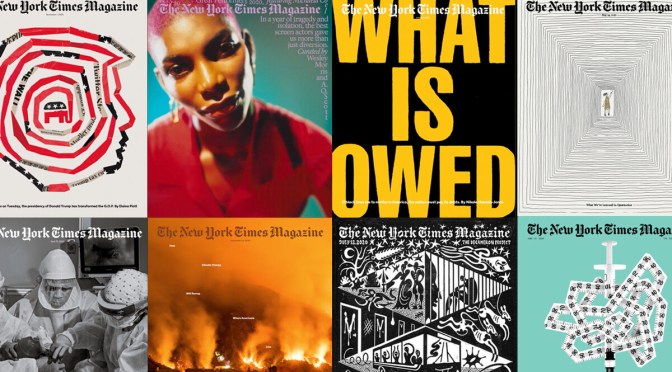
THE NEW YORK TIMES MAGAZINE: The 5.17.26 Issue features Chris Pomorski on the famed freediver Francisco Ferreras; Reginald Dwayne Betts on learning to shoot a gun; Roger Cohen on the leader of Argentina as a MAGA celebrity; and more.
An unlikely alliance between HHS Secretary Robert F. Kennedy Jr. and “critical psychiatry” activists is challenging decades of medical orthodoxy by targeting the widespread, and often harmful, reliance on psychotropic medications. This movement argues that mainstream psychiatry pathologizes normal human suffering, prompting some medical professionals to preemptively develop deprescribing guidelines to safely taper patients off medication.
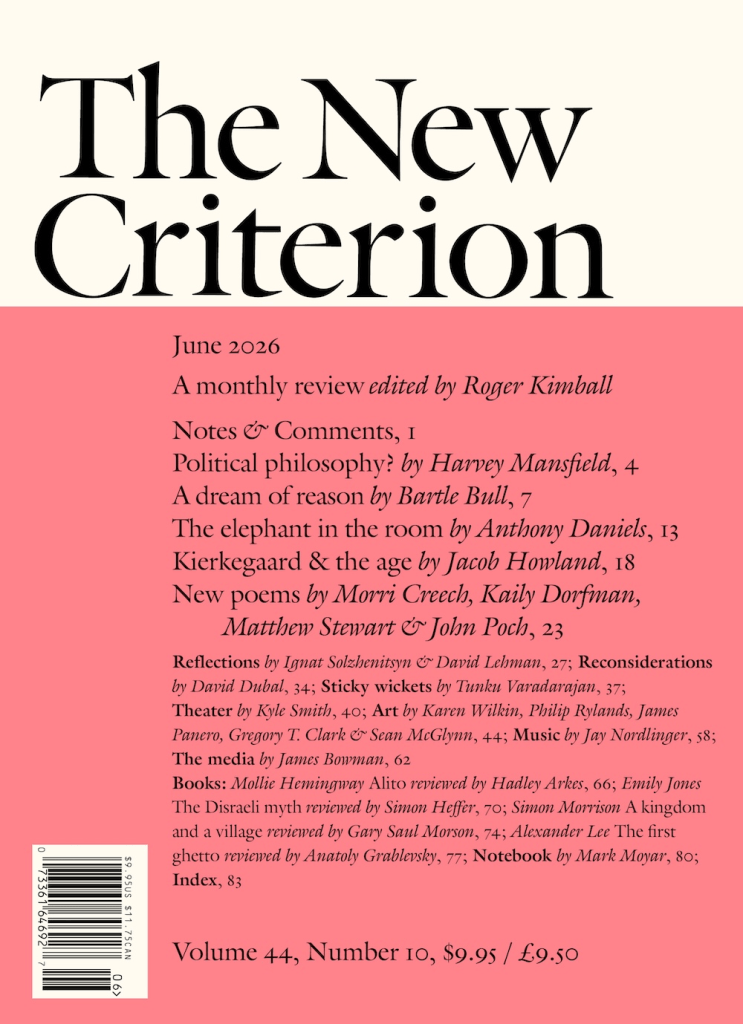
THE NEW CRITERION: The latest issue features ‘Political philosophy? by Harvey Mansfield; A dream of reason by Bartle Bull; The elephant in the room by Anthony Daniels; Kierkegaard & the age by Jacob Howland; New poems by Morri Creech, Kaily Dorfman, Matthew Stewart & John Poch….
The betrayal of Britain’s Jews and the corruption of its ruling class
In the northeast corner of Parliament Square, in the shadow of the Houses of Parliament, stands a bronze figure 12 feet high. Winston Churchill chose the spot himself in the 1950s, drawing a circle on a map and declaring with the finality of a man who knew his own place in history: “That is where my statue will go.” It was unveiled on the 1st of November in 1973. When the Queen spoke, she revealed a secret that Churchill himself had guarded: When offered a dukedom at the end of his life, he turned it down. He wished to spend his remaining years in the House of Commons—the Parliament he had saved, and that he loved more than any title the Crown could bestow.
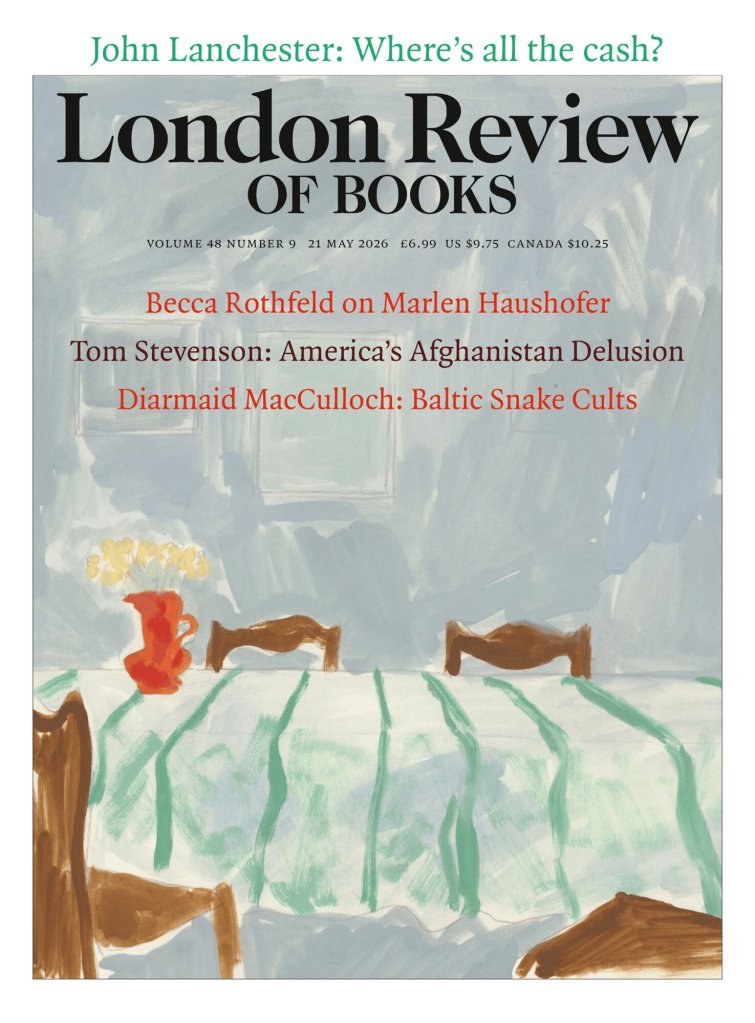
“America’s Afghanistan Delusion” by Tom Stevenson: Stevenson examines the legacy of the War on Terror, arguing that the 2021 withdrawal from Kabul was viewed by the Western establishment as a “mistake” or “cautionary tale” rather than the “crime” he suggests it was. He traces the expansion of American power through “black sites” and military advisers across the globe.
“Short Cuts: Labour’s Failure” by James Butler: Butler analyzes the results of the English local elections (held on May 7). He criticizes Keir Starmer’s leadership style as “all injunction and no argument” and explores why national revulsion toward the Labour Party overshadowed local government issues.
“Where’s All the Cash?” by John Lanchester: A characteristically lucid investigation into modern economics, focusing on the circulation of physical currency and the shifting nature of wealth in a digital-first economy.
Literature & History
“On Marlen Haushofer” by Becca Rothfeld: A deep dive into the work of the Austrian writer, specifically her 1963 masterpiece The Wall. Rothfeld explores Haushofer’s recurring themes of entrapment and isolation, noting the paradoxical “joy” found in her most barricaded characters.
“Baltic Snake Cults” by Diarmaid MacCulloch: The eminent historian reviews the long survival of paganism and “serpent worship” in the Baltic regions, challenging the standard narrative of a monolithic Christian Europe during the Middle Ages.
“Should We Punish?” by Thomas Nagel: The philosopher engages with the ethics of the penal system, weighing the traditional justifications for punishment against contemporary moral and legal theories.
Other Features
“The Clearance of Aoineadh Mòr, 1824” by Tarn MacArthur: A historical account of the Highland Clearances, specifically focusing on the displacement of communities in Scotland.
At the Movies: Michael Wood provides his regular column of film criticism, likely focusing on current European or art-house releases.
Poetry & Correspondence: The issue also contains poems and a robust letters section, which in this period has been heavily occupied by debates over the Arctic (following Laleh Khalili’s piece in the previous issue) and the fallout of the UK local elections.
THE NEW YORK TIMES MAGAZINE: The latest issue features Amanda Hess on experiments in extending the life of dogs; Susan Dominus on the quest to master cellular rejuvenation; Devin Gordon on how athletes are extending their careers; Mark O’Connell on the rich and powerful craving eternal life; and more.
Trump has taken an active role in the arts in his second term, which may be evident in the work on display at the Venice Biennale — depending on how you look at it. By M.H. Miller