Tag Archives: Culture

Literary Arts Preview: n+1 Magazine – Fall 2025

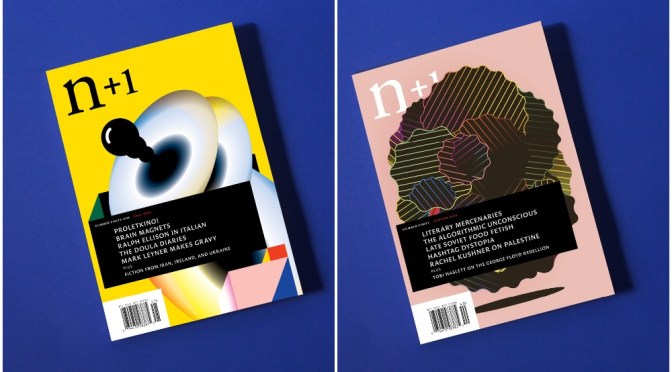
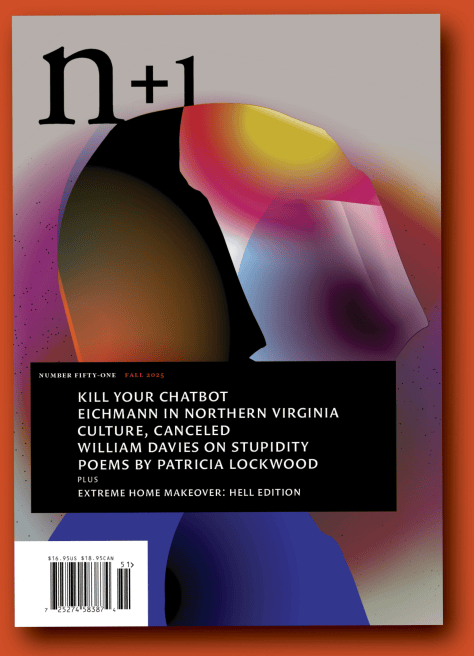
n+1 Magazine: The latest issue features ‘Force Majeure’ – New AI & I literature. Relate, revolt! Does Trump hate art? Idiocracy now. The new faces of ICE. Fiction by Elizabeth Schambelan.

Large Language Muddle

The AI upheaval is unique in its ability to metabolize any number of dread-inducing transformations. The university is becoming more corporate, more politically oppressive, and all but hostile to the humanities? Yes — and every student gets their own personal chatbot. The second coming of the Trump Administration has exposed the civic sclerosis of the US body politic? Time to turn the Social Security Administration over to Grok. Climate apocalypse now feels less like a distant terror than a fact of life? In five years, more than a fifth of global energy demand will come from data centers alone.

Two Days Talking to People Looking for Jobs at ICE

Naturally there were lots of law enforcement types hanging around the convention — men with military fades, moisture-wicking shirts, and tattoos of the Bible and the Constitution and eagles and flags distended across their arms. But there were also a handful of women ICE applicants and a lot of men of color. The deportation officer applicant pool was, I felt, shockingly diverse — one might say it looked like America. The whole place looked and felt like America.

Stupidology

The challenge posed by this political crisis is how to take the stupidity seriously without reducing it to a wholly mental or psychiatric, let alone genetic, phenomenon. Stupidity can be understood as a problem of social systems rather than individuals, as André Spicer and Mats Alvesson explore in their book The Stupidity Paradox. Stupidity, they write, can become “functional,” a feature of how organizations operate on a daily basis, obstructing ideas and intelligence despite the palpable negative consequences. Yet it’s hard to identify anything functional about Trumpian stupidity, which is less a form of organizational inertia or disarray than a slash-and-burn assault on the very things — universities, public health, market data — that help make the world intelligible.

THE GUARDIAN WEEKLY – SEPTEMBER 12, 2025 PREVIEW

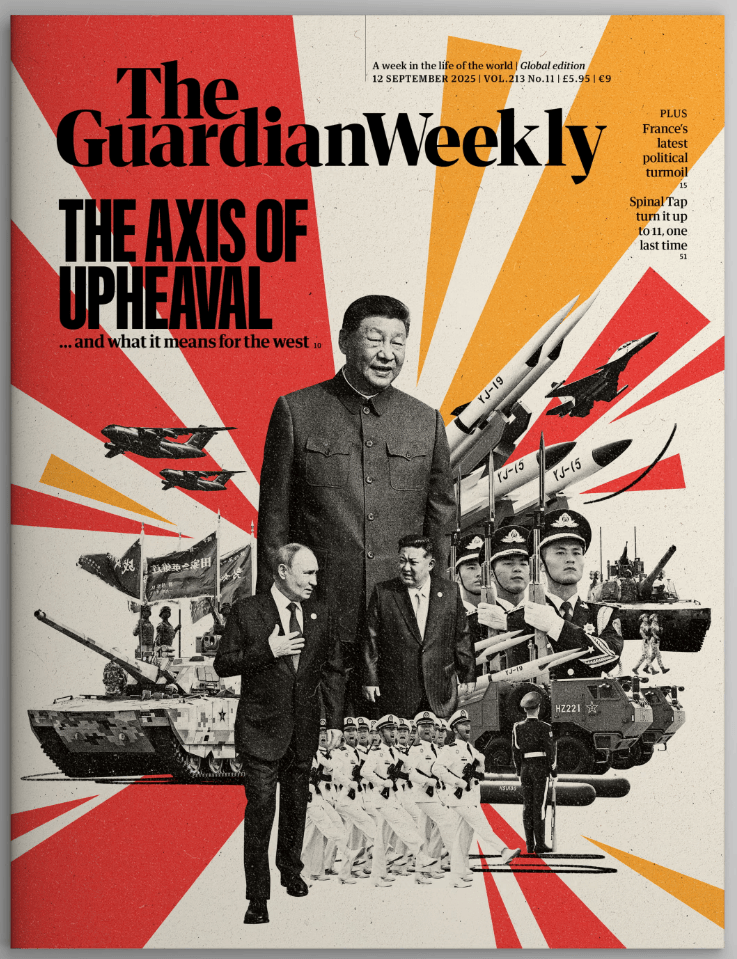
THE GUARDIAN WEEKLY: The latest issue features ‘The Axis of Upheaval…and what it means for the West’

Xi Jinping had been waiting for the right moment to serve notice of China’s growing might and influence to the rest of the world, and the 80th anniversary of the end of the second world war provided the Mao-suited Chinese leader with the perfect opportunity.

Last week’s bombastic (or should that be bomb-tastic?) military parade in Beijing – in the presence of Vladimir Putin, Kim Jong-un and a host of other global strongmen – was intended as a show of force and stability to contrast sharply with the chaotic unpredictability of Donald Trump’s America. And, as the leaders of the world’s most notorious pariah states bear-hugged and strolled around Tiananmen Square like the cast of Reservoir Dogs, the optics did not disappoint.

But behind the scenes, how robust actually is the so-called “axis of upheaval”? As our big story this week explores, the illiberal alliance is riven by internal fractures and mistrust between China, Russia and North Korea that date back many years and cannot be discarded as quickly as Xi, or anyone else, might like.

Spotlight | France’s latest political crisis
The fall this week of prime minister François Bayrou exposed a political malaise that is likely to sour French politics well beyond the 2027 presidential election, reports Paris correspondent Angelique Chrisafis

Interview | Leonard Barden, chairman of the chess board
From honing his game in air raid shelters during the second world war to beating grand masters, our record-breaking chess columnist has lived an extraordinary life. Now aged 96, he chats to our chief sports reporter Sean Ingle

Feature | Syria’s cycle of sectarian violence
Over a few brutal days in March, as sectarian violence and revenge killings tore through parts of the country, two friends from different communities tried to find a way to survive. By Ghaith Abdul-Ahad

Opinion | Angela Rayner’s exit is a bombshell for Keir Starmer
The UK deputy prime minister’s fall will exacerbate all the doubts about the PM himself and his ability to keep Labour in power, writes Jonathan Freedland

Culture | Spinal Tap turn it up to 11, one last time
More than 40 years since the film This Is Spinal Tap was mistaken for a comedy, its hard-rocking subjects are back for a legally obligated final gig. Our writer Michael Hann smells the glove

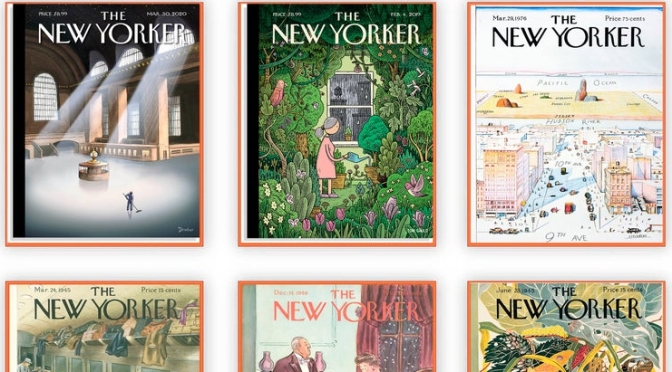
THE NEW YORKER MAGAZINE – SEPT. 15, 2025 PREVIEW

The illustrated cover of the September 15 2025 issue of The New Yorker in which a violinist plays his instrument while...

THE NEW YORKER MAGAZINE: The latest cover features ‘Kadir Nelson’s The Soloist” – A concert en plein air.

R.F.K., Jr., Brings More Chaos to COVID Policy and the C.D.C.

When MAGA met MAHA, Donald Trump vowed that Kennedy would “go wild on health.” Promises made, promises kept. By Dhruv Khullar

Playing the Field with My A.I. Boyfriends

Nineteen per cent of American adults have talked to an A.I. romantic interest. Chatbots may know a lot, but do they make a good partner? By Patricia Marx

Enemies of the State

How the Trump Administration declared war on Venezuelan migrants in the U.S. By Jonathan Blitzer

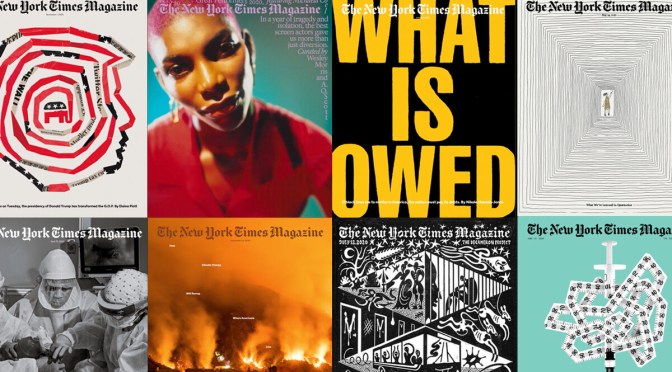
THE NEW YORK TIMES MAGAZINE – SEPT. 7, 2025

Current cover

THE NEW YORK TIMES MAGAZINE: The 9.7.25 Issue features Helen Ouyang on a clinic that is trying to convince men that getting checked out by a doctor could save their lives; Joshua Hunt on how anime took over America; Brooke Jarvis on the bloom after L.A.’s wildfires; and more.

What Does It Take to Get Men to See a Doctor?

Men in the United States live around five years less than women. One clinic is trying to persuade men that getting checked out could save their life.

The Old Climate-Activism Playbook No Longer Works. What Else Can?

Activists are hoping to recreate the magic of 1970’s Earth Day — at a moment when the movement’s future is cloudier than ever.

A.I. Enters the Museum

Talented artists are using the technology to do what talented artists always will: ask human questions and express human ideas.

How Has Being Perpetually Single Affected You?

We want to hear from women over the age of 30 who feel as if they have not yet had a meaningful relationship for a New York Times Magazine feature.

Chronicles Magazine — September 2025 Preview

Magazine - Chronicles

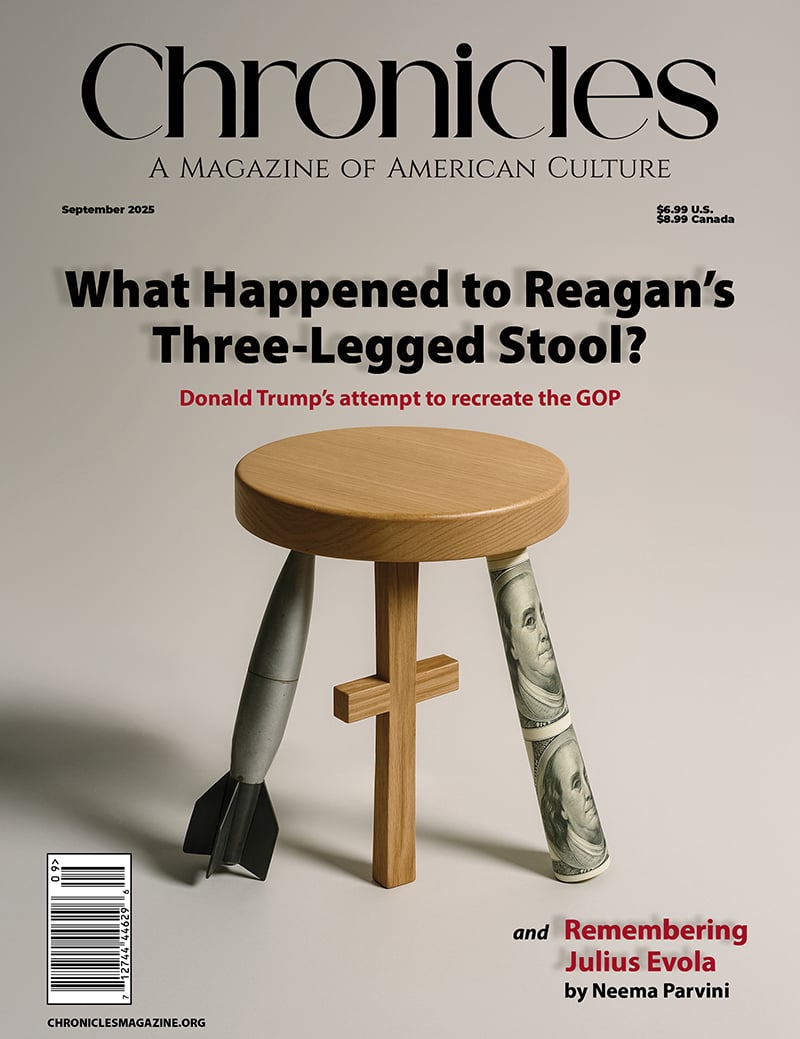
CHRONICLES MAGAZINE: The latest issue features ‘What Happened to Reagan’s Three-Legged Stool?’

Blaming the Blamable

Con Inc. talking heads like to frame inner-city voters as victims of Democratic administrations. In reality, urban populations, especially college-educated white women, are the U.S.’s most radical voters.

Remembering Alasdair MacIntyre

The late Alasdair MacIntyre equated justice with playing one’s assigned role in one’s community. This theme echoed in his major works.

The Law Allows Trump to Expand Federal Law Enforcement to Other Cities

Blue jurisdictions that do not shape up should expect to be visited by feds who have the law on their side. By Paul du Quenoy

THE NEW YORK TIMES MAGAZINE – August 31, 2025

Current cover

THE NEW YORK TIMES MAGAZINE: The 8.31.25 Issue features Nathiel Rich on the Calabasas landfill following the Los Angeles fires; Scott Anderson on Georgia’s turn toward Russia; Marcela Valdes on in-home care for disabled Americans; and more.

What Does It Take to Get Men to See a Doctor?

Men in the United States live around five years less than women. One clinic is trying to persuade men that getting checked out could save their life. By Helen Ouyang

The Gold Digger Was an Archvillain. Now She’s an Aspiration.

What do men and women really want in our fraught new mating economy?

The New Dream Guy Is Beefy, Placid and … Politically Ambiguous

Amid pitched debates about masculinity, the “himbo” stands stoically above it all. By Casey Michael Henry

THE NEW YORKER MAGAZINE – SEPT. 1 & 8, 2025 PREVIEW

A GIF switching the profiles of the dandy Eustace Tilley and the artist Condy Sherman.

THE NEW YORKER MAGAZINE: The latest cover features ‘Cindy Sherman’s and Rea Irvin’s Eustace Tilley – A special nod to celebrate a centenary of cultural coverage.

The Trump Administration’s Efforts to Reshape America’s Past

Ahead of next year’s two-hundred-and-fiftieth anniversary of the Declaration of Independence, the White House has issued a directive to the Smithsonian. By Jill Lepore

A.I. Is Coming for Culture

We’re used to algorithms guiding our choices. When machines can effortlessly generate the content we consume, though, what’s left for the human imagination? By Joshua Rothman

How a Billionaire Owner Brought Turmoil and Trouble to Sotheby’s

Patrick Drahi made a fortune through debt-fuelled telecommunications companies. Now he’s bringing his methods to the art market. By Sam Knight

THE NEW YORK TIMES MAGAZINE – August 24, 2025

Current cover

THE NEW YORK TIMES MAGAZINE: The 8.24.25 Issue features Shane Bauer writes about the disappeared children of Syria; Lauren Larson on the difficulties of setting a Guinness World Record in the modern era, Linda Kinstler on why wars no longer end; David Marchese interviews the negotiation expert Chris Voss; and more.

How Georgia Went From the Vanguard of Democracy to the Front Lines of Autocracy

Two decades after the Rose Revolution, the former Soviet satellite is turning away from the West and back toward Russia. What happened?

They Were Treated Like Orphans. But They Knew the Truth.

In Syria, the Assad regime took hundreds of children away from their parents. A Times investigation reveals the workings of the operation — and how one family fought to reunite. By Shane Bauer and Jim Huylebroek

Wholesome, Noble Superheroes Are Back. (A Wholesome, Noble World Is Not.)

This summer’s blockbusters leave behind the era of dark, “edgy” champions for heroes who can’t help but listen to their consciences. By Mike Mariani

Culture: New Humanist Magazine – Autumn 2025

The cover of New Humanist's Autumn 2025 issue is an illustration of an astronaut surrounded by stars

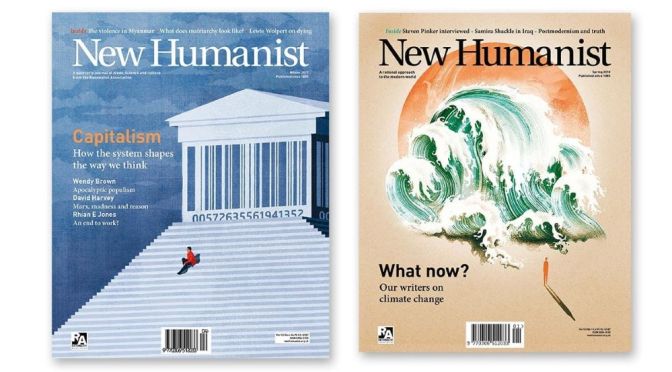
NEW HUMANIST MAGAZINE: This issue is all about how the battle over space – playing out unseen above us – concerns us all.

Space and society

In the latest edition of our “Voices” section, we ask five experts – from scientists to philosophers – how to protect space for the benefit of all of humanity.

“When people hear the term ‘space technology’, they tend to picture rocket launches, or maybe missions to the Moon … Other types of space activity with strong social impact tend to get less attention”

The satellite war

We speak to security expert Mark Hilborne about space warfare – and how it could be the deciding factor in the conflict between Russia and Ukraine.

“The public doesn’t understand how much we rely on space as a domain of warfare”

Sexism in space

When Nasa prepared a message to aliens with the Pioneer probes in the 1970s, sexism skewed how they represented humankind. Within the next decade, we may have another chance to send a message deep into space – and this time, we must do better, writes Jess Thomson.

“Only five objects we have crafted here on Earth are now drifting towards infinity, and four of them tell a lie about half of humankind”

American alien

The new Superman movie offers the vision of a kinder, more tolerant United States – saved by an immigrant, in this case a literal alien. But should we really pin our hopes on a superhero?

“Trump has even shared photoshopped images of himself as Superman. The idea that superheroes can save us all, if we just let them break all the rules, is one that the Maga followers find congenial”

The One-Room Rebellion

How Arizona’s microschool boom is reshaping the American classroom—and reviving old questions about freedom, equity, and the gaze of the state.

By Michael Cummins, Editor, August 21, 2025

Jeremy Bentham never saw his  panopticon built. The English philosopher imagined a circular prison with a central watchtower, where a single guard could observe every inmate without being seen. Bentham saw it as a triumph of efficiency: if prisoners could never know when they were being watched, they would behave as though they always were. A century later, Michel Foucault seized on the design as metaphor. In Discipline and Punish, he argued that the panopticon revealed the true mechanics of modern institutions—not brute force, but the internalization of surveillance. The gaze becomes ambient. The subject becomes self-regulating.

This, in many ways, is the story of the American public school. The common school movement of the mid-nineteenth century, led by Horace Mann, sought standardization: children from Boston to St. Louis would recite the same lessons, read the same primers, and adopt the same civic habits. As cities grew, schools scaled up. By the twentieth century, especially in the wake of A Nation at Risk, the classroom had become a site of discipline. Bells regulated time. Grades ranked performance. Administrators patrolled hallways like wardens. Testing regimes quantified ability. The metaphor was not lost on Foucault. Brown University notes that his vision of the panopticon extended beyond prisons to schools: a “system of surveillance where individuals internalize the feeling of being constantly watched, leading to self-regulation of behavior” (Brown University).

Every American child knows this regime. The bell rings. The roll is called. The test is bubbled and scanned. Hall passes are signed like parole slips. Cameras blink in cafeteria corners. Laptops carry software that tracks keystrokes. Even silence becomes an instrument of order.

Bentham saw efficiency. Foucault saw discipline. Students often see only the weight of the watchtower.

What happens when families walk out of the circle?

In the far suburbs of Phoenix, on the edge of the White Tank Mountains, a converted casita serves as the Refresh Learning Center. Founded in 2023 by a pastor and his wife, it doesn’t look like much—aluminum siding, recycled chairs, a wall chart that places the birth of the universe at 4004 B.C. Yet, as Chandler Fritz wrote in the September 2025 issue of Harper’s Magazine, the little school has become an emblem of a movement reshaping American education.

Its existence rests on a radical policy shift. In 2022, Arizona launched the nation’s most expansive Empowerment Scholarship Account (ESA) program. Unlike traditional vouchers, which could be redeemed only at approved institutions, ESA funds flow directly to parents—roughly $7,500 per student, sometimes more. Families can spend the money on almost anything that counts as “educational”: a cello, a VR headset, a trampoline, or, increasingly, a place in one of the microschools sprouting across the state.

The metaphor of the frontier clings naturally to Arizona. Here, in the desert’s glare, families are homesteading education in much the same spirit as settlers once claimed land. A garage becomes a classroom. A supply closet, a high school. A church basement, an academy. In his Harper’s piece, Fritz describes a child attending class in a room where chickens wandered the yard outside, and another high-school seminar meeting in a closet stacked with supply boxes. Parents pull their children not only for ideology but for intimacy, pace, or simple safety. “Without ESA, this school would not—could not—exist,” one founder told him.

For advocates, the program represents liberation from a failing system. For critics, it siphons resources from public schools already parched of funding. But for the families gathered in little schoolhouses like Refresh, the stakes feel simpler: children freed from the gaze of bureaucracy, from endless testing and administrative oversight, given room to learn like human beings again.

Microschools are not new. Before the rise of the common school, most American children learned in homes, barns, or one-room cabins where a single teacher instructed a dozen children of all ages. Reformers dismissed those spaces as unsystematic, unjust. The standardized school, they argued, would correct inequities and prepare citizens for democracy.

Today, the pendulum swings back. Inside Refresh’s aluminum-sided room, teenagers do crafts next to six-year-olds. Grade levels blur: a thirteen-year-old may still be in second grade; another, the same age, reads at a high school level. Students spend mornings mucking chicken coops and afternoons in shop class. A boy named Aaron, dyslexic and restless in traditional schools, thrives in the workshop, building desks and repairing tools. He dreams of becoming an Air Force mechanic. One teacher observed that he learned fractions by cutting lumber and measuring shelves—mathematics discovered in wood grain and sawdust.

Another student, Hailey, is quick with skepticism. She listens to indie rock from her AirPods between classes, balances her faith with her friendships, and rolls her eyes at biblical literalism. “Stop comparing everything to religion,” she wrote in a survey. “I know it’s a Christian school, but it’s annoying learning about history when it’s asking about the Bible.”

And then there is Canaan, a foster child, the oldest in the room. During a discussion of To Kill a Mockingbird, he startled his peers by pressing the point of segregation. “What if everyone were actually given the same resources?” he asked. The question, naïve and profound, echoed the legal logic of Brown v. Board of Education, though he had never heard of it. His teachers had worried about whether he was “ready” for a seminar text. Yet here he was, articulating the problem of equality with more clarity than many adults.

Their stories recall sepia-toned photographs of America’s one-room schoolhouses, where a teacher might balance a baby on one hip while drilling older students in long division. Nostalgia clings to such places, but for children like Aaron and Hailey and Canaan, the sense of being known—of not being lost in the machinery of standardization—is more than nostalgia. It is survival.

The ESA marketplace, though, has the volatility of a boomtown. Alongside earnest shop classes and backyard literature circles, Fritz encountered vendors offering tongue-posture therapy for ADHD, pirate-themed cooking classes tied to multilevel marketing schemes, even sword-making courses. In one Tucson suburb, a “Kids in the Kitchen” class doubled as an advertisement for a health supplement brand. Fraud has siphoned hundreds of thousands of dollars from taxpayers (Arizona Central).

More troubling is fragmentation. Public schools, for all their flaws, force pluralism: children from different families, faiths, and incomes learning together under one roof. In microschools, communities splinter. Wealthier families claim ESA funds for private tuition; poorer families scrape together what they can. Evangelical churches convert Sunday schools into full-time academies. A Southern Baptist initiative now urges every church with a basement to consider opening a weekday school. For some, ESAs represent not escape from the panopticon, but an opportunity to build new watchtowers of ideological oversight.

And yet—the children remain. Their stories suggest that the most powerful escape is not from testing regimes or surveillance, but from anonymity. In a one-room schoolhouse, a teacher cannot forget you. Your hands matter. Your questions land. You are not a datapoint in a dashboard but a voice in a circle.

The paradox of the new homestead is that it is subsidized by the very state it seeks to escape. Every ESA contract is drawn from public funds, even as public schools wither under declining enrollment and teacher shortages. Arizona’s superintendent warned in 2024 that the state’s teacher shortage, already in the thousands, could “eventually lead to zero teachers” (Arizona Policy). Meanwhile, parents swipe ESA debit cards for pianos, VR headsets, or ski passes.

But the deeper paradox is philosophical. The panopticon teaches that institutions discipline by watching. Yet children, it turns out, discipline themselves when unseen, too. In one seminar, Canaan insisted that segregation was the true injustice, not just a false verdict. Without oversight, a conversation about reparations and justice unfolded around plastic tables in a desert conversation.

Could it be that the very fragmentation critics fear might also produce unexpected awakenings? That freedom from the gaze of the state could allow children to stumble, clumsily but genuinely, into civic consciousness?

The question is not whether microschools should exist—they already do, enrolling as many students as Catholic schools nationwide. The question is how to balance their intimacy with the democratic promise of education for all. Some states experiment with guardrails: Georgia ties funds to low-performing districts; Iowa requires accreditation and assessments. Arizona, the boldest frontier, remains laissez-faire. The experiment is still young, and the stakes enormous.

Bentham dreamed of efficiency. Foucault warned of discipline. But neither accounted for what happens when the watchtower is abandoned, when families strike out into the desert to build little schools of their own. The panopticon dissolves, and in its place rises the homestead, the one-room schoolhouse, the handmade desk, the boy who lights up in shop class.

Public education was once America’s grandest democratic experiment: the poor man could reach into the rich man’s pocket and demand an education, as Emerson put it, “not as you will, but as I will” (Ralph Waldo Emerson, Education). That dream is endangered—not only by privatization, but by the creeping sense that children are means rather than ends, data points rather than persons.

The frontier metaphor cuts both ways. It can justify privatization, sectarianism, inequality. But it also gestures toward freedom, self-reliance, discovery. The challenge now is to reclaim the best of the homestead spirit—education as intimate, child-centered, alive—without abandoning the pluralistic commons that democracy requires.

Wallace Stegner once called life on the frontier a “homemade education.” He meant not only the Bible lessons of pioneer families but the curriculum of the land itself—children learning resilience from drought, ingenuity from scarcity, curiosity from the wide sky. The graduates of such an education—Lincoln, Twain, Cather, John Wesley Powell—proved that learning could be stitched together from books, rivers, and conversation. Powell, chastised in school for his parents’ abolitionist views, was pulled from the classroom and tutored privately. He learned geology by picking up stones, ornithology by watching birds, justice by watching neighbors turn cruel. The lessons carried him down the Colorado River, into history.

Perhaps the future lies not in the panopticon or the homestead alone, but in something more fluid: a system where every child is seen not from above, but up close. Where accountability measures ensure equity without strangling individuality. Where the workshop and the test, the prayer and the debate, the child who loves Jesus and the child who loves indie rock can share the same fragile, human classroom.

Education is not a prison, nor a frontier settlement. It is, at its best, a river: wide enough to carry all, winding enough to follow curiosity, strong enough to shape the land it touches. The question is whether we will keep damming it with watchtowers—or whether we will learn, finally, to let it flow.

THIS ESSAY WAS WRITTEN AND EDITED UTILIZING AI