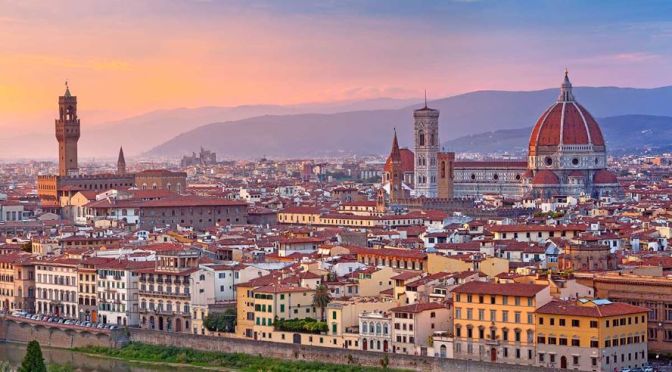
City Views: A 360° Walking Tour Of Florence, Italy

Florence, Italian Firenze, is the capital of Firenze provincia (province) and Toscana (Tuscany) regione (region), central Italy. The city, located about 145 miles (230 km) northwest of Rome, is surrounded by gently rolling hills that are covered with villas and farms, vineyards, and orchards. Florence was founded as a Roman military colony about the 1st century BCE, and during its long history it has been a republic, a seat of the duchy of Tuscany, and a capital (1865–70) of Italy. During the 14th–16th century Florence achieved preeminence in commerce and finance, learning, and especially the arts.

Florence
Florence

The present glory of Florence is mainly its past. Indeed, its historic centre was inscribed on UNESCO’s World Heritage List in 1982. The buildings there are works of art abounding in yet more works of art, and the splendours of the city are stamped with the personalities of the individuals who made them. The geniuses of Florence were backed by persons of towering wealth, and the city to this day gives testimony to their passions for religion, for art, for power, or for money. Among the most famous of the city’s cultural giants are Leonardo da Vinci, Michelangelo, Dante, Machiavelli, Galileo, and its most-renowned rulers, generations of the Medici family.

Filmed in October 2022

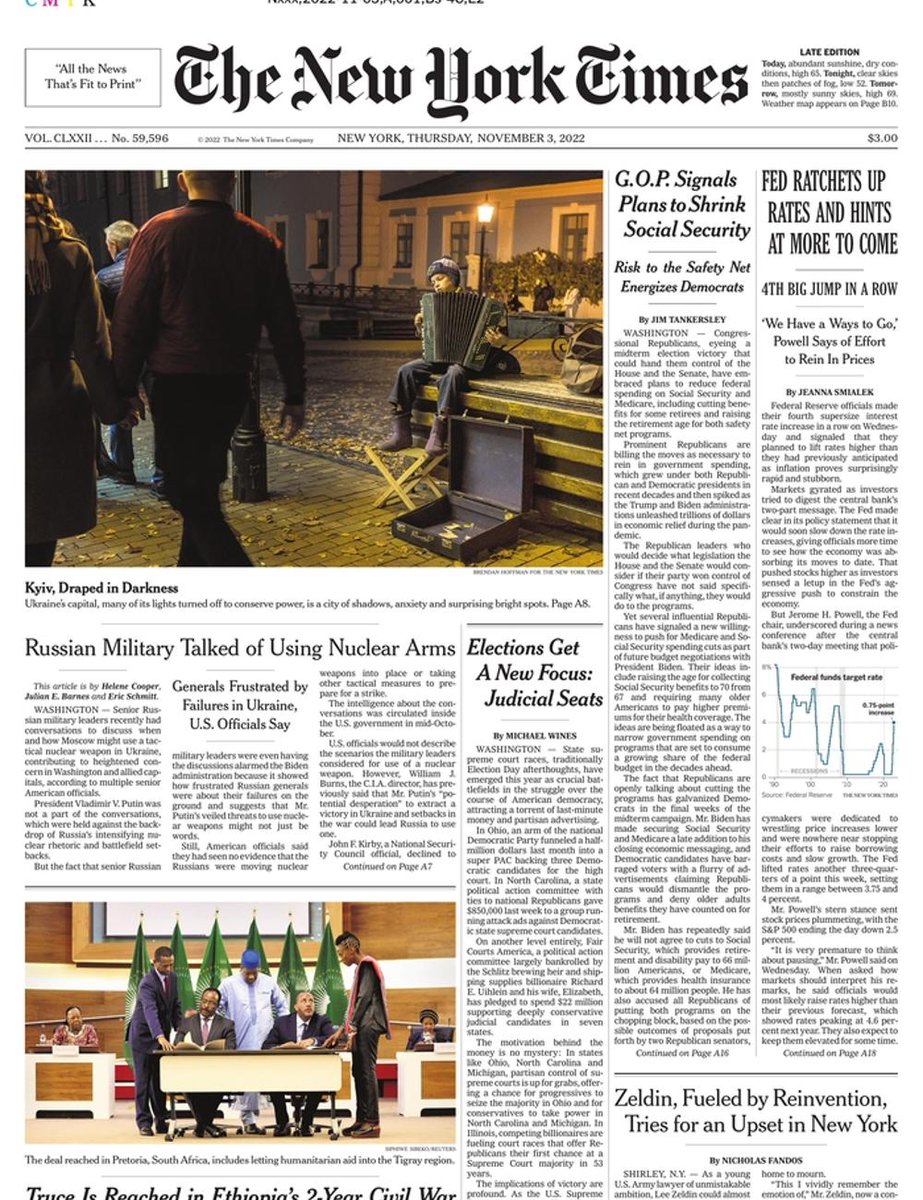
Front Page: The New York Times – November 3, 2022

Image

Fed Makes Fourth Jumbo Rate Increase and Signals More to Come

The Federal Reserve has now raised interest rates six times this year as it tries to quash the fastest inflation in four decades.

Russian Military Leaders Discussed Use of Nuclear Weapons, U.S. Officials Say

The conversations alarmed the Biden administration because they showed how frustrated Moscow had become over its battlefield setbacks in Ukraine.

Republicans, Eyeing Majority, Float Changes to Social Security and Medicare

Democrats have seized on Republican proposals to limit retirement benefits to galvanize voters ahead of the midterm elections.

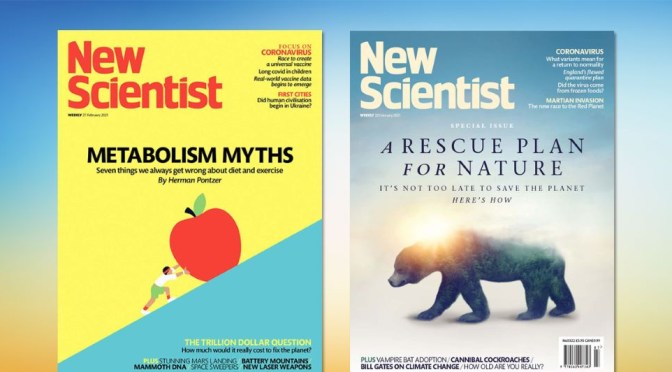
Preview: New Scientist Magazine – Nov 5, 2022

New Scientist Default Image

How technology is revolutionizing our understanding of ancient Egypt

New Scientist – A century on from the discovery of Tutankhamun’s tomb, CT scans, 3D printers and virtual reality are bringing the world of the pharaohs – and ordinary ancient Egyptians – into sharper focus

The truth about the foods said to boost your immune system

Many foods thought to enhance our natural defences, such as orange juice and turmeric, don’t live up to the hype. Instead, the key to a healthy immune system lies in nurturing your gut microbiome

The cosmologist who claims to have evidence for the multiverse

Cosmologist Laura Mersini-Houghton says our universe is one of many – and she argues that we have already seen signs of those other universes in the cosmic microwave background, the light left over from the big bang

Travel Guides: Culture & Food In Montreal, Canada

Attaché – Our Montreal travel guide! What a place. It really feels like Montreal shouldn’t exist, it’s such a strange confluence of cultures. But I am so glad it does. And I finally got to experience my Montreal food unicorn – poutine. Glorious, wonderful, Montreal poutine. Absolutely worth waiting 43 years for! Montreal, you have my heart…despite the clogged arteries.

Video timeline: 00:00 – Intro 01:07 – Transport 04:33 – Sponsor 06:01 – Food 10:39 – Money

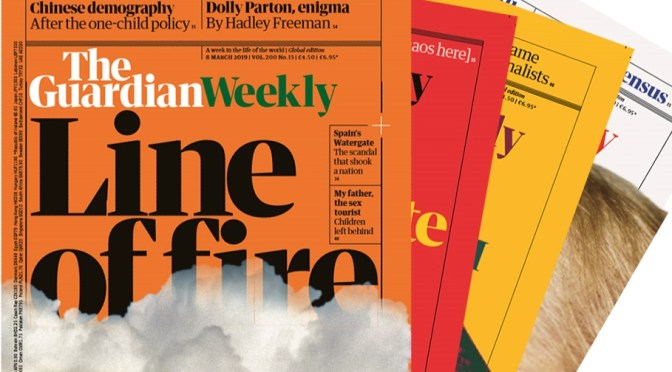
Previews: The Guardian Weekly – November 4, 2022

Inside Guardian Weekly – For readers of the Guardian Weekly magazine’s North American edition this week, the cover focuses on the Democrats’ precarious hopes in the midterm elections. Elsewhere, the spotlight shines on the Cop27 climate summit in Egypt.

The US midterm elections next week could see a Republican party still dominated by Donald Trump gain control of both the House of Representatives and the Senate. David Smith asks whether an intervention by former president Barack Obama could give a late kickstart to the Democrats’ hopes.

Cautious optimism followed the last Cop conference in Glasgow, where an international roadmap was agreed to keep the world within 1.5C of global heating. On the eve of this year’s summit, however, a slew of alarming reports have shown that carbon emissions are still rising.

Travel In Denmark: Three Top Spots In Copenhagen

Instagram is full of colorful pictures of Copenhagen. But what does the Danish capital really look like? We checked out three of the most popular spots – we went to see the old harbor Nyhavn, strolled around the 16th century Rosenberg Castle and had a blast at the famous Tivoli amusement park.

Copenhagen, Denmark’s capital, sits on the coastal islands of Zealand and Amager. It’s linked to Malmo in southern Sweden by the Öresund Bridge. Indre By, the city’s historic center, contains Frederiksstaden, an 18th-century rococo district, home to the royal family’s Amalienborg Palace. Nearby is Christiansborg Palace and the Renaissance-era Rosenborg Castle, surrounded by gardens and home to the crown jewels. 

Preview: Art In America Magazine November 2022

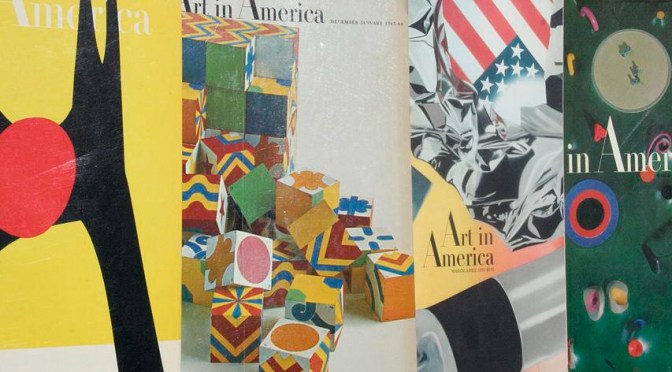
Magazine cover shows an abstract print evoking a sunset in the American Southwest. Top says Art in America "The Southwest: Aerial Photography + Native Feminisms + Rose B. Simpson

Art in America – The history of the Southwest is long and vexed. Many think of America as developing from east to west, from the original 13 colonies to settlements made in the name of Manifest Destiny. But the West in all its richness was there, of course, long before it was “discovered” by venturers from elsewhere. The region has been home to a palimpsest of cultures, but the gruesome theft of land from Indigenous people remains a defining trauma. The southernmost parts of the Southwest at one time belonged to Mexico; today that area is embroiled in battles over immigration, and scarred by a former president’s xenophobic desire to build a wall. Plagued by drought, the entire Southwest tolls the ominous bell of climate change.

GOD’S-EYE VIEWS
by Jackson Arn

Aerial photography captures the Southwest’s natural splendor, explosive urban development, and military secrets.

Tech: ‘Smell Cyborgs’ That Can Sniff Out Trouble (FT)

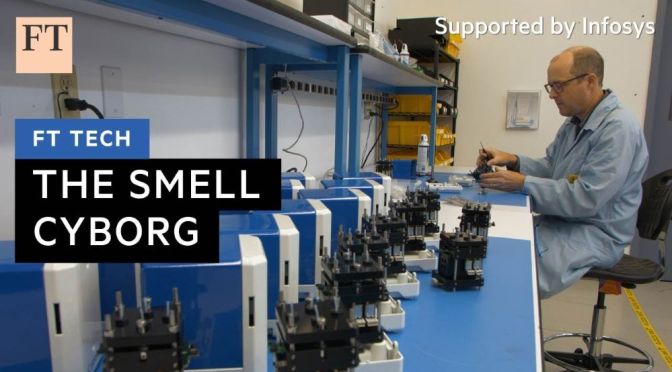
Financial Times – It could be the Shazam of smells. A California-based start-up has developed a device to sniff out substances such as drugs, explosives and viruses. Sniff tech is a burgeoning sector which could have major implications in fields including healthcare and security but may also raise issues over individual privacy. The FT’s Patrick McGee takes a trip to the lab and gets a good whiff of how the future might smell.

Koniku builds smell cyborgs. We will put out small form factor smell cyborgs in 10 million homes inside this decade. We aim to securely and safely diagnose disease and maintain health and wellness in real-time. We are building a marketplace that makes every individual the CEO of their own health.

HEALTH: HOW CHRONIC KIDNEY DISEASE, DIABETES & HEART DISEASE ARE LINKED

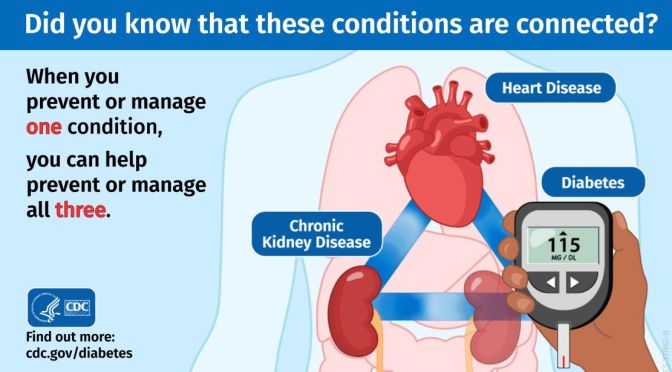
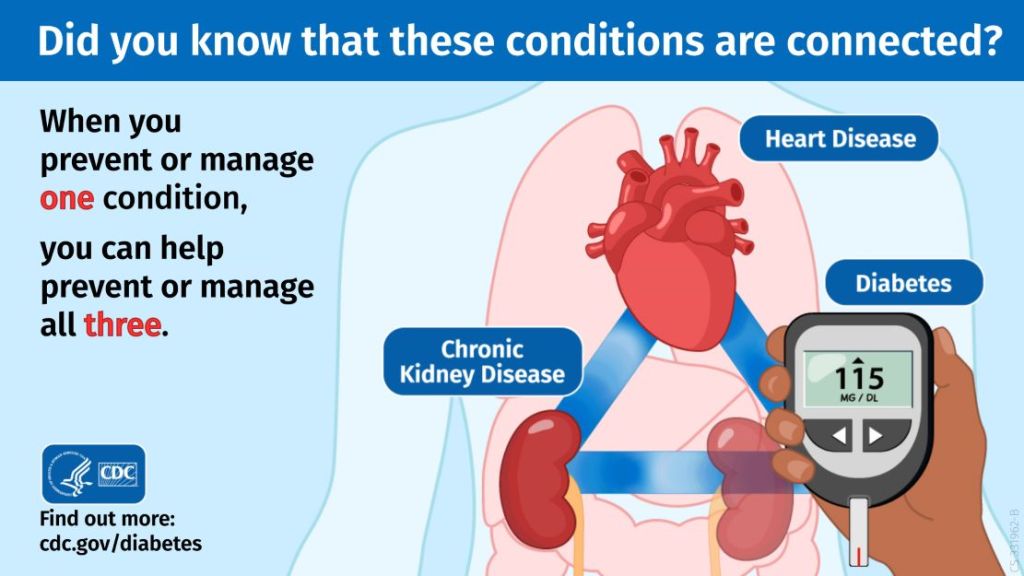
Centers for Disease Control and Prevention (CDC) – The body is complicated! While organs in your body each have a specific job to do to keep you healthy, they still rely on each other to function well. When one organ isn’t working the way it should, it can put stress on other organs, causing them to stop working properly as well.

The relationship between chronic kidney disease (CKD), diabetes, and heart disease is one example of the ways our organs are connected.

The body uses a hormone called insulin to get blood sugar into the body’s cells to be used as energy. If someone has diabetes, their pancreas either doesn’t make enough insulin or can’t use the insulin it makes as well as it should.

If someone has CKD, their kidneys are not able to filter out toxins and waste from their blood as well as they should.

Heart disease refers to several types of heart conditions. The most common condition, coronary artery disease, leads to changes in blood flow to the heart, which can cause a heart attack.

Make the Connection

So how are these three conditions connected? Risk factors for each condition are similar and include high blood sugar, high blood pressure, family history, obesity, unhealthy diet, and physical inactivity.

High blood sugar can slowly damage the kidneys, and, over time, they can stop filtering blood as well as they should, leading to CKD. Approximately 1 in 3 adults with diabetes has CKD.

When the kidneys don’t work well, more stress is put on the heart. When someone has CKD, their heart needs to pump harder to get blood to the kidneys. This can lead to heart disease, the leading cause of death in the United States. Change in blood pressure is also a CKD complication that can lead to heart disease.

Luckily, preventing or managing one condition can help you prevent and manage the others and lower the risk for more complications.

News, Views and Reviews For The Intellectually Curious