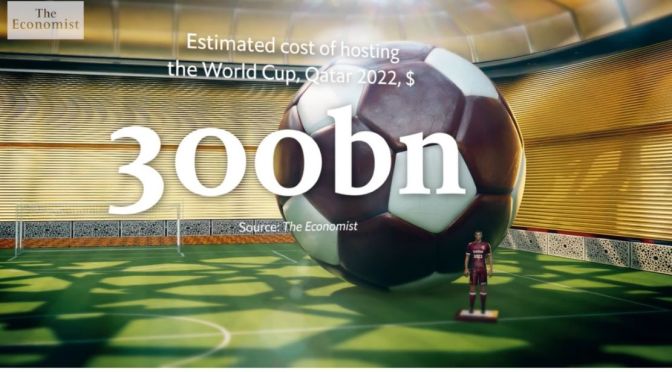
The Economist – Qatar is about to host the most expensive World Cup ever, costing as much as $300bn. Why has this small, gas-rich kingdom chosen to host football’s most prestigious event, and how does it fit into its broader plans for economic transformation?
Video timeline: 00:00 – Why is Qatar hosting the World Cup? 00:57 – World Cups are expensive competitions 01:56 – Qatar’s human rights violations 02:36 – Qatar’s place in the Gulf 04:43 – Qatar distinguishes itself from its neighbours 05:50 – Qatar bids to host the World Cup 07:18 – Qatar’s neighbours issue a blockade 10:12 – What might happen after the World Cup?
0:15 Global Population Reaches 8 Billion – That’s 8 times more humans than existed in 1800. Even so, the world’s population is growing at its slowest rate since 1950 due to a declining global fertility rate. Today there are an average of 2.3 births per woman. In 1950 it was 5. The world’s population is projected to peak at 10.4 billion by 2080.
1:49 The Economic Case for Climate Adaption – Climate adaptation means preparing our ecological, social and economic systems so they can cope with the future impacts of climate change. Heatwaves, storms, wildfires: the costs of climate change are already mounting but so far only 20% of climate finance has gone towards adaptation.
3:44 French Start Up Blends Wind and Solar Energy – Unéole’s energy system combines a photovoltaic rooftop panel with 2 compact wind turbines, generating 40% more energy than an ordinary rooftop panel. Solar panels work best in strong sunlight but Unéole’s units generate power when it’s overcast or during winter and can turn through the night to ensure a steady flow of power. The turbines are silent, so they don’t disturb building occupants and they’re built from mostly recycled aluminium and steel.
4:54 Lab Grown Blood Used in World First – UK scientists have transfused lab-grown blood into humans for the first time. It could revolutionize treatment for people with rare blood types, especially those who need regular transfusions. Two people were injected with 1-2 teaspoons of the synthetic blood to see how how their bodies respond. So far, so good – the trial participants are fit and healthy with no reported side effects.
Ben Luke talks to Hannah McGivern, a correspondent for The Art Newspaper who has just been to Qatar, about the vast number of public art projects that will accompany the FIFA Men’s World Cup that begins there on Sunday 20 November.
She also discusses the museums that Qatar plans to open by 2030. How does this explosion of cultural initiatives sit with Qatar’s record on human rights and treatment of low-paid migrant workers in the building of its cultural venues and World Cup stadia? It has been a heady fortnight of auctions in New York.
Ben speaks to Georgina Adam, an editor-at-large at The Art Newspaper, about the highs and lows, and whether we can expect even more sales of blockbuster collections in the coming years.
And this episode’s Work of the Week is an untitled painting by Luis Meque, an artist born in Mozambique who came to fame in the 1980s and early-1990s in Zimbabwe. Tandazani Dhlakama, the curator of the exhibition When We See Us: A Century of Black Figuration in Painting at Zeitz Museum of Contemporary Art Africa in Cape Town, tells us about Meque’s painting and his brief and brilliant life.When We See Us: A Century of Black Figuration in Painting, Zeitz Museum of Contemporary Art Africa, Cape Town, South Africa, 20 November-3 September 2023 Hosted on Acast. See acast.com/privacy for more information.
Like most hauntings, Fleur Jaeggy’s books are often quite baroque, but they cast a strange spell that causes everyone to remember them as nothing but austere.
Sweet Days of Discipline by Fleur Jaeggy, translated from the Italian by Tim Parks
The Water Statues by Fleur Jaeggy, translated from the Italian by Gini Alhadeff
I Am the Brother of XX by Fleur Jaeggy, translated from the Italian by Gini Alhadeff
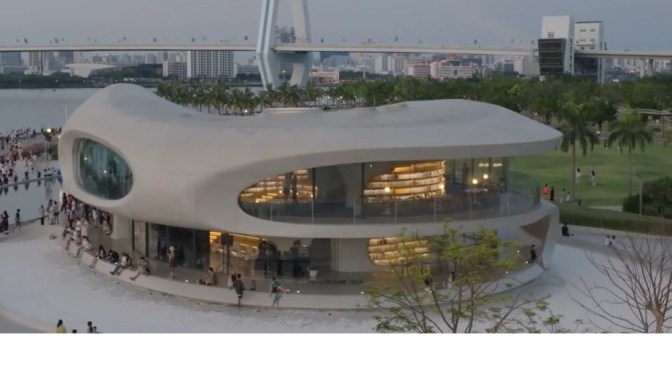
Dezeen – In the first instalment of Dezeen’s new Concrete Icons series produced in collaboration with Holcim, MAD Architects founder Ma Yansong explains how his firm’s sinuous concrete library in Haikou, China encourages visitors to use their imagination.
Yansong is the first participant in Concrete Icons, a new video series profiling the most iconic contemporary concrete buildings by the world’s leading architects. The video focusses on MAD’s Cloudscape of Haikou, a library with a flowing form cast in white concrete located in a waterside park in Haikou on the island of Hainan.
Completed in 2021, the 1,000-square-metre structure houses a library, cafe, restrooms, showers, a nursery room, and bike storage, and acts as a waystation for visitors to the park. Speaking to Dezeen in an exclusive video interview filmed at MAD’s offices in Beining, Yansong explained how the building is designed to put visitors in a contemplative or imaginative state of mind.
MAD Architects, led by Ma Yansong, has announced the opening of the Cloudscape of Haikou is located on the southern tip of China. A unique urban public and cultural space for citizens and visitors to Haikou, this flowing, sculptural concrete form was named as one of the “most anticipated architecture projects of 2021” by The Times of London.
A prominent port city on the southern tip of China, Haikou was once an important stop on the Maritime Silk Road. With the establishment of the Hainan International Tourism Island and Hainan Free Trade Zone, Haikou’s influence has seen a gradual resurgence in modern times. Meanwhile, Haikou’s government is also enriching the city’s cultural importance, through enhancing the social attributes of the city’s public spaces, and strengthening the connection between the city, humanities, and architecture. The Cloudscape of Haikou is one such culmination of this effort.
The Cloudscape of Haikou is the first of sixteen coastal pavilions commissioned by the Haikou Tourism and Culture Investment Holding Group to rejuvenate the historic port city, with the aim of improving public space along the coastline. Known as “Haikou, Pavilions by the Seaside,” the initiative invited teams of internationally recognized architects, artists, and interdisciplinary professionals to create sixteen landmark public stations.
With a growing number of people living with pain, we desperately need to understand it – but we are still unravelling the mysterious mechanisms behind the phenomenon
FEATURES – Roger Penrose: “Consciousness must be beyond computable physics”
FEATURES – Why emotions can feel so painful – and what it means for painkillers
FEATURES – We are only just beginning to understand what causes nociplastic pain
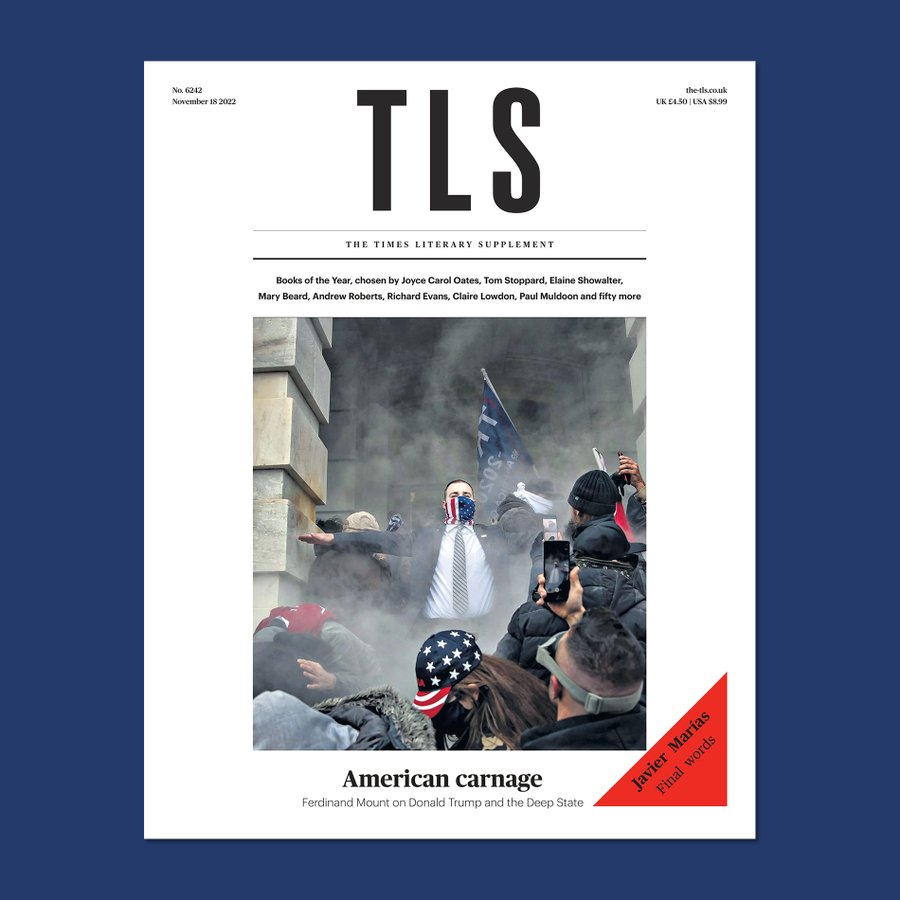
Times Literary Supplement – November 18, 2022 issue of the @TheTLS, featuring Books of the Year; Ferdinand Mount on a second Trump term; @guydammann on opera funding in England; @KieranSetiya on beauty; and Javier Marías’s last column on translation (tr., Margaret Jull Costa) – and more.
News, Views and Reviews For The Intellectually Curious