
SHE READ TACITUS

Intellicurean Essays

New on Intellicurean

She Read Tacitus

A young woman seen from behind, reading by candlelight at a winter window, while guardsmen with torches march through the snow below

In the winter after her son was taken from her, the grand duchess who would become Catherine the Great read the Annals of Tacitus and wrote later that it caused “a singular revolution in my brain.” Seven years later she took a throne. What she learned from Tacitus was not how to seize one. It was who writes the record afterward.

In the winter after her son was taken from her, a grand duchess of twenty-five read the Annals and wrote later that it caused “a singular revolution in my brain.” Seven years later she took a throne. What she learned from Tacitus was not how to seize one. It was who writes the record afterward.

Catherine managed three documents about the coup of 1762: a manifesto that said she was compelled, a second that said her husband died of colic, and a long letter to a lover in Warsaw that told him everything, hour by hour, and told him colic too. A fourth document was found in her cabinet thirty-four years later: a note from Alexei Orlov confessing a drunken accident at Ropsha, which clears her of ordering the death, which survives only in a copy made in a quarter of an hour by a courtier of her son’s, and which the archive, when asked directly, cannot find.

A carriage at a gallop on a dawn road along the sea, guardsmen closing round

The Peterhof road, six in the morning, 28 June 1762, as the essay imagines it. A generated image, not a record.

Why we’re pointing you there

Michael Cummins reads the four documents the way Tacitus taught Catherine to read everything: as records made by parties with reasons. Herzen in 1858, Bain in 1902, a Russian archivist who counted the letters in the folder and found two, and a confession that got drunker with each printing. One guess, graded, about why she wrote her own account first; two readings of the forgery, if it is one; and an ending in a drawer that held either the proof of her innocence or nothing at all.

The reader of Tacitus was read, at the end, by Tacitus’s method. The method cannot tell which.

Read the essay at Intellicurean →

Intellicurious points to the best of what we read and make. The full essay, with its sources and colophon, lives at intellicurean.com.
IS CHINA WINNING ENERGY?

The Intellitake
One argument · Two sides · One verdict · Daily
Saturday, September 26, 2026 · The Electrostate Debate
“

What the West calls China’s overcapacity, the climate calls a solution: too much clean energy, too cheap, too fast.

The Thesis — Azhar Azam, Eurasia Review

THE ARGUMENT

In Eurasia Review, geopolitical analyst Azhar Azam argues that the clean-energy “overcapacity” Washington and Brussels treat as an industrial threat is in fact accelerating global decarbonization — driving down technology costs and opening access across the developing world. The numbers behind him, from Ember’s new China Energy Transition Review: nearly 1,700 gigawatts of wind and solar added in a decade; roughly 60 percent of the world’s new battery storage installed in China last year; electric trucks at about 26 percent of new sales; and — the milestone — clean power grew fast enough in 2025 to meet all of China’s demand growth, pushing thermal generation down 0.7 percent, with coal generation broadly flat since early 2024. His conclusion: harness the benefits of Beijing’s scale without deepening strategic dependencies — but harness them.

vs

THE ANSWER

The sympathetic skeptic’s case runs through Bloomberg Opinion’s energy columns: in “China’s Energy Future Still Runs on Old Technology”, the celebrated “electrostate” is falling behind its own solarpunk dream — beneath the record solar farms, the system that actually powers China remains built on the old foundation. A companion column’s title states the charge plainly: “Xi’s Timidity Is Coal’s Last and Best Hope”. On this view, China still burns roughly half the world’s coal and keeps approving new plants; flat is not falling, and a transition that protects its incumbent isn’t finished — it’s hedged. The electrostate is real, the skeptics grant. So is the smokestack behind it.

iC

THE INTELLITAKE

Both sides read the same grid and agree on the astonishing part: no nation has ever built clean energy at this speed, and in 2025 the buildout finally outran demand itself. The dispute is over which fact is the trend and which is the residue — whether flat coal is the plateau before the fall, or the floor the system still stands on. Notice, too, the strange geometry of the argument: the West’s trade-policy complaint and the climate’s deepest need turn out to be the same fact — a country manufacturing more cheap clean energy than the world ordered. Whether China is “winning” energy may matter less than the question Azam forces: if someone must flood the world with solar panels, batteries, and electric trucks, does it matter to the atmosphere whose flag is on the crate?

TODAY’S PROVOCATION

If the fastest road to a livable climate runs through Beijing’s factories, should the West take it — dependencies and all?

— THE EDITORS, INTELLICURIOUS —

BARRON’S MAGAZINE – SEPTEMBER 28, 2026

BARRON’S MAGAZINE: The latest issue features ’16 Picks In The Booming Biotech Sector’ – A wave of innovation has drawn investors back to the stocks. How to play it.

Innovation Is Driving a New Bull Market in Biotech. 16 Picks From Our Roundtable Pros.

Biotechnology stocks are soaring this year as medical advances and merger activity rekindle investor interest. More gains lie ahead, our healthcare panel says.

Trump Calls Xi Meeting ‘Very Productive.’ What Investors Might Not Like.

The two leaders appear intent on preserving stability.

Meta Stock Soared 27% on Muse AI. The Hard Part Comes Next.

The meteoric rise of Meta’s fortunes over the past three weeks will be challenging to maintain.

The AI ‘Jobpocalypse’ Isn’t Happening. Here’s What the Data Actually Shows.

New research suggests the technology is creating new roles rather than wiping out all white-collar work.

The ‘Buffett of Bonds’ Hasn’t Retired Yet—and He Has Advice for These Tumultuous Times

The Buffett of Bonds isn’t retiring yet. Dan Fuss, on whom we bestowed that moniker decades ago, is still putting in a full week as vice chairman of Loomis Sayles. And he sounded as sharp as ever when we caught up with him this past week, just before he was to mark his 93rd birthday.

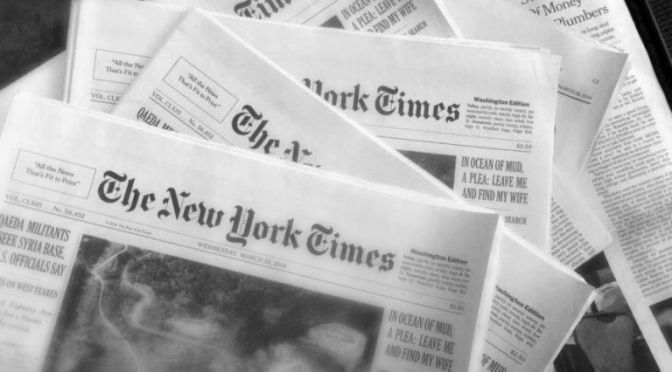
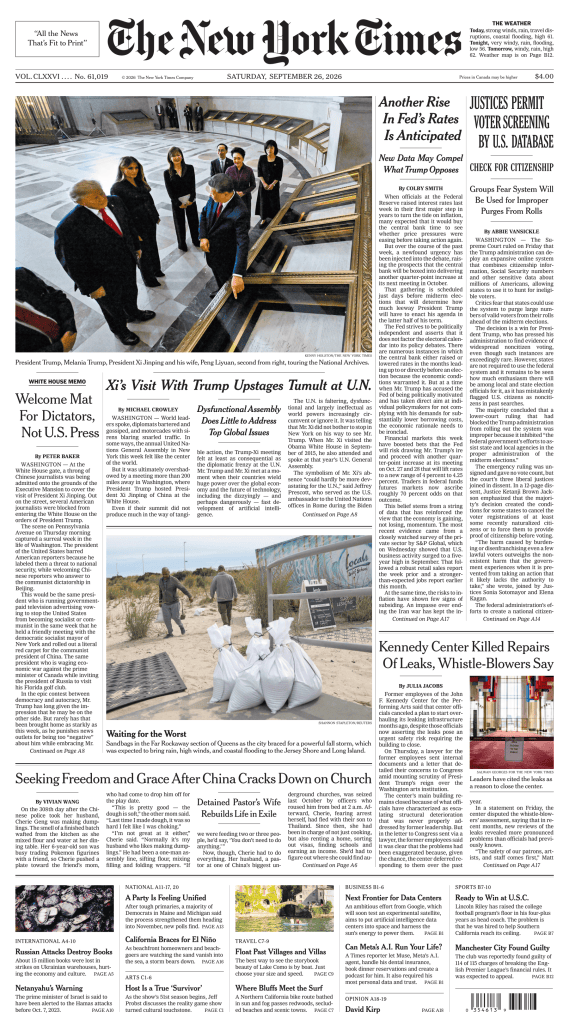
THE NEW YORK TIMES – SATURDAY, SEPT. 26, 2026

At Summit, Xi Sought to Tilt Trump’s Stance on America’s Place in Asia

In his talks with President Trump, the Chinese leader used praise, warnings and wartime history to challenge American support for Taiwan and Japan.

China’s Xi Snubs a Troubled U.N. for Trump, Overshadowing Its Big Week

The U.S.-China summit offered a sharp contrast with the action at the faltering United Nations in a gridlocked New York.

You Get an Eagle, and You Get an Eagle: Xi Takes Home Trump’s Go-To Gift

The president has often reached for statues of the national bird on diplomatic occasions in his second term. (Ronald Reagan favored them, too.)

Heroine or Public Enemy? The Israeli Blocking Much of Netanyahu’s Agenda.

Gali Baharav-Miara, Israel’s first female attorney general, has stopped many of the government’s efforts to remove constraints on its power.

A 7-Day Standoff That Said So Much About Trump and the Media

An abrupt decree, a network boycott, a legal intervention and an uneasy détente: This was no typical battle between a president and his press corps.

White House Blocks CNN From Air Force One

In the latest twist, the news outlet won’t be able to accompany President Trump on a trip to Tennessee today.

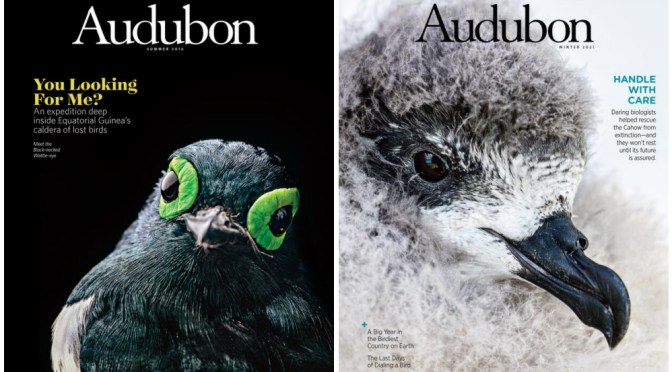
AUDUBON MAGAZINE – AUTUMN 2026 PREVIEW

AUDUBON MAGAZINE: The latest issue features ‘2026 AUDUBON PHOTOGRAPHY AWARDS’….

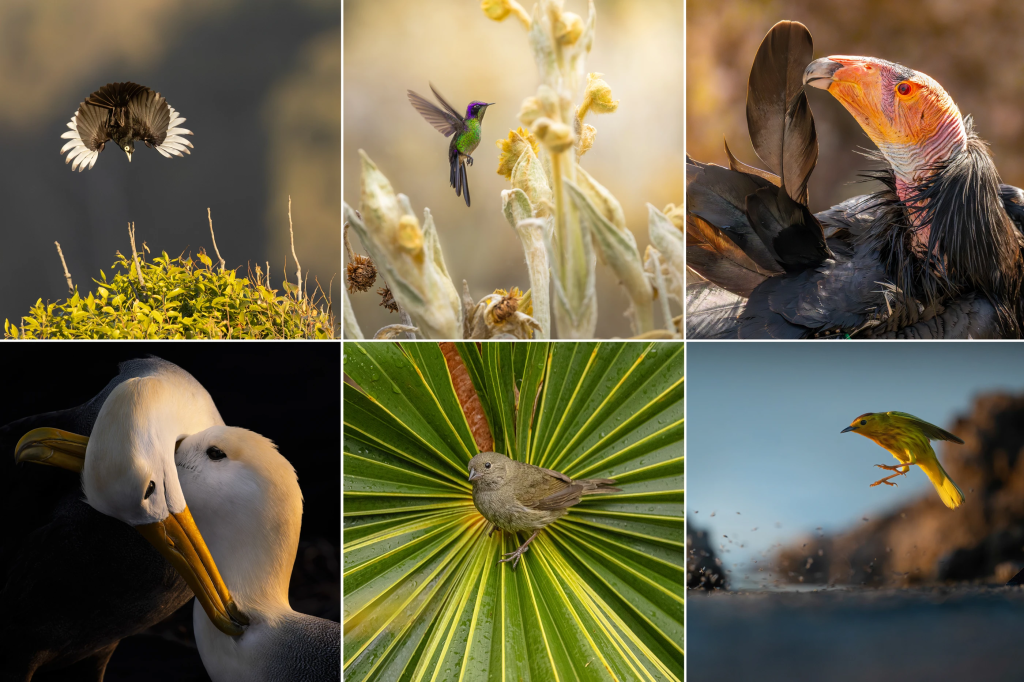
The 2026 Audubon Photography Awards: The Top 100

These jaw-dropping images and behind-the-scenes stories showcase the photographers’ artistry and the beauty of birdlife from Canada to Chile.

Smoke from Wildfires Is a Growing Health Threat to Both People and Birds

Catastrophic wildfires are stalling decades of clean air progress. Now scientists are asking: How can we help birds navigate a hazier future?