The Globalist Podcast (August 12, 2024): As the Olympic Games wrap up in Paris, France is forced to face the political crisis that has been brewing in the background.
We also discuss the latest efforts to bring peace to war-torn Sudan, what’s next for Rwanda as Paul Kagame is sworn in yet again and why the prime minister of Fiji is on a week-long trip to China. Plus: news from the Balkans and a look at the day’s newspapers.
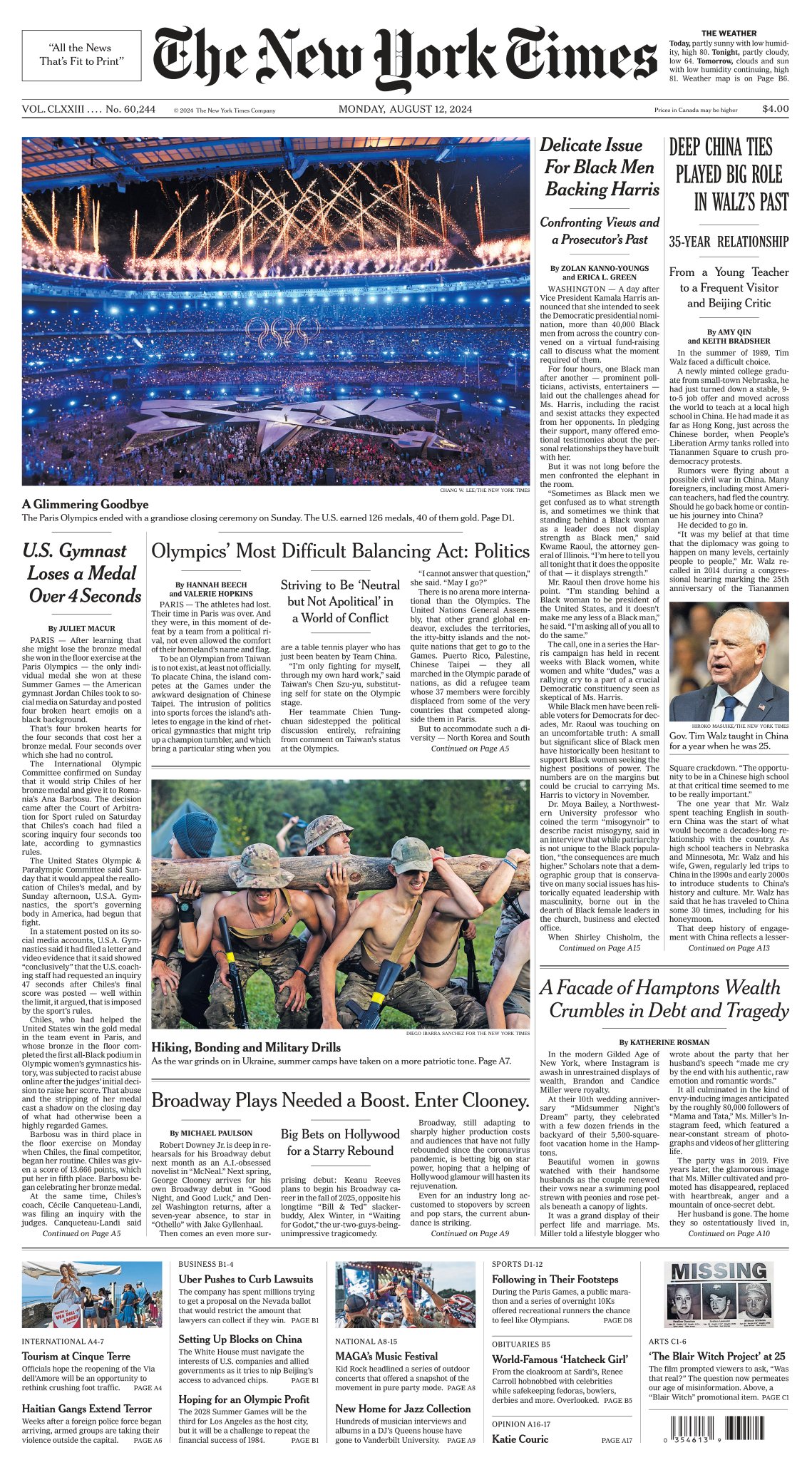
Mr. Walz, the Democrats’ vice-presidential nominee, taught in China and has visited the country around 30 times. But he has also been critical of the Chinese government’s human rights record.
“I’m standing behind a Black woman to be president of the United States, and it doesn’t make me any less of a Black man,” said the Illinois attorney general. “I’m asking all of you all to do the same.”
An inquiry by Chiles’s coach led judges to adjust her score and give her a medal. A court ruled the inquiry came too late. Now, the I.O.C. wants her bronze back.
The Olympics’ Toughest Act: Balancing Sports and Politics
The Olympics have long been a stage for political expression, for athletes who take the opportunity. Some do, while others choose to focus strictly on their sport.
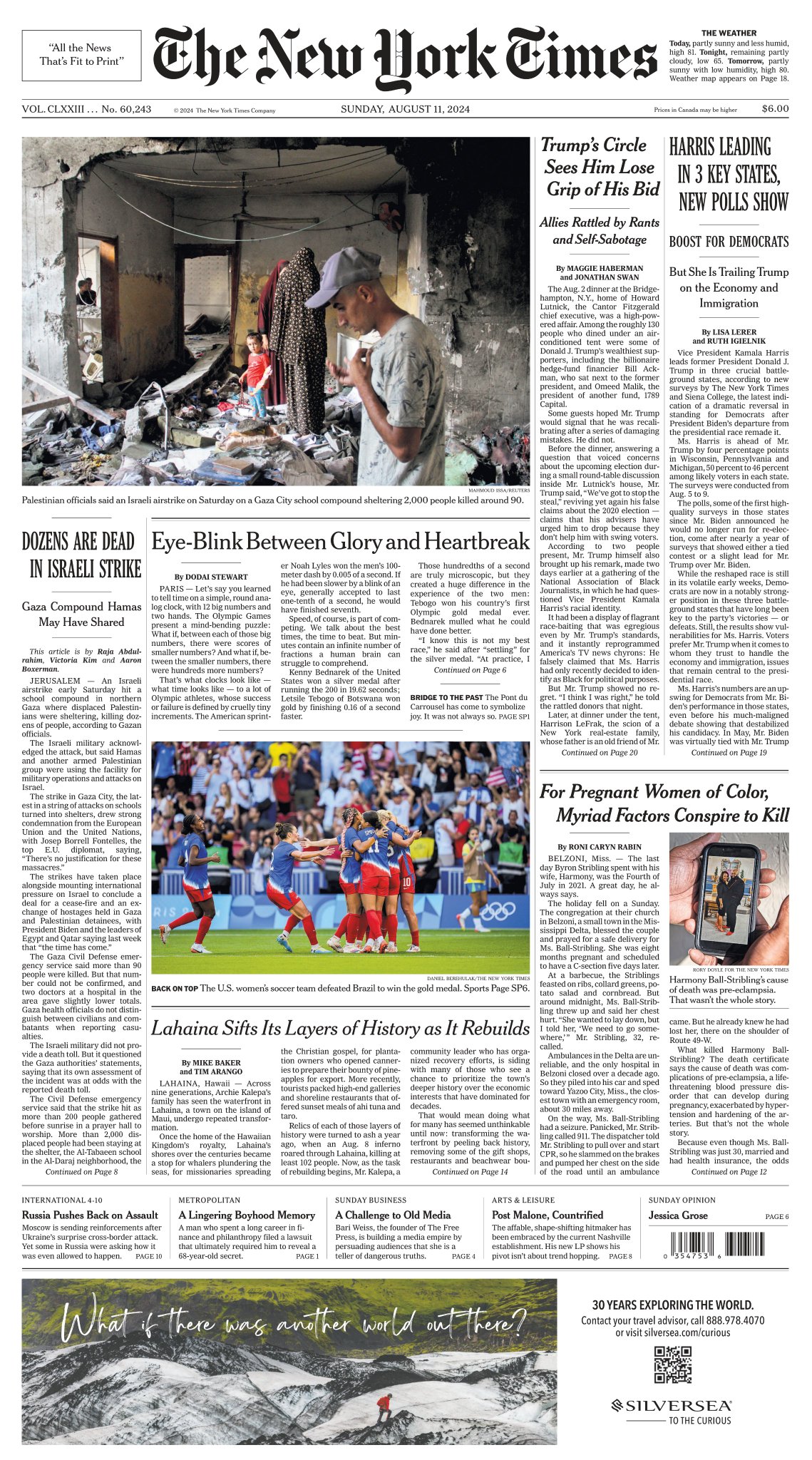
New surveys of Michigan, Wisconsin and Pennsylvania taken this week offer the latest indication of a dramatic reversal in standing for the Democratic Party since President Biden abandoned his re-election bid.
People around the former and would-be president see a candidate knocked off his bearings, disoriented by his new contest with Kamala Harris and unsure of how to take her on.
Monocle on Saturday (August 10, 2024): Live from Maison Allianz. Andrew Mueller is joined by Olympic historian Philip Barker to discuss the legacy of this year’s Olympic Games, and Joachim Roncin, director of design for Paris 2024.
Plus: Monocle’s editorial director, Tyler Brûlé, joins from Gstaad, our roving Olympics correspondent, Kieran Pender, talks about the few marquee events remaining and we explore France’s best-kept tourist secrets. Allianz is a Worldwide Insurance Partner of the Olympic and Paralympic Games.
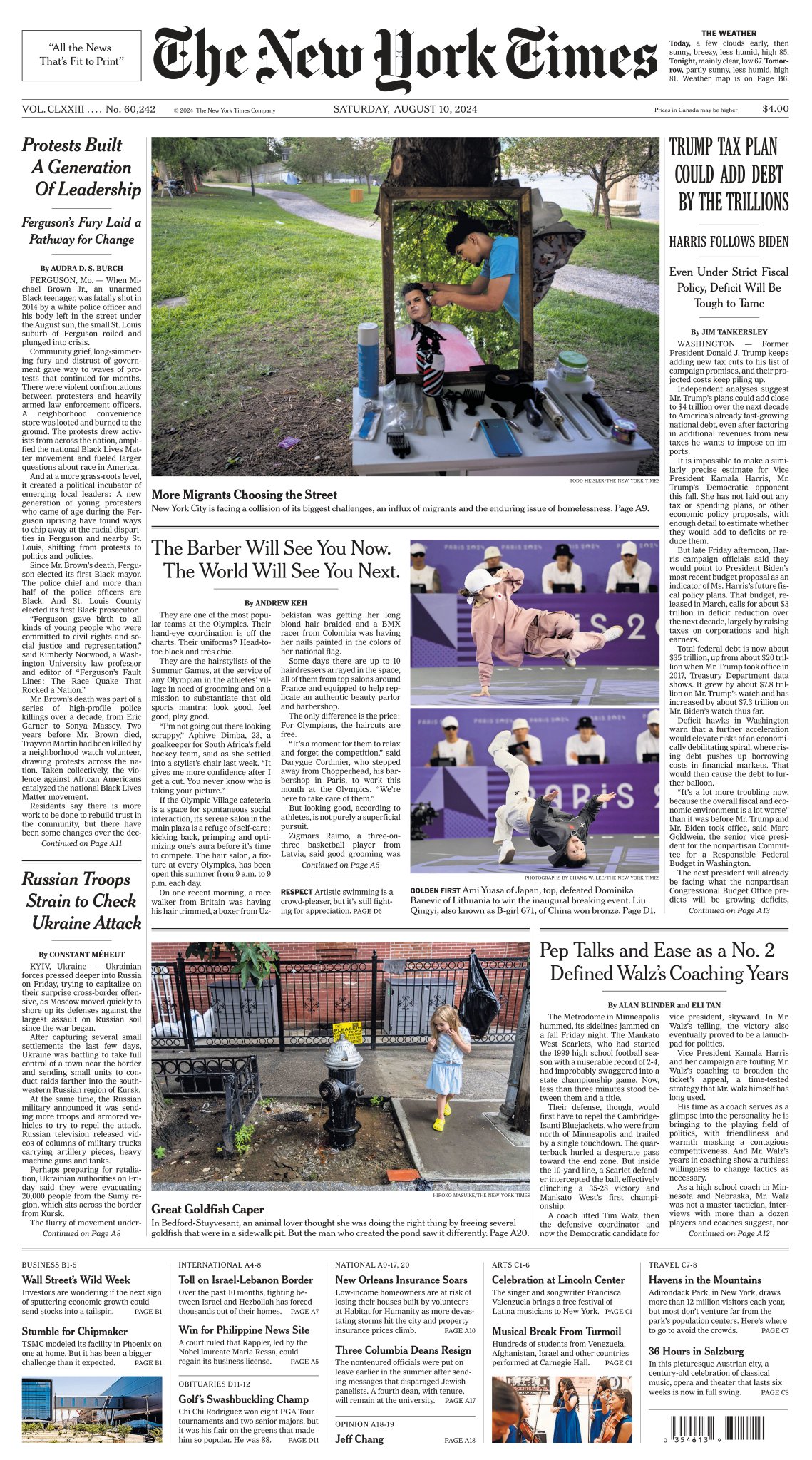
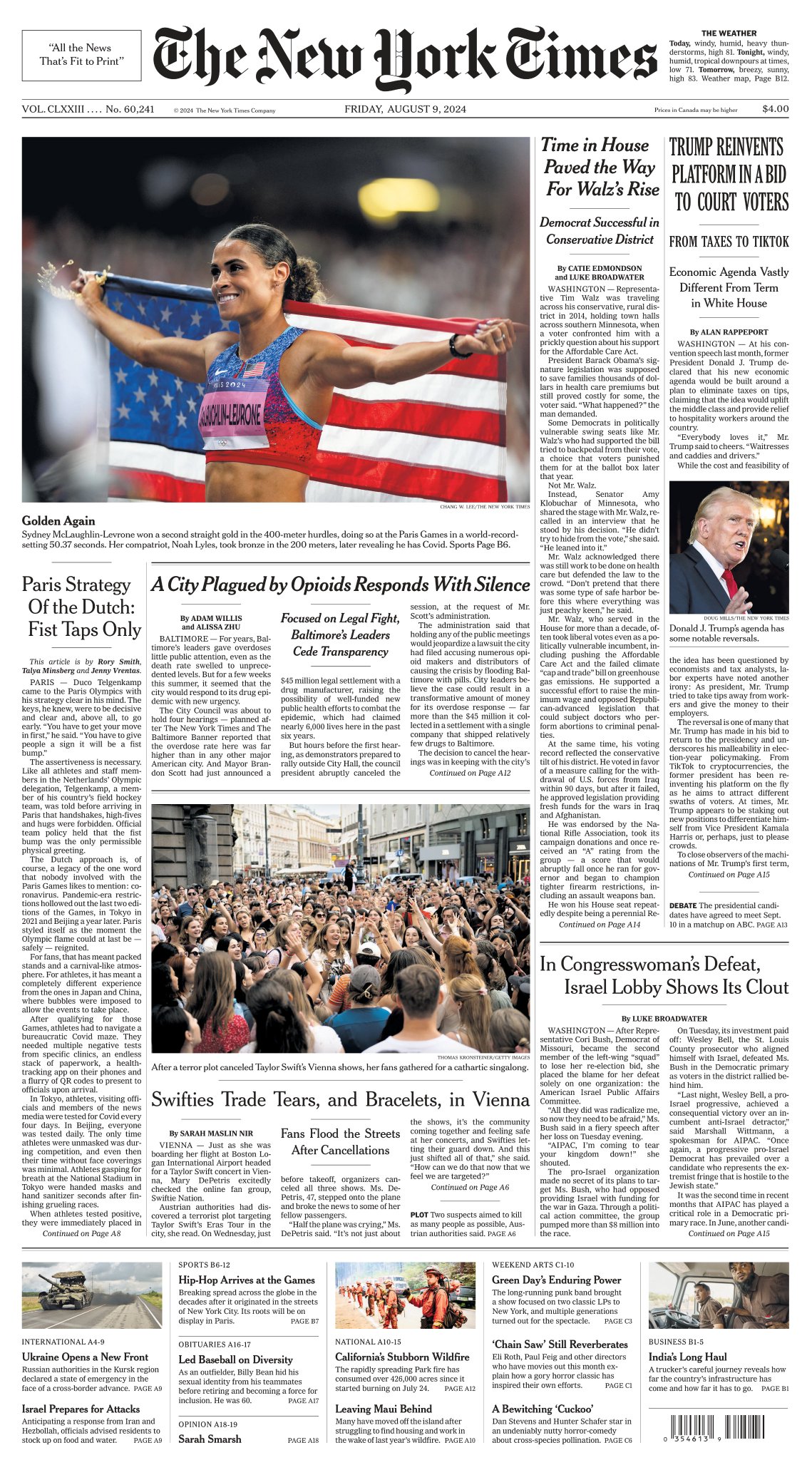
The former president’s proposals to cut taxes would lose far more revenue than his plans to raise tariffs. The vice president has not released specifics.
The shooting death of Michael Brown created a political incubator of emerging local leaders, some of whom are finding themselves in the corridors of power.
At the Olympic Village, cuts, styles and manicures are free. The benefits, the athletes say, are priceless.
As Ukraine Pushes Deeper Into Russia, Moscow Sends Reinforcements
The Ukrainian police said they were evacuating people, perhaps in anticipation of a retaliatory strike, but the goal of the military operation on Russian territory remained unclear.
The Globalist Podcast (August 9, 2024): As Lebanon braces for an attack, we ask what plans are being made in the event of an Israeli invasion, Catalan separatist leader Carles Puigdemont returns to Spain for the first time in seven years and a diplomatic rift over Israel’s exclusion from Japan’s Nagasaki bomb commemoration.
Plus: fashion news, a flick through the papers and a check-in from our team in Paris.
The congressional voting record of the Democrat nominee for vice president shows his liberal streak, but with a deference to a conservative district’s needs.
The city has declined to divulge its plans or hold hearings on one of the worst public health crises in the United States, saying it does not want to jeopardize its lawsuit against drugmakers.
No Hands, Please: We’re Dutch
After two pandemic-disrupted Olympics, most teams haven’t given Covid a second thought in Paris. The one from the Netherlands is the exception.
The Globalist Podcast (August 8, 2024): We’re joined by journalist Abeer Ayyoub and Chatham House’s Yossi Mekelberg to learn more about Hamas’s new leader, Yahya Sinwar.
Also on the programme: Muhammud Yunus is named as the interim leader of Bangladesh’s government. We consider how this will affect the nation’s relationship with neighbouring India. Plus: we hear from Monocle’s Julia Lasica in Kyiv, discuss the latest news in aviation and Emma Nelson reports from Paris ahead of day 13 of the Olympic Games.
Democrats think Gov. Tim Walz’s cultural ties are needed to talk to rural and working-class voters. But Republicans are not going to let his folksy style obscure a liberal record.
A young skater’s emergence signals a pivot in the way an Olympic power defines success. But its handling of the table tennis competition suggests old expectations may persist, too.
Venezuela’s Strongman Was Confident of Victory. Then Came the Shock.
Venezuela’s government believed its control of all levers of power would give the country’s authoritarian president an Election Day victory. A rebellion by its supporters undid the plan.
London Review of Books (LRB) – August 7 , 2024: The latest issue features ‘Henry James Hot-Air Balloon’ – “The Prefaces” by Henry James; Trivialized to Death – “Reading Genesis” by Marilynne Robinson; Different for Girls By Jean McNicol…
The first time the man heard God, he uprooted his entire life, though he was very old. Then God appeared to him in person, an event which would embarrass later thinkers. God made the man an impossible promise in the shape of a son. His wife was ninety, and she laughed. When the child arrived, it was hardly unreasonable to think it a miracle. They named the child after the laughter.
In 1904 Henry James’s agent negotiated with the American publisher Charles Scribner’s Sons to produce a collected edition of his works. The New York Edition of the Novels and Tales of Henry James duly appeared in 1907-9. It presented revised texts of both James’s shorter and longer fiction, with freshly written prefaces to each volume. It didn’t include everything: ‘I want to quietly disown a few things by not thus supremely adopting them,’ as James put it. The ‘disowned’ works included some early gems such as The Europeans. The labour of ‘supremely adopting’ the stuff he still thought worthy was grinding. He worked on the new prefaces, which he described as ‘freely colloquial and even, perhaps, as I may say, confidential’ (though James’s notion of the ‘freely colloquial’ is perhaps not everyone’s) during the years 1905 to 1909. In some respects, the venture was not a success. ‘Vulgarly speaking,’ James said of the New York Edition, ‘it doesn’t sell.’
A week before the start of the Paris Olympics, Shoko Miyata, the 19-year-old captain of the Japanese women’s gymnastics team, was forced to withdraw from the competition by her national association. She had been reported to the Japan Gymnastics Association for smoking and drinking (on separate occasions, once for each offence). The president of the JGA, Tadashi Fujita, announced that Miyata had been sent home, and bowed deeply.
News, Views and Reviews For The Intellectually Curious


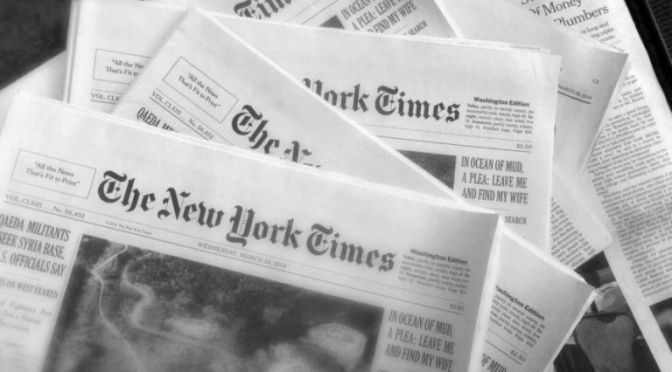





 Intellicurious