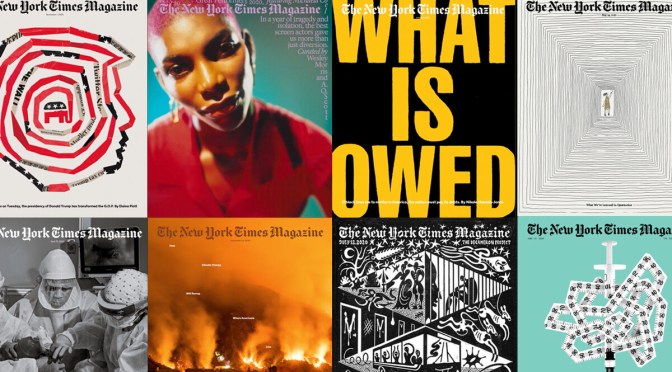
THE NEW YORK TIMES MAGAZINE:The 5.24.26 Issue features Azeen Ghorayshi on testosterone and a new male ideal; Avraham Z. Cooper on the interstitium; M.H. Miller on the Venice Biennale; and more.
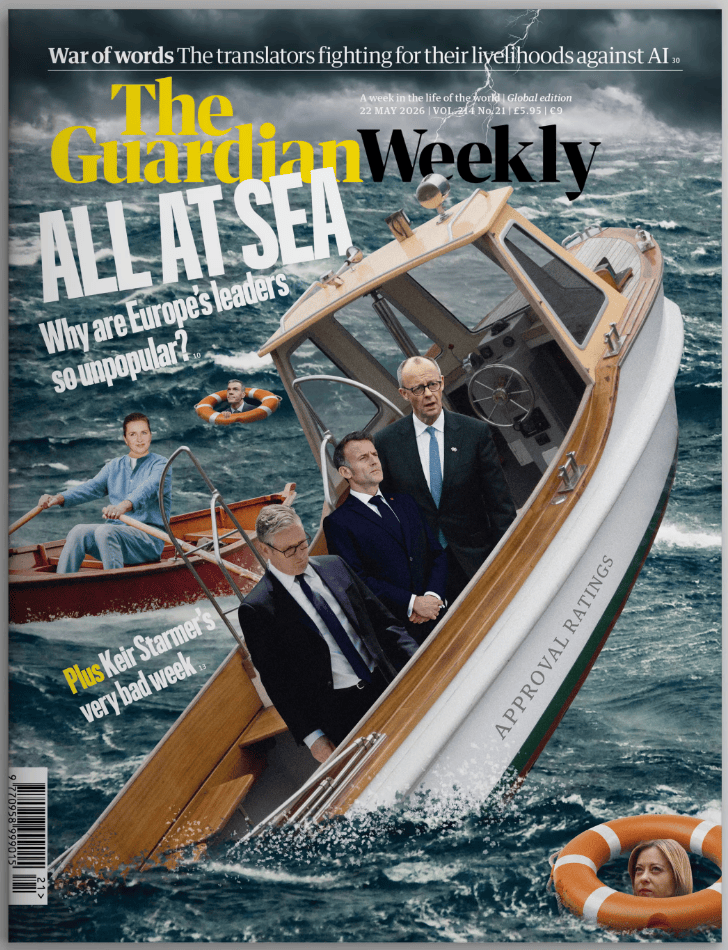
After a week like Keir Starmer just had, what could one possibly do to cheer up the beleaguered UK prime minister? (Aside from his beloved Arsenal winning the Premier League title, that is.)
Perhaps remind him he’s not Friedrich Merz or Emmanuel Macron. Starmer may not be flavour of the month with UK voters or his own Labour MPs right now, but both the German and French leaders have barrel-scraping approval ratings that make the British PM look popular in comparison.
Even among the less-disliked European leaders, Giorgia Meloni of Italy and Pedro Sánchez of Spain are only marginally more liked than Donald Trump is in the US – and neither of them have started a war in Iran.
What’s behind this widespread disaffection for Europe’s leaders? Are they a generationally bad crop of politicians or have they been dealt an impossible hand of social and economic circumstances – or is it a mixture of both?
For our cover story this week, Daniel Boffey asks what Europe’s embattled leaders can do to reverse that sinking feeling. Then, from our UK political team, Pippa Crerar and Peter Walker look back on a week when Starmer was left looking increasingly like an interim PM.
Spotlight | Xi rolled out the red carpet for Trump, but that was all There was no swift end to the Iran war, uncertainty over Taiwan and only vague outlines of commercial deals – but the US president at least got to bask in the company of his Chinese counterpart, reports David Smith
Technology | Despite rise of AI, is there still hope for Europe’s translators? A booming tech sector has disrupted translation jobs in publishing – but they could be needed for a while longer yet, writes Philip Oltermann
Feature | The sinister spread of France’s killer seaweed After a series of deaths on the beaches of Brittany, one bereaved family set out to prove the foul-smelling bloom was to blame. Marta Zaraska investigates
Opinion | Normalising Reform UK’s ideas turns neighbour against neighbour “Concern” about immigration has now morphed into policing how ethnic minorities exist in our communities, argues Nesrine Malik
Culture | How Backrooms upended the horror movie It started off just as a creepy picture on the internet. Now it’s the year’s freakiest film. Steve Rose meets its auteur, Kane Parsons, and stars Chiwetel Ejiofor and Renate Reinsve
What else we’ve been reading
The Guardian’s new list of the 100 best novels of all time provoked extensive discussion in my household. How many have you read? I won’t embarrass myself by divulging my own total, except to admit there is considerable catching up to be done. Graham Snowdon, editor
Politidex is a Pokémon-like mobile phone game where players can build their own political party by “catching” local councillors and MPs. Having started life as an April Fools’ Day joke, the game’s mission is now to humanise both politics and politicians, says its creator in this interesting piece. Bowie Qiu, Marketing manager
Parts of the MAGA movement are unhappy with President Trump’s migration strategy. The administration has softened its policy on deportations following a public uproar over the ICE killings in January, it is said. The focus has been on removing only the most violent offenders. “The truth is the first year was not a year of mass deportation,” says Mike Howell of the Mass Deportation Coalition. “A conscious
Donald Trump has had a career-long love-hate relationship with the press. On one hand, he popularized the phrase “fake news” and branded the press “the enemy of the people.” On the other, the President takes phone calls from virtually every reporter with his personal cell and is fixated on cable news and his print media coverage. Trump views journalists as friends, foes…
Donald Trump flew to Beijing this week and wants three things when he sits down with China’s President Xi Jinping: a tariff truce that survives his own courts, Chinese pressure on Iran to end the war that never seems to end and a photograph that makes him look victorious. Xi has problems of his own. But he has watched four American presidencies from Zhongnanhai, the walled compound beside the Forbidden City where the Communist party leadership rules, and he knows the value of silence when his counterpart is talking himself into trouble. Trump’s approval rating is the lowest of his second term. What Xi wants from this meeting with Trump is recognition: two great powers, two systems, meeting as equals Trump has obliged Xi noisily.
Their electoral prospects are finally improving, but opportunities can quickly give way to divisions. Does the Party have a plan? By Amy Davidson Sorkin
The Human-Trafficking Victim Next Door
A young girl was brought from Guinea to a wealthy suburb near Dallas. She spent the next sixteen years of her life in forced servitude. By Yudhijit Bhattacharjee
Can Hakeem Jeffries Lead a Democratic Takeover of the House?
An unprecedented gerrymandering effort led by Donald Trump—and internal divisions among Democrats—has made the Minority Leader’s path to victory harder than ever. By Jason Zengerle
Mary Todd Lincoln Has Long Been Derided. Is Her Reputation Salvageable?
History knows the First Lady as a hysterical widow and a lavish spender. Her most recent biographer chooses to highlight her mental fortitude and political prowess. By Thomas Mallon
THE NEW YORK TIMES MAGAZINE: The 5.17.26 Issue features Chris Pomorski on the famed freediver Francisco Ferreras; Reginald Dwayne Betts on learning to shoot a gun; Roger Cohen on the leader of Argentina as a MAGA celebrity; and more.
An unlikely alliance between HHS Secretary Robert F. Kennedy Jr. and “critical psychiatry” activists is challenging decades of medical orthodoxy by targeting the widespread, and often harmful, reliance on psychotropic medications. This movement argues that mainstream psychiatry pathologizes normal human suffering, prompting some medical professionals to preemptively develop deprescribing guidelines to safely taper patients off medication.
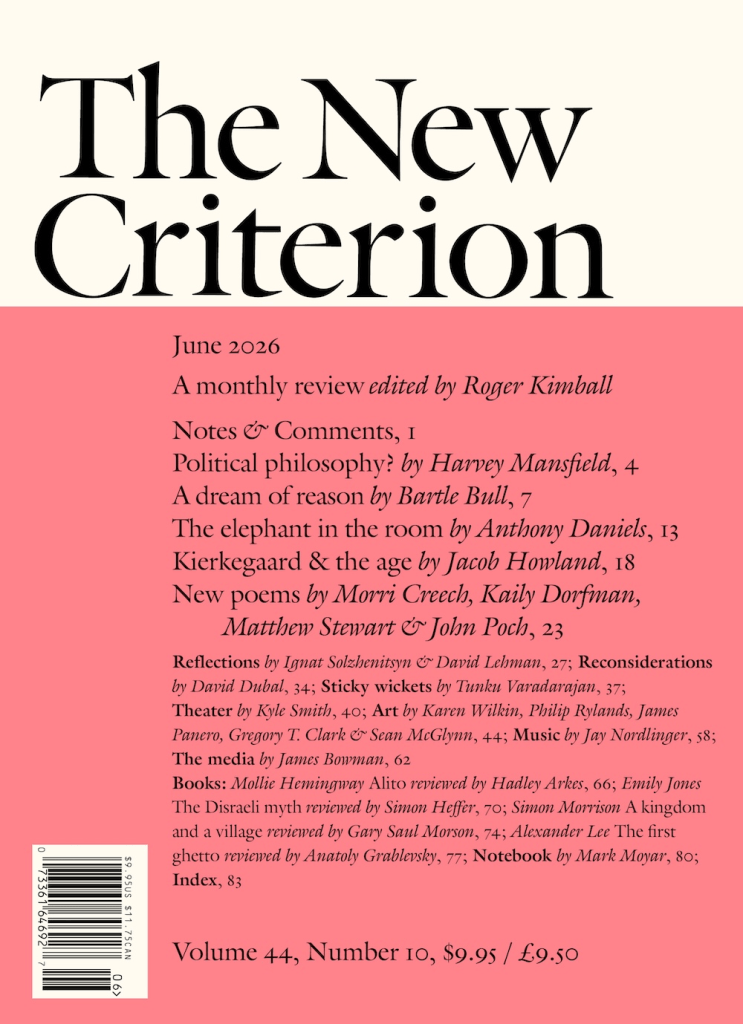
THE NEW CRITERION: The latest issue features ‘Political philosophy? by Harvey Mansfield; A dream of reason by Bartle Bull; The elephant in the room by Anthony Daniels; Kierkegaard & the age by Jacob Howland; New poems by Morri Creech, Kaily Dorfman, Matthew Stewart & John Poch….
THE NEW YORK TIMES MAGAZINE: The latest issue features Amanda Hess on experiments in extending the life of dogs; Susan Dominus on the quest to master cellular rejuvenation; Devin Gordon on how athletes are extending their careers; Mark O’Connell on the rich and powerful craving eternal life; and more.
Trump has taken an active role in the arts in his second term, which may be evident in the work on display at the Venice Biennale — depending on how you look at it. By M.H. Miller
The casa grande could be an ancient chalet in the Austrian Tyrol. A steeply gabled roof to slough off the winter snow, dandelion-yellow paintwork, and inside a treasure trove of all an outdoorsman loves. Antlers jostle for space on every wall. There is a tack room thick with the leathery tang of saddles, a bathroom
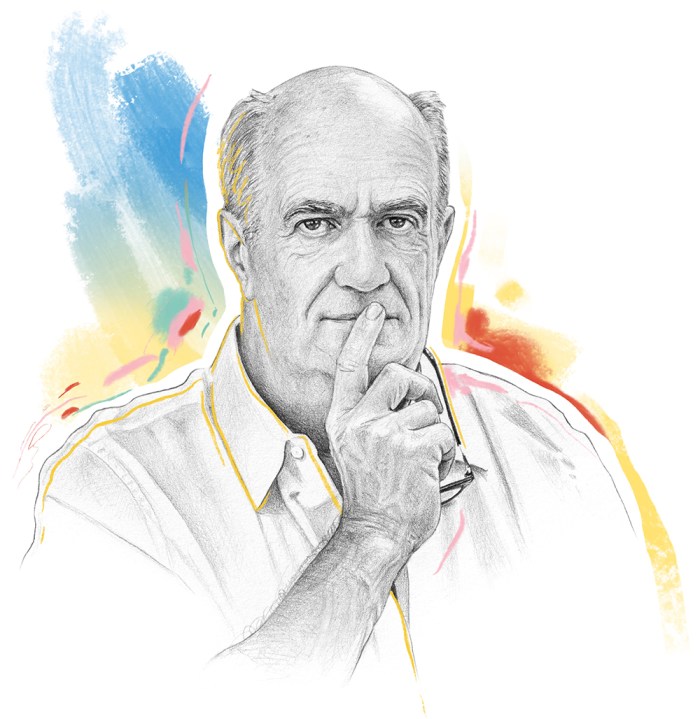
Colm Tóibín explores the art of short story writing
hen I was 20 and tentatively trying to write, every single person I knew read Ian McEwan’s First Love, Last Rites (1975). It not only gave the short story a good name, but it also gave writing a good name. It was like a punk moment converted into fiction. People used the word “macabre,” but there was a sort of excitement about the characters, the strangeness of the stories, the shortness of some of the stories and just how much contemporary urban life was in them.
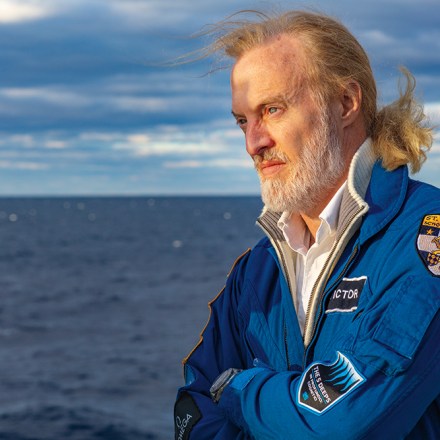
It’s a popular phrase on X, usually in response to someone accomplishing something remarkable, taken to mean that there’s nothing stopping you from doing something out of the ordinary. SpaceX might post video of a rocket landing – “you can just do things.” Victor Vescovo might be the living embodiment of the phrase.
My first introduction to Vescovo was an email from him, extending an invitation to be a guest at his table for the Explorers Club Annual Dinner. The name was vaguely familiar to me but didn’t immediately register. Who was this mysterious correspondent?
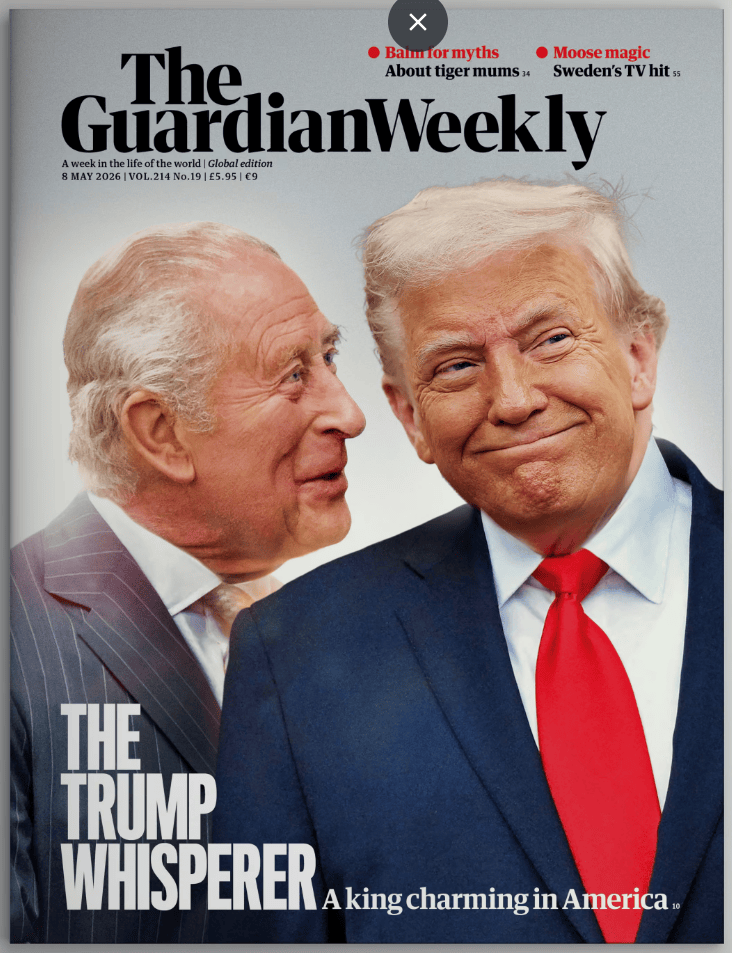
It’s fair to say that the Guardian Weekly does not cover many royal visits, but King Charles III’s US state visit was the most consequential of his reign so far. The king’s ostensible purpose was to celebrate America’s 250 years of independence but last week’s trip was freighted with other agendas, most important of which was to flatter his host, Donald Trump. Washington bureau chief David Smith’s cover story shows how “like a rapier wrapped in ermine, Charles managed to tame Trump while rebuking Trumpism”. Both David and our veteran foreign affairs commentator Simon Tisdall unpick the skill with which Charles spoke truth to this capricious and egotistical president and gave both sides of the heavily divided Congress much to praise. It was a performance of high diplomacy at a time of huge tension in the transatlantic relationship and beyond.
But the charm didn’t wash in New York where, as Adam Gabbatt’s sketch shows, the shadow of Jeffrey Epstein and Andrew Mountbatten-Windsor, Charles’s disgraced brother, lurked while the mayor, Zohran Mamdani, brought up the spectre of colonialism in the shape of the Koh-i-noor diamond, snatched under disputed circumstances.
Spotlight | A small town in Germany Landstuhl, the heart of the largest American military community outside the US, considers its future after Donald Trump’s decision to withdraw 5,000 troops, reports Deborah Cole
Environment | A gift of wings Patrick Barkham takes off for a flight of wonder with The Lost Words duo, who have reunited for a new book on endangered birds
Feature | A balm for tiger mother myths Rebecca Liu explores why a certain image of the tiger mum – strict, cold and demanding – is ubiquitous in popular culture
Opinion | Antiracists need to stand up for us all Another attack on the UK’s Jewish population demands a clear show of solidarity from those who march to protect minorities, argues Jonathan Freedland
Culture | Moose magic on the loose How do cameras capture Sweden’s seasonal TV hit, the Great Moose Migration? Malcolm Jack travels to an uninhabited island in the Ångerman river to ask the show’s makers
News, Views and Reviews For The Intellectually Curious