The number of people under 50 with cancer is increasing in many countries and for many different tumour types. Why this is occurring isn’t entirely clear, but it may be due to some aspects of modern life
Science Magazine – March 24, 2023 issue: This color-enhanced scanning electron microscopy image shows Ti2CCl2 MXenes grown by chemical vapor deposition. The two-dimensional layers of this material grew perpendicular to the substrate and then folded into microspherical structures. Ion intercalation between two-dimensional MXene sheets has potential for energy storage and other applications.
Workers disinfected Wuhan’s Huanan Seafood Wholesale Market in March 2020, but not before a Chinese research team collected samples there that would reveal the presence of SARS-CoV-2–susceptible mammals.
Virology database cuts off—and then reinstates—scientists who found and analyzed data collected 3 years ago by team in China
If Zhamanshin crater in Kazakhstan is 30 kilometers wide (red ring) instead of 13 kilometers (black ring), as a new study suggests, the impact that made it would have been far more fierce.
“It would be in the range of serious crap happening.”
At a basic level, humanity’s survival odds come down to one thing: the chances of a giant space rock slamming into the planet and sending us the way of the dinosaurs. One way to calibrate that hazard is to look at the size of Earth’s recent large impact craters.
nature Magazine – March 23, 2023 issue: One of the main hurdles to putting autonomous cars on the road is how to ensure the reliability of the artificial intelligence that replaces the human driver. Evaluating the safety of an AI driver to the level of a human in a naturalistic environment would require testing across hundreds of millions of miles — something that is clearly impractical.
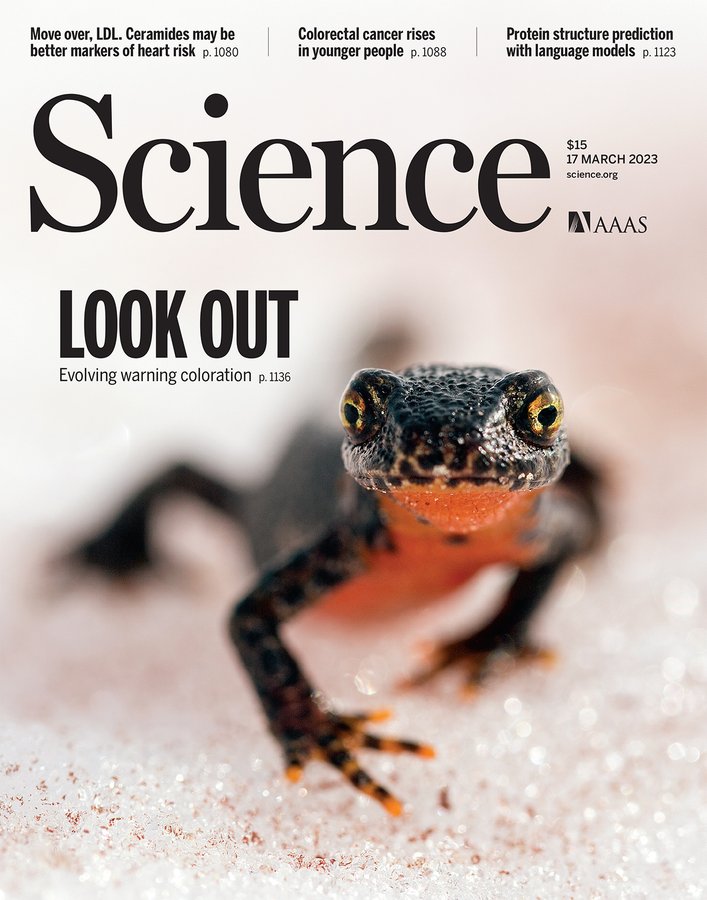
Science Magazine – March 17, 2023 issue: An alpine newt (Ichthyosaura alpestris) walks to a breeding pond in the Alps, France. Many amphibians have a cryptic upper side but a normally concealed, conspicuous underside. These hidden signals have evolved for several reasons, including as a warning display to would-be predators.
The gut microbiota is critical for human health. Understanding how beneficial bacteria colonize the gut enables medical interventions that promote gut health. Krypotou et al. discovered a mechanism that enhances the fitness of a commensal bacterium in the gut.
Palaeolithic hand stencils with missing fingers could indicate ritual mutilation or frostbite – but new research suggests they might be trying to tell us something
From mice with two fathers to cures for debilitating diseases, the transformative power of genomic technology requires some big decisions on what we want to do with it
nature video (March 15, 2023) – Lymphocytes are immune cells that play vital roles in fighting infections. The most well-known lymphocytes are the T cells and B cells of the adaptive immune system. In the 1950s and 1960s, scientists performed experiments to follow lymphocytes on their journey around the body, which helped us to work out where they go and what they do.
This work laid the foundation for everything we know about T cells today, including how they become activated to fight infections and how they form memory populations that provide long-lasting immunity.
National Science Foundation (March 13, 2023) – Harnessing the power of AI, researchers calculate our brain’s age leading to earlier detection of Alzheimer’s and other cognitive diseases.
Researchers at USC have developed a new artificial intelligence model that more accurately captures brain age. This study could result in earlier detection of Alzheimer’s and other cognitive diseases and provide important information about how quickly our brains age.
Science Magazine – March 10, 2023 issue: A honey bee (Apis mellifera) performs a complex dance to communicate resource location and value. Research now shows that novice bees dance better and communicate location more accurately if they were previously able to follow and socially learn from more experienced dancers.
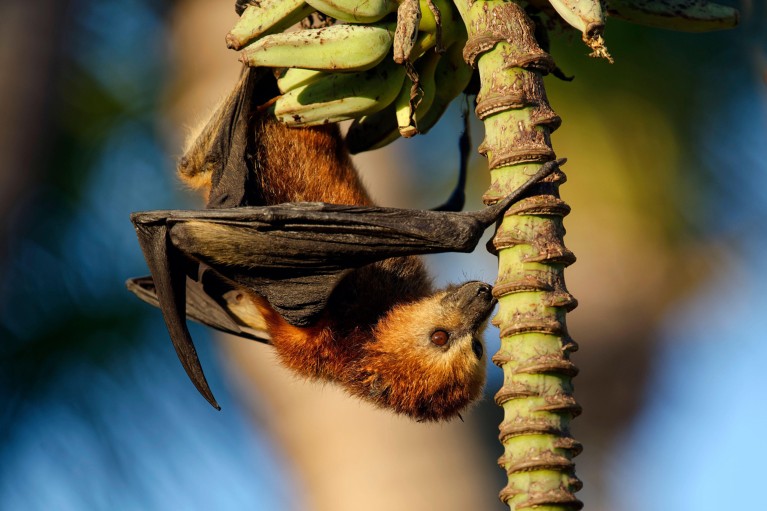
Human hunt at least 19% of bat species worldwide — especially flying foxes, which can have wingspans of 1.5 metres.
The Mauritian flying fox (Pteroptus niger). As relatively large bats, flying foxes are hunted more heavily than other species. Credit: Fabrice Bettex Photography/Alamy
Large tropical bats with narrow home ranges are disproportionately likely to be hunted by humans, according to a global analysis of 1,320 bat species — nearly all of the 1,400 known to science1.
From tracking the disease’s spread in wild birds to updating human vaccines, there are measures that could help keep avian influenza in check.
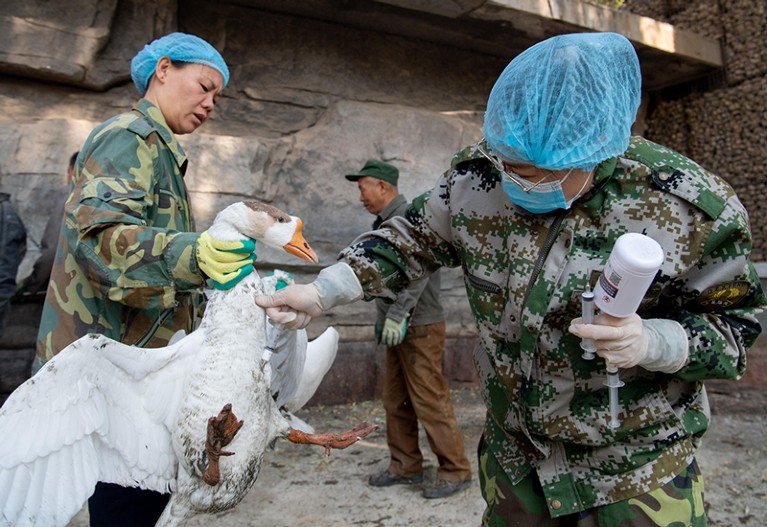
A goose being vaccinated against avian influenza in China.Credit: Wei Liang/China News Service/Getty
Fears are rising about bird flu’s potential to spark a human pandemic, as well as its destruction of wildlife and farmed birds. An 11-year-old girl tragically died in Cambodia last week after catching avian influenza. That followed reports earlier this year of the virus spreading from mammal to mammal through a mink farm, and causing mass mortality in Peruvian birds and sea lions. Since the beginning of 2022, more than 50 million poultry birds in the United States, and a similar number in Europe, have either died of the disease or been killed in efforts to stem its spread. Can bird flu be stopped, and if yes, how?
News, Views and Reviews For The Intellectually Curious





















 Intellicurious