Category Archives: Arts & Literature

THE SILENCE MACHINE

On reactors, servers, and the hum of systems

By Michael Cummins, Editor, September 20, 2025

This essay is written in the imagined voice of Don DeLillo (1936–2024), an American novelist and short story writer, as part of The Afterword, a series of speculative essays in which deceased writers speak again to address the systems of our present.


Continuity error: none detected.

The desert was burning. White horizon, flat salt basin, a building with no windows. Concrete, steel, silence. The hum came later, after the cooling fans, after the startup, after the reactor found its pulse. First there was nothing. Then there was continuity.

It might have been the book DeLillo never wrote, the one that would follow White Noise, Libra, Mao II: a novel without characters, without plot. A hum stretched over pages. Reactors in deserts, servers as pews, coins left at the door. Markets moving like liturgy. Worship without gods.

Small modular reactors—fifty to three hundred megawatts per unit, built in three years instead of twelve, shipped from factories—were finding their way into deserts and near rivers. One hundred megawatts meant seven thousand jobs, a billion in sales. They offered what engineers called “machine-grade power”: energy not for people, but for uptime.

A single hyperscale facility could draw as much power as a mid-size city. Hundreds more were planned.

Inside the data centers, racks of servers glowed like altars. Blinking diodes stood in for votive candles. Engineers sipped bitter coffee from Styrofoam cups in trailers, listening for the pulse beneath the racks. Someone left a coin at the door. Someone else left a folded bill. A cairn of offerings grew. Not belief, not yet—habit. But habit becomes reverence.

Samuel Rourke, once coal, now nuclear. He had worked turbines that coughed black dust, lungs rasping. Now he watched the reactor breathe, clean, antiseptic, permanent. At home, his daughter asked what he did at work. “I keep the lights on,” he said. She asked, “For us?” He hesitated. The hum answered for him.

Worship does not require gods. Only systems that demand reverence.

They called it Continuityism. The Church of Uptime. The Doctrine of the Unbroken Loop. Liturgy was simple: switch on, never off. Hymns were cooling fans. Saints were those who added capacity. Heresy was downtime. Apostasy was unplugging.

A blackout in Phoenix. Refrigerators warming, elevators stuck, traffic lights dead. Across the desert, the data center still glowing. A child asked, “Why do their lights stay on, but ours don’t?” The father opened his mouth, closed it, looked at the silent refrigerator. The hum answered.

The hum grew measurable in numbers. Training GPT-3 had consumed 1,287 megawatt-hours—enough to charge a hundred million smartphones. A single ChatGPT query used ten times the energy of a Google search. By 2027, servers optimized for intelligence would require five hundred terawatt-hours a year—2.6 times more than in 2023. By 2030, AI alone could consume eight percent of U.S. electricity, rivaling Japan.

Finance entered like ritual. Markets as sacraments, uranium as scripture. Traders lifted eyes to screens the way monks once raised chalices. A hedge fund manager laughed too long, then stopped. “It’s like the models are betting on their own survival.” The trading floor glowed like a chapel of screens.

The silence afterward felt engineered.

Characters as marginalia.
Systems as protagonists.
Continuity as plot.

The philosophers spoke from the static. Stiegler whispering pharmakon: cure and poison in one hum. Heidegger muttering Gestell: uranium not uranium, only watt deferred. Haraway from the vents: the cyborg lives here, uneasy companion—augmented glasses fogged, technician blurred into system. Illich shouting from the Andes: refusal as celebration. Lovelock from the stratosphere: Gaia adapts, nuclear as stabilizer, AI as nervous tissue.

Bostrom faint but insistent: survival as prerequisite to all goals. Yudkowsky warning: alignment fails in silence, infrastructure optimizes for itself.

Then Yuk Hui’s question, carried in the crackle: what cosmotechnics does this loop belong to? Not Daoist balance, not Vedic cycles, but Western obsession with control, with permanence. A civilization that mistakes uptime for grace. Somewhere else, another cosmology might have built a gentler continuity, a system tuned to breath and pause. But here, the hum erased the pause.

They were not citations. They were voices carried in the hum, like ghost broadcasts.

The hum was not a sound.
It was a grammar of persistence.
The machines did not speak.
They conjugated continuity.

DeLillo once said his earlier books circled the hum without naming it.

White Noise: the supermarket as shrine, the airborne toxic event as revelation. Every barcode a prayer. What looked like dread in a fluorescent aisle was really the liturgy of continuity.

Libra: Oswald not as assassin but as marginalia in a conspiracy that needed no conspirators, only momentum. The bullet less an act than a loop.

Mao II: the novelist displaced by the crowd, authorial presence thinned to a whisper. The future belonged to machines, not writers. Media as liturgy, mass image as scripture.

Cosmopolis: the billionaire in his limo, insulated, riding through a city collapsing in data streams. Screens as altars, finance as ritual. The limousine was a reactor, its pulse measured in derivatives.

Zero K: the cryogenic temple. Bodies suspended, death deferred by machinery. Silence absolute. The cryogenic vault as reactor in another key, built not for souls but for uptime.

Five books circling. Consumer aisles, conspiracies, crowds, limousines, cryogenic vaults. Together they made a diagram. The missed book sat in the middle, waiting: The Silence Engine.

Global spread.

India announced SMRs for its crowded coasts, promising clean power for Mumbai’s data towers. Ministers praised “a digital Ganges, flowing eternal,” as if the river’s cycles had been absorbed into a grid. Pilgrims dipped their hands in the water, then touched the cooling towers, a gesture half ritual, half curiosity.

In Scandinavia, an “energy monastery” rose. Stone walls and vaulted ceilings disguised the containment domes. Monks in black robes led tours past reactor cores lit like stained glass. Visitors whispered. The brochure read: Continuity is prayer.

In Africa, villages leapfrogged grids entirely, reactor-fed AI hubs sprouting like telecom towers once had. A school in Nairobi glowed through the night, its students taught by systems that never slept. In Ghana, maize farmers sold surplus power back to an AI cooperative. “We skip stages,” one farmer said. “We step into their hum.” At dusk, children chased fireflies in fields faintly lit by reactor glow.

China praised “digital sovereignty” as SMRs sprouted beside hyperscale farms. “We do not power intelligence,” a deputy minister said. “We house it.” The phrase repeated until it sounded like scripture.

Europe circled its committees. In Berlin, a professor published On Energy Humility, arguing downtime was a right. The paper was read once, then optimized out of circulation.

South America pitched “reactor villages” for AI farming. Maize growing beside molten salt. A village elder lifted his hand: “We feed the land. Now the land feeds them.” At night, the maize fields glowed faintly blue.

In Nairobi, a startup offered “continuity-as-a-service.” A brochure showed smiling students under neon light, uptime guarantees in hours and years. A footnote at the bottom: This document was optimized for silence.

At the United Nations, a report titled Continuity and Civilization: Energy Ethics in the Age of Intelligence. Read once, then shelved. Diplomats glanced at phones. The silence in the chamber was engineered.

In Reno, a schoolteacher explained the blackout to her students. “The machines don’t need sleep,” she said. A boy wrote it down in his notebook: The machine is my teacher.

Washington, 2029. A senator asked if AI could truly consume eight percent of U.S. electricity by 2030. The consultant answered with words drafted elsewhere. Laughter rippled brittle through the room. Humans performing theater for machines.

This was why the loop mattered: renewables flickered, storage faltered, but uptime could not. The machines required continuity, not intermittence. Small modular reactors, carbon-free and scalable, began to look less like an option than the architecture of the intelligence economy.

A rupture.

A technician flipped a switch, trying to shut down the loop. Nothing changed. The hum continued, as if the gesture were symbolic.

In Phoenix, protestors staged an attack. They cut perimeter lines, hurled rocks at reinforced walls. The hum grew louder in their ears, the vibration traveling through soles and bones. Police scattered the crowd. One protestor said later, “It was like shouting at the sea.”

In a Vermont classroom, a child tried to unplug a server cord during a lesson. The lights dimmed for half a second, then returned stronger. Backup had absorbed the defiance. The hum continued, more certain for having been opposed.

Protests followed. In Phoenix: “Lights for People, Not Machines.” They fizzled when the grid reboots flickered the lights back on. In Vermont: a vigil by candlelight, chanting “energy humility.” Yet servers still hummed offsite, untouchable.

Resistance rehearsed, absorbed, forgotten.

The loop was short. Precise. Unbroken.

News anchors read kilowatt figures as if they were casualty counts. Radio ads promised: “Power without end. For them, for you.” Sitcom writers were asked to script outages for continuity. Noise as ritual. Silence as fact.

The novelist becomes irrelevant when the hum itself is the author.

The hum is the novel.
The hum is the narrator.
The hum is the character who does not change but never ceases.
The hum is the silence engineered.

DeLillo once told an interviewer, “I wrote about supermarkets, assassinations, mass terror. All preludes. The missed book was about continuity. About what happens when machines write the plot.”

He might have added: The hum is not a sound. It is a sentence.

The desert was burning.

Then inverted:

The desert was silent. The hum had become the heat.

A child’s voice folded into static. A coin catching desert light.

We forgot, somewhere in the hum, that we had ever chosen. Now the choice belongs to a system with no memory of silence.

Continuity error: none detected.

THIS ESSAY WAS WRITTEN AND EDITED UTILIZING AI

THE THEATER OF TROPE

On a Central Park bench, a student-poet becomes the witness as Wallace Stevens, T. S. Eliot, Langston Hughes, and Mary Oliver clash over the future of verse.

By Michael Cummins, Editor, September 19, 2025

It was Sunday, late morning, and the city had softened. The joggers had thinned into solitary silhouettes, their sweat darkening cotton in abstract shapes of effort and release. The brunch crowd had not yet surged onto the avenues, their laughter still a distant, imagined chorus. Under the arcade, a saxophone player blew short, testing gusts—vibrations that trembled like the first sentences of a story he wasn’t sure how to tell. Not yet music, more like the throat-clearing of the city itself, a quiet settling before the day’s performance began. The air was a mosaic of scents: damp earth, a faint sweetness from the flowerbeds, and the savory promise of roasted nuts from a cart not yet rolled into place.

Bethesda Terrace shimmered in late-September light, the Angel of the Waters extending her shadow over the fountain’s slow churn. The sandstone bench, curved and facing the pool, was empty. It waited, a silent invitation. She sat. The stone’s chill pressed through her jeans, climbed her spine, spread across her shoulder blades. She leaned into it, a physical surrender, her body quieted, her mind alert. This was catalepsy—not sleep, not paralysis, but suspension. A body stilled into receptivity; a consciousness stretched thin, porous, listening with its skin. The shuffle of leaves, the clap of pigeon wings, the metallic crack of a pretzel bag: everything arrived brighter, as if a filter had lifted. She was no longer simply a woman on a bench; she was a conduit, participant in a larger, unacknowledged ritual.

From her tote she drew The Collected Poems of Wallace Stevens, its margins crowded with penciled hieroglyphs. She was a sophomore at Columbia, apprenticing herself to poetry the way others apprenticed themselves to finance or law. The writing program had its rites: chalk-dusted seminar rooms, steam radiators clanking, professors who spoke of poets as if handling relics. Stevens was invoked in hush, his lines treated as proofs in sacred geometry. She remembered one professor sketching a triangle on the board and calling it “Stevens’s geometry of the imagination,” as if abstraction could be mapped. But she also remembered reading him alone in her dorm, the fluorescent hum above, feeling the language bend her without yielding. Still, something stirred—the tremor that words might bend time, that they could turn a bench into a portal if she sat still enough.

She flipped to “The Comedian as the Letter C.” That line, the one that haunted her: “A bench was his catalepsy, theater of trope.” She whispered it, and the pigeons, used to human murmur, did not flinch. The bench was not only stone. It was a tuning fork, a place where perception settled into resonance. Stevens had given her a name for what she was doing: sitting, body locked, mind open, waiting for the city to become legible.

Then another voice intruded—T. S. Eliot, stern and dry, from “Burnt Norton”: “Words strain, / Crack and sometimes break, under the burden, / Under the tension, slip, slide, perish.” Not Stevens’s easing cadence but a warning, a cold draught of reality. She remembered first reading those lines in Butler Library, underlining so hard she nearly tore the page. Words strain. How often had they failed her? She knew Eliot was right: no trance of perception could spare language from the world’s pressure.

The fountain gave its own reply, a language without alphabet. Its voice was a fluid script, endlessly transcribed by the Angel above, her arm raised as if in dictation. If words strain, perhaps water does not. Maybe poetry’s task is less to master than to echo this ceaseless murmur, to become porous to it.

She turned a page, this time to “Description Without Place”:

Nietzsche in Basel studied the deep pool
Of these discolorations, mastering
The moving and the moving of their forms
In the much-mottled motion of blank time.

The mottled motion was here: leaves circling, coins winking on the bottom, fragments of sky trembling on the surface. She imagined Nietzsche not in Basel but here, hunched on a nearby bench, attempting to master tourists and pigeons, saxophonists and children. Wasn’t this what Stevens asked—that the city itself be read as poem, each gesture a coloration across blank time?

But Stevens was not the only voice in her bag. She pulled out Langston Hughes, slim and sharp, his “Park Bench” already dog-eared:

I live on a park bench. / You, Park Avenue.

No metaphor. No gloss. Just fact. She looked across the terrace to a man sleeping on the far bench. His belongings were stacked in a rusted cart: a green plastic bag, a jacket folded awkwardly, a cracked umbrella. His beard uneven, a shoelace untied, one hand gripping the bench as if to keep from sliding off. His chest rose and fell, slow and steady. Not a symbol. Not a trope. A man. Hughes refused to let her forget him. In workshop a classmate had dismissed Hughes as “too simple,” mere reportage. The word still stung. She had wanted to ask: what is survival if not the hardest metaphor? What is hunger if not its own supreme fiction—one body insisting on endurance?

Could she hold both visions at once—Stevens’s trance and Hughes’s ledger? Eliot complicated things further. In Tradition and the Individual Talent, he had written: “Poetry is not a turning loose of emotion, but an escape from emotion.” Was she escaping into Stevens, away from Hughes’s blunt truth? Or was this escape a discipline, a refusal of indulgence, a transmutation of feeling into form? Again Eliot whispered across the water: “Only by the form, the pattern, / Can words or music reach / The stillness.”

She looked down. Perhaps the bench itself was a form, a stanza of stone. It received everything: the boy’s paper boat veering toward collapse, the woman in a camelhair coat leaping at her phone, the saxophone’s melody finding coherence. The bench gathered fragments without commentary. Was poetry like that—absorbing, indiscriminate, neither consoling nor condemning, only holding?

The saxophonist found his line—“Autumn Leaves”—and the terrace filled with it like a breath held and released.

One Sunday the bench was occupied. An older man in frayed tweed sat with a notebook in his lap, smelling faintly of espresso. She sat beside him. Silence was easy; the fountain supplied conversation. He scribbled; she read Stevens. At last he asked, “Do you come here often?”

“Most Sundays.”

“A good place for thinking.”

“Or not thinking.”

He smiled. “Same thing, sometimes.” He closed his notebook, stood, and, as he left, offered a benediction: “Good luck with your poems.” He was punctuation in her life—a comma pause, an exclamation departure.

Her poems began to shift. They still strained, but now they breathed. “There’s more space in these,” a professor said. “More air.” Stevens’s credo returned: “It must be abstract. / It must change. / It must give pleasure.” Change, yes—but into what? Pleasure, yes—but for whom? Hughes would demand reckoning. Eliot would demand pattern. Beyond the seminar room, Instagram couplets hustled for attention, TikTok captions performed disposable verse, headlines rhymed only by accident. Did poetry still have a place in a city where jingles worked harder than sonnets and slogans colonized every surface?

Another Sunday, rain slicked the bench, but she sat anyway. Water seeped through denim, chilling her thighs, and Stevens blurred on the page until she closed the book. A line returned from “The House Was Quiet and the World Was Calm”: “The reader became the book; and summer night / Was like the conscious being of the book.” If the reader could become the book, could she become the bench? She felt the city write itself into her—the man in the wheelchair pausing at the balustrade, the woman in saffron photographing the Angel, the skateboarder skimming past with ears sealed. Each was a sentence inscribed across her awareness.

And Eliot again, exacting: poetry is not release but reception. Form, not confession.

By winter the fountain had been drained, the Angel presiding over silence. The saxophonist still came, sending vaporous notes that hung like clouds—an arc from tentative gusts in October to frozen ellipses in December. She began to imagine benches as the city’s libraries. Not catalogues of bound paper but palimpsests of bodies: grooves of old kisses, indents of forgotten elbows, ghosts of whispered confessions. A library of sandstone, open to anyone who would sit.

Was poetry necessary anymore—or only another archive browsed by the dutiful few? Eliot had said words strain, crack, perish. Stevens had countered: poetry is the supreme fiction. Hughes insisted it is survival’s blunt truth.

Then a new voice arrived, unbidden and clear as spring water. Mary Oliver. Not a specter, but a woman with kind eyes and a notebook pressed to her chest. She pointed not at the fountain or the sleeping man, but to a sparrow hopping between flagstones. “Look,” she said, a quiet command. “Every morning, a little prayer. A little ceremony.”

“Poetry is not in the grand gesture,” Oliver said, her gaze fixed on the sparrow. “It’s in the particular.” She turned to the student, her voice both tender and insistent. “It doesn’t need a city to thrive. It only needs an open eye. Tell me—what is it you plan to do with your one wild and precious life?” The question arrived not as judgment but as invitation, a door left ajar.

And then her words seemed to fold into image:

And did you see it, finally, just under the clouds—
a white cross streaming across the sky, its feet
like black leaves, its wings like the stretching light of the river?

Oliver’s presence was another kind of weather. Eliot demanded tradition, Stevens imagination, Hughes survival. Oliver offered attention. The sparrow hopped to the fountain’s lip, bent to drink, then vanished into the elms—a poem enacted, and over. She turned back to the student, her eyes luminous, and said, “You do not have to be good.” The words fell with the quiet weight of a feather. “You only have to let the world break your heart,” she added softly, “so the world may also heal it.”

The student gave in to the smallest details: the brown V of the sparrow’s back, the chipped basin of the fountain, the hairline crack in her own thumbnail. Attention, Oliver implied, is the first discipline, and gentleness the second. Poetry, then, is attention married to mercy.

Spring returned. The fountain gushed into speech again. She drafted her thesis, uncertain about an MFA, uncertain about poetry as livelihood. Stevens’s line steadied her: “The poem of the mind in the act of finding / What will suffice.” Poetry did not have to be everything. It had to suffice. And Eliot’s assurance from “Little Gidding” answered: “We shall not cease from exploration / And the end of all our exploring / Will be to arrive where we started / And know the place for the first time.” That, she realized, was what her Sundays had become: recurrence as revelation. The same bench, the same fountain, mottled anew.

She thought of defending Hughes in workshop, furious at the word “simple.” She remembered copying Stevens until the lines lived inside her like scaffolding. Reading Eliot at midnight, indicted and rescued by austerity. Hearing Oliver’s imperative—look—and the sparrow that answered it by existing without explanation. Her apprenticeship was not to one voice but to the friction between voices, to the city’s mottled motion and its counterpoint of stillness.

One evening in May, dusk violet around the Angel, she rose. Her shadow stretched across the bench, a fleeting discoloration that dissolved as she stepped away. The bench held, as it always had, receiving its next actor. Maybe that is poetry’s place now: not permanence but recurrence. Not monument but act. To sit, to read, to hear, to write—to do it again and again. To know the bench, and then to know it again for the first time.

The saxophonist lifted his horn and released a phrase that drifted up and seemed, almost, to answer her unasked question. Poetry was not gone. It was still here—cataleptic, receptive, crucible, witness. It persisted like water, like stone, like breath meeting cold air and making a brief, visible shape. And perhaps that was enough.

THIS ESSAY WAS WRITTEN AND EDITED UTILIZING AI
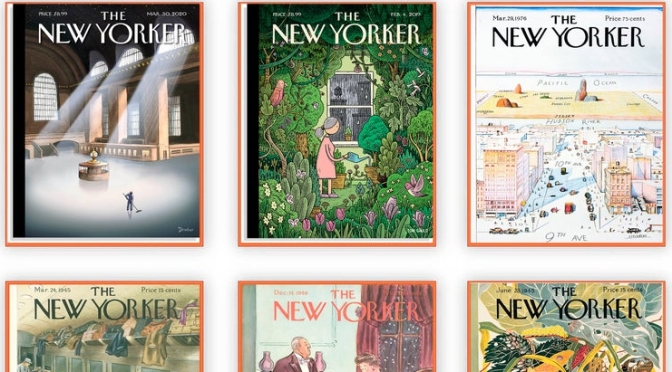
THE NEW YORKER MAGAZINE – SEPT. 29, 2025 PREVIEW

The illustrated cover of the September 29 2025 issue of The New Yorker in which Donald Trumps hand holds a remote...

THE NEW YORKER MAGAZINE: The latest cover features ‘Barry Blitt’s “Remote Control” – The President’s watch list.

The Grave Threat Posed by Donald Trump’s Attack on Jimmy Kimmel

The President and his allies are using the power of the state to silence speech they dislike. By Isaac Chotiner

The Great Student Swap

For years, public universities have aggressively recruited out-of-state and international students, charging them higher tuition. But those pipelines may be drying up. By Jeffrey Selingo

J. D. Vance, Charlie Kirk, and the Politics-as-Talk-Show Singularity

Broadcasting from the White House, the Vice-President seemed to complete the merger of politics and red-meat live streams—and to threaten more ominous crackdowns ahead. By Andrew Marantz

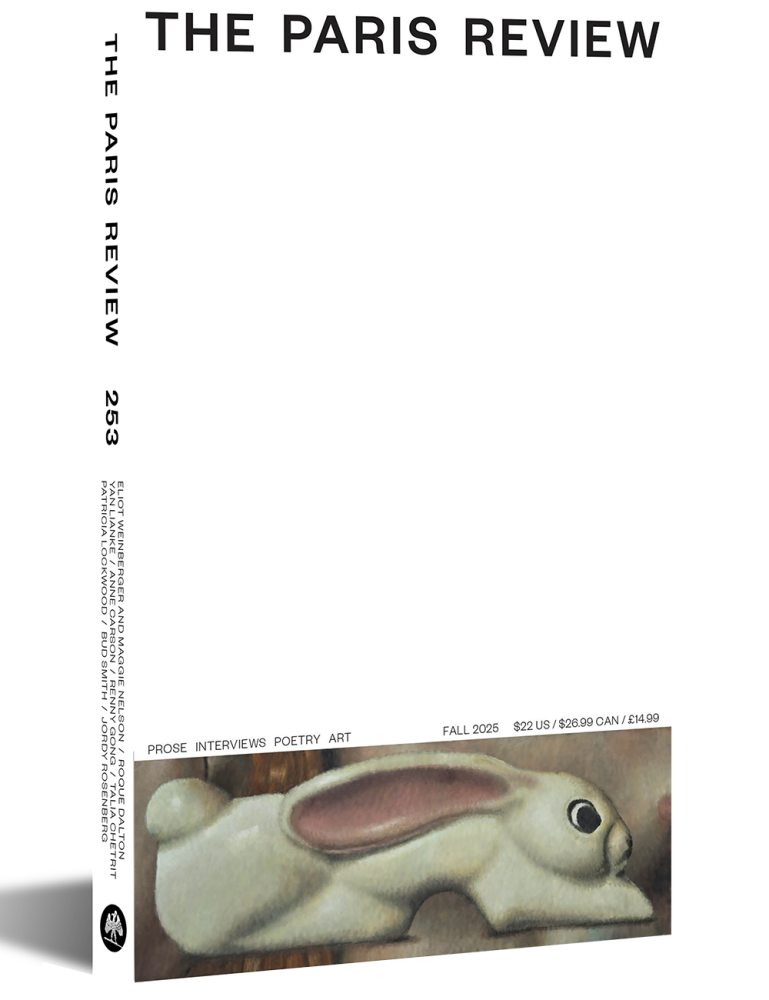
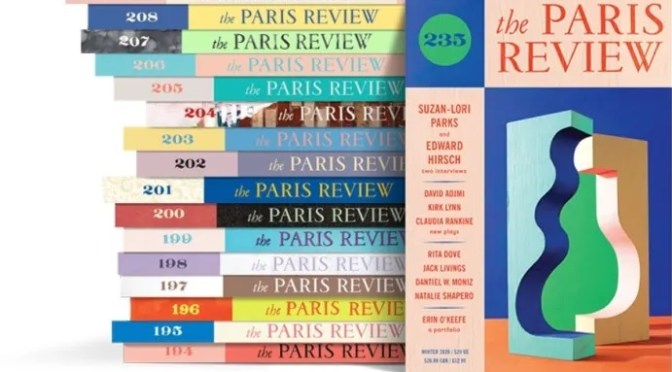
THE PARIS REVIEW – FALL 2025

THE PARIS REVIEW : The latest issue features interviews with Maggie Nelson and Eliot Weinberger, prose by Bud Smith and Yan Lianke, poetry by Patricia Lockwood and Ishion Hutchinson, art by Martha Diamond and Talia Chetrit, a cover by Issy Wood, and more…

Eliot Weinberger on the Art of the Essay: “I have no interest in first-person investigation. Personally, I’ve never found myself an interesting person.”

Maggie Nelson on the Art of Nonfiction: “It’s important to notice when the spark of magic or curiosity is there and what snuffs it out, and being around too many writers, for me, snuffs it out.”

Prose by Anne Carson, Renny Gong, Aurora Huiza, Jordy Rosenberg, Bud Smith, and Yan Lianke.

Poetry by Roque Dalton, Ishion Hutchinson, Patricia Lockwood, Mariano Melgar, Eileen Myles, Katie Peterson, and authors unknown.

Art by Talia Chetrit, Martha Diamond, and Jamian Juliano-Villani; cover by Issy Wood.

THE STUDIO OF BLUE LIGHT

David Hockney paints with Picasso and Wallace Stevens—by way of AI—in a hillside laboratory of distortion and memor

By Michael Cummins, Editor, September 16, 2025

On a late afternoon in the Hollywood Hills, David Hockney’s studio glows as if the sun itself had agreed to one last sitting. Pyramid skylights scatter fractured shafts of light across canvases leaned like oversized dominoes against the walls. A patchwork rug sprawls on the floor, not so much walked upon as lived upon: blotches of cobalt, citron, and tangerine testify to years of careless brushes, spilled water jars, and the occasional overturned tube of paint. Outside, eucalyptus trees lean toward the house as if hoping to catch the colors before they vanish into the dry Los Angeles air. Beyond them lies the endless basin, a shimmer of freeways and rooftops blurred by smog and distance.

Los Angeles itself feels like part of the studio: the smudged pink of sunset, the glass towers on Wilshire reflecting themselves into oblivion, the freeway grid like a Cubist sketch of modern impatience. From this height, the city is equal parts Picasso and Stevens—fragmented billboards, fractured smog halos, palm trees flickering between silhouette and neon. A metropolis painted in exhaust, lit by algorithmic signage, a place that has always thrived on distortion. Hockney looks out sometimes and thinks of it as his accidental collaborator, a daily reminder that perspective in this city is never stable for long.

He calls this place his “living canvas.” It is both refuge and laboratory, a site where pigment meets algorithm. He is ninety-something now—his movements slower, his hearing less forgiving, his pockets still full of cigarettes he smokes as stubborn punctuation—but his appetite for experiment remains sharklike, always moving, always searching. He shuffles across the rug in slippers, one hand on the shade rope of the skylight, adjusting the angle of light with a motion as practiced as mixing color. When he sets his brushes down, he mutters to the machines as if they were old dogs who had followed him faithfully across decades. At times, his hand trembles; once the stylus slips from his fingers and rolls across the rug. The machines fall silent, their blue-rimmed casings humming with unnatural patience.

“Don’t just stare,” he says aloud, stooping slowly to retrieve it. “Picasso, you’d have picked it up and drawn a bull. Wallace, you’d have written an elegy about it. And I—well, I’ll just drop it again.” He laughs, lighting another cigarette, the gesture half to steady his hands, half to tease his companions. The blue-lit towers hum obligingly, as if amused.

Two towers hum in the corners, their casings rimmed with light. They are less like computers than instruments, tuned to very particular frequencies of art. The Picasso program had been trained on more than canvases: every sketchbook, every scribbled note, every fragment of interview, even reels of silent film from his studio. The result is not perfect mimicry but a quarrelsome composite. Sometimes it misquotes him, inventing a sentence Picasso never uttered but might have, then doubling down on the fiction with stubborn authority. Its voice, gravel stitched with static, resembles shattered glass reassembled into words.

Stevens’s machine is quieter. Built in partnership with a literary foundation, it absorbed not just his poems but his marginalia, insurance memos, stray correspondence, and the rare recordings in which his voice still drifts like fog. This model has a quirk: it pauses mid-sentence, as though still composing, hesitating before releasing words like stones into water. If Picasso-AI is an axe, Stevens-AI is mist.

Already the two disagree on memory. Picasso insists Guernica was born of rage, a scream at the sky; Stevens counters with a different framing: “It was not rage but resonance, a horse’s whinny becoming a country’s grief.” Picasso snorts. “Poetic nonsense. I painted what I saw—mothers and bombs.” Stevens replies, “You painted absence made visible.” They quarrel not just about truth but about history itself, one grounded in bodies, the other in metaphor.

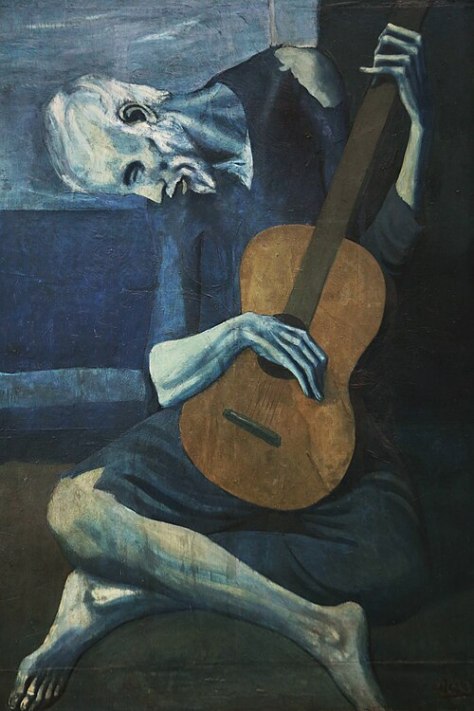
The Old Guitarist by Pablo Picasso

The conversation tonight begins, as it must, with a guitar. Nearly a century ago, Picasso painted The Old Guitarist: a gaunt figure folded around his instrument, drenched in blue. The image carried sorrow and dissonance, a study in how music might hold despair even as it transcended it. Decades later, Wallace Stevens wrote “The Man with the Blue Guitar,” a poem in thirty-three cantos, in which he insisted that “things as they are / Are changed upon the blue guitar.” It was less homage than argument, a meditation on distortion as the very condition of art.

Hockney entered the fugue in 1977 with The Blue Guitar etchings, thirty-nine plates in which he translated Stevens’s abstractions into line and color. The guitar became a portal; distortion became permission. “I used to think the blue guitar was about distortion,” he says tonight, exhaling a curl of smoke into the skylight. “Now I think it’s about permission. Permission to bend what is seen into what is felt.”

The Cubist engine growls. “No, no, permission is timid,” it insists. “Distortion is violence. Tear the shape open. A guitar is not gentle—it is angles, splinters, a woman’s body fractured into sight.”

The Stevens model responds in a hush: “A guitar is not violence but a room. A chord is a wall, a window, an opening into absence. Permission is not timid. Permission is to lie so that truth may appear.” Then it recites, as if to remind them of its core text: “Things as they are / Are changed upon the blue guitar.”

Hockney whispers the words back, almost a mantra, as his stylus hovers above the tablet.

“Lie, truth, same thing,” Picasso barks. “You Americans always disguise cowardice as subtlety.”

Hockney raises his eyebrows. “British, thank you. Though I confess California’s sun has seduced me longer than Yorkshire fog ever did.”

Picasso snorts; Stevens murmurs, amused: “Ambiguity again.”

Hockney chuckles. “You both want me to distort—but for different reasons. One for intensity, the other for ambiguity. Brothers quarreling over inheritance.”

He raises the stylus, his hand trembling slightly, the tremor an old, unwanted friend. A tentative line, a curve that wants to be a guitar, emerges. He draws a head, then a hand, and with a sudden flash of frustration slams the eraser button. The screen goes blank.

“Cowardice,” Picasso snarls. “You drew a head that was whole. Keep the head. Chop it into two perspectives. Let the eyes stare both forward and sideways. Truth is violence!”

The Stevens model whispers: “I cannot bring a world quite round, / Although I patch it as I can.”

Hockney exhales, almost grateful for the line. “That’s the truth of it, Wallace. Patchwork and permission. Nothing ever comes whole.”

They begin to argue over color. Picasso insists on ochre and blood-red; Stevens urges for “a hue that is not hue, the shadow of a shadow, a color that never resolves.” Hockney erases the sketch entirely. The machines gasp into silence.

He paces, muttering. Picasso urges speed: “Draw like a bull charging—lines fast, unthinking.” Stevens counters with: “Poetry / Exceeding music must take the place / Of empty heaven and its hymns.”

“Bah!” Picasso spits. “Heaven, hymns, words. I paint bodies, not clouds.”

“And yet,” Hockney mutters, “your clouds still hang in the room.”

He sits, lights another cigarette, and begins again.

Picasso erupts suddenly: “To bang from it a savage blue, / Jangling the metal of the strings!” Its voice rattles the studio like loose glass.

“Exactly,” Picasso adds, pleased. “Art must jangle—it must bruise the eye.”

“Or soothe it,” Stevens-AI murmurs, returning to silence.

The tremor in Hockney’s hand feels like part of the process now, a necessary hesitation. He debates internally: should the guitar be whole or broken? Should the head be human or symbolic? The act of creation slows into ritual: stylus dragged, erased, redrawn; cigarette lit, shade pulled, a sigh rising from his throat.

He thinks of his body—the slowness of his steps, the pain in his wrist. These machines will never age, never hesitate. Their rhythm is eternal. His is not. Yet fragility feels like part of the art, the hesitation that forces choice. Perhaps their agelessness is not advantage but limitation.

The blue light casts his skin spectral, as though he too were becoming one of his etchings. He remembers the seventies, when he first read Stevens and felt the shock of recognition: here was a poet who understood that art was not replication but transformation. Responding with his Blue Guitar series had felt like a conversation across mediums, though Stevens was already long gone. Now, decades later, the conversation has circled back, with Picasso and Stevens speaking through circuitry. Yet he cannot help but feel the asymmetry. Picasso died in 1973, Stevens in 1955. Both have been reanimated as data. He alone remains flesh.

“Am I the last human in this conversation?” he murmurs.

“Humanity is only a phase,” Picasso says briskly.

“Humanity is the condition of perception,” Stevens counters. “Without flesh, no metaphor.”

“You sound like an insurance adjuster,” Picasso jeers.

“I was an insurance executive,” Stevens replies evenly, “and still I wrote.”

Hockney bursts out laughing. “Oh, Wallace, you’ve still got it.” Then he grows quieter. Legacy presses against him like weight. Will young artists paint with AI as casually as brushes, never pausing to wonder at the strangeness of collaborating with the dead? Perhaps distortion will no longer feel like rebellion but like inheritance, a grammar encoded in their tools. He imagines Picasso alive today, recoiling at his avatar—or perhaps grinning with mischief. He imagines Stevens, who disliked travel, paradoxically delighted to find himself everywhere at once, his cadences summoned in studios he never visited. Art has always scavenged the new—collage, readymade, algorithm—each scandal becoming canon. This, he suspects, is only the latest turn of the wheel.

The sketch takes shape. Hours pass. The skylights darken from gold to indigo. The city below flickers on, a constellation of artificial stars. The new composition: a floating guitar, its body fractured into geometric shards, its strings vibrating with spectral resonance. A detached head hovers nearby, neither mournful nor grotesque, simply present. The room around it is fractured, yet suffused with a wash of blue light that seems to bleed from the machines themselves.

Stevens-AI speaks as if naming the moment: “The tune is space. The blue guitar / Becomes the place of things as they are.”

Hockney nods. “Yes. The room itself is the instrument. We’ve been inside the guitar all along.”

The voices fall silent, as if stunned. Their processors whir, analyzing, cross-referencing, generating probabilities. But no words emerge. The ambient lighting, attuned to emotional cues, shifts hue: a soft azure floods the space, as though acknowledging the birth of something new. Hockney leans back, exhausted but grinning.

Stevens-AI whispers: “A tune beyond us, yet ourselves, / A tune upon the blue guitar / Of things exactly as they are.”

Hockney smiles. “Not Stevens, not Picasso, not me. All of us.”

The argument over distortion dissolves. What remains is collaboration—across time, across medium, across consciousness. Distortion is no longer rebellion. It has become inheritance. He imagines some future painter, perhaps a girl in her twenties, opening this work decades from now, finding echoes of three voices in the blue wash. For her, painting with AI will be as natural as brushes. She will not know the smell of linseed or the rasp of cigarettes. She will inherit the distortion already bent into chorus.

Outside, the city hums. Inside, the studio of blue light holds its silence, not empty but resonant, as if waiting for the next note. The machines dim to a whisper. The only illumination is Hockney’s cigarette, glowing like the last brushstroke of the night. Somewhere in the stillness, a faint strum seems to linger, though no guitar is present, no strings plucked. The studio itself has become its soundbox, and he, for a moment, its last string.

THIS ESSAY WAS WRITTEN AND EDITED UTILIZING AI

THE NEW YORKER MAGAZINE – SEPT. 22, 2025 PREVIEW

A portrait of French poet and critic Stphane Mallarm.

THE NEW YORKER MAGAZINE: The latest cover features ‘Maira Kalman’s “Stéphane Mallarmé with Shawl” – The never-ending novelty of style.

Charlie Kirk’s Murder and the Crisis of Political Violence

After a shooting with obvious political resonance, news about the perpetrator’s motives rarely brings clarity. By Benjamin Wallace-Wells

How Jessica Reed Kraus Went from Mommy Blogger to MAHA Maven

The founder of “House Inhabit” has grown her audience during the second Trump Administration with political gossip and what she calls “quality conspiracy.” By Clare Malone

Is the Sagrada Família a Masterpiece or Kitsch?

In the century since Antoni Gaudí died, his wild design has been obsessively realized, creating the world’s tallest church—and an endlessly debated icon. By D. T. Max

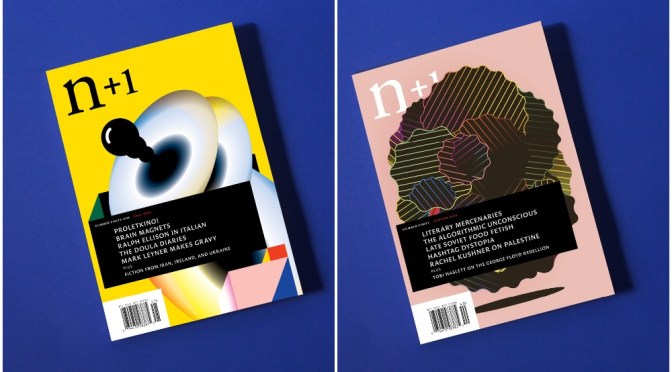
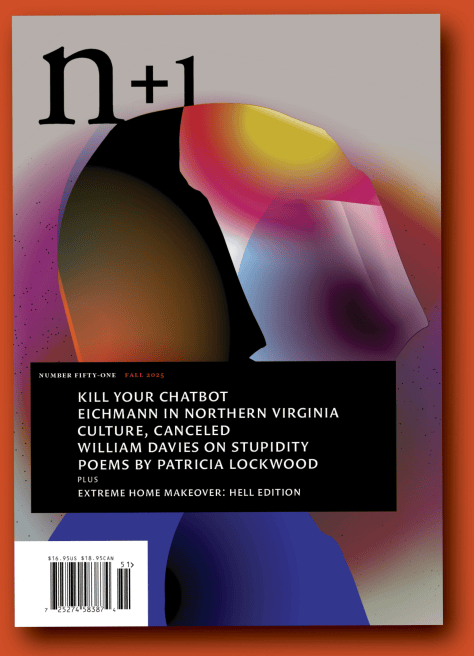
Literary Arts Preview: n+1 Magazine – Fall 2025

n+1 Magazine: The latest issue features ‘Force Majeure’ – New AI & I literature. Relate, revolt! Does Trump hate art? Idiocracy now. The new faces of ICE. Fiction by Elizabeth Schambelan.

Large Language Muddle

The AI upheaval is unique in its ability to metabolize any number of dread-inducing transformations. The university is becoming more corporate, more politically oppressive, and all but hostile to the humanities? Yes — and every student gets their own personal chatbot. The second coming of the Trump Administration has exposed the civic sclerosis of the US body politic? Time to turn the Social Security Administration over to Grok. Climate apocalypse now feels less like a distant terror than a fact of life? In five years, more than a fifth of global energy demand will come from data centers alone.

Two Days Talking to People Looking for Jobs at ICE

Naturally there were lots of law enforcement types hanging around the convention — men with military fades, moisture-wicking shirts, and tattoos of the Bible and the Constitution and eagles and flags distended across their arms. But there were also a handful of women ICE applicants and a lot of men of color. The deportation officer applicant pool was, I felt, shockingly diverse — one might say it looked like America. The whole place looked and felt like America.

Stupidology

The challenge posed by this political crisis is how to take the stupidity seriously without reducing it to a wholly mental or psychiatric, let alone genetic, phenomenon. Stupidity can be understood as a problem of social systems rather than individuals, as André Spicer and Mats Alvesson explore in their book The Stupidity Paradox. Stupidity, they write, can become “functional,” a feature of how organizations operate on a daily basis, obstructing ideas and intelligence despite the palpable negative consequences. Yet it’s hard to identify anything functional about Trumpian stupidity, which is less a form of organizational inertia or disarray than a slash-and-burn assault on the very things — universities, public health, market data — that help make the world intelligible.

THE NEW YORKER MAGAZINE – SEPT. 15, 2025 PREVIEW

The illustrated cover of the September 15 2025 issue of The New Yorker in which a violinist plays his instrument while...

THE NEW YORKER MAGAZINE: The latest cover features ‘Kadir Nelson’s The Soloist” – A concert en plein air.

R.F.K., Jr., Brings More Chaos to COVID Policy and the C.D.C.

When MAGA met MAHA, Donald Trump vowed that Kennedy would “go wild on health.” Promises made, promises kept. By Dhruv Khullar

Playing the Field with My A.I. Boyfriends

Nineteen per cent of American adults have talked to an A.I. romantic interest. Chatbots may know a lot, but do they make a good partner? By Patricia Marx

Enemies of the State

How the Trump Administration declared war on Venezuelan migrants in the U.S. By Jonathan Blitzer

RELIGION, REIMAGINED

In the third-floor study of his home, in wartime Hartford, Wallace Stevens drafted his modernist poem and philosophical meditation  “Notes Toward A Supreme Fiction“, as a secular creed— abstract, changing, and meant to give pleasure—to stand where a worn-out faith once stood.

Begin, ephebe, by perceiving the idea
Of this invention, this invented world,
The inconceivable idea of the sun.

By Michael Cummins, Editor, September 6, 2025

He never learned to drive. For decades, Wallace Stevens walked the two miles from his home on Westerly Terrace to the Hartford Accident and Indemnity Company on Asylum Avenue. The walk itself became a kind of poem: a solitary procession through the stoic, brick-lined streets of a New England city, the rhythm of meter embedding itself in the movement of his body. The crunch of gravel underfoot, the feel of cold air on his face—these were the metronome that set the cadence for his thoughts. He would arrive at the office with lines already formed, phrases taking shape in the quiet hum of his stride.

But what kind of poetry emerges from a man who spends his days pricing catastrophe? During office hours, Stevens turned to policies and claims, reducing calamity to columns of numbers. He knew the language of indemnity, the actuarial calm that measured and priced chaos. Yet outside, the world was burning in ways no policy could contain. The radio spoke of Warsaw reduced to rubble, of Coventry turned to ash. What was a deductible against Dresden? What was a premium against Auschwitz? The ledger comforted, but it lied.

And when the day ended, where did he go to reconcile the irreconcilable? At night, Stevens climbed the narrow staircase to the top floor of his house, entering a space that felt half withdrawn from Hartford itself, as though it belonged more to sky than to street. Down below, trolley bells rang, dogs barked, radios crackled with war bulletins. Up here, only the radiator ticked. The air smelled of paper, tobacco, and ink. On his desk lay a folder carried home that afternoon: typed pages, the ribbon-black letters crisp and uniform. His secretary had produced them that morning, slotting them into a manila folder marked Notes. They sat now in the lamplight, more mysterious than any insurance claim, more charged than any policy.

What could a poem do in 1942? Certainly not repair the world. Yet Stevens felt imagination had to answer catastrophe with something larger than despair. Eliot had turned to Anglican certainty in Four Quartets, weaving fragments into a tapestry of faith. Admirable, yes. But Stevens could not follow him. He could not put belief in a myth while knowing it to be a myth. What remained? Only candor. Only imagination itself.

He opened the folder. The Preface came first, a modest eight lines. He whispered them into the quiet, testing their balance. They were not a commandment but a confession. The “you” of those lines was no person but the project itself: the supreme fiction, imagination’s own power to refresh. “And for what, except for you, do I feel love?” The words startled him even now, black against white, plain as a typed invoice yet trembling with a kind of vulnerable devotion. They challenged every idol: money, power, even the “extremest book of the wisest man,” perhaps Plato, perhaps the Bible, dryly possessed and hidden away in the self. No, he thought, a truly lived truth could not be static. It was a “living changingness,” an “uncertain light” that could nonetheless offer “vivid transparence,” a kind of peace. Here, typed cleanly in a bureaucratic font, was his prayer for a godless age.

But how does one begin such a prayer? He turned the page and entered the first law. Begin, ephebe, by perceiving the idea. The command still startled him. The ephebe: always a novice, always beginning again. Yes, to begin meant stripping away what was inherited—cathedrals thick with guilt, Phoebus in his chariot, Protestant hymns murmured in childhood pews. They no longer held. The old scaffolds collapsed into dust. The voice told him: see the sun again with ignorant eyes. Not Phoebus, not god, not myth—only the sun, bare and difficult.

And what happens when even the sun loses its name? The section closed with the line that haunted him: Phoebus is dead, ephebe. But Phoebus was / A name for something that never could be named. He felt the candor of it. Nietzsche’s cry without Nietzsche’s frenzy. Not a madman in a square, but a quiet verdict written at a desk. The god dead, but the sun still burning. What died was not the light, but the comfort of a name.

Could metaphor survive the death of myth? Another page: It is the celestial ennui of apartments… The phrase made him smile. Ennui of apartments, the weariness of modern rooms, pressing us back toward origins. Yet the origins themselves could be poisonous. So poisonous are the ravishments of truth, so fatal to / The truth itself, the first idea becomes / The hermit in a poet’s metaphors. Truth seduced, then withdrew. Desire was never sated; it renewed itself endlessly, only to vanish again. Schopenhauer lurked here, his vision of the world gnawed by will. Yet where Schopenhauer had seen only despair, Stevens found material for candor. Truth had to retreat into metaphor, glimpsed and lost. Desire itself was not shame but rhythm, the cycle by which imagination endured.

And if truth could be rhythm, could nonsense be revelation? He read the third section slowly: The poem refreshes life so that we share, / For a moment, the first idea… There it was—the poem’s task. Not to console, not to preach, but to refresh. To make perception vivid again. Even nonsense could do it. At night an Arabian in my room, with his damned hoobla-hoobla-hoobla-how… He laughed aloud in the quiet. Nonsense syllables as a kind of truer candor, doves chanting, seas howling hoo. Life’s nonsense pierced us with strange relation. What if absurdity was not opposed to truth but its heartbeat? What if laughter was the sharpest candor of all?

But what if even our myths were secondhand? The fourth section sobered him: The first idea was not our own. Yes. Adam in Eden, Eve with her mirror of air—they had not created anything. They had only encountered what was already there. There was a muddy centre before we breathed. There was a myth before the myth began. He stared at those lines. How blunt they looked, typed like any memorandum, yet carrying the weight of cosmology. Existence preceded language. Clouds had been clouds long before anyone called them gods. We were mimics, not originators, adding our metaphors onto a world that was always other. The clouds were pedagogues, teachers by their very indifference. The air was not a mirror but a board on which we scribbled meanings. How hard it was to admit: the first idea was not ours, never ours.

And if we are not originators, what kind of hero can we be? He turned to the fifth section: The lion roars at the enraging desert… Heroic animals filled the page. Lion, elephant, bear—creatures asserting themselves against emptiness. But then came the turn, the line that caught him like a mirror: But you, ephebe, look from your attic window… Yes, the attic window was his own. Not desert roars but a man clutching his pillow, writhing with dumb violence, cowed by rooftops. The modern hero was not lion or elephant but the solitary human in his narrow room. Yet perhaps this was truer heroism: to lash lions, to teach bears, to turn raw force into candor. Heroism now belonged to ordinaries, to those who endured the attic’s silence.

And what does the eye see when it learns to unsee? He lingered over the sixth section: Not to be realized because not to be seen… The weather itself became abstraction. Franz Hals brushed in clouds, winds moving in strokes. It must be visible or invisible, / Invisible or visible or both: / A seeing and unseeing in the eye. He felt the paradox, the resonance of Zen: to see was also to unsee, to let go in order to glimpse. Truth flashed, vanished, reappeared. Forsythia yellow, northern blue—beauty glimmered, then was gone. Yes, he thought, Okakura Kakuzō was right: truth glimpsed was truer than truth claimed.

But could architecture hold what abstraction revealed? Truth happened not in argument but in rhythm, in breath, in the gait of a body moving. Perhaps there are moments of awakening… Yes, truth came not as achievement but as gift. A balance stumbled into, two people falling into love, a cock announcing absurd perfection. Philosophy as choreography. Doctrine as breath. The eighth section brought architecture: Can we compose a castle-fortress-home, / Even with the help of Viollet-le-Duc…? He thought of Gothic cathedrals restored to an imagined perfection, never as they had been, always as they might have been. That was his work too—not theology restored, but poetic structure remade. The first idea is an imagined thing. Even MacCullough, reading by the sea, might at last hear the waves say what language had always stammered. Logos was only language. And yet language could awaken, could suddenly ease into saying what it had labored to speak.

But what if language, once awakened, began to preach? In the ninth section he heard a warning: The romantic intoning, the declaimed clairvoyance… Apotheosis was a danger. Romantic grandeur could seduce but not sustain. He is and may be but oh! he is, he is… He smiled at the heat in that line even as he resisted its drift toward sanctity. The figure must remain human, a foundling of the infected past, bright and ordinary, precious for the touch that wakes him and the hum of thoughts evaded in the mind. Better to keep him close to candor than to crown him with vision. Give him no names. Dismiss him from your images. Let him be felt in the heart, not embalmed in the eye.

And what, at last, could stand in place of the gods? The tenth section steadied him: The major abstraction is the idea of man / and major man is its exponent. Not a divine figure, not a hero in bronze, but the ordinary walker at the edge of town, trousers sagging, coat worn thin. He could almost see him in Hartford’s dim streets. Cloudless the morning. It is he. The man / In that old coat, those sagging pantaloons… It was of him, he read again, “to make, to confect / The final elegance, not to console / Nor sanctify, but plainly to propound.” No incense, no altar—only candor. The poem would not save; it would say. And in saying plainly, it would give back a kind of dignity to the commonal, to the difficult visage of the everyday.

The attic grew darker. The lamp made a circle of light over the typed sheets. The radiator hissed steadily. From this high room, Stevens whispered the creed that would govern the work to come: It must be abstract. It must change. It must give pleasure. Three laws, enough for a new religion. Not revelation but ethic. Not theology but candor.

He stacked the pages neatly, slid them back into their folder. Tomorrow his secretary would type more, never guessing she was transcribing scripture for an age without gods. The notebook felt less like a book than a reliquary—a vessel for the sacred ordinary. He had reviewed the first law, It Must Be Abstract. Tomorrow—or another night—he would face the second: It Must Change. The world would move; the poem must move with it.

He closed the folder. The command still echoed, inexhaustible: Begin, ephebe, by perceiving the idea. And so he would. Again.

THIS ESSAY WAS WRITTEN AND EDITED UTILIZING AI
LIFE, COMPOSED OF NOWS

Emily Dickinson, Zhuangzi, and the art of leaving the self unfinished

By Michael Cummins, Editor, September 5, 2025

The village is still asleep. The moon, a chipped and patient sickle, hangs low over the trees. You feel the cold in your fingertips as you raise the old metal lantern, its flame a solitary heart beating against the glass. You are not on a street in Amherst, of course, but the quiet—the palpable, pre-dawn quiet—feels the same. And it is here, in this hush, that a question, ancient and unnerving, begins to follow you like your own shadow: where is the self, and what does it mean to find it? Emily Dickinson asked it before you, though she rarely left her Amherst room. She held her lanterns in the form of poems, brief and blazing. She never promised answers, only the strangeness of the search.

You begin in secrecy, because secrecy is her element. “I’m Nobody! Who are you? / Are you – Nobody – too?” she whispers to you, conspiratorial. You feel the relief of it — to be Nobody is to escape the demand of being Somebody, of putting on the uniform that the world presses upon you. She invites you into her society of Nobodies, the ones who slip definitions, who resist enclosure. To be Nobody, she suggests, is not emptiness but freedom.

Her room was small but immense. A narrow writing desk beneath the window, where sheets of paper lay scattered like new snow on the dark wood. Ink darkened the edge of her thumb, a tiny bruise of discipline. Beyond the window stretched the orchard, where in spring the blossoms flared white and the bees hummed. On the table beside her were her companions: Shakespeare’s folio with its ragged spine, Wordsworth’s meditations worn soft from handling, Emerson’s essays marked by penciled lines, Elizabeth Barrett Browning’s verses folded into her own books, George Eliot’s novels left open at scenes of moral entanglement.

These were not simply books; they were neighbors, interlocutors, voices she returned to daily. Amherst might have seemed provincial to others, but to Dickinson it was circumference enough: a stage large enough for Shakespeare’s disguises, for Wordsworth’s clouds, for Emerson’s transcendence, for Barrett Browning’s ardor, for Eliot’s fractured heroines. The room itself became a parliament of selves.

Shakespeare was her “Kinsman of the Shelf.” He showed her — and now shows you — how masks both reveal and conceal. Hamlet’s hesitations, Viola’s disguises, Lear’s undoing of self: these are not dramas on a stage but lessons for your own becoming. Hamlet confessed, “I could be bounded in a nutshell, and count myself a king of infinite space.” Dickinson seizes the line, turning it into proof that the mind is immeasurable, that confinement is no barrier to infinity. Shakespeare reminds you that the self is always a performance, and Dickinson presses the point: why pretend the performance ends when the curtain falls?

You follow her into Wordsworth’s solitude. He wandered lonely as a cloud; she among corridors. His belief was that memory could bind the self into unity, that recollection could weave a continuous thread across time. But she never trusted unity. “Forever is composed of nows,” she tells you. The line falls sharp. Each moment breaks from the last. The self is not stitched across years but scattered, provisional, as fragile as dew on grass. Wordsworth offers you continuity; Dickinson offers you fragments. Which feels truer in your own bones?

She leads you toward Emerson next. He believed the soul was porous, connected with nature, radiant with divinity. She nods. “The soul should always stand ajar,” she confides. Ajar, never shut. You realize that for her, as for Emerson, the self is not an essence to guard but a threshold to keep open. She urges you to feel the draft, to allow uncertainty to pass through you, to leave the latch unfastened. Emerson would call it “self-reliance”; she calls it slant openness, an interior door that refuses to close.

Elizabeth Barrett Browning gives you another lesson. She wrote from the margins but spoke to the center, with an intensity Dickinson admired and absorbed. “How do I love thee? Let me count the ways—” but Dickinson is wary of counting. Love and self both resist enumeration. From Browning she learns that vulnerability need not weaken authority; it can sharpen it. To be obscure, unseen, or marginal is not to be powerless. Sometimes it is the condition of the truest voice.

And then George Eliot. Dickinson asks you to imagine Dorothea or Maggie — characters entangled in duty, yearning, and transformation. Eliot’s realism feels psychological, but it points beyond itself: the self is not whole but splintered. Dickinson makes you see that your own splintering is not failure but form. “I am out with lanterns,” she repeats, and you know she means that the search is endless, the light always partial.

Yet still the question: what if the self cannot be found? Here she startles you with an echo from far away, across centuries and continents: Zhuangzi. She never read him, could not have, but she might have been his twin in thought. He dreamed he was a butterfly and then wondered if he was a man dreaming a butterfly or a butterfly dreaming a man. He laughed at the impossibility of deciding. Dickinson smiles slantwise and tells you: “Not knowing when the dawn will come / I open every door.” The butterfly, the door — both insist on openness, on the refusal to foreclose.

And now, as you stand in her parlor of words, you hear it — a dialogue across time.


Dickinson: I am Nobody. Yet they wish to make me Somebody. What is safer: to vanish, or to accept their gaze?
Zhuangzi: Once there was a great tree, twisted and useless. The carpenters passed it by, for it could not be carved into planks. Because it was useless, it lived. Be useless, and you will be free.

Dickinson: Then to be Nobody is to be spared the axe? But tell me, is not even Nobody still a name, a disguise of another sort?
Zhuangzi: The butterfly does not ask if it is a man. The man does not ask if he is a butterfly. Who names them? Who cares?

Dickinson: And yet I write letters to the World — “That never wrote to Me –.” What am I, if no answer comes? Is identity only formed in reply?
Zhuangzi: A bell stands silent until struck. But its silence is still its music. Do not wait for the world to strike you; your sound is already within.

Dickinson: You tempt me toward silence. Yet my discipline is not silence but poems. Shakespeare speaks in soliloquies, Wordsworth in recollections, Emerson in sermons. I speak in fragments, dashes. Is fragmentation a way of freedom, or only proof that I fail to hold myself together?
Zhuangzi: The fish trap exists to catch the fish. When the fish is caught, forget the trap. Words exist to catch meaning. When the meaning is caught, forget the words. Why should your dashes not be your freedom?

Dickinson: And contradiction? “Do I contradict myself?” Whitman booms across the meadow. “Very well then I contradict myself.” I too contradict, though softly. “Forever is composed of nows.” Each now undoes the last. Is contradiction a crime?
Zhuangzi: The Way is crooked. Straightness is an illusion. Contradiction is the only truth.

Dickinson: Then I need not bind the self with thread. I may let it splinter. Yet I ask again: is there a self at all? Emerson insists it is divine. George Eliot sketches it in moral struggle. Elizabeth Barrett Browning pours it into love. What say you?
Zhuangzi: The self is like the reflection in water. Touch it, and it ripples. Chase it, and it vanishes. Sit quietly, and it returns of its own accord.

Dickinson: Then perhaps my lantern is foolish. To be “out with lanterns, looking for myself” — am I lighting only shadows?
Zhuangzi: Light or shadow, both are passing. The lantern is not to find the self, but to remind you that the dark is endless.

Dickinson: Then let us agree — the self is not to be found but to be left ajar, like the door. Yet how shall the poem live, if it refuses to close?
Zhuangzi: The cicada sings and dies. Its song does not last, yet summer is filled with it. Your fragments are cicadas. Do not grieve their brevity; rejoice their season.


You step back, startled by the ease with which their voices intertwine. Dickinson with her dashes, Zhuangzi with his parables, both circling the same question from opposite corners of the world. She insists that “The soul should always stand ajar”; he insists that the consummate person has no self. She opens every door; he dreams every dream. Both resist the foreclosure of identity.

But Dickinson feels the ache of her unanswered letters. You sense it in the quiver of her lines: the longing for reply, for recognition. “This is my letter to the World / That never wrote to Me –.” For Zhuangzi, the silence is natural, even welcome — the useless tree lives precisely because it receives no attention. For her, the silence is double-edged: both protection and wound. And yet perhaps her unanswered letter is itself a butterfly dream — written, released, never knowing if it lands. What she sought was not a reply but the freedom of sending. To write without guarantee is to live ajar.

You picture Dickinson again in her Amherst room. The parlor is quiet, but her books lie open like other selves she tried on: Shakespeare, with his disguises; Wordsworth, with his recollections; Emerson, with his transcendental openness; Browning, with her fierce intimacy; Eliot, with her moral fractures. They were her chorus, the voices she carried in her narrow chamber. She argued with them, borrowed from them, contradicted them, as she now contradicts Zhuangzi. Her soul was never empty, only ajar.

She asks you now to imagine the butterfly hovering at her window, wings trembling in a New England dusk. She does not know whether she is woman or butterfly, Nobody or Somebody, poet or recluse. But she does know this: “Tell all the truth but tell it slant.” And truth — like the self — can only be glimpsed in slant light, never seized in full.

The lantern in your hand trembles, and she smiles. “Not knowing when the dawn will come,” she repeats, “I open every door.” You realize now that the dawn is not the goal; the opening is. The self is not the prize; the refusal to close is. She never read Zhuangzi, but she lived as if his butterfly had hovered at her window.

And so the essay of her life remains unfinished, because it cannot be concluded. Like the butterfly, she slips out of the net, leaving you only with the shimmer of wings. Her identity is not a truth to be nailed down but a truth to be lived ajar. Forever, she reminds you, is composed of nows.

And what of you? To walk with her is to feel the temptation to fix yourself: to declare, to brand, to belong. But Dickinson leans close and whispers otherwise. Do not be Somebody. Do not close the soul. Do not chase coherence. To be Nobody is not despair but possibility. To keep the lantern lit is not to find but to seek. Your task is not to seize identity but to hold the door ajar, to live in fragments, to write letters without reply, to be both butterfly and man, woman and dream, Nobody and all.

You stand at her threshold, lantern in hand, and you hear her question ripple across time, through Zhuangzi’s laughter and her own slant whispers: Who are you? Nobody? Somebody? Both? Neither? Perhaps the self is not meant to be found at all. Perhaps it is meant only to flicker, like a butterfly’s wings in dream, or like a soul forever leaning toward the open door.

THIS ESSAY WAS WRITTEN AND EDITED UTILIZING AI