The historic Maya anchored their calendars and rituals to celestial events, and their astronomical knowledge is now coming into sharper focus thanks to new analyses of archaeological relics and insights from today’s Maya.
— Science Magazine (@ScienceMagazine) June 2, 2022
Science Magazine – June 3, 2022: A 10th-century Maya structure at Chichen Itza, Mexico, is often called the Observatory for its expansive view of the sky and a design seemingly guided by key positions of the Sun, Moon, and planets. The historic Maya anchored their calendars and rituals to celestial events, and their astronomical knowledge is now coming into sharper focus thanks to new analyses of archaeological relics and insights from today’s Maya.
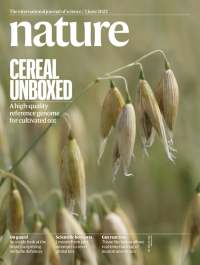
With six sets of chromosomes, the hexaploid cultivated oat (Avena sativa L.) has a complex evolutionary history. In this week’s issue, Nick Sirijovski and his colleagues present a high-quality reference genome for A. sativa alongside those for its close relatives the diploid Avena longiglumis and the tetraploid Avena insularis. By examining the three genomes, the researchers were able to trace genomic reorganizations in the crop’s evolution. They were also able to map the genes for important agronomic traits, highlighting gene families linked to human health and nutrition. With health and sustainability high on global agendas, the team hopes this new resource will bolster genomics-assisted breeding and trait studies to address these challenges and more.
Friday May 27, 2022: Are stolen Cambodian statues hidden in the world’s great public collections?
We discuss Cambodia’s looted heritage with Celia Hatton, Asia Pacific editor and presenter at the BBC World Service, whose documentary for BBC TV and radio Cambodia: Returning the Gods exposes the connections between looters, smugglers and, allegedly, some of the world’s most famous encyclopaedic museums. Plus, the dark truth behind the art and antiques assembled by the Marcos family in the Philippines as they return to power.
We talk to the Filipino artist Pio Abad—who’s made art about Ferdinand and Imelda Marcos and their collections for more than a decade—about Bongbong Marcos’s presidential election victory in the Philippines and what that means for the country and the art and antiquities seized by its government after the Marcoses were deposed in the 1980s. And in this episode’s Work of the Week, we discuss a sculpture by Ruth Asawa—Untitled (S.266, Hanging Seven-Lobed, Multi-Layered Interlocking Continuous Form within a Form) (1961)—a highlight of a new exhibition at Modern Art Oxford in the UK, with Emma Ridgway, the show’s co-curator. Remarkably, the solo exhibition is the first in a European institution dedicated to the Japanese-American artist.
You can read Celia’s report on Cambodian antiquities online at bbc.co.uk. Cambodia: Returning the Gods (radio version) is on the BBC website and the BBC Sounds app—under The Documentary Podcast stream for the World Service and the Crossing Continents podcast stream in the UK—and on other podcast platforms.
Cambodia: Returning the Gods (television version) is on iPlayer in the UK and will be shown again on the BBC World news channel, broadcast date tbc—check listings.Pio Abad: Fear of Freedom Makes Us See Ghosts, Ateneo Art Gallery, Ateneo de Manila University, until 30 July, pioabad.com.
Ruth Asawa: Citizen of the Universe, Modern Art Oxford, UK, 28 May-21 August; Stavanger Art Museum, Norway, 1 October-22 January 2023.
The puzzle of Palaeospondylus – Over a hundred years ago, archaeologists discovered fossils of the aquatic animal Palaeospondylus. But since then researchers have been unable to place where this animal sits on the tree of life. Now, new analysis of Palaeospondylus’s anatomy might help to solve this mystery.
08:18 Research Highlights
A strong, silk-based version of mother of pearl, and the parrots that use their heads when climbing.
10:51 How lasers revealed an ancient Amazonian civilization
Archaeologists have used LiDAR to uncover evidence of an ancient civilization buried in the Bolivian Amazon. The team’s work suggests that this area was not as sparsely populated in pre-Hispanic times as previously thought.
We discuss some highlights from the Nature Briefing. This time, the debate surrounding the first transplant of pig kidneys into humans, and the plants grown in lunar soil.
Times Literary Supplement, May 27, 2022 – @TheTLS, featuring @NshShulman on the Queen; @nclarke14 on Melvyn Bragg; @richardlea on nuclear power; Claire Lowdon on Elif Batuman; @RohanMaitzen on Rosalind Brackenbury; @rinireg on abortion – and more.
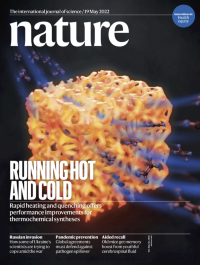
This week in Nature: Running hot and cold – rapid heating and quenching offers performance improvements for thermochemical syntheses. Browse the full issue here: https://t.co/75SVFt4Jgxpic.twitter.com/XBKgp8QFVI
Nature Magazine, May 19, 2022 – At industrial scales, chemical reactions are typically driven by applying continuous heat to the reactants. In this week’s issue, Liangbing Hu and his colleagues show that pulsed heating and quenching can enhance synthetic performance while also saving energy.
The researchers use a programmable electric current to switch between high and low temperatures very quickly — typically 0.02 seconds on, 1.08 seconds off. Rapidly quenching the reaction gives high selectivity, maintains catalyst stability and reduces energy usage. The cover image illustrates the heater in action for the pyrolysis of methane — the model reaction the team tested. Methane molecules travel through the pores of the high-temperature heater and are selectively converted into useful products.



 Intellicurious