Conflicting accounts from a bystander who called the police and from President Trump have led to questions about whether security services knew about the possible plot in advance.
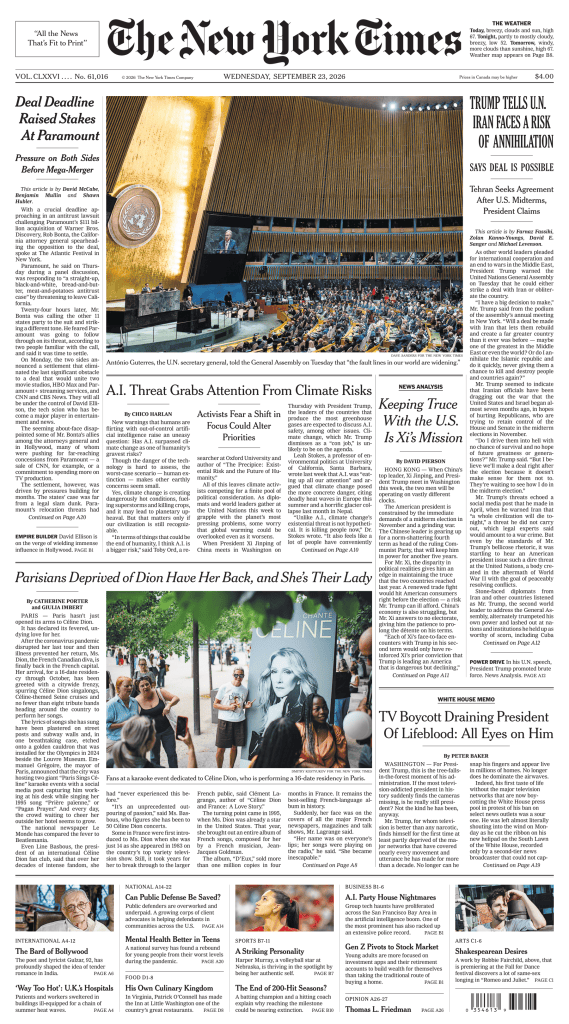
Black voters largely rejected James Talarico in the Democratic primary for U.S. Senate. Recent interviews suggest the hard feelings may be wearing off.
My father dedicated his life to studying the Guna people of Panama, and they may soon allow unprecedented development through their land. I went on a trek through the jungle to find out why. By Ben Ryder Howe and Federico Rios
Russia’s foreign minister met with his German counterpart during the U.N. General Assembly but spent part of his address defending his country’s war on Ukraine.
The ledger used by a task force created by President Trump is difficult to verify and includes cases that went to trial during the Biden administration.
Ukrainian officials are calling Russia’s campaign “total war” for its emphasis on economic impact, rather than on battlefield gains or infrastructure damage.
After visiting Africa, Pope Leo’s four-day trip to France shows how he is seeking to appeal to Roman Catholicism’s original heartlands as well as to the church’s newest strongholds.
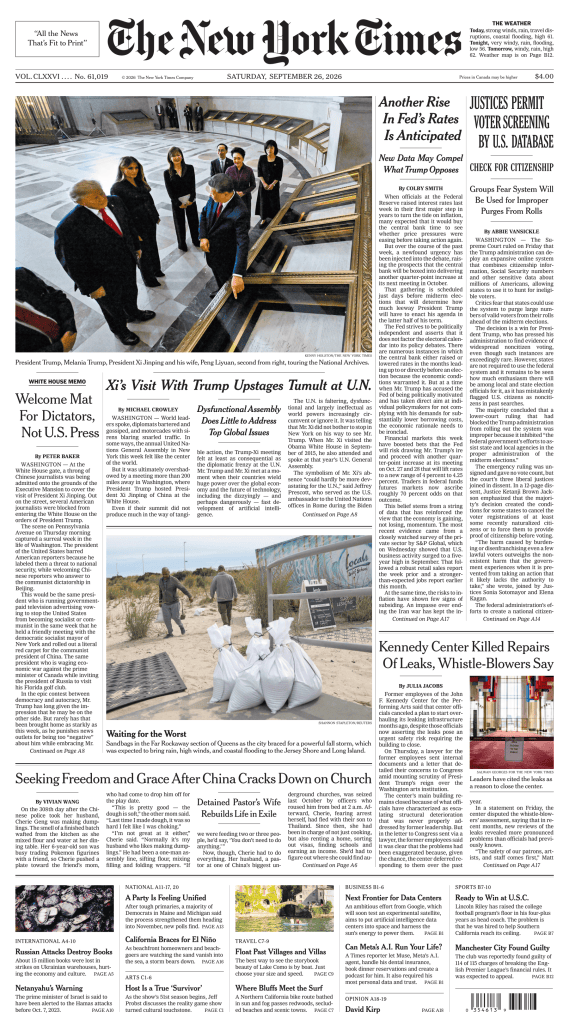
President Xi Jinping is making his first visit to Washington in a decade as President Trump continues his sharp turn from a hard line on China. Little progress is expected on the many issues dividing the powers.
A Moscow firm uses shell companies and cryptocurrency to launder money, and a custom app to forge trade records, to help Russia bypass sweeping restrictions.
As Russia Steps Up Shadow War, Europeans Waver on How to Respond
If President Vladimir V. Putin was hoping to get Europeans’ attention, he’s succeeded with a series of close-call incursions. The question now is what they will do about it.
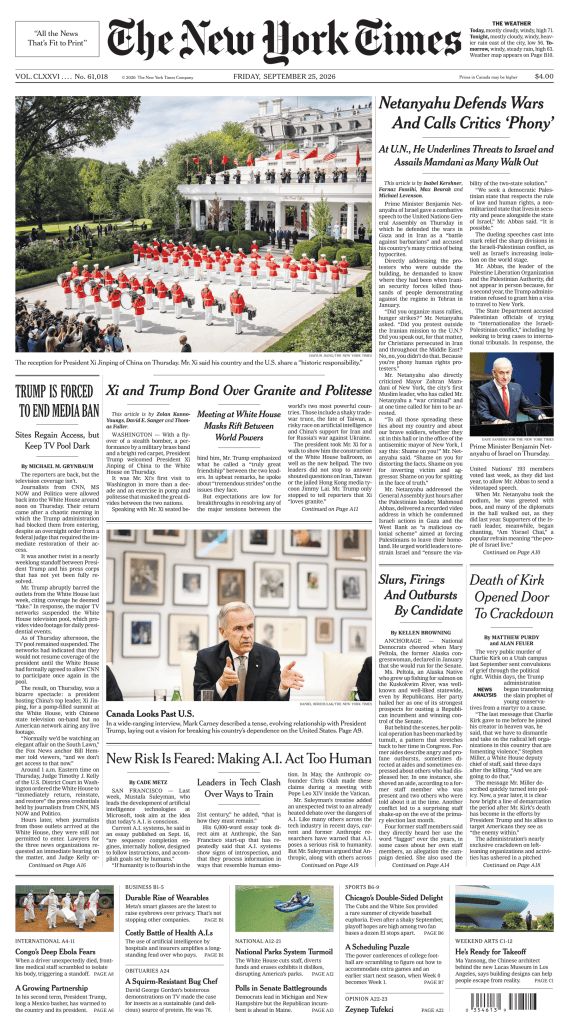
Prime Minister Benjamin Netanyahu of Israel and the Palestinian leader Mahmoud Abbas are set to deliver addresses amid criticism of Israel’s conduct in Gaza.
A federal judge issued a temporary restraining order and told the White House to immediately restore press credentials for employees of the three news outlets.
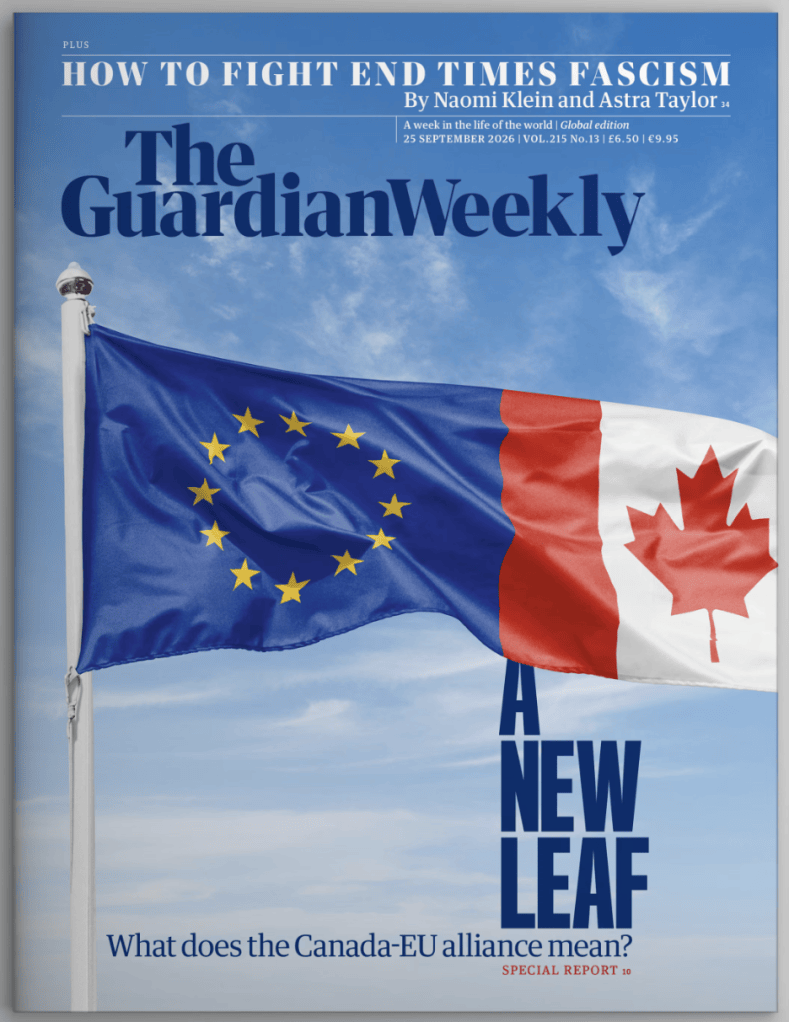
The European Commission president, Ursula von der Leyen, last week extended an unprecedented offer to Canada, inviting it to become the EU’s first “associate member”.
For our big story this week, Brussels correspondent Jennifer Rankin explores what the proposed alliance might mean. While there is a lot of common ground for the two parties, she writes, their agreement raises many questions and is clouded in uncertainty.
Meanwhile, senior correspondent Lisa O’Carroll examines the possible implications for the UK – asking whether it offers a blueprint for Britain, or a reminder it is out in the cold.
Then, former White House speechwriter Ted Widmer says Canadian prime minister Mark Carney’s remarks before the European parliament set out what a new west might look like, without its most powerful member – the US.
Spotlight| Yemeni families’ flight Fierce fighting has forced people to abandon their homes, leaving everything behind to seek shelter in refugee camps. Nasser Al-Sakkaf reports from Taiz
Science| ‘A map is never neutral’ The cartographers who took on centuries of western bias with the new Equal Earth projection speak to Oliver Holmes,Ana Lucía González Paz and Pablo Gutiérrez about their alternative to the 16th-century Mercator display
Feature| How to fight end times fascism An unholy alliance is working toward an apocalyptic future from which only a chosen few will emerge unscathed. It’s becoming clear how we stop them, say Naomi Klein and Astra Taylor
Opinion| This Israeli election could be the country’s last Spend time on the ground and you see how high the stakes are for next month’s contest – for Israelis and Palestinians alike, writes Jonathan Freedland
Culture| Present and correct Author Jonathan Franzen talks to Sophie McBain about a new TV adaptation of his bestseller The Corrections, the future of reading and why creating new work is “horrible”
Tuesday, September 22, 2026 · The Persuasion Debate
“
I have unshakable faith in vaccines. I went to the anti-vaccine conference intending to mock it — and that was wrong. Ridicule helps no one.
The Thesis — Leana Wen, The Washington Post
THE ARGUMENT
In today’s Washington Post, physician and former Baltimore health commissioner Leana Wen opens with a confession: she arrived at the Grand Hyatt to cover an anti-vaccine conference — keynoted by Health and Human Services Secretary Robert F. Kennedy Jr. — intending to make fun of it. Her verdict on her own intention: “That was wrong.” Wen’s faith in vaccines is unshakable, and the conference’s talking points struck her as the same deceptive claims she has rebutted for years. But the painful lesson of her title is aimed at her own side: ridiculing the people in those seats, she argues, helps no one — least of all the cause of vaccination itself.
vs
THE ANSWER
The maximal case for the opposite view was made by Pulitzer Prize–winning Los Angeles Times columnist Michael Hiltzik in his notorious January 2022 column, “Mocking anti-vaxxers’ COVID deaths is ghoulish, yes — but may be necessary”. Written at Omicron’s peak, it argued that “pleas for ‘civility’ are a fraud” — typically the work of hypocrites seeking to blunt criticism — and that mockery is not necessarily the wrong response to public figures who belittled the disease that then killed them. Denying sympathy, he contended, might be the only way to make such teachable moments heard. Where Wen sees counterproductive contempt, Hiltzik saw a moral pedagogy: some lessons are taught only by consequence, named plainly.
iC
THE INTELLITAKE
Note what this collision is not: a debate about vaccines. Both writers are emphatically pro-vaccine; the dispute is over what contempt accomplishes. And unusually for an Intellitake, history has partly run the experiment. Hiltzik’s wager was made in 2022; Wen writes in 2026, from a conference where the movement his side mocked now keynotes as the sitting health secretary. Whatever four years of scorn were supposed to teach, the class did not convert — it took over the school. Yet honesty cuts both ways: civility’s record is unproven too, and Hiltzik would ask what respectful engagement has won lately. The real question beneath the manners: does persuasion begin with respect — or does normalization? Wen has staked her answer on the first. The last four years are the evidence both sides now have to explain.
TODAY’S PROVOCATION
Think of the last time someone mocked something you believe. Did it change your mind — or harden it?
A decade ago, Xi Jinping asked if China could master A.I. His push is remaking the economy, challenging the United States and keeping society under control.
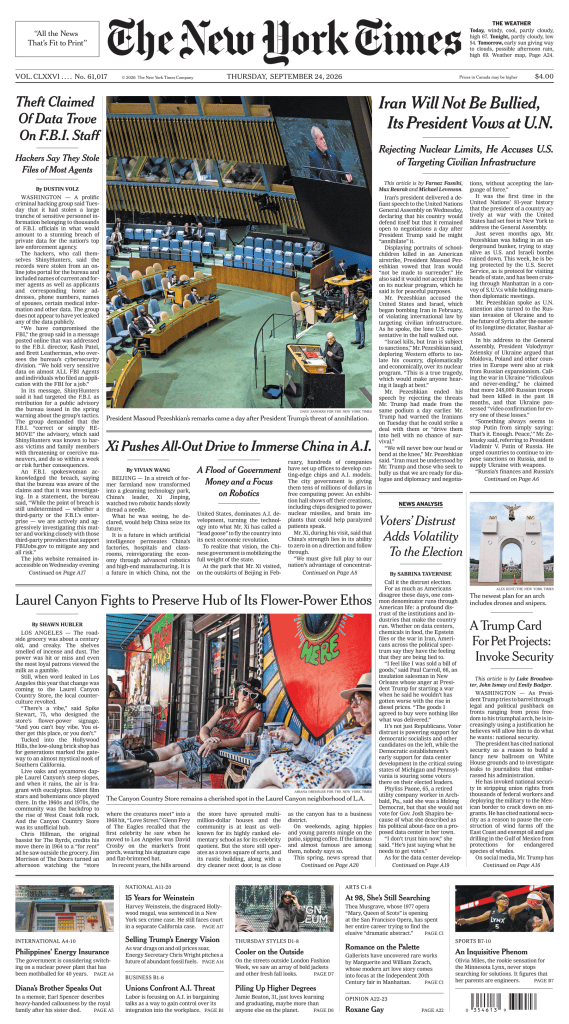
Masoud Pezeshkian is the first leader whose country is at war with the United States to travel to New York to address the General Assembly. President Trump said he faced a choice over whether to “annihilate” the Islamic republic.1h ago
As the far right surges, Chancellor Friedrich Merz’s unpopular economic policies and gruff manner have failed to sway voters turned by rivals’ promises of easy fixes.